
I started writing this update well over a month ago, planning to only redo my valuation model. But stuff just kept happening, and I kept going down rabbit holes, so you’re getting a more fulsome update.
I don’t cover the background material again, so if you haven’t read my first piece, I suggest you do that now.
In my first effort at a valuation I found myself in an iterative cycle of adding more and more arbitrary haircuts to the value just because “number too big”. This time I take a different approach and make my best effort at a base case valuation and then apply “risk factors” to reach a final “risked” valuation.
Everybody’s favorite sociopathic nutjob has been up to his usual tricks. And it turns out that in his first term he was on his best behavior. While PV recycling and biofuel refining might, on the surface, appear relatively immune to tariffs (they are), Mr Trump is nonetheless making Comstock’s life more difficult. Financial conditions in the debt and equity markets have tightened noticeably since the Trump-induced uncertainty and increased risks of economic contraction.
Given Comstock is in the process of multiple financings and asset sales, this could hardly have come at a worse time. I talk about the specifics below.

For Metals we’ve got a recycling certification, RWE, financing update, and my updated model.
Recycling accreditation
Metals was recently “R2v3/RIOS Responsible Recycling Standard” certified for zero landfill recycling of PV panels. R2 is a globally recognized certification framework for recycling of electronics, and RIOS is a broad recycling industry operational standard in use worldwide. Metals is the only PV recycler in North America (world?) to be R2v3+RIOS certified. Their biggest customers are utilities, and of critical importance to utilities is the extinguishing of environmental liability. R2v3/RIOS is part of Metals’ credentials that allow them to issue a certificate of destruction, terminating the utility’s liability.
RWE
In Q1, Metals performed a full decommissioning of 4 million pounds (1800 tons) of storm-damaged panels for RWE. Full decommissioning means Metals did everything from dismantling the panels, to packing them on crates, to transporting them to their Nevada facility where they’ll sit until they’re recycled. While it is a lower margin business, decommissioning services is a whole new revenue stream that I had not anticipated. However, I think the growth of this business is too uncertain right now to reasonably model, so I don’t include it in my updated valuation.
RWE is a very large German company who is the 3rd largest renewable energy producer in the US. After this project completed, RWE was apparently so happy with the results that they signed a Master Services Agreement with Metals and collaborated on a case study. The MSA sets the terms for future recycling/decommissioning contracts and establishes Metals as a preferred contractor. The case study, along with Metals’ recycling credentials, will be a important component of future RWE utility-scale PV projects. Today when RWE applies for permitting for new PV installations, the counties typically demand proof of end-of-life disposal of the panels and they want guarantees the panels won’t end up in their landfills.
This RWE MSA is expected to be the first of many: they are negotiating agreements with at least four other large utilities.
Financing
Metals funding requirements are relatively modest: ~$12M per 100k ton/y plant. For their first plant in Silver Springs, NV they have elected to start with a 50k ton/y capacity requiring $6M on top of what has already been spent. As soon as they approach 50k ton/y throughput, they’ll spend another $3M to bring nameplate up to 100k ton/y. They need $3M of that $6M by this summer, and the remaining $3M by late in the year.
They are pursuing four options for funding:
USDA loan.
Now that the demo plant has been operating for over a year, they qualify for a USDA loan. This is probably the best option, but would be a eoy 2025 thing at best.Industrial development bonds.
They may qualify for tax exempt Nevada State bonds, analogous to the OK State bonds that Fuels was granted. These are great, but their high fixed costs means upwards of $40M-$50M in debt needs to be raised for them to be cost effective. Metals just doesn’t need that much debt – they will be able to self-fund out of FCF after the first plant is operating. They could draw down ~$40M in tranches, so this might be an option if they decide to build out 3 or 4 plants in quick succession, but I am skeptical the market demand justifies that today. Additionally, even if they were to pursue these bonds, they would not be placed in time for the first plant.Strategic equity investor at the Metals level.
Analogous to Fuels Series A, these investors would bring cash plus some strategic value. They could be a recycler who knows nothing about PV, or someone in the waste management business who has a number of permitted sites in the eastern US that would expedite Metals’ expansion. This is a very appealing option, but again, I can’t imagine it getting done in time for plant #1.Comstock raise.
Yup, I hate to say it, but all this likely means more dilution at the Comstock parent level. As best I can tell SBC is effectively out of the picture for everything except the real estate. At current valuation, a $3M raise is about 4% dilution. Not great Bob, but IMO better than letting the Metals schedule slip. The economics are just so good, we don’t want any delays that would imperil our first-mover advantage. Gird your loins. You heard it here first.
Growth
During the Q4 call Q&A, in response to a question about international expansion of Metals, Corrado said
we're being approached from multiple continents
The obvious continents would be Europe (Spain, Germany) and Oceania (Australia). However, we don’t know anything about what an international expansion would look like – I’m guessing it would be some sort of licensing deal, but I have NFI on terms or volumes – so I haven’t added international revenues to my model.
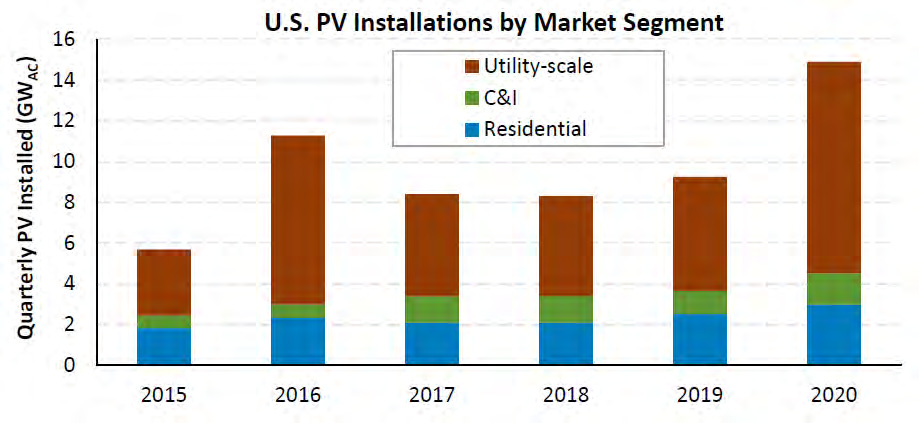
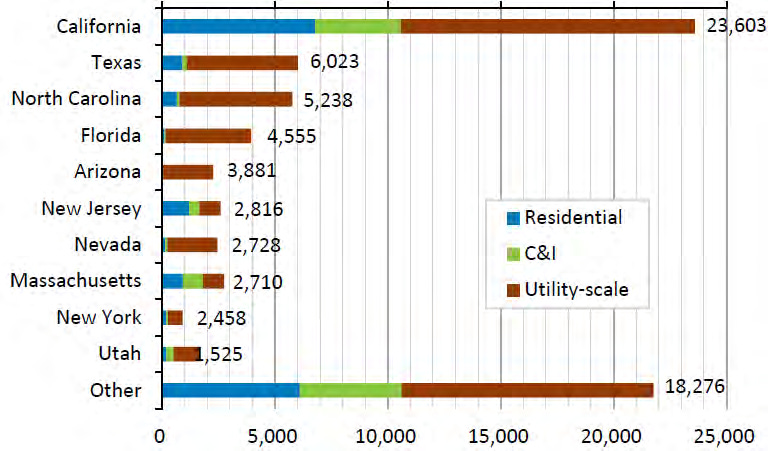
In the US, by far the largest PV installation base is California, followed by Texas, North Carolina, and Florida.
During Corrado’s Planet Microcap presentation he stated:
we’re not stopping at three (plants)
Metals’ first two plants will be in Nevada to capture the CA, AZ, and NV markets. I expect we’ll see plans for plants in TX and/or FL after that.
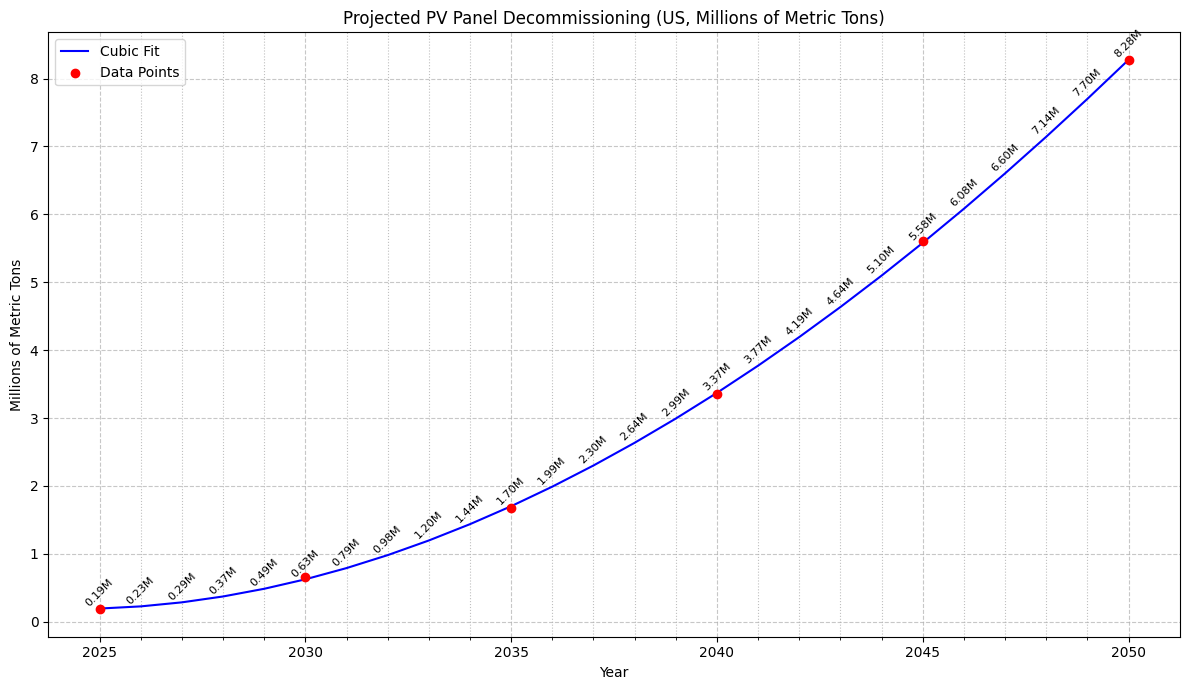
It seems clear I was overly pessimistic to model only three recycling plants in the next 10 years. Metals is forecasting US volumes of end-of-life panels of 1M tons in 2030 and 10M tons by 2050. Those numbers are near the upper range of the EPA’s forecasts.
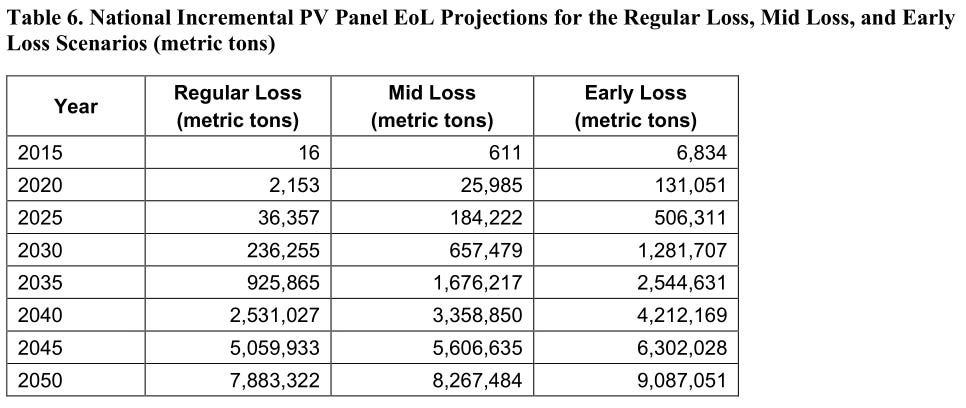
I believe that they’re using near the upper end because that is what the market has been seeing so far. However, in an effort to be conservative, I will use the mid case. To get a year-by-year estimate I fitted the forecast with a polynomial and interpolated.
My updated model adds US plants at a rate to maintain a 30% market share in the US: this slows the buildout in early years compared to company projections (200 kton/y by 2030 vs company’s 300 kton/y) but ends 2035 with 500 kton/y.
Tipping Fee
In an interesting development, the Texas House recently passed (Republican sponsored) legislation to mandate the recycling of PV panels. As Metals proves it can zero-landfill recycle panels at a price competitive with landfills, I think you will see a lot more states do this, and maybe the Feds. Take the green win for no real cost - why wouldn’t you?
Disposal of end-of-life panels in the US generally falls under the Federal Resource Conservation and Recovery Act (RCRA) and Universal Waste Rule, but inclusion of PV panels is not explicit, so applicability isn’t always clear cut. Some states legislate mandatory recycling of panels (eg CA, WA, and maybe soon TX), HI classifies them as hazardous waste, others are ambiguous. Large scale owners of panels are utilities, and utilities are risk adverse, so will tend to use Universal Waste processing to limit any future environmental liability even if they may not be legally required to do so. This hazardous material handling is why it costs $500/ton to dispose of panels at a landfill.
Having said all that, I do not believe that a $500/ton tipping fee will be sustainable: the margins are just too rich. Competitors will come. I will be aggressive and model the tipping fee falling to $100/ton, about the cost of a landfill with no hazardous material handling, by 2030 – just 5 years from now.
Opex and Offtakes
I have seen opex quoted as either $100/ton or $150/ton, and the value of offtakes as either $200/ton or $250/ton. In Corrado’s April presentation, he went with the conservative end of both of those:
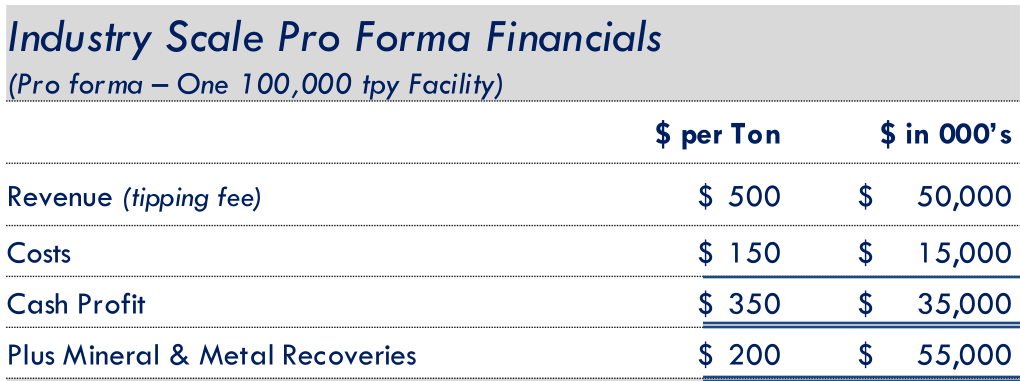
So I will use $150 and $200 respectively.
Metals currently ships the output fines to Asia (South Korea and Japan) for refining, and in the process only realize ~50% of the value of silver in those fines. Metals is looking at bringing that processing in-house, and doing so could double offtake revenues - that would improve margins even if tipping fees fall to zero. There is no visibility on the that switch, so for now it isn’t in my model.
Earnings
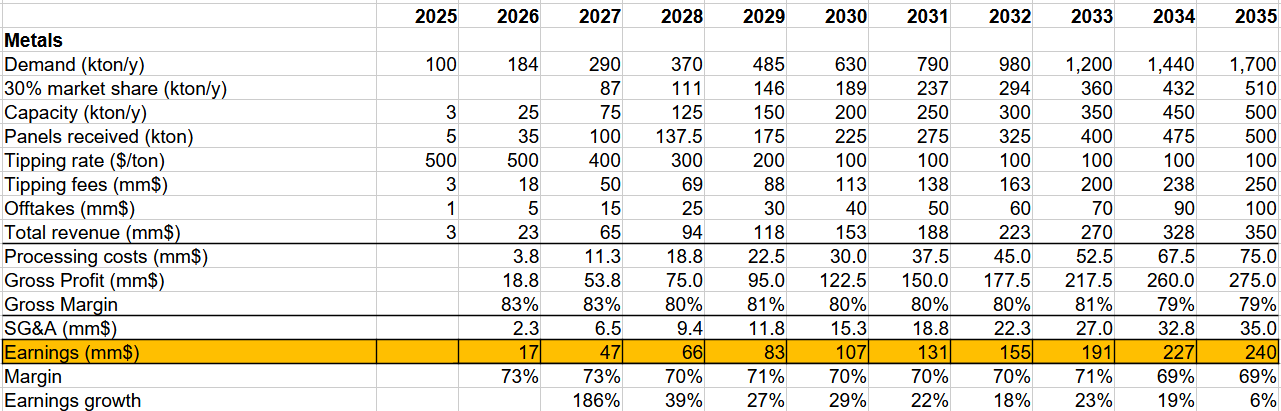
The business grows very rapidly for the next couple years, and then settles into a steady growth of around 20%/y. My key assumption is that Metals’ maintains a 30% market share. To be honest, I think the risks are skewed to the upside. Metals appears to have capex demands less than half they closest competitor (Solarcycle), the most automated system (lower opex), the only R2v3/RIOS certification, and the only zero landfill solution.
Even with what I believe are very defensible assumptions, and a squeezing of the tipping fee from $500 to $100, I see earnings of $107M by 2030.
For Fuels, we’ve got a rename, “separation” not spin, regulatory landscape update, NREL/MIT importance, and a model update.
So long Fuels, Hello Bioleum
We were expecting a Fuels “spin”, but at the 2025 AGM we instead got a new entity “Bioleum Corporation”. Bioleum is a new unlisted company into which Comstock contributed the Comstock Fuels assets in return for ~70% of ownership, but less than 50% voting rights. Bioleum won’t be public anytime soon, but as Comstock doesn’t have control, Bioleum financials will not be consolidated into Comstock financial statements, so the separation of Bioleum and Metals will be clear.
The capital structure of Bioleum is a bit complicated, and as of today, all the details are not public. We do know that a mix of preferred and common shares were used to create a structure whereby Comstock has a majority ownership, but not control – the latter part was demanded by the Strategic investors. The Strategics were not prepared to invest in Fuels at a $1 billion valuation, ~20x the current mark, if Comstock retained control.
First, let me talk about the change from expectations of spinning off Fuels. To be clear, a spin was never promised, but there were enough references to it this year that I’m guessing most investors were expecting it. I would have liked a spin to force the market to independently value Fuels and everything else (mostly Metals), but in hindsight there are a couple obvious reasons why that wasn’t the best path forward:
With LODE trading around a $50M valuation, there was no credible argument that a spun-off Fuels would trade anywhere near a $1 billion valuation. Even if we’re generous and say Fuels traded at $100M, almost immediately the Strategics would still be looking at -90% mark-to-market losses. I can imagine there may have been some concerns about that. Strategics are critical to unlocking the value in Fuels, so it is reasonable to accommodate them.
The financing of Fuels owned refineries will involve equity investments, expected to be done at the project level to the tune of ~30% of capex. If Fuels was a public company trading at $100M valuation, who would invest in the Oklahoma Refinery #1 at a $250M valuation? Spoiler alert: nobody! They’d just buy the parent. Floating an independent Fuels at a very low valuation would have impeded capital raising at the project level.
Coincident with the Bioleum announcement, Corrado also announced the closing of another tranche of Series A: a $20M cash investment from an unnamed “extremely high net worth investor” at over a $1 billion valuation. Effectively selling 2% of Fuels at a 10-figure valuation while LODE was trading around a $50M market cap is a remarkable achievement, and Comstock/Fuels management deserve some serious credit for getting this done. I think it speaks to the upside potential sophisticated industry insiders are seeing in the Bioleum technology.
Comstock is expressing confidence they will raise at least another $30M before closing Series A in Q3, and have hinted that due to increasing interest, Series A may get upsized as high as $100M. It is worth remembering that Series A investors are expected to be large, well funded industry players (think oil majors and airlines). We should see some offtakes, licensing deals, joint ventures, etc. in addition to cash.
The $20M just raised will fund Bioleum for over a year, and will reduce the liquidity drain on Comstock Inc by as much as 70%. Comstock Inc’s pro forma financials will instantly look a whole lot better.
Guidance on Bioleum ownership is:
up to 10% for Series A investors; the upper end implies ~$100M raised.
up to 20% for Fuels founders (10 individuals), subject to performance targets and an IPO.
the remaining 70+% is Comstock Inc’s interest.
A Bioleum IPO is planned upon “completing the construction of its first 400,000 barrel per year refinery and meeting key commercialization milestones”. Those 400 mbbl will be from the Oklahoma “Site 1” 75 kton/y refinery, and that should be coming online in 2028, so I’m guessing the IPO will be a 2029-2030 thing. Although, I believe the main hurdle to listing Bioleum is the expectation of realizing a fair value in the public listing, so if LODE gets a fair valuation before those hurdles are met, I wouldn’t be surprised to see the IPO date moved forward.
To summarize:
Comstock Fuels’ assets have been contributed to a new independent company (“Bioleum”) in exchange for a ~70% economic interest, but less than 50% voting rights.
The second tranche of Fuels Series A closed with $20M cash at a Bioleum valuation in excess of $1 billion. At least $30M more expected in Q3.
A Bioleum IPO is some years away, but is necessary for insiders to receive their equity grants.
I was initially disappointed in the “no spin” option, but we’ve got an independent Bioleum, Series A progressing at an incredible valuation, Bioleum well funded, and an IPO required before insiders can cash out. It’s pretty hard to be unhappy with that outcome.
Regulatory Risks
Despite Fuels’ long term ambitions to reach fossil fuel “parity”, they are currently dependent upon government subsidies. The withdrawal of those subsidies is an important risk for the Fuels thesis in the term. However, the Renewable Fuel Standard (RFS) is now 20 years old, biofuels are worth over $30B/y in the US, and there is a powerful farmers’ lobby supporting biofuel subsidies.
I have been encouraged to see continued support from the Trump administration for biofuels. Early in his presidency he signed executive order Declaring a National Energy Emergency that included support for biofuels:

And updates to the 45Z legislation, relevant to biofuel tax credits, are progressing through Congress. 45Z, born in Biden’s IRA bill, looks to be extended through 2031, although as currently written, it will exclude fuels from feedstocks sourced from outside the US, Canada, and Mexico.
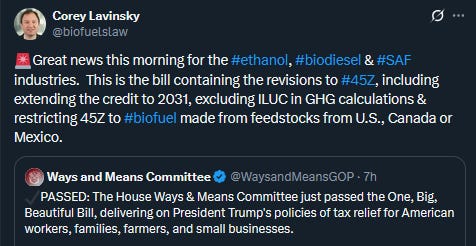
The extension to 2031 is unequivocally good, and demonstrates enduring support from both side of the political aisle, but the restriction to North American feedstocks is less good. Removing the 45Z credits for used cooking oil from Asia (~235M gallons in 2024), needed for blending with cellulosic biofuel, could increase Bioleum opex. The flip side is if Bioleum breaks the blend wall (see below), then this would be a Bioleum advantage. Only fuels refined in the US are eligible for 45Z, so it has no relevance to international site licensees.
Margins
At Planet MicroCap in April, Corrado spoke publicly about Fuels’ operating costs for the first time. Using a woody feedstock, they expect opex of $4.50/gallon, with a visible path to $2.50/gallon.
In the same presentation, Corrado provided an updated pricing table:
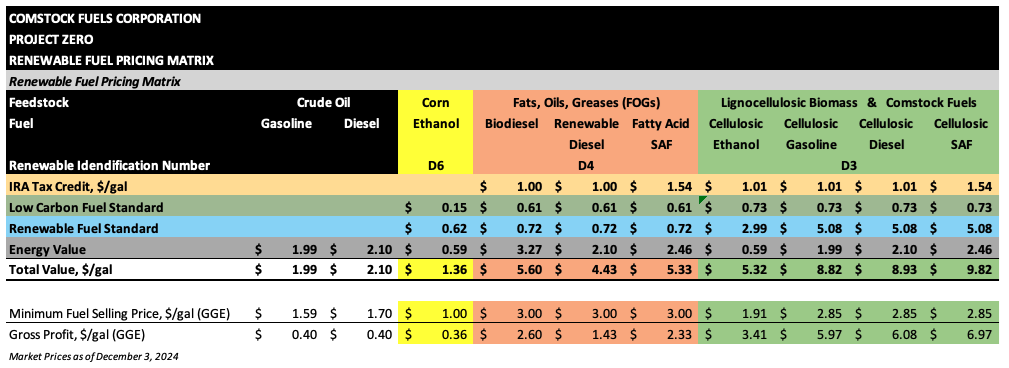
The four right columns are what is applicable to Fuels, and those are some big numbers: as of Dec 2024, cellulosic SAF was worth almost $10/gallon! The price table I shared in my original piece was missing most of the cellulosic prices. It is worth noting that in industry jargon, “cellulosic” actually means from lignocellulosic feedstock, not from cellulose as you might expect. “Lignocellulosic” is what you say instead of “woody” when you want to sound smart.
With the current yield of 140 GGE/ton, 45 of that is ethanol, with up to 90 GGE of SAF. Adjusting for GGE/gallon that gives us a blended price of $8.60/GGE, or a gross margin of ~48% based on $4.50/gallon opex. I will model with $8/GGE.
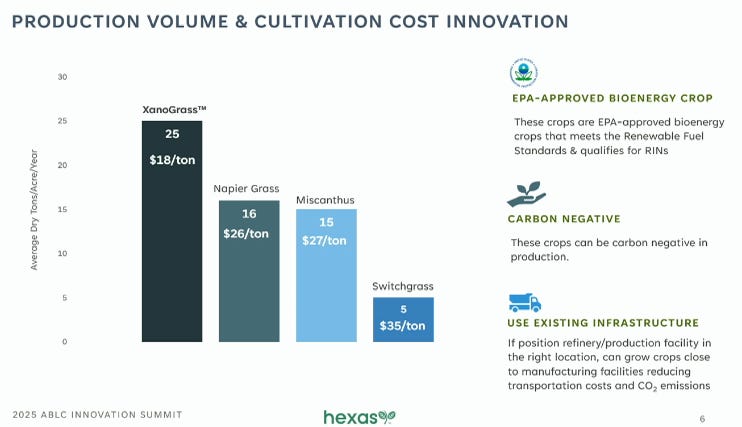
Using Hexas as a feedstock makes economics even better: the cost to refinery door for Hexas will be more like $50/ton compared to $100/ton for woody waste. Taking $50/ton off feedstock cost lowers opex by ~$0.35/gallon, giving $4.15/gallon and getting us above 50% margins.
Corrado has quoted > $30M operating profit for their first 400 mbbl/y refinery in Oklahoma. By my estimation that equates to a ~22% EBIT margin. Servicing $100M in debt at 8% would cost $12M/y, giving us ~16% BT margins. This is a 75 kton refinery which is very small. Margins should improve as they build more refineries and scale to larger plants (eg 1 Mton/y = 3.3 mmbbl/y), so I will model with a 15% BT margin.
NREL/MIT Collaboration
I had previously under-appreciated the importance of the NREL/MIT collaboration. Their first objective is to break the “blend wall”. The aviation fuel that comes out of a cellulosic refinery does not contain enough aromatic hydrocarbons to qualify as a Jet A drop-in replacement, so must be blended with vegetable oil. The vegetable oil requirement ultimately lowers margins and caps supply of SAF, as there is only so much canola/soy/used cooking oil available.
Bioleum working with NREL and MIT have demonstrated producing biofuel rich in aromatics at lab scale; now it needs scaling up and integrating into the Bioleum refining stream. Breaking the blend wall would obviate the need for RenFuel’s tech (and thus royalties) except for when integrating into an operating pulp/cane mill, and would be a large step forward in terms of capacity and opex.
Owned Refineries Earnings
Bioleum is sticking with their “200 mmbbl/y by 2035”, but I’m sticking with my “hmmm, I think I’ll only model half that”. I’ve made a few changes to my model:
instead of trying to model EBITDA and apply a multiple to that, I will keep it simple and use a BT net margin to estimate earnings and use a PE. I don’t model any tax until after 2030.
In light of updated cellulosic pricing, I am increasing my near term blended price to $8/gallon, but lowering that to $6/gallon by 2035. I am assuming opex falls in concert, keeping BT margins at 15%.
Instead of trying to model the roll-up of equity financing at the project level, I am simply assuming refineries are financed with 30% equity so allocating 70% of economic interest to Bioleum.

Bioleum before tax earnings.

Licensees and Financial Conditions
Bioleum licensed refineries will, pretty much by definition, have worse economics than owned facilities: that rich 6% royalty and 20% equity will take their toll on even the most creative of spreadsheets. Throw in the Trump-induced tightening of financial conditions, and I feel I need to rollback my expectations a bit.
“Integrations”
Corrado has publicly dropped lots of hints about “integrations”: adding a Bioleum refinery stream to existing pulp/paper mills, cane mills, or corn ethanol plants. There are three angles to this proposition:
Those mills typically just burn separated lignins for industrial heat. Huge value would be added by refining those lignins into biofuel.
The paper market is in secular decline: many mills are either shut down or underutilized. The opportunity to monetize lignins and turn underutilized feedstock entitlements into biofuel could literally be company savers for these mills.
The economics of a Bioleum refinery could be better than that for a pulp mill or an ethanol plant, so we could see conversion of entire facilities to Bioleum, possibly with the substitution of Hexas for corn.
Today, this segment of the licensee market is completely ignored by everybody’s models. If we see one of these deals drop this year or next, which I expect … numbers go up, again.
Licenses valuation
I’ve made a few changes to my licensed refinery valuation model:
I am delaying financing, hence the refinery buildout, by 1 year. Instead of first production in 2028 like Bioleum, I’m now aiming for 2029, but still ramping production at a rate 2x Bioleum owned refineries.
I am using a blended price equal to the new Bioleum price model less $1/gallon. This is mostly to capture selling into the international market should the US RFS market become unavailable to international producers.
The 10% royalty I attributed to RenFuel and EFT was way too high. I have lowered that to 1%. The total royalty due to all licensed IP/tech will change over time – after the NREL/MIT collaboration bears fruit, for example. The tricky part is that incorporating that tech into the Bioleum processing stream will change many factors, from yield to capex and opex. The only thing I confidently say is that it will make economics better, but beyond that I have no way of modeling it, so for now I am just modeling as if RenFuel/EFT will be the only licensed IP through 2035.
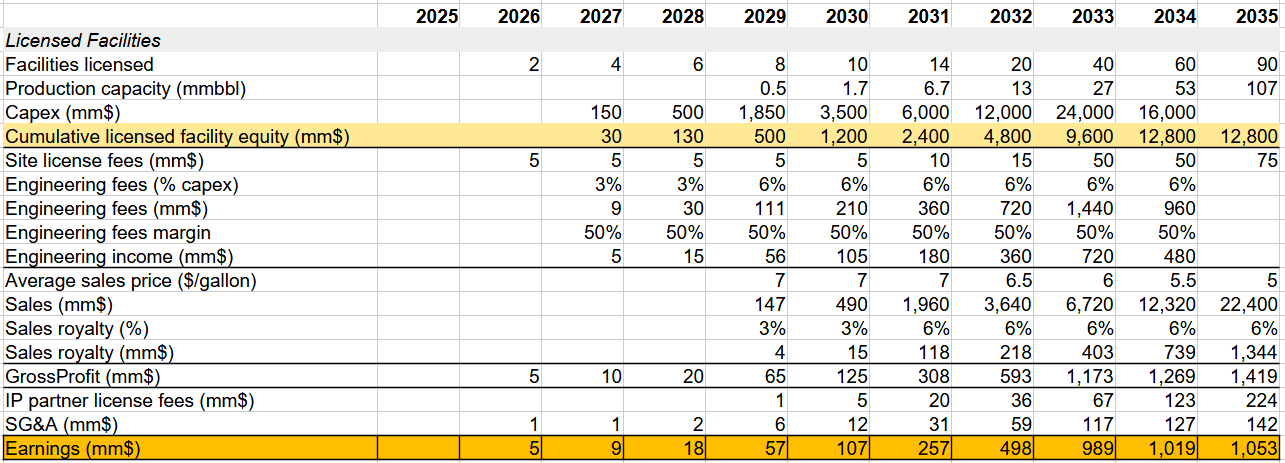
Now that I’ve got projected earnings for these businesses, I need to convert those to valuations and risk adjust them.
I value Metals and Bioleum in 2025 and 2030, but it is not as simple as slapping on a multiple. Both businesses have upcoming de-risking events in the form of turning on their first commercial facility: Metals in 2026 and Bioleum in 2028. It is nonsensical to value them today based on current earnings, so we need to look forward and discount back.
To value Metals today, with its first plant coming on line next year, I apply a 15x multiple to 2030 earnings (~70% margins, earnings growing ~20%) and discount it back to today with a 12% discount rate. I do the same in 2030, discounting back 2035 earnings.
Valuing Bioleum today is relatively easy: use the mark well informed investors have just given us: industry players are investing at a $1 billion valuation, so that’s what I use. For 2030, I do the same as I did with Metals: apply a 15x multiple to 2035 earnings and discount back at 12%. If by 2030 Bioleum is well on its way to producing 100 mmbbl/y from woody feedstock with robust economics, 15x will be a pretty low bar.
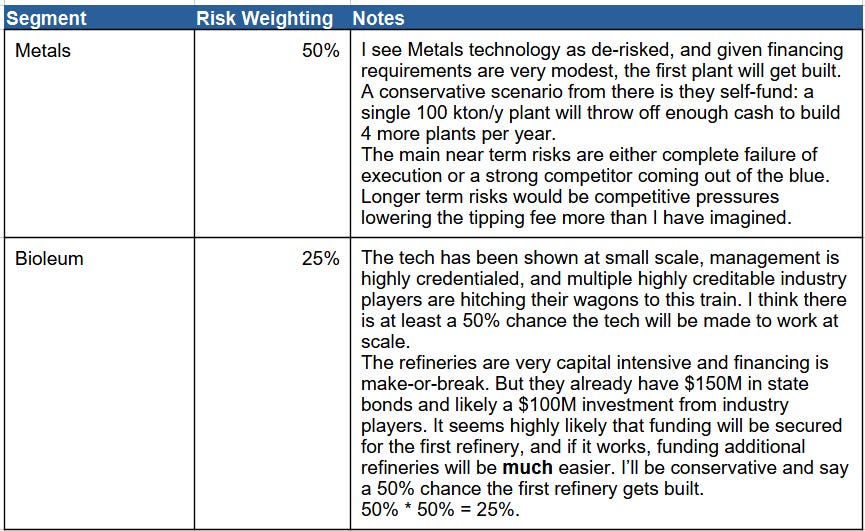
Once I calculate those valuations, I “risk adjust” them. Ideally I’d calculate low, base, and high cases for valuation, each with an assigned probability, and then sum the products of valuation times probability to get an expected value. Unfortunately I feel such a process would smack of the illusion of precision: there is just too much uncertainty in my numbers. So instead I just wave my arms in the air and guess at a number that I think conservatively captures the chance of success in these businesses.
At time of writing, there are around 33M shares of LODE outstanding. I dilute that by assuming another 3M shares for the $9M needed for Metals ($3/share). Bioleum stock based comp appears set until the IPO, but after that I am adding 3%/year in dilution.
There are a number of other assets on Comstock’s balance sheet:
Real estate in Silver Springs, Nevada. Value: ~$100+M.
Shares in Green Li-ion. Last round mark: $19M.
Mining asset in Nevada. Value: $30M-$50M.
At least the first two have real hope of divestment in the next 12 months. I will record these three as “Other assets” and give them a combined $100M value.
For tax, I assume Metals is tax free through 2035 due to Comstock NOLs available. For Bioleum, I assume it starts paying tax after 2030 at a 25% rate.
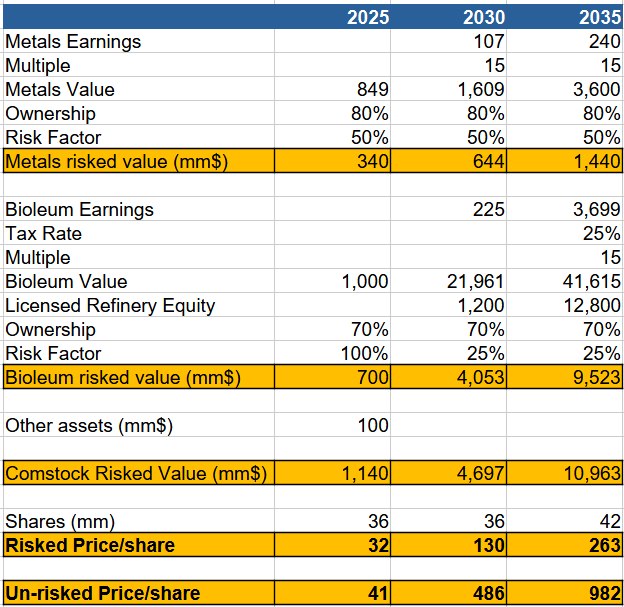
The “risked price” is what I think about when I consider what LODE 0.00%↑ is worth today. However, the last “un-risked” line is the per share value without the risk factor applied. The risk factor is trying to adjust today’s value for the risks to this investment, but if these businesses succeed, obviously the risk factors won’t apply, so this line is about what happens if things go right.
The obvious and not very profound conclusion is that if you believe the Series A investors are indeed competent and informed industry insiders, the current price of Comstock is just silly. And that’s being polite. It is trading at a -90% discount to what seems risked fair value to me.
Beyond today’s value, the asymmetry on offer here is extraordinary, and the per share prices I come up with are pretty big even assuming only a 1-in-2 and 1-in-4 chance of success for Metals and Bioleum respectively.
I’ve come to think about buying LODE as a very cheap bet on Metals becoming an amazing business and getting a free call option on this moon shot called Bioleum. Imagine a world where Bioleum is producing 100’s of millions of barrels of near-zero-carbon liquid fuel, disrupting and transforming the global energy markets, and enabling developing nations to become energy self sufficient. Pie in the sky stuff, but there is a plausible path to such a world, and I’m amazed we can buy into this upside at a whopping discount to what appears to be fair value.
A final reminder: none of my number are forecasts or targets. The market is smarter than me, and is currently saying I’m wrong. I am just an idiot with a spreadsheet who is sharing the work I’ve done.
Finally, a huge shout out to my friend Uzo Capital for helping me immeasurably in my valuation efforts. If you’re not following him on X and Substack, seriously, what are you doing?
No posts
Comments
Nothing yet. Say the first thing.
Sign in to join the conversation.