
This is a story about a biofuels refiner and a PV panel recycler on the cusp of commercialization that appear to be priced so cheap by the market that I feel I must be missing something. But despite looking and looking, I haven’t found that thing. This idea fits into my highly asymmetric bin: very large upside and 100% downside. The upside is so large you could view it as a perpetual call option.
Comstock ($LODE.AMEX) has a history as junior precious metals miner that somehow morphed into a tech incubator – certainly not a corporate path you see often. They do however find themselves with two very interesting businesses in the renewables space, both of which are on the cusp of commissioning their tech. The market, as you’ll see if you make it the end of this piece, appears to be valuing these two businesses at zero. I think the market is insane.
This idea is originally from my friend Chris; on his prompting I looked at it briefly, but saw an undeveloped silver asset in Nevada and too many references to AI so it was a quick “hard no” for me. But Chris repeatedly prodded me until I looked deeper, and eventually drank the Kool-Aid.
Chris has an excellent Substack on LODE here, and a recent update here. They’re both behind a paywall, but if you subscribe to the free tier, you get one free article.
$LODE has three businesses: Fuels (biofuels), Metals (PV recycling), and Mining (Nevada silver asset). It is Fuels I am most interested in, but I’ll go through all three, saving the best for last.
Comstock Mining did pour some gold in a past mining operation, but I actually haven’t researched the history much because it doesn’t matter to me. Today Comstock Mining has rights to 12 square miles of land over a historic gold and silver district in Nevada. 600k oz of measured and indicative gold, 8M oz of silver. I’m told this asset is worth 10’s of millions; I have no opinion. Maintenance costs are de minimus, and I think they are covered by some licensing agreement they made. They are not planning to commit any new capital, have had inbound buying interest, and are open to selling the mining asset.
IMO, this silver asset just weighs on the other two excellent businesses-in-the-making. Investors who are interested in biofuels or PV recycling are unlikely to be looking for exposure to an undeveloped silver mine. It should be divested, and I am encouraged that the CEO, Corrado DeGasperis, is open to selling this asset.
I value this business at zero.
Comstock Metals have world-leading recycling tech for PV panels. We are just at the beginning of a tsunami of end-of-life PV panels: the US market for disposed PV panels is expected to be 1M tons by 2030 (33M panels), and 10x that by 2050.
The Comstock Metals recycling process produces no landfill waste: everything is recycled or incinerated. They will sell all three streams of output:
Ground aluminum.
Ground glass.
“Tails”, which is the remaining metals (silver, copper) in ground up form, with economic quantities of silver (30-35 oz/ton). They expect to become one of the largest silver “mines” in Nevada.
The adhesives and plastics are effectively burnt, which sounds a bit scary, but they recently passed a Nevada State environmental assessment of their emissions.
The economics are very good:
They receive a $500/ton “dumping fee” to accept the old panels. This is at least price competitive with the alternative, which is a landfill.
It costs them ~$100/t to process the panels.
They receive ~$200/t for the three sales streams at current pricing.
So ballpark ~$600/t gross profit, 85% margin.
Unsurprisingly, the first supply of end-of-life PV panels will come from SW US states: California, Nevada, and New Mexico. California has banned PV panels from landfills, so they currently have to be trucked to be buried out of state. Metals is planning three 100 kton/y PV recycling plants on the CA border to capture that supply. They talk about the “first mover” advantage: the argument is that no one can compete with them right now, and if they can get their facilities built in key spots before anyone else, they’ll be hard to catch.
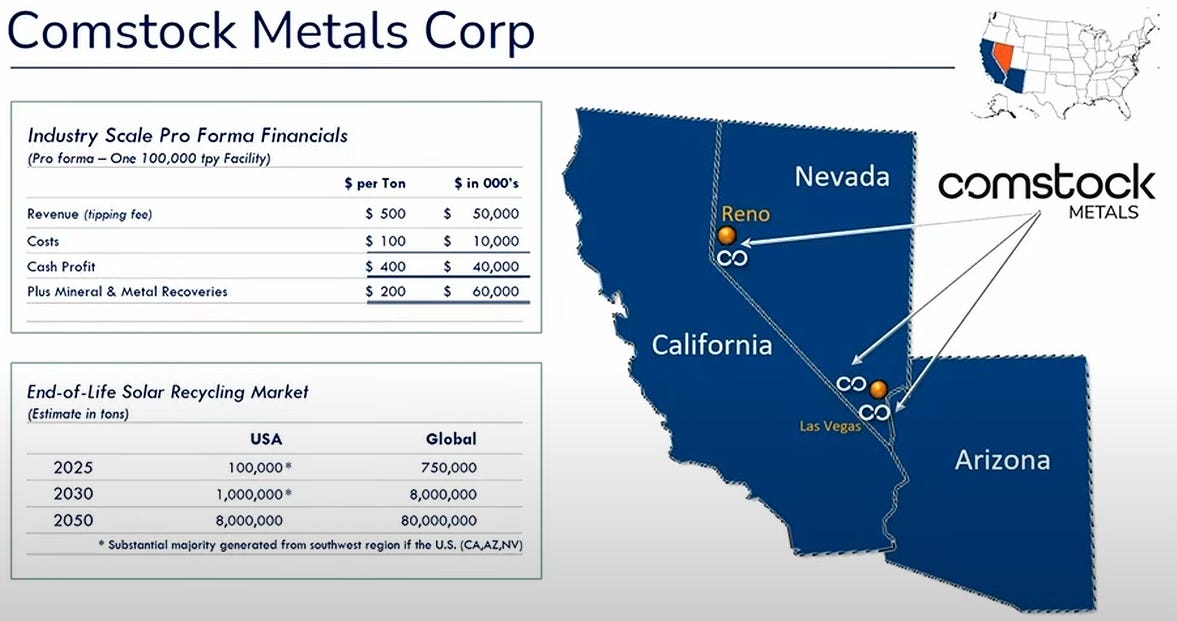
Metals has a permitted site in Silver Springs Nevada, and have started accepting panels for storage this year, so will be booking that as deferred revenue in 2025. They expect to have their first facility operational next year, and have three plants for 300 kton/y of nameplate capacity built by 2030. Each 100kton/y facility requires $12M capex and should generate $60M in gross profits at today’s pricing.
They are currently still arranging financing for these facilities. There are multiple potential sources: 1) SBC (see below), 2) USDA loan, 3) Nevada tax exempt bonds, 4) some other equity investment. I think SBC is most likely for the first plant.
At build-out, there will be three plants processing 300 kton/y (11 million panels), producing 9-10 million oz of silver, and generating $180M in gross earnings in a lead position in a growing industry … put a 10x on that, and you’ve got a $1.8B valuation.
They have assembled, via in-house IP and licenced tech, a biofuel process that has demonstrated 125 gasoline gallon equivalent (GGE) yield per ton of woody biomass. To my knowledge, that is close to 2x their closest competitor. With gas-to-liquids tech recently licensed from Emerging Fuels Technology, they expect to push that to 140 GGE/ton, which is an extraordinary yield. They achieve such high yields by processing lignins as well as cellulose – no one else does lignins.
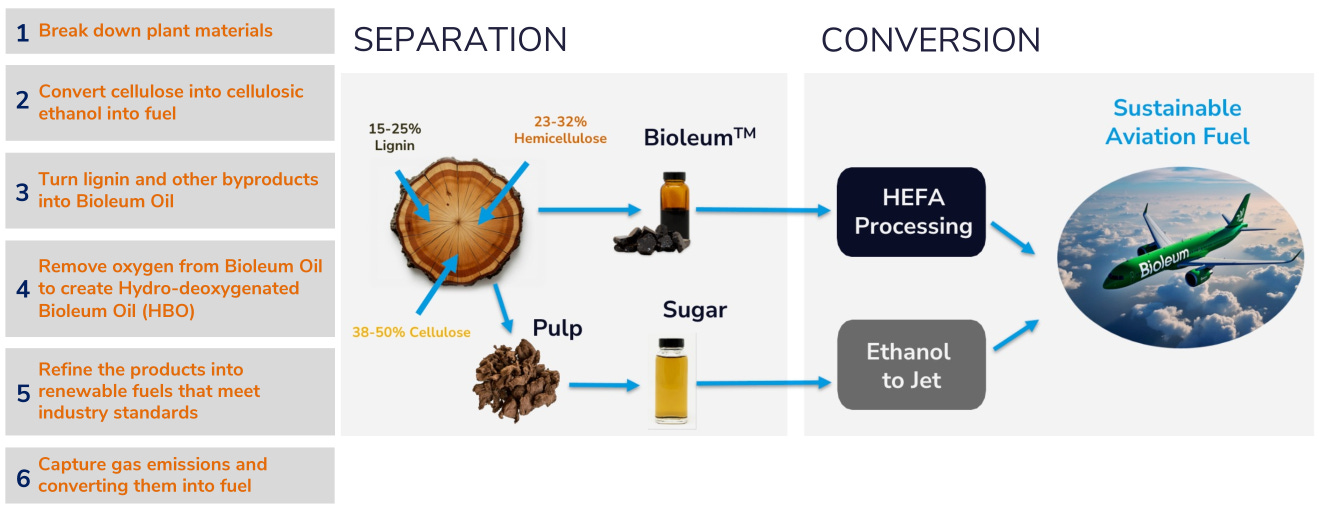
After initial digestion, their process has two streams, one for ethanol from cellulose which is pretty industry standard now, and one for “Bioleum oil” from lignins. Their lignin processing is partially enabled by tech they have licensed from RenFuel (multiple patents), a Swedish bioenergy company spun off from Uppsala University. Fuels recently expanded their exclusive license with RenFuel to just about everywhere except Europe where RenFuel had some existing contracts. In addition to the extra yield, lignins also have a higher carbon density than cellulose, so are better for producing gasoline/diesel/jet. Output fractions depend on the feedstock, but of the 140 GGE, ~45 will be ethanol and up to ~60 can be SAF.
Here is current US liquid fuel pricing:
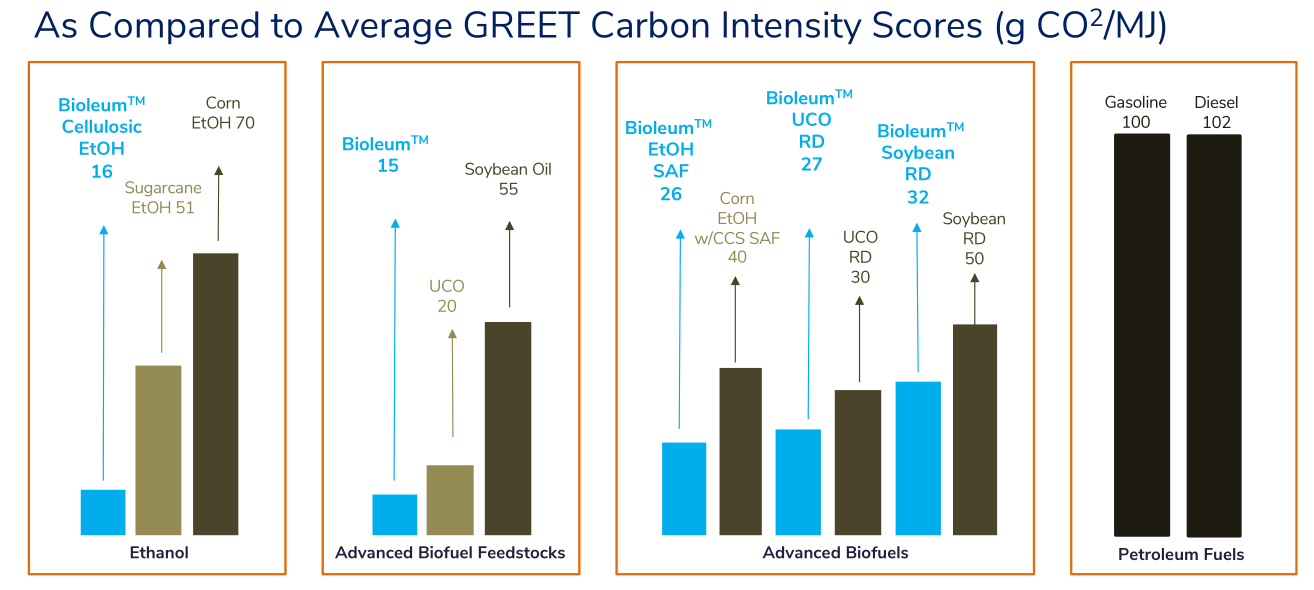
Note that the price of ethanol from cellulose ($5.37) is 3.6x that of ethanol from corn ($1.49), even though they are chemically identical. The tax credits assigned to a fuel is directly related to the “carbon intensity” of the production of that fuel. Cellulosic ethanol is so much more valuable because it can be produced with a carbon intensity of 16 vs 70 for corn.
They also have worldwide exclusive license to a feedstock crop XanoGrass (infertile corn/bamboo hybrid) from Hexas. It is a perennial crop: “proven yields exceeding 25 to 30 dry metric tons per acre per year, or about 4 to 7 times the yields of traditional forestry species … [that thrives on] marginal or underutilized lands”. Fuels is saying they can get ~100 bbl/acre of fuel from Hexas, which is about 10x what you get from corn.
The very low carbon intensity scores for Fuels’ tech is a very big deal, and translates directly into government credits (worldwide, not just the US).
Fuels has signed a definitive contract with SACL, a Singapore-based renewable energy project manager. Currently four sites are covered by the contract: 1 in Vietnam and 3 in eastern Australia. Additional sites in Malaysia and NZ are expected soon. The terms of the contract specify that Fuels receives an “engineering fee” equal to 6% of capex, a 6% sales royalty, and 20% equity in constructed facilities. Those first four plants have expected capex of $4B at full buildout, and $3B in annual sales, so this contract implies $240M in engineering fees, $180M/y in recurring royalty, and equity in the facilities worth $800M at cost.
And that is just for the first four plants – there could be hundreds if this tech works.
They have also signed a contract, with the same terms, for a site in Pakistan for up to 1Mt/y (different partner: Gresham’s Eastern). Corrado told me that Pakistan sees this tech as a potential path to energy independence, which could be a pretty big deal.
Who would sign such onerous terms? Fuels is currently fairly tight lipped about the economics, but I have been able to piece together some rough numbers for the first four facilities and they look very, very good. Corrado confirmed for me that a 4-year payback was about right.
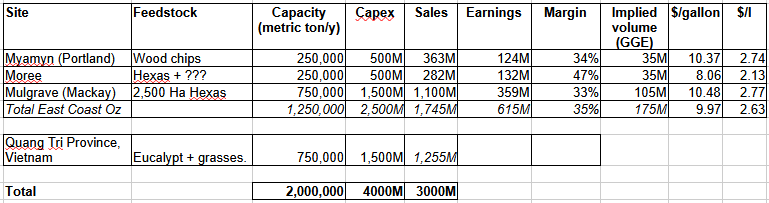
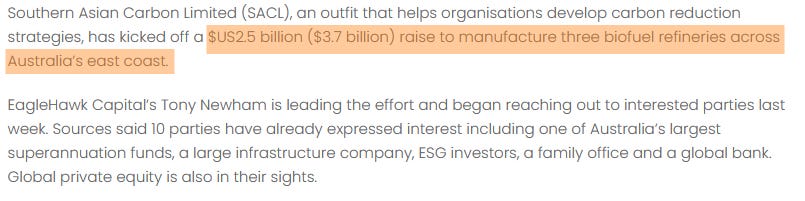
Fuels is mandating that SACL’s first plant be no larger than 75 kton/y (some commissioning challenges are to be expected). But SACL is currently in the market to raise $2.5B, so appear to be progressing aggressively. An Aussie Super fund is rumoured to be interested, which is not surprising. I figure they will be all over this sort of opportunity: a domestic biofuel producer with excellent economics, which will not only boost their environmental cred but will also help the national airline (Qantas) meet their SAF goals (10% by 2030 and 60% by 2050).
Fuels has not been chasing these foreign deals – the foreign interest has all been inbound. Fuels have been focused on the US, and have been negotiating with multiple large, “blue chip” partners who are currently in various stages of due diligence. These “Strategics” will bring financing and either licensing or an offtake or marketing/regulatory/project assistance. Official notice of the first of these dropped recently when they signed a definitive agreement with Marathon Petroleum for an equity investment; finalizing an offtake, and assistance in facility construction/regulatory approvals is expected by the end of May. Expect more agreements with Strategics, with equity investments of up to $50M, also before the end of May.
At a special meeting, LODE shareholders recently approved a 1:10 reverse split. Reverse splits have a justifiably bad rep, but this one looks to be an exception to that rule. They were not at risk of delisting, but did need to increase the number of authorized shares to accommodate some of these strategic investors. Increasing authorized shares is difficult outside of AGMs, and apparently a RS is a common way to accomplish that: 1:10 split without reducing the authorized share count.
They have also announced an intention to spin off Fuels. I am very supportive of this: it will make for a much cleaner story for strategic partners and investors both.
They are currently looking to raise funds for a 75kt/y “demonstration” facility in Oklahoma ($150M-$200M capex). They have received a $3M grant from OK, and approval for $152M in OK “activity bonds” which are tax exempt bonds. They have already been talking to bulge bracket investment banks to place those bonds. My thinking is that with those bonds, they will not have trouble raising another $50M from the partners they are bringing on. Their plan is to finance facilities going forward on a project basis with 20-30% equity and the remainder in debt. Corrado’s position is that once they have their first facility operating, debt financing will not be a problem.
In August they announced a transformative $350M financing deal with a special purpose company, SBC, that I’m told is an investment vehicle for a sovereign wealth fund. Despite the elapsed time since the deal was announced, it has not died or closed. I am told that shortly after that agreement was made, the SWF sacked their investment manager, and thus the deal did not progress for months, but is progressing again.
SBC agreed to pay $200M for 40% of Fuels ($500M valuation), but there since then there has been significant progress for Fuels (increased yield, OK grant + bonds, Marathon, Hexas, SACL and Gresham deals), and I think SBC has missed their chance. Corrado told me they can get at least as good terms for investment that also come with offtakes/licensing/joint developments, and SBC can’t compete with that. They also don’t need nearly so much equity now they have those OK bonds.
SBC agreed to pay $22M for 20% of Metals, a $110M valuation.
I think SBC will still happen: they’ll invest a modest amount at the Comstock parent level, and probably in Metals to build one or two 100 kton/y plants. They also want to buy some of LODE’s real estate holdings (more on that later). Despite likely missing out on the Fuels Series A funding round, SBC sees a long term opportunity. Corrado told me they are interested in equity in LODE so they will be around to invest in the “next 100 facilities”. Obviously that’s pretty speculative, but does give you an idea of the bull case upside.
On 28feb2025 Comstock inked a definitive funding deal with Marathon Petroleum. Bringing on a major is a significant milestone. Marathon agreed to invest $14M in Fuels ($1M cash, $13M PIK in the form of renewable refinery assets in Wisconsin) at “up to $700M valuation”. Public comments Corrado has made since imply that $700M is a floor going forward, and some of the Series A round may price above that.
Marathon conducted significant research into Fuels prior to this investment, so I consider this an endorsement of Fuels’ tech from a significant industry player with expertise in both conventional and biofuel refining. The refinery assets Marathon is contributing are near a Fuels’ research facility in Wisconsin and along with assistance committed by Marathon will expedite ASTM and Pathways approvals. ASTM approval is certification a fuel meets standards (diesel, jet, etc.) and can be used as a plug-in replacement for conventional fuel. Pathways approval is the determination of a fuel’s eligibility for government credits. Practically this deal means Fuels OK demonstration facility will come online sooner.
Importantly, the agreement marks the end of November2025 as the deadline for finalizing financing of at least $25M in Fuels Series A financing. That tells me Fuels are quite confident in meeting that deadline, so we can expect more Fuels Strategics financing news in the next 9 months.
XanoGrass + Fuels looks to be a disruptive combination. The yields those two technologies enable will be a game changer for the liquid fuels markets. Fuels has set themselves a target of producing 200 mmbbl/year from just their owned facilities in the US. Licensed facilities in the US and worldwide could be multiples of that. Countries may see it as a path to energy independence. Farmers may transition away from sorghum/alfalfa on marginal land to Hexas. Ethanol from food crops will come under pressure, both from the higher yields and lower carbon intensity of Hexas/Fuels but also from the more attractive product profile from oil rather than ethanol. Once Fuels’ tech is demonstrated at scale, all other biofuels will struggle with financing. If it plays out like it appears it could, the ramifications are hard to overstate.
There are plenty of catalysts in the pipeline:
$25M-$50M investment in Fuels from large well known US players.
Placement of ~$150M in Oklahoma tax exempt bonds to fund construction of first demonstration Fuels facility in Oklahoma.
More foreign license agreements for Fuels facilities.
Funding for Metals first plant(s).
Dilution is a bogey man on many investors minds, especially after the recent reverse split. Comstock does have a long history of dilution (remember the mining history), but today I think these worries are way overblown.
Mining: no further capital commitment is expected.
Metals: the 20% of Metals to be sold to SBC on the original terms is likely the upper limit of dilution expected for Metals. Further growth will be financed with cash flow and maybe debt.
Fuels: no dilution is required when they license the tech to 3rd parties, as has been done with SACL and Gresham’s. The “Series A” round for Fuels will be with multiple large strategic partners; I am expecting around $50M total funding at the Fuels level at a $700M valuation or higher.
The first Fuels demonstration facility needs up to $200M capex funding. I am expecting ~$150M in Oklahoma tax exempt bonds and up to another $50M in equity financing at the project SPV level. Make no mistake, Fuels facilities are capital intensive to build and will require dilution, but at Corrado’s guided 20-30% range for equity, these will be highly accretive dilutions.
Comstock parent: yes there will be further equity investments at the parent level, but I expect them to be modest, with most of the financing occurring at the subsidiary level.
Comstock owns 258 acres of prime data centre land in Silver Springs Nevada. SBC has agreed to pay $50M for this land (still non-binding). Comstock also owns 17% of 2500 acres of similar land nearby. All of this land will likely be sold, and likely/possibly all to SBC, but I understand it is complicated, so will take some time.
The two blocks together are worth around $100M, 72% more than the current market cap of the entire Comstock family of companies.
We’ve got the $110M Metals valuation via the SBC deal, the $700M Fuels valuation via the Marathon deal, and at least $100M of assets for sale. I’m happy to round up and say just on that, we’re close to a $billion valuation. As of 28feb2025, market cap is under $60M. I was tempted to just say it obviously has 10-bagger potential and call it a day, but my friend Uzo urged me to do better.
Given 1) the early stage of these companies, and 2) the limited release of financial forecasts, putting hard numbers to the valuation is a challenge. I am not up for attempting to model earnings, so I will stop at EBITDA, and even that requires some real guess work.
My assumptions/guesses:
Metals:
The first plant is operational on 1jul2026, the second 1jul2027, and the third 1jul2030.
No facility growth after 2030. This is unlikely to be the case, but I’m being conservative.
The rate of receipt of panels for recycling matches the nameplate capacity with a 6-month lead.
SG&A = 10% of gross revenues.
The first two plants are financed with equity at a $110M valuation, and the third plant is financed with retained cash.
While the dumping fee is booked as “deferred revenue” and only becomes revenue after processing and sale of output streams, for simplicity I am treating the dumping fee as revenue.
Valuation ramps from 5x to 10x EV/EBITDA as the business executes. Waste management comps are $WM at 15x and $WCN at 18x.
Fuels owned facilities:
They break ground on the first 75 kton/y plant in 2026.
Plants have a 3-year construction and commissioning period.
While Fuels expects up to 140 GGE/ton once EFT tech is fully integrated, I will use the currently demonstrated 125 GGE/ton, which allows some room for feedstock variability and a bit of room to run below nameplate capacity.
Fuels has a stated goal of producing 200 mmbbl/y from owned plants by 2035. There is a ton of work and capex required to get from here to there, so to be conservative I will model only 100 mmbbl by 2035.
Production increases in a straight line from the start of the first 75 kton/y facility to 100 mmbbl in 2035.
Gross margins are 35%. Based on SACL data, 35% may in fact be net margins.
SG&A = 20% of gross revenues.
After the first plant, facilities are financed with 30% equity and 70% debt.
Capex is spread evenly over the 3-year construction period.
Current biofuel pricing in the US is north of $5/gallon, but I expect that will come under pressure if this tech delivers as promised, so I am using a flat $3/gallon price.
Owned facilities will be ramping debt faster than EBITDA so EV/EBITDA is not an appropriate metric, instead I’ll use 8x price/EBITDA as I can’t estimate ITDA. Comps are VLO 0.00%↑ at 14 P/E and MPC 0.00%↑ at 15 P/E.
Fuels licensed facilities:
First plants start construction in 2026.
Licensed plants capacity expands at a rate 2x owned plants.
50% gross margin on engineering fees.
$3/gallon price for outputs.
The revenue royalty model should be highly valued by the market, so I am ramping P/E to 10x. You could easily make the case for a higher number.
RenFuel & EFT License fees
Licence fees will be due to RenFuel and EFT for the tech licenced from them, but I have no information on that, so I just have to guess. I am assuming RenFuel is owed 10% of sales revenue (oil sales and licenced facilities royalties) as RenFuel tech is key to producing Bioleum from lignin and EFT is owed 1% as EFT gas-to-liquids tech increases yields by 12%.
Dilution
To get to 100 mmbbl/y, I calculate capex needs at $67 billion. The facilities are expected to be joint ventures with large financial or industry players. They will be structured as SPVs, and funding is expected to be 20-30% equity, with the remainder debt. A key point, is that the funding/dilution will happen at the SPV-level, not at the Fuels parent level.
I don’t have enough information, nor am I modelling in nearly enough detail, to model the equity dilution of Fuels facilities at the project level where they will happen. And for simplicity, I am also not modelling the spin-off of Fuels that has been announced. Raising equity at the project level is optimal for Comstock holders, but I can only guess at what the effective amount will be. I simply use 15% dilution per year.
The engineering fees are technically not recurring, but I believe the build-out of this tech will take decades, so those fees should continue for a long time. I have included them in earnings for the first 10 years.
Final Fudge
As a final conservative measure, I have arbitrarily reduced the EV by 50%, to provide an even more conservative result.
Results
The numbers get really big, really fast. This despite these conservative assumptions I’ve made:
I’m assuming a yield of 125 GGE/ton rather than Fuels’ expected 140 GGE/ton.
My assumed growth in Fuels’ nameplate capacity to 2035 is half of Fuel’s stated goal of 200 mmbbl/y.
I’m not counting Fuels’ engineering fees as revenue.
I’m using a 35% Fuels gross margin, which based on SACL information is conservative.
I’m using a Fuels price of $3/gallon when current market price is north of $5.
I’m assuming Metals stops growing at 3 plants, which I consider unlikely.
I’m ignoring $100M in land value and a silver mining asset likely worth 10’s of $millions.
I’ve arbitrarily cut my calculated valuation in half.
It is important to remember there is lots of guess work involved in my calculations. I have tried to be conservative, but at best this is an order-of-magnitude estimate. You could consider this a slightly more rigorous effort than waving my arms in the air and shouting “100-bagger!”.
By 2035 I come up with an 11-digit valuation, and a triple-digit price by 2028. There is room for a lot to go wrong and this opportunity still work. If Fuels is a zero, I still see Metals as worth $56/share in 5 years.
I should stress again that this is just trying to get my arms around the size of the opportunity. I am not putting out a price target, but I am comfortable saying this is a yuge opportunity.
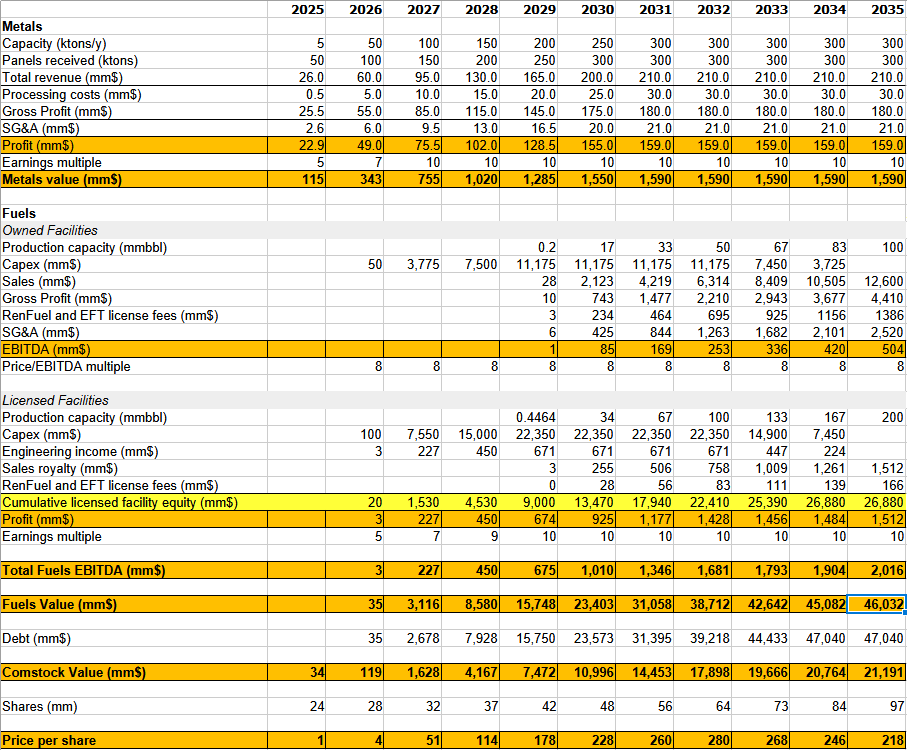
[Note: a reader noticed a problem in my original model, so I have updated the above image and link with updated versions. See note at end for details of changes.]
Metals and Fuels have the promise of being extraordinary businesses: badly needed decarbonizing businesses that should be wildly profitable. Metals does not rely on any government subsidies. Fuels is still reliant on biofuel tax credits, but looks set to be a disruptive force in the market due to its remarkable yields and apparently impressive economics.
With market pricing today, you can buy $100M of data center land in Nevada for $60M and get two amazing businesses-in-the-making for free. You can make a coherent argument those businesses will have a valuation of at least 10-figures in the 2030s.
I hear you, there are lots of risks: tech, execution, financing, dilution. You have to risk-adjust the upside, but the market is effectively putting a zero probability on either Metals or Fuels succeeding. I will definitely take the over on that risk.
You wouldn’t be effectively getting these businesses for free if there were no risks, so yeah, there are risks aplenty.
Metals has an operating 5000 ton/y recycling plant, that has met all expectations (they have successfully sold all three output streams). Scaling up 20x to the commercial size of 100 kton/y carries some risks, but given the nature of the tech, I personally do not see this as a large risk.
I’m not clear on the depth of Metals’ competitive moat. Maybe they will face more competition than expected or sooner than expected.
History is littered with the desiccated carcasses of investors of past biofuels technologies that failed to scale or deliver the expected economics. What Fuels is trying to do is not easy, and no one has done it before. Some components are TRL9, others are TRL6, and so the combined process is TRL6.
To counter that, we see Fuels partnering with very capable organizations, multiple parties preparing to commit 9 figures of capital to deploying this tech, and an apparent endorsement of the tech from Marathon Oil. Fuels appears to have a very legitimate shot at making this work. Nonetheless, this is the risk that keeps me awake at night.Financing/dilution risk. LODE is very much undercapitalized right now, and while great progress has made in this area in the past half year, there are still obvious risks.
Execution risk. By all appearances, Corrado is capable and extremely hard-working, but they currently have an awful lot of balls in the air.
Fuels is dependent on government biofuel incentives. Those could be ended, however even Trump, in his executive order declaring a national energy emergency, included biofuels in the energy mix.

Also, I’m not sure the economics of the planned facilities in Pakistan or Vietnam benefit from government subsidies, and the Australia regulatory regime if far less generous than in the US, so the regulatory risks are lower in these jurisdictions.

Everything I know about biofuels I learned from ChatGPT. Last week. If there is something I am missing here, I’d appreciate hearing from you.
I am long $LODE.
A helpful reader let me know that in my original spreadsheet I had an error in the calculation of market cap from EV, and fixing this bug exposed another problem: attempting to calculate market cap as EV - debt doesn’t work in the early years of a growing capital intensive business, as calculated market cap goes negative. So I made some changes to the model:
I use price/earnings ratios to value Metals and Fuels licensed facilities, as I have modeled both with no debt. For Fuels own facilities, I used 8x for price/EBITDA (industry comps at 14-15 P/E).
In my original model I had attempted to model dilution using my calculated market cap, but in reworking my valuation calculations I became uncomfortable with that approach: the dilution will be at the Fuels project level and based on valuations of those projects, not market cap of LODE/Fuels. Using my low market cap estimates in the early years of my model likely grossly over-exaggerates the expected dilution. I have settled for a simple 15%/year dilution.
Since I can no longer use engineering fees to offset the equity raises, I now include those fees in income. This is slightly less conservative than in my original model.
I left all my other conservative assumptions in place. The end result is lower but still very large.
No posts
Comments
Nothing yet. Say the first thing.
Sign in to join the conversation.