

It rarely happens at your desk. It happens somewhere the business isn’t: in a hospital waiting room, at a friend’s exit dinner where the number was smaller than everyone assumed, or in the quiet after a launch that finally hit the revenue goal and changed nothing about your actual bank account. Something clicks. You’ve been running a business for years, and you still don’t know what you’re actually worth without it.
That’s the moment. Not a birthday, not a specific revenue milestone, not a magazine-cover ARR number. It’s the realization that a growing P&L and a growing net worth are two different projects, and you’ve only been working on one of them.
This piece is about that switch: why almost every founder makes it too late, what the data says about the risk you’re carrying without knowing it, and the specific mechanisms that convert business income into wealth that doesn’t disappear the day your biggest client leaves or your industry gets disrupted.
Founders track revenue because it’s visible, it’s motivating, and it’s the scoreboard everyone else can see. Investors ask about it. Competitors watch it. Your own team rallies around it. None of that makes it a measure of wealth.
Revenue is a flow. Wealth is a stock. A flow can stop tomorrow: a platform algorithm change, a key client renegotiating, a lawsuit, a health event that takes you out for three months. A properly built stock keeps compounding whether you show up to work or not. Most founders spend years maximizing the flow and never build the stock, because the business itself feels like the stock. It isn’t. It’s an illiquid, undiversified, single-point-of-failure asset that happens to also be your job.
The confusion is understandable. Every dollar you don’t spend goes back into the company: new hires, inventory, ad spend, equipment, a bigger office. Reinvestment is often the correct call for growth. But reinvestment is not the same act as wealth-building, and treating them as interchangeable is how a founder can generate eight figures in lifetime revenue and retire with almost nothing that isn’t tied to a company they can no longer run.
Here’s the number that should bother you more than it probably does. Research from the Exit Planning Institute puts 70% to 80% of the average business owner’s net worth inside the business itself. No outside brokerage account of meaningful size. No real estate beyond the house. No diversified holdings that would survive a bad year for the company, let alone disappear.
Compare that to the standard rule most fee-only wealth managers use for public-market clients: cap any single position, including employer stock, at around 10% of total net worth. A founder running at 80% concentration isn’t just off that guideline. They’re running eight times the risk tolerance a conservative advisor would allow a W-2 employee to take with a single stock position, except the founder’s position doesn’t trade on an exchange, can’t be sold in a day, and depends entirely on the founder staying healthy, engaged, and relevant.
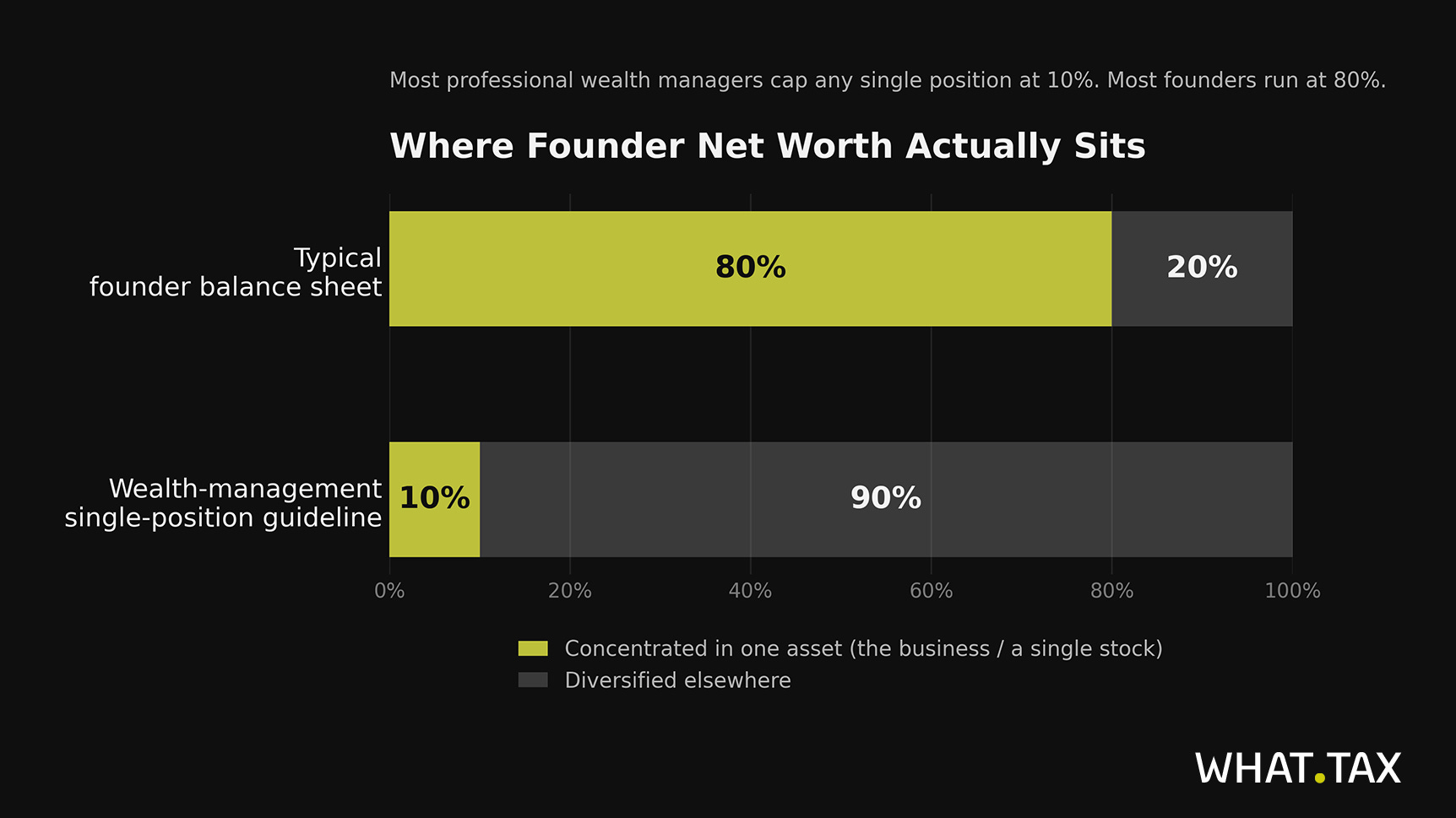
The chart above isn’t a hypothetical. It’s the gap between how founders actually hold their wealth and how any advisor would tell a client to hold it if the asset in question weren’t their own company. Founders get a pass on this concentration because it doesn’t feel like a stock position. It feels like the plan. That framing is exactly the problem.
It gets worse when you look at what happens when founders finally try to convert that concentrated position into liquidity. Only 20% to 30% of businesses that go to market actually sell, according to research cited by Chris Snider, president of the Exit Planning Institute. The other 70% to 80% run out of time, fail buyer diligence, or simply never find a buyer willing to pay what the owner needs to walk away. That means the majority of founders who are counting on “the exit” as their wealth plan are counting on an event that, statistically, is more likely not to happen than to happen, at least not on their terms and timeline.
None of this is an argument against owning a business. It’s an argument against treating the business as if it were also your retirement account, your emergency fund, and your diversified portfolio, all wrapped into one asset that can be wiped out by a single bad year, a single lost client, or a single health scare.
A profitable company gives you three things: income, optionality, and (eventually, maybe) a lump sum. It does not give you liquidity on demand, diversification, or protection from the specific risks unique to your business. Customer concentration, key-person dependency, sector cyclicality, regulatory exposure: these are risks a diversified portfolio doesn’t carry, and they’re risks your business carries every single day whether you’re thinking about them or not.
There’s also a valuation problem founders consistently underestimate. The number you have in your head for what your business is worth is almost never the number a buyer will actually pay. Multiples compress for a hundred reasons: too much revenue concentrated in one or two clients, too much of the operation running through the founder’s personal relationships, financials that don’t hold up under a quality-of-earnings review, a market that’s cooled since you last checked comparable sale prices. The business you’ve been building your entire net worth around has a market value that is, in practice, a range you won’t know until you’re inside a transaction, and the low end of that range is usually where the deal actually lands.
This is the part that separates founders who build real wealth from those who build a large, illiquid balance-sheet entry. The ones who build real wealth stop treating the eventual sale as the wealth plan and start treating it as a bonus on top of a wealth plan that already exists independently of the business.
Wealth, in the sense that matters here, has three properties the business itself doesn’t have. It’s diversified, meaning no single event can wipe it out. It’s liquid over a reasonable time horizon, meaning you can access it without needing a buyer, a bank, or a favorable market cycle. And it compounds independently, meaning it grows whether or not you show up to the office tomorrow.
Cash in a checking account technically satisfies the liquidity test and fails the compounding one. A concentrated stock position in your own company satisfies neither. The asset classes that actually check all three boxes, when structured correctly, are the ones that should be absorbing a growing share of every dollar you pull out of the business as profit, not just whatever happens to be left over after payroll, taxes, and the next growth initiative.
There isn’t one correct vehicle. There’s a stack, and which pieces matter most to you depends on your entity structure, your exit timeline, and how much of your net worth is already outside the business.
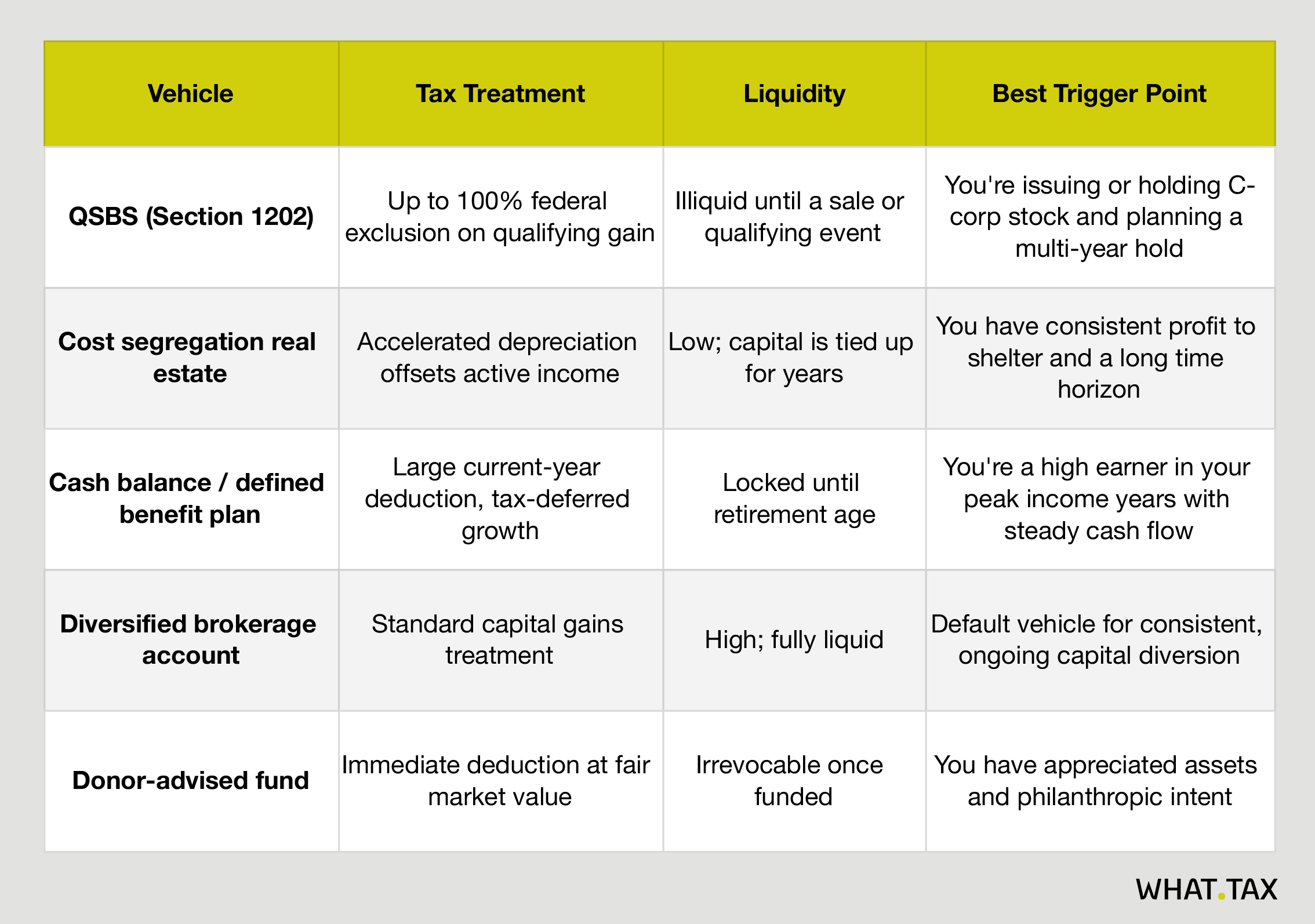
Two of these deserve more attention than a table row can give them, so let’s take them one at a time.
If your company is a C corporation, or could reasonably become one, Section 1202 Qualified Small Business Stock treatment is arguably the single most powerful founder-specific tax provision in the code. The One Big Beautiful Bill Act, signed July 4, 2025, made it substantially better for stock issued after that date.
Under the current rules, the per-issuer gain exclusion cap rose from $10 million to $15 million, with inflation indexing starting in 2027. The company-level eligibility threshold, the aggregate gross assets test, rose from $50 million to $75 million, meaning a meaningfully larger set of growth-stage companies can now issue qualifying stock without being disqualified on size alone. And the holding period, which used to be an all-or-nothing five-year cliff, is now tiered: 50% exclusion at three years, 75% at four years, and the full 100% exclusion at five years or more.
Run the full exclusion on a $10 million exit and the math is almost uncomfortable to say out loud: zero federal capital gains tax on the entire gain, assuming you meet the qualified trade or business requirements, the five-year hold, and the gross assets test at issuance. That’s not a deduction. That’s income the federal government has agreed, by statute, not to tax at all.
The requirements are specific enough that this deserves its own dedicated breakdown rather than a paragraph here, including which industries qualify, how the gross assets test actually gets measured, and what happens if you sell early and want to use a Section 1045 rollover to preserve your holding period. That’s coming in a future issue. For now, the takeaway is simple: if you’re operating as an S-corp or an LLC purely out of habit, and you’re planning a multi-year hold before a sale, it’s worth finding out what QSBS eligibility would actually be worth to you.
This is the least exciting line in the table and the one that matters most for most founders, because it’s the only vehicle that’s fully liquid, fully diversified, and available to literally everyone regardless of entity structure or income level. QSBS and cost segregation both require specific structural conditions to apply. A brokerage account requires a decision to fund it, consistently, on a schedule, regardless of how the business is performing that quarter.
The single biggest determinant of how much outside wealth a founder ends up with isn’t the return they earn. It’s the year they started. Founders routinely delay building an outside portfolio because “there’s nothing left over right now” or “it makes more sense to reinvest in the business at this stage.” Sometimes that’s true. Often, it’s a story that gets repeated for five or ten years after it was actually accurate.
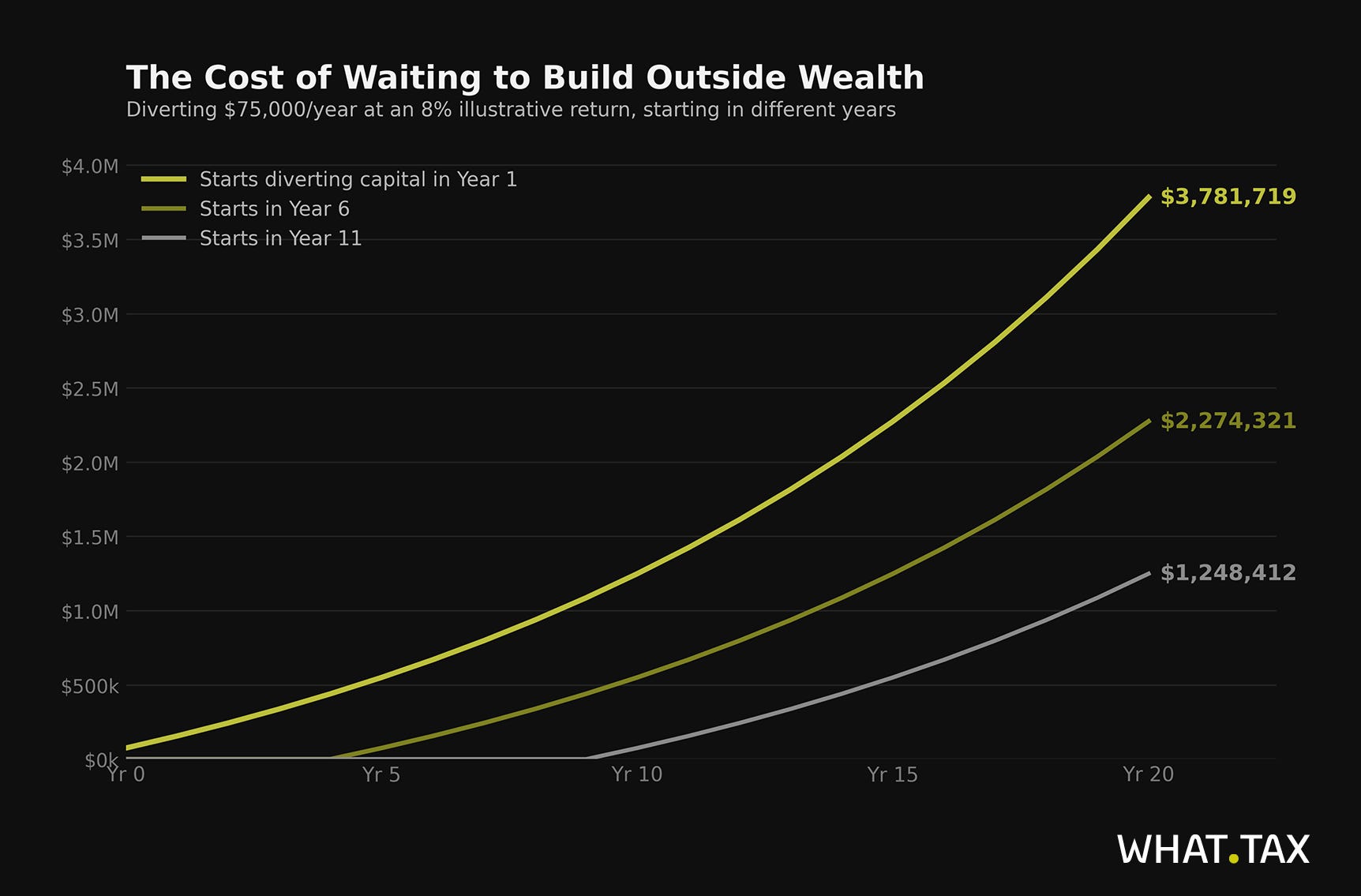
That gap between the three lines isn’t driven by contribution amount. All three scenarios divert the same $75,000 a year. It’s driven entirely by time in the market and the number of compounding cycles that money gets to go through before you need it. A founder who starts diverting capital in year one ends up with roughly three times the outside wealth of a founder who waits until year eleven, using identical annual contributions and the same illustrative 8% return. The delay doesn’t cost you the money you didn’t save during those years. It costs you every year of compounding that money would have gone through afterward.
This is the actual argument for starting before you feel “ready” or “rich enough.” The dollar amount you start with matters far less than the decision to start the mechanism at all.
The honest answer is that there’s no universal percentage that applies to every business, but there is a decision rule that works better than the one most founders default to, which is diverting whatever happens to be sitting in the account at the end of the quarter.
Set a fixed percentage of owner distributions, not revenue, that moves out of the business and into outside assets every time you pay yourself. Somewhere in the range most financial planners recommend for high earners, roughly 15% to 25% of distributed owner income, is a reasonable starting range depending on your age, existing outside assets, and how aggressive your growth reinvestment needs currently are. The number matters less than the mechanism: automatic, scheduled, and treated with the same non-negotiable priority as payroll or tax payments, not as a leftover.
The trigger point most founders wait for, “once the business is more stable,” is usually the wrong one, because businesses rarely feel stable to the person running them. A better trigger is structural: once you’re covering true baseline personal expenses from owner comp and the business is holding close to three to six months of operating expenses in reserve, the next dollar of distributed profit is a candidate for outside diversification rather than automatic reinvestment.
The founders who end up wealthy, not just successful, aren’t the ones who built the biggest business. They’re the ones who, at some point, stopped treating the business as the entirety of their financial life and started treating it as one asset among several. The business kept growing. It just stopped being the whole balance sheet.
That’s the switch this piece is named after. It doesn’t require selling anything, taking money off the table in a way that slows growth, or abandoning reinvestment. It requires a decision, made deliberately instead of by default, about which dollars build the company and which dollars build a version of your net worth that would survive the company having the worst year of its life.
Most founders make that decision by accident, usually after a scare. The ones who make it on purpose, years earlier, are the ones this newsletter is written for.
This article is for educational purposes and doesn’t constitute tax or legal advice. Run your specific numbers past a qualified CPA before filing anything.
The free edition covers the strategic framing.
The Premium Newsletter is where it gets specific: the exact QSBS qualification checklist, how to structure a cash balance plan alongside an S-corp, and the cost segregation math that turns real estate into an active-income tax shelter. If you’re past the point of needing to know these tools exist and ready for the mechanics, that’s where the paid issues live.
No posts
Comments
Nothing yet. Say the first thing.
Sign in to join the conversation.