

Every founder eventually has the same conversation with their CPA. It usually starts with a number: what the business might sell for. It usually ends with a smaller number: what actually lands in the bank account after the IRS takes its cut.
On a long-term capital gain today, the federal government takes 20% in capital gains tax plus another 3.8% in Net Investment Income Tax, a combined 23.8%, before your state takes its own bite. In California, that pushes the total north of 36%. On an $8 million exit, that is roughly $2.9 million to the IRS alone, gone the moment the wire clears.
Most owners accept this as the cost of doing business. They shouldn’t.
There is a provision in the tax code, over forty years old, that lets you sell some or all of your company, defer the entire capital gains bill, potentially erase it forever, and stay in the CEO chair the next morning. It is not a loophole. It is not aggressive. It is written into Internal Revenue Code Section 1042, and it was built specifically for owners like the people reading this newsletter: private, profitable, and not interested in handing their life’s work to a private equity shop just to get liquid.
The strategy is a sale to an Employee Stock Ownership Plan, paired with what’s called a 1042 election. A few numbers to size the field:
Roughly 6,411 U.S. companies currently sponsor an ESOP
Together they cover 15.1 million participants
They hold more than $2.1 trillion in combined assets
About 270 new ESOPs form every year
(Figures via the National Center for Employee Ownership.) That’s not a fringe tactic. It’s a mainstream succession tool that most business owners have simply never had explained to them properly, because the advisors who sell M&A deals make their fee on a sale to a third party, not a sale to your own employees.
That last point is worth sitting with. An investment banker running your sale process gets paid on transaction value, usually a percentage of the deal, regardless of what you keep after tax. A wealth manager gets paid on assets under management once your proceeds land with them.
Neither one has a strong financial incentive to steer you toward a structure that might mean a smaller headline sale price but a dramatically larger after-tax outcome. This is why the strategy stays underused. The people most owners default to for exit advice usually aren’t the people who specialize in it.
Run the math before you get attached to any exit path. Say your business has appreciated to the point where you’re sitting on a $10 million long-term capital gain, whether from a straight asset sale, a stock sale, or a recapitalization.
Sell it the conventional way, to a strategic acquirer or a private equity buyer, and the federal government takes its 23.8% off the top before you ever get to reinvest a dollar of it. That’s not a rounding error. It’s the difference between funding a real second act and funding a smaller one.
The chart below shows what happens to that same $10 million gain under three different paths: a conventional taxable sale, a sale to an ESOP with the gain deferred under Section 1042, and a 1042 sale where the seller holds the replacement investment until death.
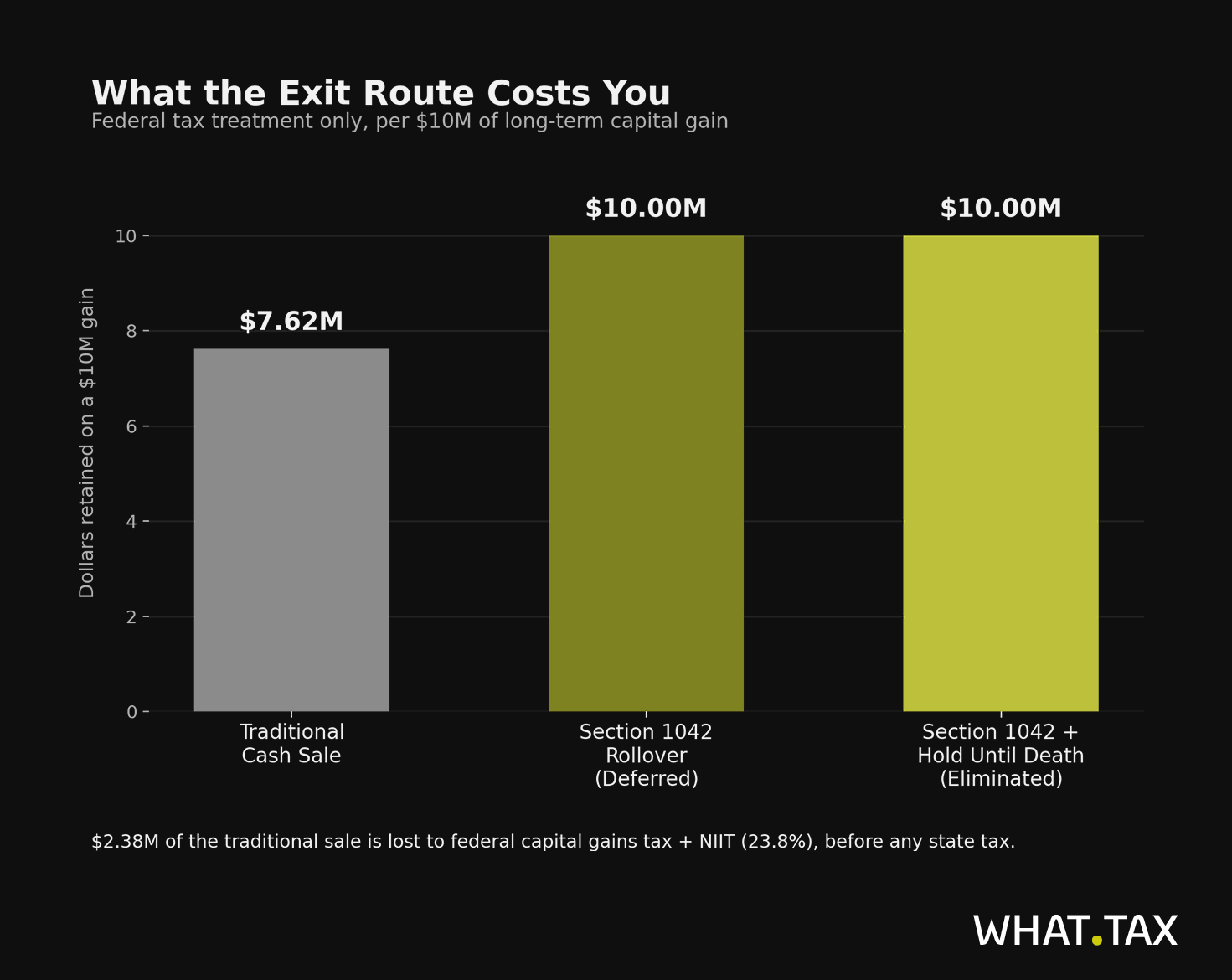
That gap between $7.62 million and $10 million isn’t a projection or a best-case scenario. It’s the mechanical result of one election, made correctly, on the day you sign the purchase agreement.
And it compounds. The $2.38 million lost to federal tax in a conventional sale isn’t just gone; it’s money that would otherwise have kept working. Reinvested at even a modest return, that gap widens every year you hold the alternative asset instead of the tax bill. Owners who run a straight cash sale almost never model this properly, because their advisors are pricing the deal itself, not the twenty years of compounding that follow it.
Section 1042 dates back to 1984, championed largely by Senator Russell Long, who spent much of his career trying to broaden employee ownership in America.
The idea was straightforward: if a business owner sells enough of the company to the workforce through an ESOP, the government will let that owner defer the capital gains tax on the sale, so long as the proceeds get reinvested into other American businesses rather than pulled out of the economy entirely.
That’s the whole philosophical bargain. You’re not avoiding tax through a technicality. You’re trading a check to the IRS for continued investment in productive U.S. companies, and in exchange, the government lets the clock on your tax bill stop, sometimes permanently.
It also solves a second problem that has nothing to do with tax rates: succession. Most privately held businesses in this country don’t have an obvious buyer waiting in the wings. Selling to a competitor risks your team and your culture. Selling to private equity usually means a leveraged recapitalization, aggressive cost-cutting, and a management team answering to a new board within the year.
An ESOP sidesteps both problems at once. The buyer is already inside the building, the transition doesn’t require finding a stranger willing to write a check, and the incentive structure for the workforce actually improves the moment the deal closes, since employees now hold a direct stake in the company’s performance.
Here’s what’s different about this exit compared to selling to a strategic buyer or a PE fund: you don’t have to leave. An ESOP is a retirement trust that buys your shares; it isn’t a new management team walking in the door. Plenty of founders who sell 30%, 60%, or 100% of their stock to an ESOP keep their office, their title, and their daily authority over the business.
Most owners hear “sell to an ESOP” and picture something closer to a co-op, employees voting on the paint color and the parking policy. That’s not what happens. The trust structure, the fiduciary rules, and the way voting rights actually work are specifically designed to leave day-to-day authority exactly where it already sits. Clearing up that confusion is the first thing worth doing before you evaluate whether this fits your situation.
What paid subscribers get in the rest of this issue: the full eligibility checklist for a 1042 election, exactly how the reinvestment mechanics work (including the “swap till you drop” move that can erase the tax bill entirely), why you keep operational control after the sale, the guardrails the IRS uses to stop people from gaming the rule, the 2028 rule change that finally opens a version of this to S-corps, and a side-by-side table comparing this strategy against a traditional sale and a QSBS exit.
Comments
Nothing yet. Say the first thing.
Sign in to join the conversation.