
Everything in BPM becomes easier, almost effortless, when the underlying organizational structures are aligned with Strategy. And yet, this is exactly where many organizations struggle.
They invest in tooling, define processes, but overlook the basic wiring of how the organization actually operates. If that wiring is off, no methodology or platform will compensate.
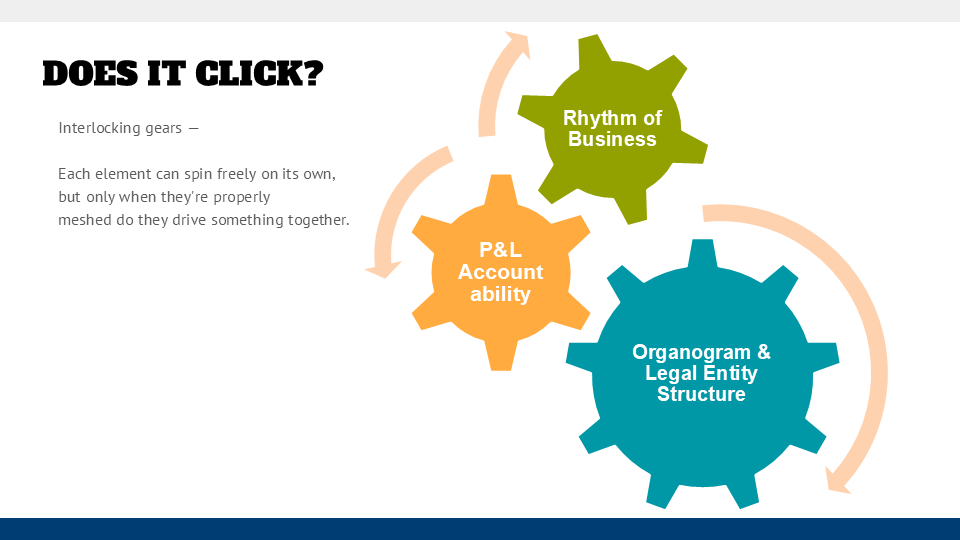
While writing this, I realized that I subconsciously think of a Dutch handheld puzzle toy from the ’80s: “Does it click?/ “Klikt Het?”
It consisted of two, rounded plastic halves. You’d rotate them, testing different positions, and when everything lined up just right…you got that satisfying click.
And that’s what it should feel like in an organization too.
(I know—it’s a cheesy analogy. But that’s how my brain works.)
When structures, responsibilities, and rhythms align, you don’t need endless layers of governance to tell you something is working. You feel it. Things fall into place. Decisions flow. Ownership is clear.
👉 It just clicks.
Assuming there is a clear defined Strategy, it is important to start with the organization’s organogram and to decide whether to focus primarily on a line or a staff organization.
Most modern companies adopt a line-and-staff structure, combining both elements:
Line managers are responsible for running operations and delivering results
Staff specialists provide expertise, guidance, and support
From my perspective, during periods of rapid growth or transformation, a line-focused structure tends to dominate. This approach helps optimize the value chain and enables strong execution, often with a sharp focus on customer intimacy.
In contrast, when an organization is in a more stable or mature phase, it becomes more beneficial to emphasize the staff function. This supports the standardization of processes, increases efficiency, and leverages specialized knowledge across the organization.
Closely linked to this is P&L and business unit accountability. If P&L outcomes are not aligned with how accountability is structured in the organizational model, ownership becomes unclear. As a result, no one fully takes responsibility, making it difficult to truly optimize processes.
For example, if the segmentation of a product portfolio is not aligned with the defined business units and their respective managers, it becomes challenging to hold those managers accountable for actual performance.
Then there is the Rhythm of the Business. Meeting cadences, and decision cycles should align closely with the organization’s core processes.
For example, in a logistics context, there is typically a recurring value chain meeting where operational and tactical issues are reviewed with line management, guided by key value chain KPIs such as the “On Time In Full” (OTIF) ratio.
For organizations undergoing significant transformations, a regular Project Management Office (PMO) meeting is often established to steer progress, align priorities, and ensure effective execution across initiatives.
When the rhythm of the business is disconnected from the underlying value streams, organizations end up managing through fragmented updates rather than integrated performance dialogues.
When designed effectively, process KPIs, operational reviews, and strategic decisions all follow the same cadence, creating a unified and consistent heartbeat across the organization.
Often overlooked, but my personal favourite, legal entity alignment significantly impacts efficiency: keep entities to a minimum and align Business Units with the legal structure to avoid complex intercompany flows.
I once had to untangle 200 entities for a carve-out. It was nearly impossible due to lack of logic; more entities simply mean more complexity and a heavier finance function.
Many organizations look well-designed on paper: processes are mapped, roles are defined, and KPIs are set; theoretical alignment,. But true alignment only exists when structure, ownership, and ways of working match how value actually flows, resulting in clearer accountability, fewer escalations, faster decisions, and ultimately less effort with more flow.
So be sure to make it “Click” and the rest will follow!
No posts
Comments
Nothing yet. Say the first thing.
Sign in to join the conversation.