
Hello from 8 weeks postpartum. I am so fucking exhausted I could cry, except that would take energy I don’t have. So, while I try to figure out if people are interested in day-in-my-life or night-in-my-life or postpartum ramblings, let’s get into a great story I wrote for Yahoo about the most toxic debate in parenting. And if you have any words of encouragement for an 8-week pp mom, plz leave them below because ya girl is struggling.
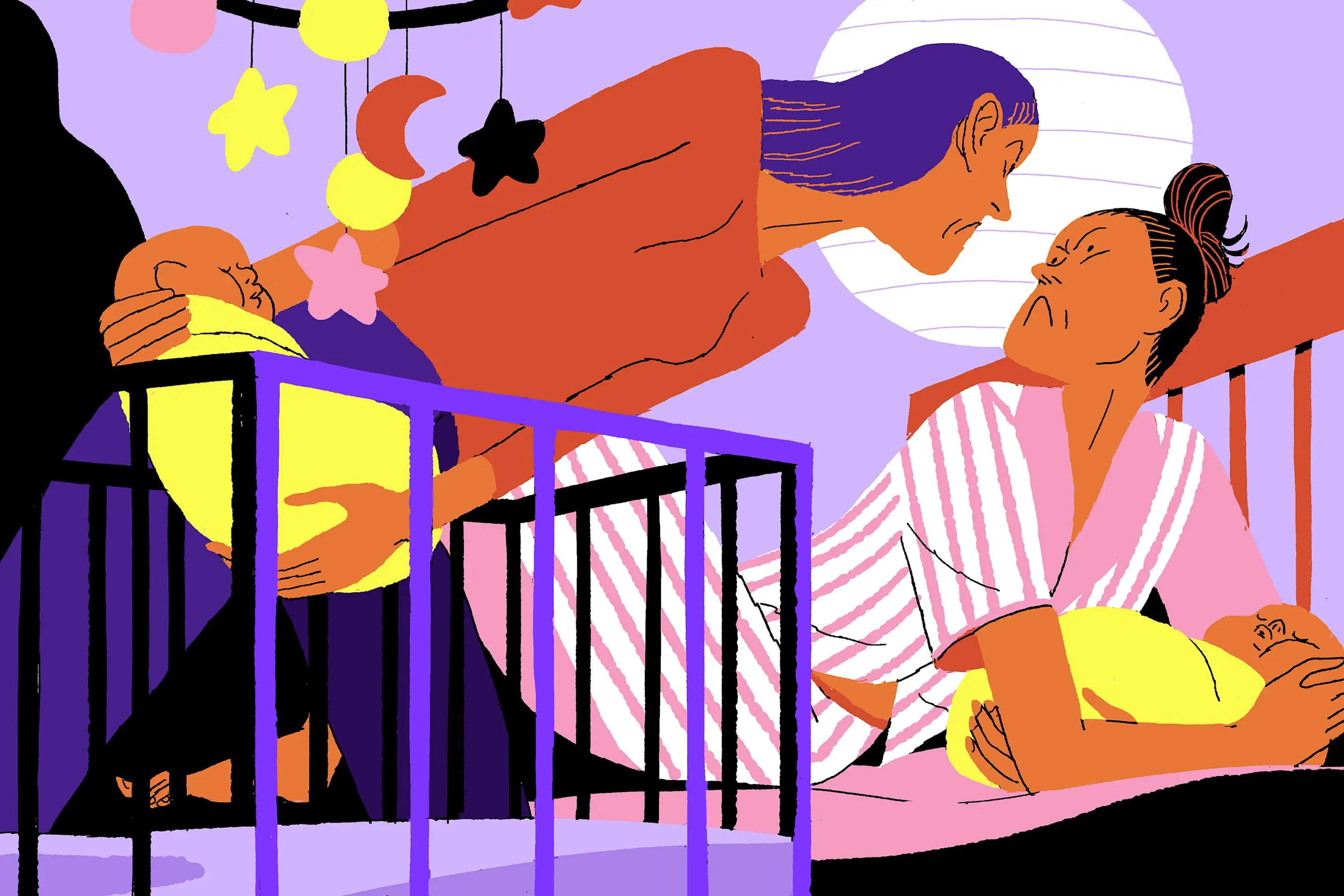
As the wife of an NFL player, Haley Williams Pepper often found herself parenting alone when she became a mother in the summer of 2022. It didn’t help that her daughter wasn’t sleeping that well, meaning 32-year-old Pepper herself wasn’t getting much rest. As the months went by, she became more exhausted and more burnt out, eventually culminating in diagnoses of postpartum psychosis and postpartum obsessive-compulsive disorder.
When Pepper had her second child a few years later, she decided to make some changes to her parenting strategy, including sleep training her son. Her postpartum mental health was markedly improved, a difference she considers to be directly related to sleep training.
When Pepper posts on social media about her experience with sleep training, she gets plenty of backlash from other moms who accuse her of being selfish. The logic goes something like this: You chose to be a mother and being a mother means you don’t get to sleep, possibly for a few years. “It’s supposed to be hard and it’s supposed to be grueling,” Pepper said, summing up the criticism. “If you’re doing something for yourself to make it not hard or grueling, well, you’re not a good mom. You’re choosing yourself over your kids.”
One of the hottest debates in motherhood right now revolves around how your baby will get through the night. In one camp are the sleep trainers, who swear by a structured process of teaching your infant to fall asleep on their own and training them to sleep for longer periods of time in their own cribs. On the other hand, there are those who see sleep training as comparable to a form of torture for babies, whose needs are being disregarded for reasons ranging from callousness to incompetence.
Search “sleep training” on any social media website and you’ll turn up a torrent of virulent defenses and accusations. Among the defenses: Sleep training helps a child sleep better, it’s good for a mother’s mental health and it has been shown to have no effect on parent-child attachment. Among the accusations: There isn’t enough long-term data to know for sure that sleep training isn’t harmful, you’re selfish if you choose to sleep train your child and you are doing irreparable harm to their nervous system.
“Sleep training is insane!!! I can not believe how people let babies cry ON PURPOSE 😭😭,” reads one comment under a video from a mom giving a 5-step tutorial on how she got her own children to sleep through the night. “Why have a baby if you can’t meet their basic needs at literally 4 months,” reads another on a video engineered to troll critics, of a mother getting into bed with her red-light mask at 7:30 pm because of sleep training. Alongside the negative remarks are dozens of comments asking for help and advice.
Behind all the recriminations seems to be a simmering anxiety about what modern motherhood requires. In an era of intensive parenting, the rise of tradwives and no shortage of Instagram-appointed experts, sleep training has become a proxy war over how a “good mother” should be. Is she endlessly self-sacrificing and nurturing? Or is she allowed to consider her own sanity and well-being in undertaking the Herculean task of taking care of an infant? Caught in the middle are exhausted new parents trying to forge a path forward and make the best decision for their own families.
Sleep training’s association with harsh parenting tactics goes all the way to its origins. One of the first major medical figures to act as a proponent was Dr. Luther Emmett Holt, who published The Care and Feeding of Children: A Catechism for the Use of Mothers and Children’s Nurses in 1894. It was Dr. Holt’s view that babies sometimes cry out of “temper, habit, or to be indulged.” In his seminal text, Holt wrote that a baby “should simply be allowed to ‘cry it out’. This often requires an hour, and in extreme cases, two or three hours. A second struggle will seldom last more than 10 or 15 minutes, and this will rarely be necessary.”
A few decades later, famous psychologists of the time, like behaviorist John Watson, were urging parents away from affection and also advocates of letting children cry it out. In his 1928 book Psychological Care of Infant and Child, Watson wrote, “If he howls, let him howl. A week of this regime will give you an orderly bedtime.” Watson believed that an overly affectionate parent would create a needy child.
Such harsh attitudes toward child-rearing slowly went out of fashion in the second half of the 20th century. Nonetheless, sleep training itself remained popular in many parts of the world.
One of the reasons sleep training is so hotly debated is because there is no accepted definition. Generally, it refers to any process that helps a baby learn to fall asleep on their own and sleep for longer intervals, but underneath that umbrella term there are vastly different approaches. “In the actual research literature, it can mean anything from ‘I implemented a bedtime routine’ to ‘I let my baby scream for hours alone, multiple nights in a row,’” says Elena Bridgers, a science writer who publishes the Substack Motherhood Until Yesterday. “Those are very, very different things.”
There is the cry-it-out or “extinction” method of sleep training, which entails putting your baby to bed and letting them cry until they fall asleep, even if it takes hours. Other parents turn to an in-between path, like the Ferber method, which instructs parents to put their child to sleep and check on them at set intervals (like 5, 10, and 15 minutes) if they’re still crying. There’s also the chair method (parents using this protocol sit in a chair in their child’s room until they fall asleep), the fading method (where parents slowly stop whatever they’re doing to get their baby to sleep, like rocking or singing) and the pick-up-put-down method (where parents pick a child up if they are crying, then put them back down and repeat as necessary).
If sleep-deprived parents were hoping that science would clear things up about which approach is best, that’s not exactly the case. Some studies have shown that sleep training results in not only better sleep for the child but also improvements in child and family well-being. Crucially, research has found that sleep training improves maternal mental health, which has a cascade of positive effects both for the child and the family at large. “On average, sleep training improves infant sleep, by which we generally mean the infant is going back to sleep on their own more,” Emily Oster, the bestselling author of Cribsheet: A Data-Driven Guide to Better, More Relaxed Parenting, From Birth to Preschool, told me. “The second thing is, sleep training tends to improve parental sleep and often parental depression.” As for the accusation, often lobbed online, that you’re traumatizing your children? Sleep training has been found to have no negative impact on parent-child attachment, though few longitudinal studies follow sleep-trained infants deep into childhood.
On the other hand, other research has found that sleep training has little, if any, effect on a baby’s sleep. One study found that sleep-trained babies only sleep an average of 16 minutes longer before waking. Yet another revealed that many parents aren’t only sleep training once — caregivers said they had to repeat training between two and five times within a year. Sleep training detractors often say that sleep-trained infants experience higher levels of stress and show elevated levels of the hormone cortisol. “I’m a stress researcher. I frequently see claims on social media that sleep training is toxic and will damage your child’s brain because they’re producing too much cortisol,” says Darby Saxbe, a professor of psychology at the University of Southern California. “There’s no solid cortisol study finding that.”
Still, the evidence — both for and against — around sleep training seems, at best, to be a mixed bag. “The level of intensity in the popular discourse doesn’t really match the quality of the research evidence in either direction,” says Saxbe. Put simply, both sides are cherry-picking evidence to support their claims. In sleep training research, the gold standard of a bulletproof study would be a randomized clinical trial in which parents are assigned to sleep train or not sleep train. That’s nearly impossible to pull off.
Despite the lack of definitive evidence, sleep training is a booming business. One of the most popular sleep training guides, which was created by sleep consultant Cara Dumaplin of Taking Cara Babies, costs $249. Moms on Call offers consultation services ranging in cost from $100 to $1,000. Rachael Shepard-Ohta of Hey, Sleepy Baby offers a “comprehensive package” including 30 days of follow-up text support for $597.
“I would compare [offering sleep training services] to multilevel marketing,” Shepard-Ohta says, “where moms get into it probably because they want to help other moms. And then they realize that they can make a business of it. They can work from home and be home with their own kids. And I’m including myself in this. It also makes it a very scary industry because you don’t know who you’re getting your advice from or what their background is.”
The promise of sleep training courses, guides, and books is that your child is capable of sleeping better and if you spend your money on these resources, you can unlock the key to that potential. With the growing backlash against sleep training, there has been a hydra of anti-sleep training guides that promise to improve infant sleep without crying. “Everyone who is trying to sell something about sleep is, in my opinion, regurgitating what worked for their kid and then delivering it as fact,” said Pepper, who is now also a postpartum doula.
I have some experience with how overwhelming it can all be. When my daughter was around six months old and I was burnt out from constant night wakings, I started reading everything I could about sleep training. I stopped short of buying a sleep training course but I did consult reams of research. I felt good enough about it that my husband and I decided to try a version of the Ferber method. For us, this meant that, after feeding and putting our daughter down for the night, we would go in to check on her at regular intervals, picking her up and rocking her back to sleep if she was crying (strictly speaking, the Ferber method prohibits this but my husband and I couldn’t abide by that).
The first night was, in a word, hell. I cried while my daughter cried. I couldn’t bring myself to follow the rules so I kept shortening the time we were supposed to wait before checking on her.
During those painful early nights, I doubted myself and my husband constantly. I wondered if we were terrible parents. I remembered the anti-sleep training content I had seen online and worried that those people had been right. I texted my mom friends who had successfully sleep-trained their children and begged them for assurance. By the end of three nights, my nerves were frayed and my confidence in myself as a mother was shaken. But on the fourth night, my daughter fell asleep without crying and slept through the night. This time, I could’ve cried with joy. And the next morning, when she woke up, she still reached for me like she always did.
For moms who choose to sleep train, the judgment can be intense. For Natalie, a 29-year-old mother of a 10-month-old, sleep was nonnegotiable. She’s trying to manage an autoimmune disease, the symptoms of which are worsened by too little sleep. Through her disease, she dabbles in “crunchy” corners of the internet, where sleep training is taboo. “I felt most judged by them,” she says. “Other moms see sleep training as cold and regimented [but] it was successful for both baby and me.”
For 46-year-old Julia, who sleep trained her 4-year-old, the judgment was explicit. Once, a friend told Julia’s husband that their daughter only stopped crying “‘because she knows you’re not coming back.’” Julia is able to deal with the judgment through her own recognition that it comes from a place of people trying to validate their own choices.
Megan, a 40-year-old mother of two boys, works as a nurse practitioner while her husband is an emergency room doctor. They don’t have family to lean on where they live and both needed to return to work shortly after she gave birth. The couple used the Moms on Call sleep training method but felt judgment from their own family members. “My sister judged me for the strict schedules with naps and feedings during the day and my mother-in-law did not understand letting babies cry at night to allow them to self-soothe,” she says. “I have been afraid to tell people I used Moms on Call to sleep train because of judgment. For me, it was a personal decision and I think each family needs to decide what they feel most comfortable with.”
Not every mom who tried sleep training would wholeheartedly recommend it. Bridgers, the science writer, is a fascinating case study because she did a “pretty aggressive, cry-it-out, extinction method” of sleep training for her son. “It really goes against your every instinct. It was a really emotionally painful experience for me,” she says. “I always question whether it was the right choice. I can’t help feeling that it wasn’t the right choice. I do feel that experience was somewhat traumatic for me.” Now, she advocates for what she calls safe bed-sharing.
In my eyes, the debate over sleep training boils down to a question we seem to be constantly asking of mothers: Are you willing to give yourself over completely to the task of raising your child or not? “We have to be martyrs,” says Colleen Reichmann, a perinatal therapist. “You have to be entirely giving of yourself and that’s what makes a good mother. You don’t have needs. Your number one [priority] is motherhood and you have to give until you have nothing left to give.”
It’s also perhaps no surprise that sleep training wars are flaring up at a time when tradwives — and the idealized vision of marriage and motherhood they represent — have more cultural weight than ever. The ideal mother in this mode is entirely self-sacrificial. She stays home with her babies and nurtures them with attachment parenting. She nurses them as long as they want to. She doesn’t work outside the home. She doesn’t try to make motherhood easier or more restful for herself by choosing to sleep train.
Working mothers can feel particularly attacked by this logic. The thinking goes: If a mom didn’t have to work, she wouldn’t need to sleep train — as though stay-at-home moms don’t also deserve sleep.
“You are supposed to die for your children,” says Pepper, “God forbid you try to make one thing in your life a little better [by sleep training], then you’re a bad mom, you’re abusing your child, you’re harming your child — when really you’re just trying to survive in this society that you didn’t really ask for. We hate women. It puts the blame on us. And nobody’s yelling at dads for sleep training.”
Meanwhile, co-sleeping, most often defined as sleeping in the same bed as your infant or child, is often situated as diametrically opposed to sleep training. Though this is a common practice in many countries, medical authorities like the AAP and the CDC discourage co-sleeping in order to reduce the risk of sleep-related infant deaths.
What is a parent — and especially a mother — to do? The answer seems to depend on who you ask and which of your neuroses is getting activated as a parent. “I hear people saying [about sleep training], you’re a terrible person and you’re ruining your kid,” Oster says. “I also hear people say, if you choose to co-sleep, you’re being told you’re a terrible person and your baby’s probably going to die. So everybody’s getting judged all the time. We’ve given parents this terrible choice where it’s like, if you co-sleep, your baby will die. If you sleep train, your baby will never form [healthy] adult attachments.”
It feels like co-sleeping parents are on one side of a wrestling ring and sleep training parents are on the other, but everyone is miserable and defensive about their choices. The only answer seems to be the complete martyrdom of the mothers at the center of the debate. “There is this sacrifice that is expected of mothers and people think you should be able to get by without getting adequate sleep,” says Vanessa Hill, a sleep scientist. “But that’s not the case biologically — your brain and your body need that time to rejuvenate and restore and actually work properly. Your brain isn’t going to be working at its best capacity if you’re getting a bad night’s sleep.”
For Colleen Reichmann, the perinatal psychologist, the backlash against sleep training has a very real effect on her patients. “Sleep-deprived mothers are potentially the most vulnerable to really significant, very scary mental health issues. I actually hate when people laugh about sleep deprivation in motherhood — like, ‘we’re all so sleep-deprived’ — because it’s so correlated with depression, anxiety and postpartum psychosis.’”
But, as with so many issues that arise in parenthood, we can’t help but judge each other for our choices, even as we feel judged ourselves.
That’s not a surprise to Bridgers. “Anything that gets at the psychological health of our babies [is so sensitive],” she says. “It’s all of our deepest hopes and dreams and fears, right? It’s getting into our inner psyche. No one who has sleep-trained their child wants to hear that they messed them up in some way. Conversely, people who don’t sleep train, it’s because they often feel very strongly that allowing your child to cry is harmful — because it feels that way.”
Online, you’re on one side or the other — and no matter which side you’re on, you’re being judged. The specifics change, but the message remains the same: You’re doing it wrong. “All the different mommy wars online are just evidence of that — there’s no right choice to make everybody else happy,” says Shepard-Ohta. “It’s like moms really can’t win.”
What delving so deep into the world of sleep training has revealed to me is how little room we leave for moms to be people in their own right, to make imperfect decisions without being cast as selfish or negligent. The science, for all its ambiguity, offers at least one clear takeaway: There is no single right way to do this. And yet the cultural pressure to find one (and defend it at all costs) is relentless. I wonder how much less agonizing these decisions would be if we could let go of that pressure.
If you’re interested in more of my work about family vlogging and mom influencers, give these pieces a read –
the new litmus test for parenting: what you share (and hide) online
influencers are selling a delusional fantasy of being postpartum. why is it so easy to believe?
I figured out why there are so many Mormon influencers
influencer kids are having babies and not showing their faces online
If you’re interested in more of my postpartum ramblings, you can find them here:
night in my life with a 5-week-old
day in my life 10 days postpartum
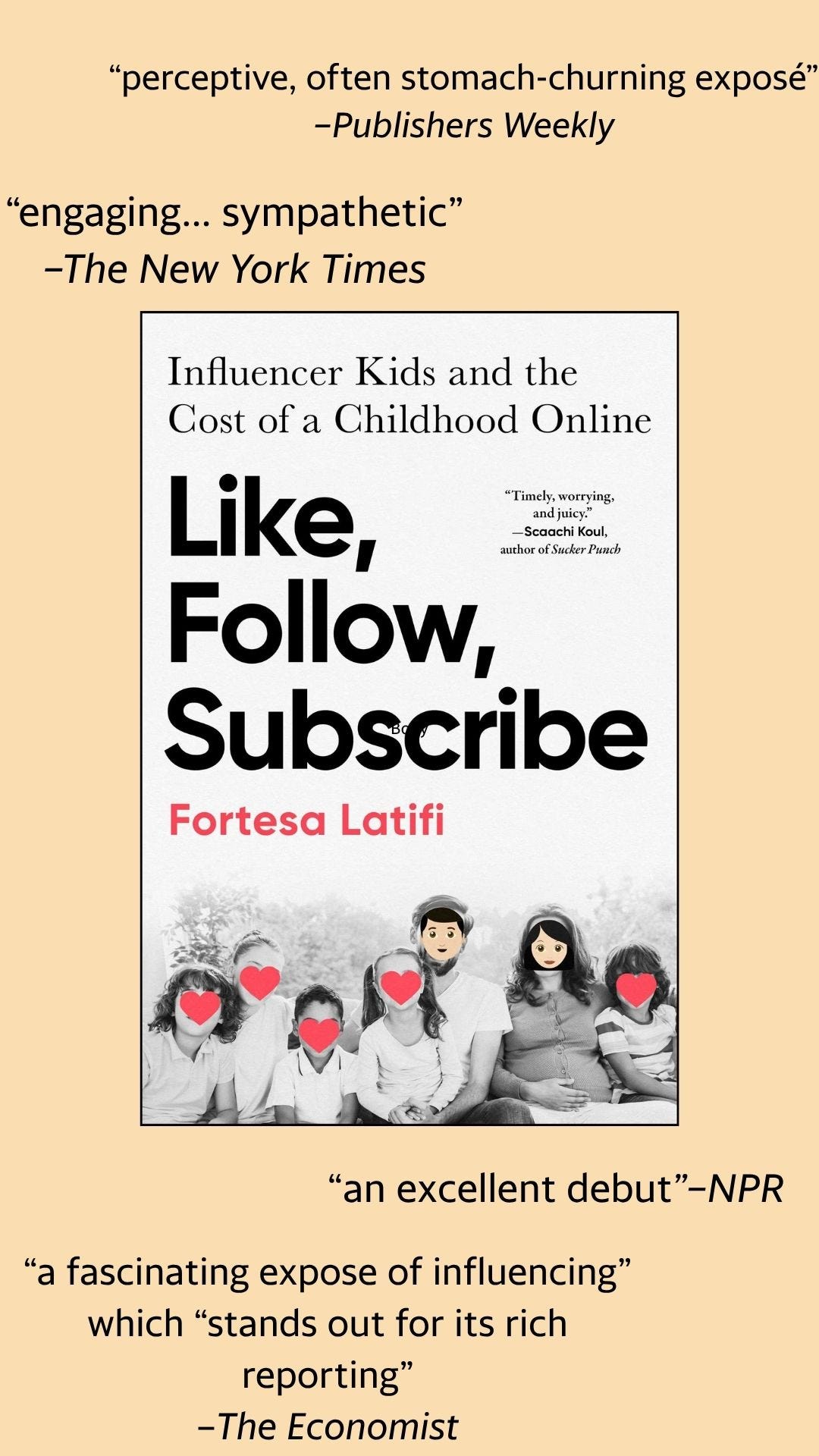
While you’re here, here is the reminder I have to give every single time I write anything because I spent the last 2.5 years pouring my blood sweat and tears into this book – you can get my new book, which has been called a “stomach-wrenching exposé” into mom influencers, family vloggers, and child influencers – Like, Follow, Subscribe: Influencer Kids and the Cost of a Childhood Online – at: Amazon, Barnes & Noble, Books-A-Million, Bookshop, Hudson Booksellers, Target, Walmart and more.
No posts
Comments
Nothing yet. Say the first thing.
Sign in to join the conversation.