
Into the Forest: Folktales at DEFA is available now through Eureka Entertainment.
The East German state-owned film production company, Deutsche Film-Aktiengesellschaft (DEFA), grew out of post-war Europe, with a clear socialist slant. Reading Sebastian Heiduschke’s essay for Eureka Entertainment, it’s clear that the Soviet powers saw film as a vital part of its propaganda. The company’s Märchenfilm, or folk tale, productions would have budgets of up to 2.5 million marks and would attract a host of famous and up-and-coming actors.
It’s easy to see why folk and fairytales would appeal to a communist and later socialist regime. Ideologically, fairytales align with the idealised versions of communism. Greed is frowned upon, and those attempting to amass wealth for their own benefit normally meet misfortune. Kindness and helping others are promoted heavily, as is hard work and perseverance. If these things were not always present in the real-world regimes of socialist and communist governments, they could at least be portrayed on the big screen.
Eureka Entertainment has now released the first of two boxsets collecting some of the most famous examples of DEFA’s Märchenfilm catalogue. The five films collected here have been restored and upscaled to 1080p by the DEFA Foundation, giving these technicolour wonders a fresh lick of paint.
It also gives viewers a new perspective on the films. Bob Fischer explains in his featurette, Fairytales and Nightmares, that The Singing Ringing Tree (Das singende, klingende Bäumchen) would have been seen by many in black and white when it was licensed and cut up by the BBC in the 1960s. For those with fond memories of that broadcast, this presentation is a wonder.
It makes sense to start with The Singing Ringing Tree as it’s the most famous film in the collection outside of mainland Europe. Directed by Francesco Stefani, working from a script co-written with Anne Geelhaar, it is a loose adaptation of a fairytale of the same name, and the Grimm tale The Dwarf, the Fox and the Princess.
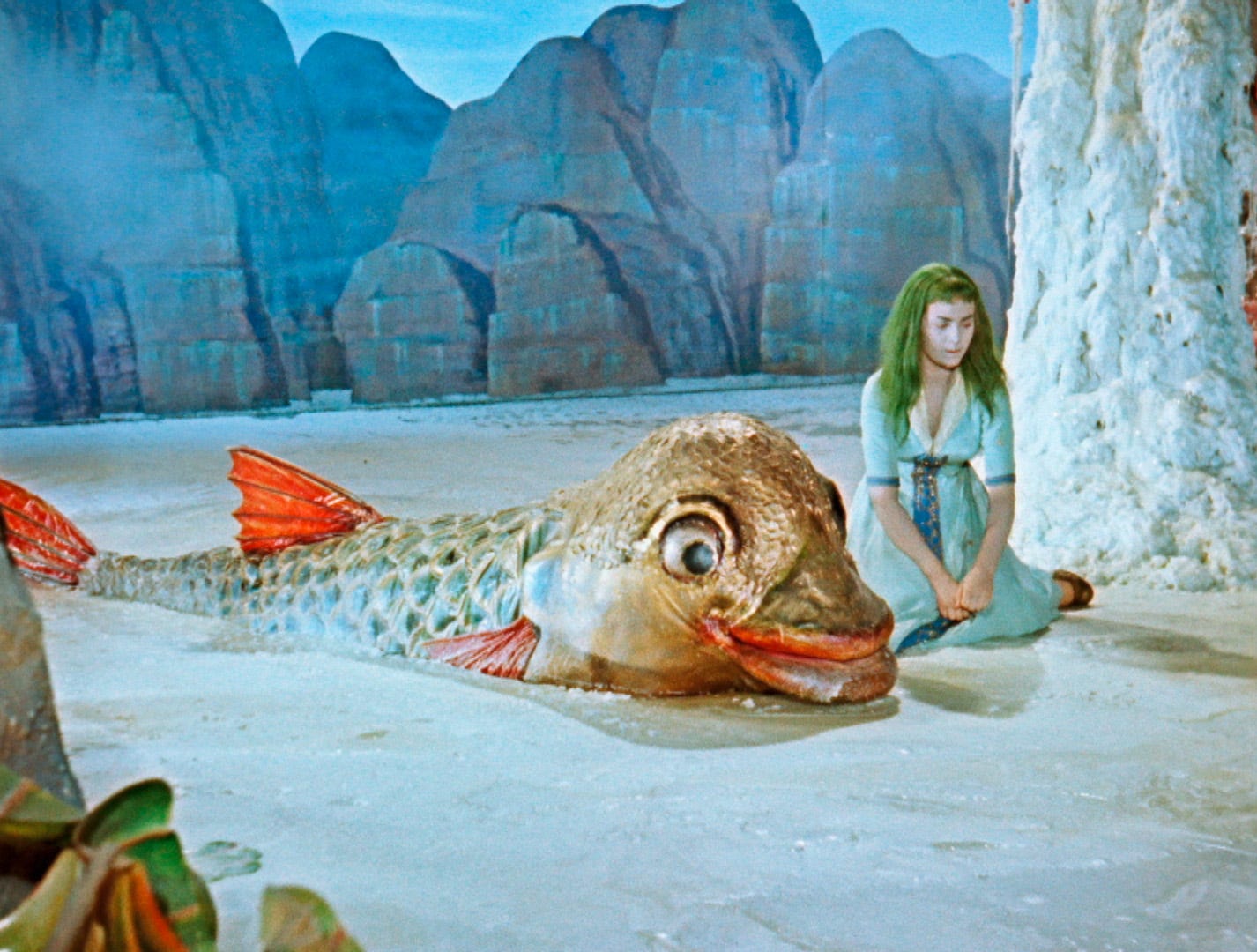
Erich Zandor handles the production design, creating a wondrous world of bright, painted backdrops, against which the characters and various creatures learn about the importance of inner beauty. Christel Bodenstein plays a spoiled, demanding princess who insists that her suitor, Eckart Dux, bring her the titular tree before she will consider his proposal.
When he finds the tree, there is a catch, explained by a trickster dwarf (Richard Krüger). From here, the film escalates into a series of transformations. The prince, for his hubris, is transformed into a bear; the princess, into a supposed ‘ugly’ version of herself – the fact that her transformed form isn’t ugly in the slightest, working in the film’s favour as it shows her to be obsessed with only minor parts of her appearance.
It’s a fascinating film. Ahead of its time – it predates some of the UK’s most disturbing television content by over a decade – the film is less scary to modern eyes, but still unsettling. The strange atmosphere, the fakery of the backdrops, and the animal design give it a unique feel that still translates today. For those who want to relive those BBC broadcasts, Eureka has also included the UK soundtrack, which retains the German dialogue but adds an English language voiceover by Tony Bilbow.
Sticking with the tricksy helpers with more malevolent intent, Rumpelstiltskin (Das Zaubermännchen) is directed by Christoph Engel and written by Gudrun Deubener, Margot Beichler and Günter Kaltofen. It’s a fairly faithful retelling of the fairy tale, and again uses the studio space to the maximum, with some incredible set design and rudimentary effects.
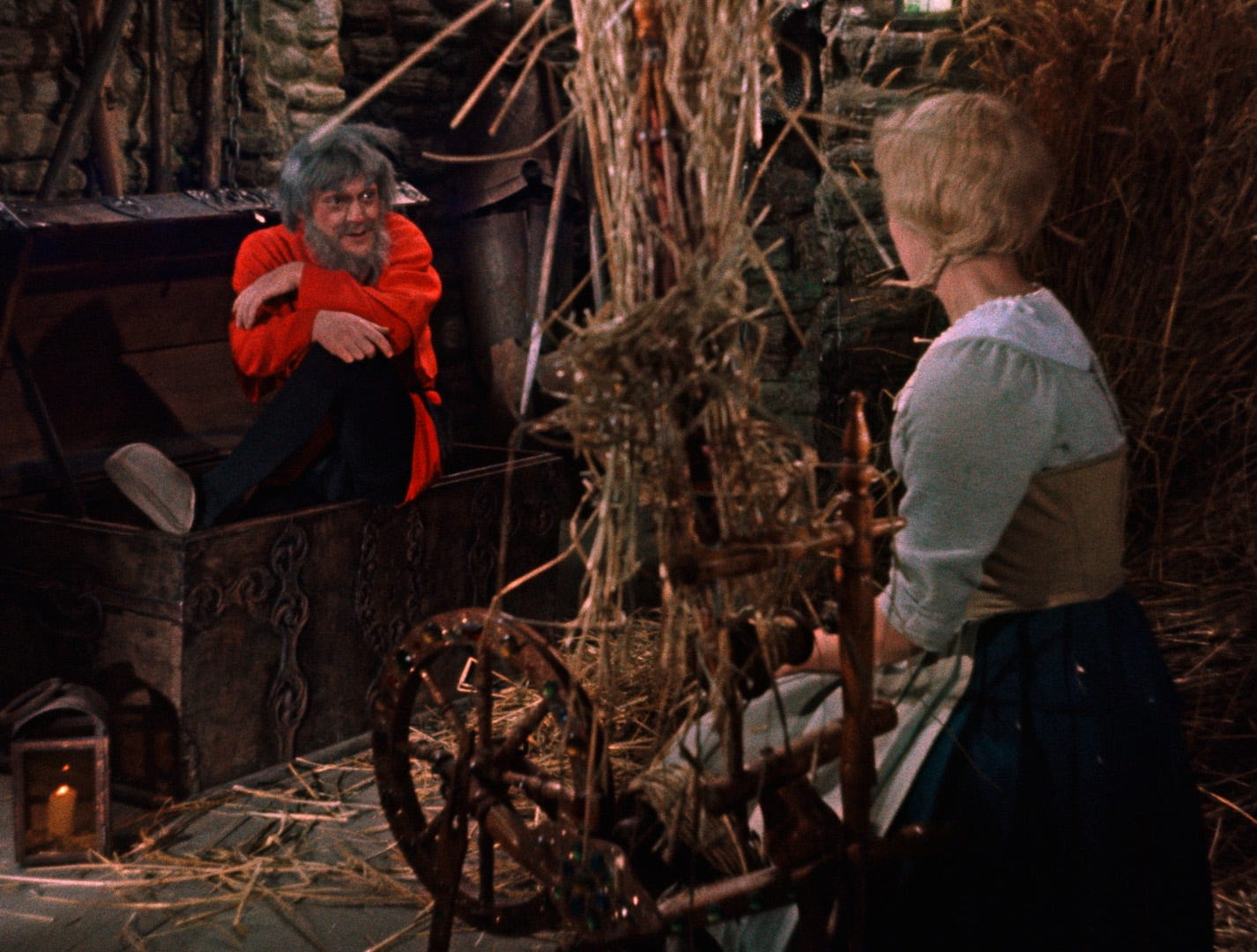
Siegfried Seibt toes the line between humorous and frightening as Rumpelstiltskin, while Karin Lesch is excellent as the miller’s daughter forced to weave gold from straw. You can see some of the necessary changes to meet the ideology, although they do not impact the story particularly.
The miller (Karl-Heinz Rothin) is still brought down by his greed, and is a comedically useless character throughout, but instead of discovering the name Rumpelstiltskin herself, the daughter enlists the entire town for help, slotting neatly into the community spirit that socialism demands.
Another highlight is The Devil’s Three Golden Hairs (Wer reißt denn gleich vor’m Teufel aus), written and directed by Egon Schlegel. It has a convoluted beginning, but once it focuses in on the task of Jakob (Hans-Joachim Frank), who must collect three golden hairs from the devil so he can marry the princess (Katrin Martin), the film becomes a very funny delight.
PENDA’S FEN
·
October 31, 2025
Spoilers for Penda’s Fen (1974). Trigger warning for brief discussions of bigotry.
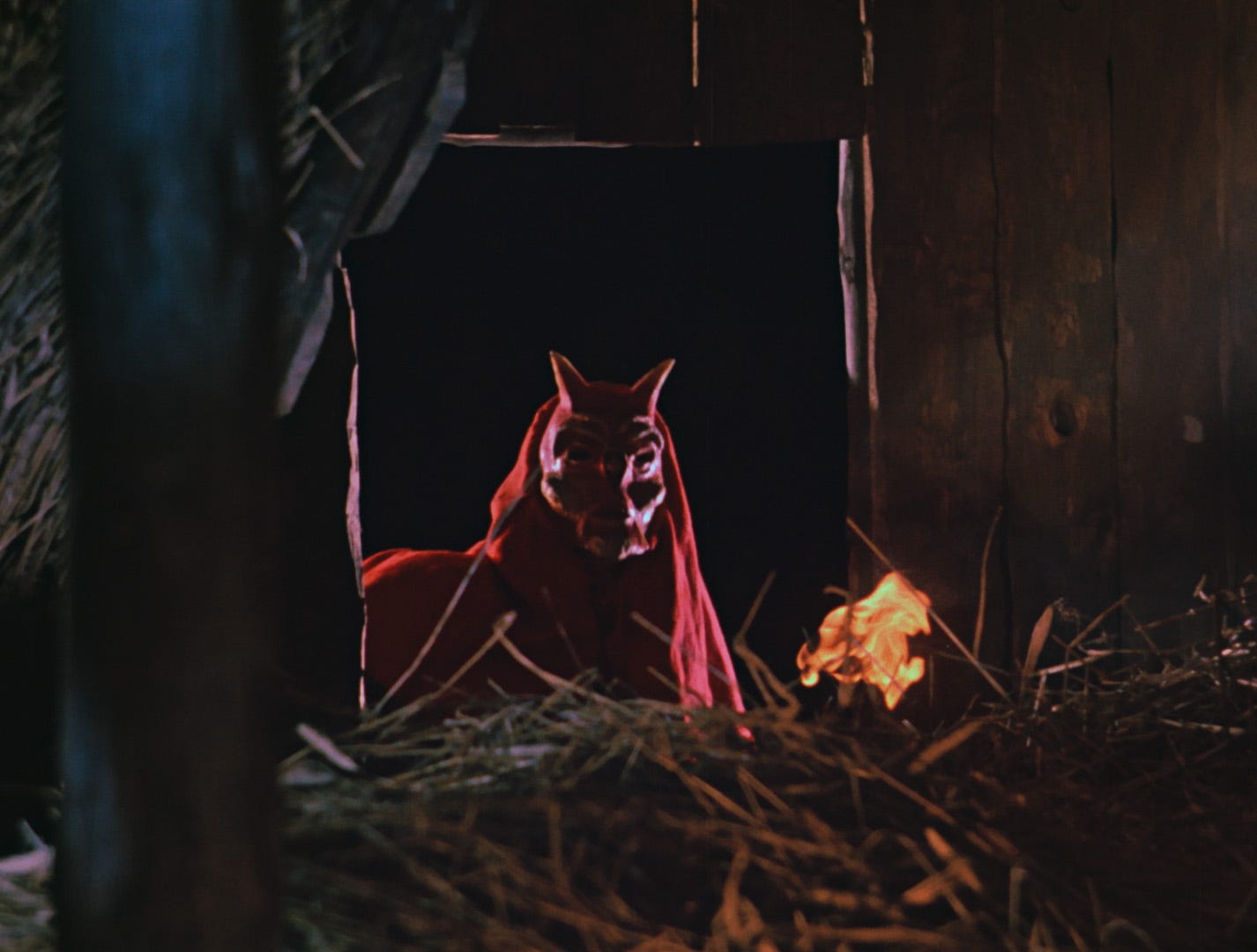
Dieter Franke is a joy as the devil, shown to be equal parts terrifying and ineffective. There’s a camp energy to the performance, which fits as it is the ruling class who are shown to be the real villains throughout. This is all backed up by a set design that matches The Singing Ringing Tree, put together by Georg Kranz.
The Devil from Mill Mountain (Der Teufel vom Mühlenberg) is the most clearly political film in the set. While the other films highlight the existing moral lessons of fairytales, this is a very grounded story, with its later supernatural flairs feeling tacked on. Directed by Herbert Ballmann, it follows a greedy miller (Willy A. Kleinau) and steward (Gerhard Frei) who collude to burn down the farmers’ mill and force them to pay to use his services.
The film has a much darker tone, including allusions to sexual assault and torture, and there are some deeply unsettling moments. However, it’s a much slower and less visually impressive film. Barring the introduction of the forest spirits at the midway point, this feels like it could have been dropped into almost any genre and ends up feeling slightly out of place here.
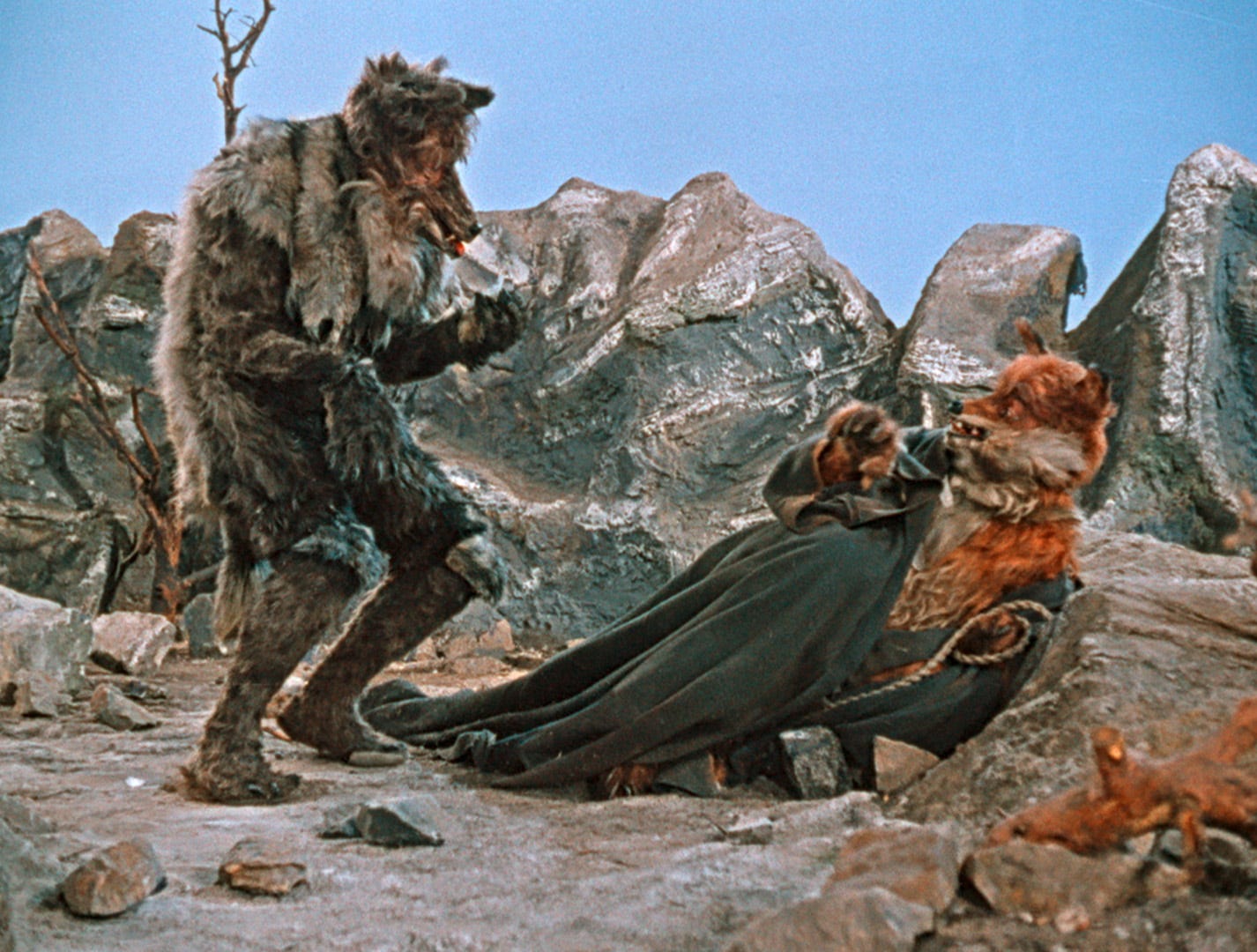
Götz Friedrich’s adaptation of Little Red Riding Hood (Rotkäppchen) is better. Taking as much from the stage play as the original fairytale, which allows the use of additional characters including the bunny, the bear and the fox. Still, the bulk of the film is faithful to the main tale.
The highlight, however, is the interactions between the wolf (Werner Dissel) and the fox (Harald Engelmann). Both are put into spectacular, if horrendously uncomfortable, costumes and have a wonderfully funny, bickering relationship.
The five films collected here make for a wonderful time capsule. Each has a unique and stunning style, built around the impressive sets and costumes made available to DEFA productions. As well as the features, we also get The Magic Scissors (Bruno J. Böttge, 1956), an entertaining short silhouette animation, Sleeping Beauty Was a Beautiful Child (Katja Georgi, 1987), a slightly off-putting puppet short, and The Wolf and the Seven Little Goats (Otto Sacher, 1990), a short animation.
This alongside a collection of essays and featurettes which add a huge amount of background information to the collection. DEFA and the Devil by Mary Going is a particular highlight, showcasing how the devil was frequently used as a metaphor for the upper class in these socialist productions.
Comments
Nothing yet. Say the first thing.
Sign in to join the conversation.