
This is the first of three July articles focused on life with a disability.
“Disability Pride Month is observed every July to celebrate disability identity and community, mark the anniversary of the Americans with Disabilities Act (ADA), and push for full inclusion in everyday life.”1
I recently wrote about How I Learned to Drive Again, but the challenges of getting back behind the wheel after a three-year, illness-induced hiatus didn’t disappear just because I was deemed safe enough to do so. I had to find the vehicle I felt safest driving. I sought adaptability and usability. Ideally, it would also allow me to travel independently.
I knew that a one-size-fits-all solution didn’t exist and I would have to explore many options. Two elements of my search process are important to acknowledge, before I take you through my journey:
The driving solution that ended up working for me may not work at all for someone else, and vice versa, even if our disabilities are similar.
Not everyone can afford the adaptability they deserve. I was fortunate that my parents were on the verge of trading in an older family minivan at the exact time I passed my driving re-assessment test, which put us in a better financial position to secure what I needed. This process would have been financially prohibitive for me otherwise.
With all that in mind, these are the steps I took to find the best vehicle and adaptations for my disability.
Even before I was lucky enough to receive a stamp of approval to drive again, I was trying to figure out what my needs would be if I did.
Could I drive an unmodified vehicle?
Did I need a wheelchair-accessible van for my mobility scooter?
Would I require hand controls?
Was there a way I could transport myself, or would I always need a second person with me for assistance? Finding ways to travel independently would be a gamechanger.
Through an online search, I discovered MobilityWorks, whose website indicated:
“We sell, lease, rent, and service wheelchair accessible vehicles and adaptive driving equipment. We also provide mobility equipment and home accessibility solutions.”
They have 90+ locations across the United States and are a valuable resource. Even if my own experience wasn’t entirely positive.
I called a local MobilityWorks store in early May 2022 to set up what they refer to as a “needs analysis.” At that appointment, this authorized car dealership’s salesman brought my parents and I out to the lot and began showing us the inventory. Based on my recent driving re-assessment, I knew I didn’t need to seek out hand controls, so instead, we were introduced to a sea of minivans, each of which had been modified for wheelchair accessibility by either BraunAbility or VMI.
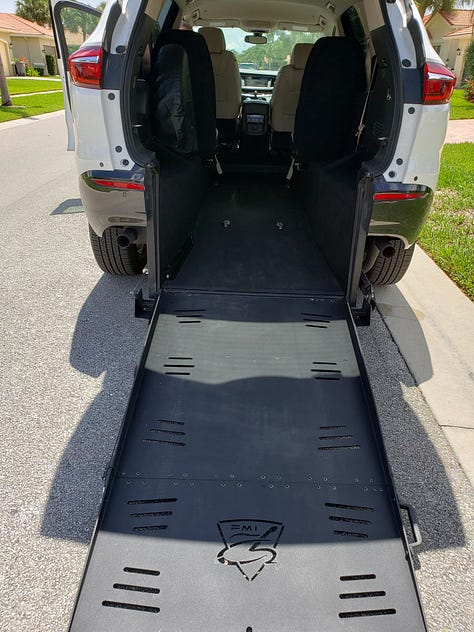
An abundance of Toyota Sienna Hybrids and a handful of Dodge Grand Caravans and Chrysler Pacificas sat side-by-side on the lot.2 Every van had been raised 12-14” above its original height to accommodate wheelchair ramps that extended out either the driver’s or passenger’s side of the van. With the goal of understanding how I might be able to bring my own scooter with me, the salesman taught us about the difference between the occupied ramps we were seeing in these vans and the internal or external unoccupied lifts for wheelchairs and mobility scooters we might also consider.
My most vivid memory of that day is the extraordinary physical toll it took on me to climb in and out of more than a dozen driver’s seats in that car lot. As a very petite person, who has lost an additional 1½ inches of height since developing this autoimmune sensory neuropathy, these lifted vehicles were a challenge, and each entry/exit only served to increase my nerve pain. It was hard to imagine incorporating one of these vehicles into my daily life. Feeling frustrated, I asked the salesman what other options were available.
Were there vehicles with ramps in the back instead of the sides? I knew that would make it easier to find parking.
Were there any choices offering seats lower to the ground? The climbing was too difficult.
Did he have any SUVs instead of minivans? I previously drove SUVs, and a minivan wasn’t my first choice.
In short, the salesman’s answers were no, no, and no. He made it sound as though these were our only options, even if they weren’t quite the right fit. In turn, I wondered if he was just trying to make a sale. He told us rear entry vans are not recommended because they are “harder to manage for independent drivers.” That I wouldn’t find any options at a lower height. And that adapted SUVs cost even more than the minivans because there is less demand for them, which is why he didn’t have any to show me on the lot.
When we left, I was discouraged. If this accessible vehicle mecca didn’t have anything that suited my needs, I assumed I wouldn’t be able to find anything anywhere. Thankfully, I was wrong, and I was determined to keep trying.
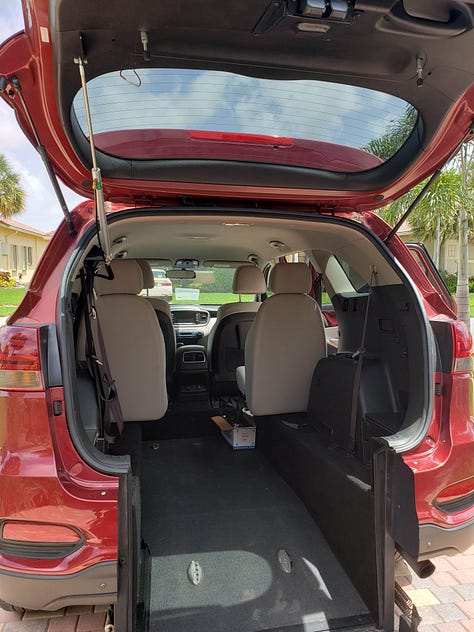
The next option I pursued was Freedom Motors. Per their website, they had a significant number of wheelchair-accessible vehicles with ramps in the back instead of the side, including SUVs and even smaller cars such as a Kia Soul.
Freedom Motors offered a lot of Pros:
Free home demos and deliveries anywhere in the country.
If you purchased with them, the vehicle could be serviced at the local shop of your choice.
10-year financing was available for 100% of the cost of a used vehicle.
They offered a buyback program if you no longer needed or wanted your vehicle.
But there were also Cons:
High prices: a new vehicle was approximately double the cost of an unmodified version of the same minivan or SUV. We would only be able to consider used ones, where those with the lowest mileage were the most expensive.
No discounts or negotiations were available for the pricing of modified SUV’s.
The salesperson I worked with was kind enough to do two separate home demos for us, despite living a couple of hours away, and I was grateful for his willingness. In late May 2022, he brought one used wheelchair-accessible SUV for us to look at. When we had more questions two weeks later, he drove all the way back to the house with another one. I test drove them both, and was happy to once again be at the wheel of an SUV, much like the beloved ones I used to drive before illness took over my life.
Wheelchair-accessible SUVs turned out not to be quite as high as the modified minivans had been, but they were still raised to accommodate the ramp and difficult for me to navigate as a driver. Plus, my mother, who would occasionally be driving it, also felt it was too high to climb into and out of.
To assess how the scooter would ride in the back, either on its own or with me aboard, I rode it in and out multiple times to see what position it would sit in.
Could I ride it in forward?
Did I have to back in?
Once it was there, could I safely navigate my way on foot back down the ramp and out to the driver’s seat?
My scooter just barely fit in the back. I did have to back in, and, no, I couldn’t really get out once the scooter was parked, if I was to be the driver.
Freedom Motors and MobilityWorks had both helped me amass knowledge about what I didn’t want, so I felt like I was getting closer to a solution, even if I still hadn’t quite found the right fit for my needs. It was time to try something a little different.
I remembered seeing a Joey Lift in the MobilityWorks showroom, although it wasn’t installed in a vehicle, so I couldn’t see a demonstration at the time. This internal scooter and wheelchair lift is named as such because, when installed inside a vehicle, it looks like a baby kangaroo inside its mama’s pouch. The Joey is made by the company Bruno, which also makes lifts like the Curb-Sider. Harmar sells similar products.
None of the external scooter or wheelchair lifts from either company appealed to me; my mobility scooter isn’t supposed to get wet because water can cause it to malfunction, and I live in a location with a significant rainy season.
An internal lift like the Joey seemed most appropriate, but now I needed a vehicle that could accommodate it. Bruno provided a list of vehicles compatible with its lifts, so that’s where I began, essentially working backwards from the Joey Lift and narrowing the list down to SUVs that appealed to me.
Off we went to Buick first to check out the Enclave, Essence, and Avenir. The SUVs themselves were nice, but upon further inspection, they weren’t really sufficient to support the width and weight of the Joey Lift. Next, we visited Chevrolet to look at the Traverse, which is a common option for accessibility conversion. When I climbed into the driver’s seat, the vehicle just felt huge, in an unwieldy way for someone of my small stature. Next door was Kia, where we checked out the Telluride (also huge) and Sorento (a definite maybe), and across the street the Hyundai dealership, where the Palisade was even bigger than the Chevy Traverse.
The Bruno compatibility chart proved to be more of a guideline than a dependable resource, so I asked a lot of questions by phone and then at the dealerships to be 100% sure the vehicles we test drove were even really options if I wanted to install the Joey Lift in the back.
Would we need to remove any seats to do so?
Would it void the warranty to make those modifications?
In late June, after months of research, I consulted the Bruno compatibility list again. This time, I decided to include minivans in my search, and I scheduled a test drive for a Honda Odyssey at the local dealership.
Unlike the minivans that had been modified for wheelchair accessibility, the Honda Odyssey was almost entirely a list of Pros:
The driver’s seat was not too high off the ground. In fact, it was lower than every other vehicle I had considered.
It was comfortable inside and drove smoothly; I felt like I was driving a car rather than a van.
The Odyssey was exactly the right size and shape to accommodate the Joey Lift, including a chassis that could confidently support the extra weight.
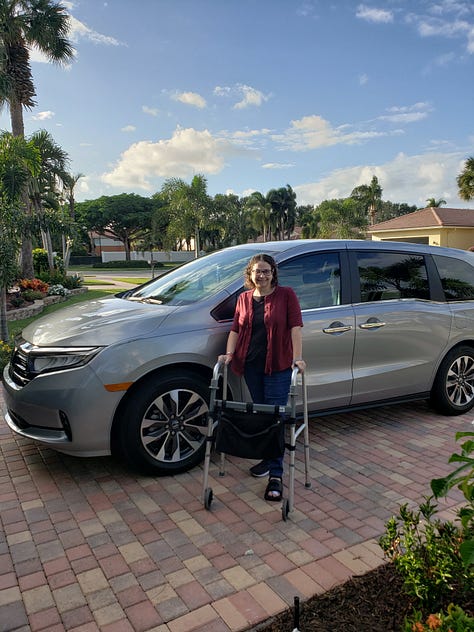
Automatic sliding doors made it easy for me to stow my walker in the back seat, before getting into the front seat to drive.
The icing on the cake was the Honda Mobility Assistance Program, which would refund us $1000 towards the purchase and installation of the Joey Lift, upon submission of our receipt.
The Odyssey was the clear right choice for me and my specific needs, so I happily resigned myself to the minivan life, and I have not regretted it once. At the time my family purchased it, there was a vehicle shortage, and I wanted this one so much that we waited 3 full months, until late October 2022, for a Silver 2023 Honda Odyssey to make its way across the country from the Pacific Northwest.
Of course, the final step in the process was to install the Joey Lift, which I ordered as soon as the van arrived. The cost was a hefty but worthwhile $5205.00 (US), and Honda did indeed reimburse for $1000 of that total. The combined cost of the new van and the Joey Lift was about 50-60% of what we would have spent to buy a new wheelchair-accessible minivan from either MobilityWorks or Freedom Motors and more than $25K less than one of their used vehicles.
Installation took one full day in December 2022. The 3rd row of seating in the Odyssey is folded down, and the Joey Lift is installed on top of it. If the lift is ever uninstalled, we can easily pop the seats back up again. The electrical wiring for the lift runs under the floor of the vehicle and connects to the main battery. There is still plenty of room for 5 passengers and space for luggage, groceries, or other items. Two scooter seatbelts were specifically installed on the Joey lift, keeping it in place as I drive. But the van hasn’t been modified in a way that prevents other people from being able to drive it. Most importantly, I can load and unload the scooter without assistance.
Ironically, the wonderful store that did the installation was bought out by none other than MobilityWorks about a year later, and they now have a local monopoly, forcing me to have the lift serviced there!
On April 4, 2023, just over a year after I started driving again and a few months after getting the Joey Lift in order, I drove that Honda Odyssey nearly the full length of the east coast with the help of two amazing friends. I was able to go wedding dress shopping with my sister and attend her bridal shower. I also got to visit with friends and family I hadn’t seen since before the pandemic because of my mobility challenges. The Honda Odyssey and the Joey Lift have been lifesavers, and I’m grateful to have them every time I pull out of the driveway.
Check out this Joey Lift Demo Video:
Each issue of “What’s Her Problem?” includes questions for further discussion. Leave a comment below!
This week’s questions:
Do you have a wheelchair-accessible vehicle? Have you ever looked into purchasing hand controls, a lift, or another vehicle modification? If so, what was your experience like?
Up Next:
Disability Pride Month Article #2. On “The Trouble with Doors.” Yes, doors. Such a problem. See why next week.
Their 2026 inventory has more variety.
Comments
Nothing yet. Say the first thing.
Sign in to join the conversation.