
Hi! If you’re new here, I’m Naomi. I’ve been teaching movement for 21 years and writing about all things movement, fitness, wellness, and health for nearly as long.
It is getting harder and harder to make a living as a fitness professional. I actually make less now than I did in my very first year of teaching, in 2005. The same thing is true of writing — I have 40% fewer paid subscribers today than I did 1 year ago. This piece required an enormous amount of research and time, which I squeezed in around working with clients, raising my kids, and being on vacation.
If you value this kind of work, please consider supporting it. A “like” and a comment go a long way. Sharing goes even further. And a paid subscription makes it possible for me to pay my bills.
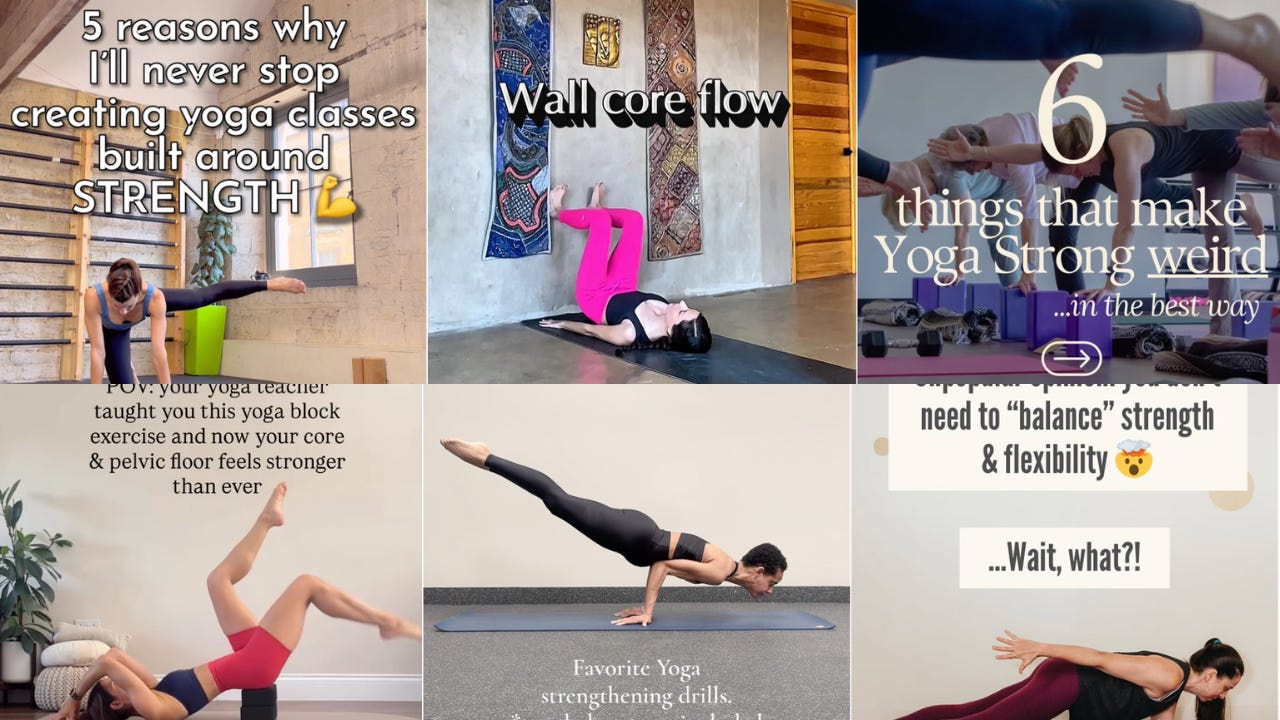
A few weeks ago, I wrote an article about 2 yoga teachers who created and sell a program designed for older women that promises to help them build strength. Sounds great, but the problem with this program is that it doesn’t seem to feature progressive stimulus or doing many non-bodyweight strength exercises It also leans into some of the persistent, unsubstantiated fears about women who are post menopausal lifting heavier weights or offering significant physical challenges to their bodies.
There wasn’t a lot of backlash to the piece, but there were a lot of questions, particularly regarding the belief that a yoga practice can build strength.
I had multiple people say to me, “my yoga practice makes me feel stronger” or “I thought (insert hard pose) was strength building.”
There are many studies that indicate yoga is insufficient for building muscle (hypertrophy) or for increasing bone density. But can yoga actually build strength?
I think it’s important to define terms and get really clear on what it means to build strength.
Let’s start with what strength means:
Strength is the greatest amount of force a muscle or a group of muscles can produce against resistance. From a real life perspective, this might be lifting something heavy off of the ground, pushing something heavy, or pulling something heavy.
It doesn’t even need to be for a long amount of time, either.
That’s endurance.
Endurance is the ability of a muscle or a group of muscles to contract repeatedly or sustain a contraction for a length of time without fatigue. Endurance might look like running or cycling or hanging from a bar or holding Warrior 2.
So what does it mean to build strength?
If you want to build strength, you have to increase the amount of force your muscles can produce against resistance.
In order to do this, you have to change the resistance or stimulus.
This can mean all sorts of things, but what’s essential is that you’re not doing the same thing every time within the same exercise. Or you’re aiming for a change, even if it’s tiny.
Here’s what I mean:
Let’s say you’re doing squats. You might be able to do 8 squats while holding a 15 pound dumbbell in each hand. If you kept doing just that week after week, those squats would start to feel less challenging because there is no change to the stimulus or resistance – which means you’re no longer building strength. You’re maintaining it.
In order to build strength, you could increase the heaviness of the weights you’re holding and do fewer reps (at first), then increase the number of reps with the new, heavier weight.
If that feels too intimidating or you don’t have heavier weights, you could do the squats with the 15lb weights, but hold for a few breaths at the bottom of your squat before pushing back to stand. Or you could try to go further down in your squat, so your hips are lower than your knees. Or you could hold at the bottom and then imagine that you were going to jump up, pushing to stand more forcefully.
And that’s just thinking about 1 set of squats, 1 day a week.
You could do 2 sets of 8 squats, because adding another set changes the stimulus. Or you could aim for 3 sets. Maybe 4!. The following week, you could aim to add a single rep 1 one set or across 2 sets or even across all of the sets you do.
You could increase the number of days you workout and add a completely different exercise on that second day, but one that works similar muscle groups – like doing deadlifts or lunges or even single leg squats.
All of these are ways to build strength by progressing the stimulus or resistance your muscles are working with/against.
Welcome to resistance training.
Is it possible to do something like this in yoga or any other bodyweight practice?
Not really.
In your average yoga class, even one that includes an insane amount of chaturangas, you’re never changing the resistance or stimulus to your muscles. You are doing some great endurance work, particularly if you’re holding certain poses for more than a breath or 2. But you’re not building on what you’ve done the week before in the way you would with resistance training.
Here’s why:
Typically, the instructions a yoga teacher gives in their classes week to week are the same. They’re not asking you to do one more tree pose than you did the week before. They might ask you to go a little lower in that chair pose or Warrior 2, but they’re not asking you to forcefully push your body out of them. No one is asking you to add more weight to your pigeon pose to increase the resistance or stimulus.
And those chaturangas? They are hard. That’s a legit strength building bodyweight exercise. Unfortunately, most folks are physically underprepared for them – which can lead to rotator cuff injuries. Even if this wasn’t an issue, you’re still not changing the stimulus or resistance to the chaturangas.
In yoga, things tend to stay very similar in regard to how to do the poses. And depending on the style of yoga you do, things can change radically week to week or stay nearly identical (looking at you, Ashtanga and Bikram).
This doesn’t make yoga bad. It simply makes yoga an ineffective tool for building strength.
Now all of this might make sense, but there will still be people who say these 3 things:
Yoga is a complete practice.
Yoga (and pilates) are safer for folks who are older or recovering from injury
Yoga makes me feel strong
Let’s start with “yoga is a complete practice.”
I hear this most often from yoga teachers, but occasionally dedicated practitioners. I was even one of these people, years ago, before I started strength training. I genuinely felt like yoga was enough. I was in my 20’s. I didn’t have kids and had lots of time, so I practiced for hours and went to lots of classes and taught a lot of classes.
And also, my income depended on teaching yoga and showing people how awesome yoga was for everything from mobility to healing from injury to regulating emotions to building strength. I really needed to believe that yoga was the magical practice that could do all of these things so that I could tell other people it was true, too.
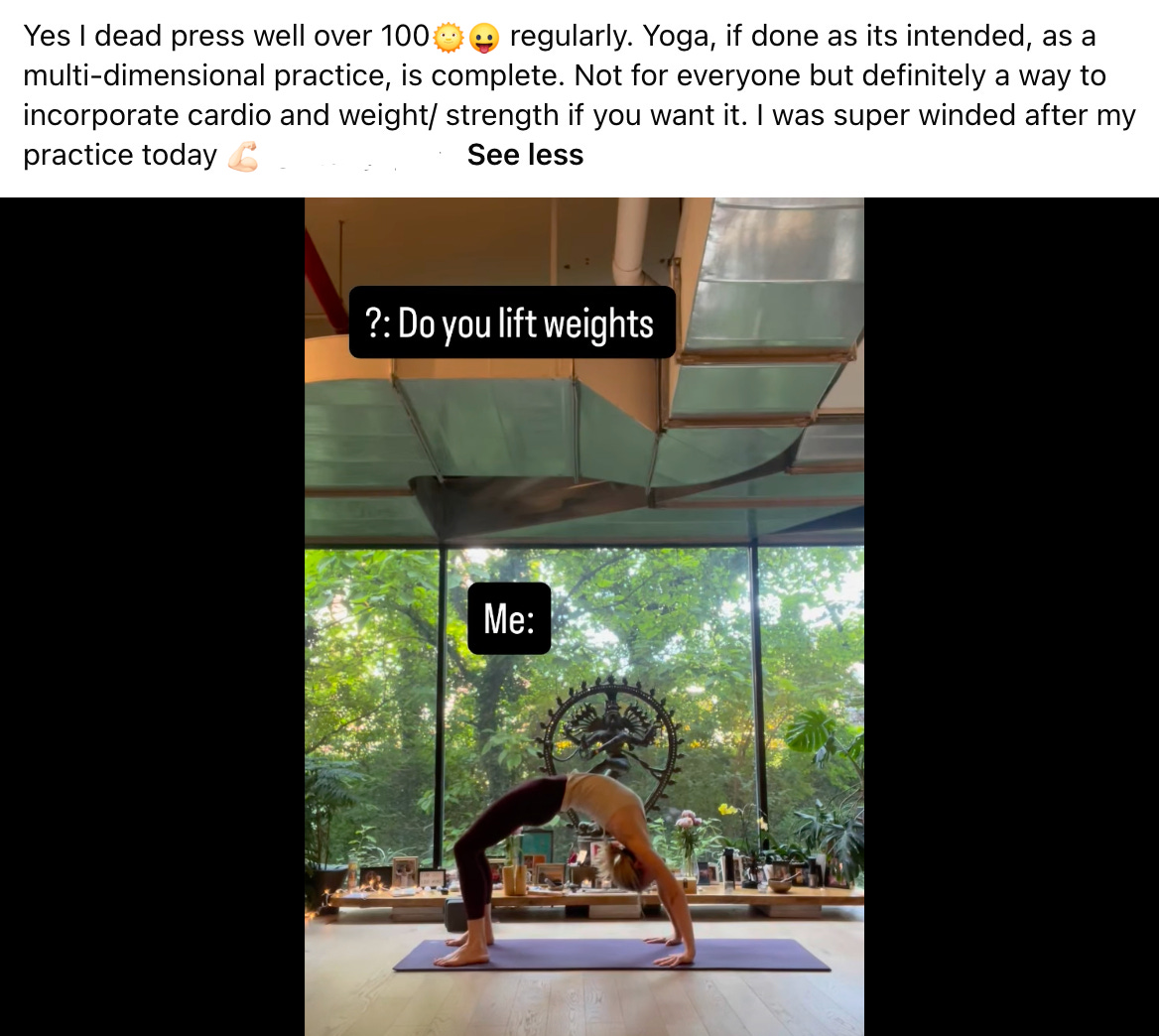
I am not going to argue with the idea that yoga is the only physical practice a person can have. If you don’t enjoy other forms of movement, but you practice yoga regularly and enthusiastically, I support that. What matters is that you have a consistent movement practice that you enjoy. Keep at it.
But don’t call yoga a “complete practice”. That is simply untrue. It is a mischaracterization of what yoga can and cannot do for your body.
To be clear, I am not hating on yoga. I still practice yoga occasionally and teach it regularly. Or yoga-ish classes. But that’s not the point.
Yoga, as a physical practice, is wonderful. It can be challenging or relaxing. It can be wildly creative or incredibly rote. It can offer some small strength gains early on, but mostly yoga is great for body awareness, endurance, and stretching.
Next up is the idea that yoga and pilates are safer for older folks or those recovering from injuries.
This is the same idea that contributes to the belief that lifting heavier weights is dangerous. Let’s make something fairly clear: lifting heavy weights is not inherently dangerous.
First of all, it’s not the heaviness of the load; it’s about lifting any load appropriately. Heavy is relative. What is heavy for one person is moderate or even light for another. So the goal is to ease someone in and figure out what is appropriate for them.
Second, yoga and pilates can actually be problematic for folks who are hypermobile or have injuries because the movements are not stabilizing enough. A weight provides resistance, which is actually good when you’re working with injuries or recovering. I’m not saying that someone who has had knee surgery should jump right into squats with a barbell. I’m saying that yoga and pilates might not be the best option here if you’re trying to rebuild muscular strength.
One of my private clients actually requested that I not offer her any yoga in the programming I created for her because she was worried the yoga practices would be too hard on her body – which was new for me.
The point here is not that strength training is best for all injuries or that yoga and pilates are dangerous.
The real point is that demonizing one form of movement or another helps no one.
When it comes to working with someone who has an injury or is recovering from an injury, what I recommend depends on the person and it depends on the nature of the injury.
The last one is the one that feels personal – the idea that yoga can make someone feel strong.
I say it’s personal because I understand it. When I was only doing yoga, I felt like doing handstands and arm balances and planks were sufficient for building strength. They were hard for me. I had to work for them. I felt proud when I was able to do something I’d never done before or when I did something with greater ease.
I also think it’s fair to say that in some cases, I was making marginal strength gains. They were tiny and only for my upper body, but it wasn’t nothing.
Upper body strength is one of the few areas where bodyweight can actually make a dent in building strength – at least for a while.
With many of those poses – inversions and arm balances – there’s a mental game, too. A big part of success is the confidence to try. You have to be ok with falling on your face if you want to try crow pose. You have to be ok with tumbling out of a handstand or forearm stand if you want to try to go upside down. Confidence is at least 50% of those poses, if not more.
And more importantly, there is a big difference between feeling strong and actually being strong.
One of those things is based more on emotion than measurable change. Feeling strong is important and powerful. It can build confidence. But it isn’t always an indicator of capacity.
That’s why being able to measure your strength gains matters. As Dr. Sarah Court said in my interview with her a few articles ago, “What’s fun about lifting weights is that you can say, ‘two months ago, my deadlift was 20 pounds and now it’s 40 pounds. That is a demonstrable change.”
The same measure simply isn’t available in yoga.
I think yoga is a fantastic movement practice. For many it is more than just movement, too. I’m not writing any of this to turn people away from yoga. Or pilates. Or bodyweight practices of any kind. I’m sharing it because there is a lot of misinformation in the yoga world and it feels important to correct it.
A lot of that misinformation involves profiting off of people’s lack of understanding about what is required to build muscle, increase bone density, and get physically stronger.
If you want to feel strong, yoga can do that for you.
If you want to be stronger, you’re going to need more than yoga.
*****
I’ve actually written about this a lot so here are a few helpful resources if you want more information:
On Fit Bottomed Girls, I wrote about Yoga and Bone Density almost exactly a year ago today. I also recently published a piece about Squats, progressing from sit-to-stands up through working with barbells.
On my substack, I wrote about the updated position stand from the ACSM about what is required to build strength (among other things):
I also shared an interview with Dr. Sarah Court, which I quoted above, but honestly answers all of the questions people had about the somatic strength piece, so if you haven’t read that one, you can here:
And here’s a deep cut about words:
*****
If you enjoyed this piece, please “like” it by clicking on the heart icon below. If you really liked it, please leave a comment or share it via Notes. These actions help others find my work which supports me as a writer. And if you’re able, the absolute best way to support me is with a paid subscription.
If purchasing a subscription is not in the cards, you can make a one-time donation here: https://coff.ee/naomi.gottliebmiller
I’ll happily give you a year subscription here if you donate $50ish via the link above.
Comments
Nothing yet. Say the first thing.
Sign in to join the conversation.