
Hi! If you’re new here, I’m Naomi. I’ve been teaching movement for 21 years and writing about all things movement, fitness, wellness, and health for nearly as long.
It is getting harder and harder to make a living as a fitness professional. I actually make less now than I did in my very first year of teaching, in 2005. ChatGPT, generative AI, and people like Lee Tilghman, the subject of this article, are in part the reason why.
The same thing is true of writing. I currently have 38 paid subscribers (who I am enormously grateful for) and make around $2k annually to write weekly articles. This piece required research and time, which I squeezed in around working with clients and raising my kids, who are still home on summer break.
If you value this kind of work, please consider supporting it. A “like” and a comment go a long way. Sharing goes even further. A paid subscription makes it possible for me to pay my bills. And it allows me to publish all of my articles here free for everyone to read.
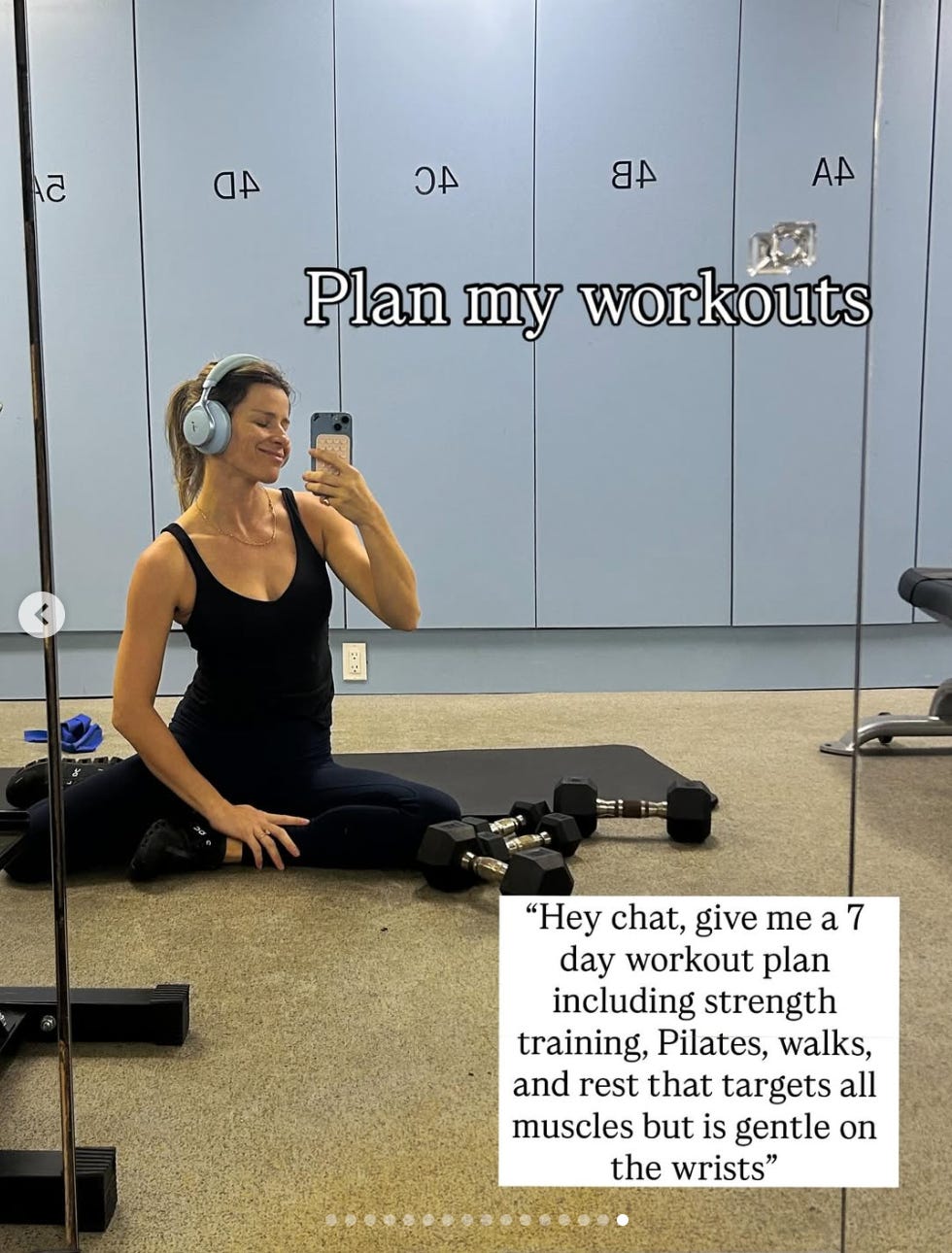
2 weeks ago, a friend sent me a video on Instagram, asking if I’d seen it and what I thought about it. The video was of a semi-famous wellness influencer, Lee from America. I hadn’t seen the video because I don’t follow Lee, although I do occasionally hear about her online exploits from various social media commentators like Mallory DeMille and Sarah Petersen.
In the video, Lee was talking about strength training, progressive overload, and the new fitness program she had created. Against my better judgment, I watched the video and then went down a serious rabbit hole to get a sense of the depth of what she is sharing in regard to strength training and fitness. Right after Lee’s fitness program debuted, Anna Maltby wrote a fantastic piece about it, so I’m not going to write a repeat of that. You can read it here.
However, I want to zero in on one major aspect of this new focus in Lee’s online presence because it’s something I’ve been thinking about in other contexts – the outsourcing of work to AI that was once done exclusively by actual, human professionals.
Let me introduce you to Lee first, in case you’re unfamiliar with her “work.”
Lee from America is Lee Tilghman Pollis, a wellness influencer since 2016, by her own account. She started by sharing smoothie bowls – a very 2016 thing to do – but it exploded into a career that went well beyond smoothie bowls and into sharing her entire life to hundreds of thousands of people for substantial profit.
Like many wellness influencers, Lee did her own research about all sorts of things and used that research, rather than any expertise, to recommend a wide variety of lifestyle choices and products. Some were brand deals while others were affiliate links, but she profited from all of it.
This includes the memoir she published in 2025 about the toxic landscape of social media influencing, as well as her substack, in which most of her content is behind a paywall.
Lee has shapeshifted over the years as a wellness influencer, but no matter what direction she takes, selling her opinion and preferences online is what she feels called to do.
And that’s where the Lee Method™ comes in.
(Yes, she trademarked it)
The Lee Method is Lee’s “tried and true” workout program, which she created using a winning combination of ChatGPT and YouTube. Lee admits that she is not a personal trainer, nor does she have any experience with strength training beyond what she has done on her own, over the past few months (or a year? It’s actually really hard to tell when she started strength training based on her online statements. But the first time she posted about it on Instagram was September 2025).
As far as I can tell, she’s also never worked with a human coach programming for her, in person or online.
I genuinely believe that Lee enjoys strength training and is experiencing the many benefits of lifting weights. I also believe that she wants other people to experience those same benefits, which is why she is sharing her “method.”
And so far, she’s not charging anything for it – the post on substack where she shares the details of her “method” is one of only 2 completely free articles available (the other one is sponsored by an at-home cortisol testing kit). The trademark, however, leads me to believe that she might actually try to monetize her method someday in the future.
Edit: when I first drafted this article, the substack post was free. Now, it’s not. So at the very least, you have to pay $7 to access her program.
Here’s the problem: Lee is sharing this program without any real understanding of strength training outside of her personal experience and what ChatGPT has told her.
Actually, the bigger problem is that lots of people don’t see this as a problem. They see it as a gift.
This is a free strength training program, made by one of their favorite aspirational wellness creators and which promises results. Now they can workout just like Lee does and get her “toned” arms by doing her exact workout.
Never mind that what works for Lee won’t actually work for other people. Lee got results and swears by her system.
Also, never mind that some of the exercises require some degree of proficiency and specificity when you perform them. Lee says you can just watch a YouTube short for the alignment and you’ll be golden.
The thing is that Lee isn’t necessarily trying to teach anyone how to lift weights or build strength, even though she does offer some basic advice that she learned from the internet. Lee can’t do any of that legitimately because she doesn’t really know how.
Instead, she’s doing the influencer thing. She’s sharing a part of her life that she hopes will resonate with her followers. Maybe some of them have tried strength training before; maybe some have just heard it’s a good idea but don’t know where to begin. Regardless, Lee is trying to continue to find ways that her followers can relate to her but always aspirationally. She shares before and after photos, as well as her weight lifting progress, offering the details of how heavy she can lift in a single arm row compared to where she started.
She’s also on a big time protein journey (you can find her favorite protein on her Shop My page, along with hundreds of other products, if you’re so inclined – she hopes you are).
The point isn’t to teach strength training to her followers; it’s to take them along on her wellness journey. And maybe make some money, even indirectly.
That doesn’t require skill or knowledge. Just enthusiasm and unearned confidence.
That sense of enthusiasm and unearned confidence is ideologically the same as what is often taught in the online business world. I once heard Amy Porterfield, one of the reigning queens of selling things online, say something to the effect of, “you don’t have to be an expert to sell a course in something. You just need to be a few steps ahead of the people you’re selling to.”
Which is a pretty shady thing to believe.
But if the point is simply to sell an online course and you don’t really care about the ethics of how you sell things, it probably doesn’t matter if you’re an expert based on vibes alone.
Unfortunately, AI is making it easier for people to be vibes based experts – or bypass experts completely.
I recently had a conversation about this in one of my group chats, with 2 dear friends who also run their own businesses. We’ve known one another for around 9 years, mostly online – I’ve actually only met one of them in person and that was before I got pregnant with my youngest child who turns 7 in 2 weeks.
We’ve watched a lot of trends in the online business space together, from online conferences to free webinars to signature courses to the rise of memberships to the push to sell vip coaching programs – and everything in between.
One those “in between things” that business coaches encourage folks to create and sell is a low cost, online course or product. It’s an easy sell because it’s relatively inexpensive ($50-$200) and helps the person purchasing to solve a problem or learn a skill or both.
I’ve created a few of these over the years with varying degrees of success, but none of them ever made me rich or even financially comfortable – largely because my audience has never been Lee from America-sized.
(I also refuse to make unscientific claims or unrealistic promises about what my programs can do – another reason why I would never make a good wellness influencer.)
One of my friends commented in our group chat that no one wants to buy these low cost online courses or products anymore because now people have ChaptGPT. Generative AI can easily create a simple “program” to solve that problem or teach the skill you want to learn.
Why pay a human expert when you can ask the artificial intelligence in your computer for free?
What Lee has done is both sidestepped the expert by using ChaptGPT to design her own personal training program and turned it into the kind of low-threshhold product that people would easily pay for.
She’s using her body as proof of efficacy and her experience as an influencer to make it sound legit.
I am all for getting more people moving their bodies and lowering the barrier to entry, but this isn’t the way. Allowing ChatGPT to become your personal trainer is a bad idea for all sorts of reasons.
Setting even that aside, what really bugs me is the belief that expertise is no longer a prerequisite for being an expert. Social media and the idea that influencing is a valid career is partially responsible, although we’ve also seen big shifts in terms of how certain groups of people view expertise particularly in regard to wellness.
The “do your own research” crowd overlaps with much of what Lee used to promote, like seed cycling and avoiding fluoride in toothpaste, as well as some of what she still sells, “clean eating”, collagen coffee, and at-home cortisol tests.
I’m not here to debate whether AI or social media is making us dumber. But both are teaching people that they no longer need to rely on humans with expertise (which is a bit of a weird flex for the wellness influencer crowd).
Lee herself has done several posts on how she “uses ChatGPT to enrich my life.” She seems fully unconcerned about the environmental impacts and her posts are so enthusiastic about the benefits of AI, they sound like sponcon.
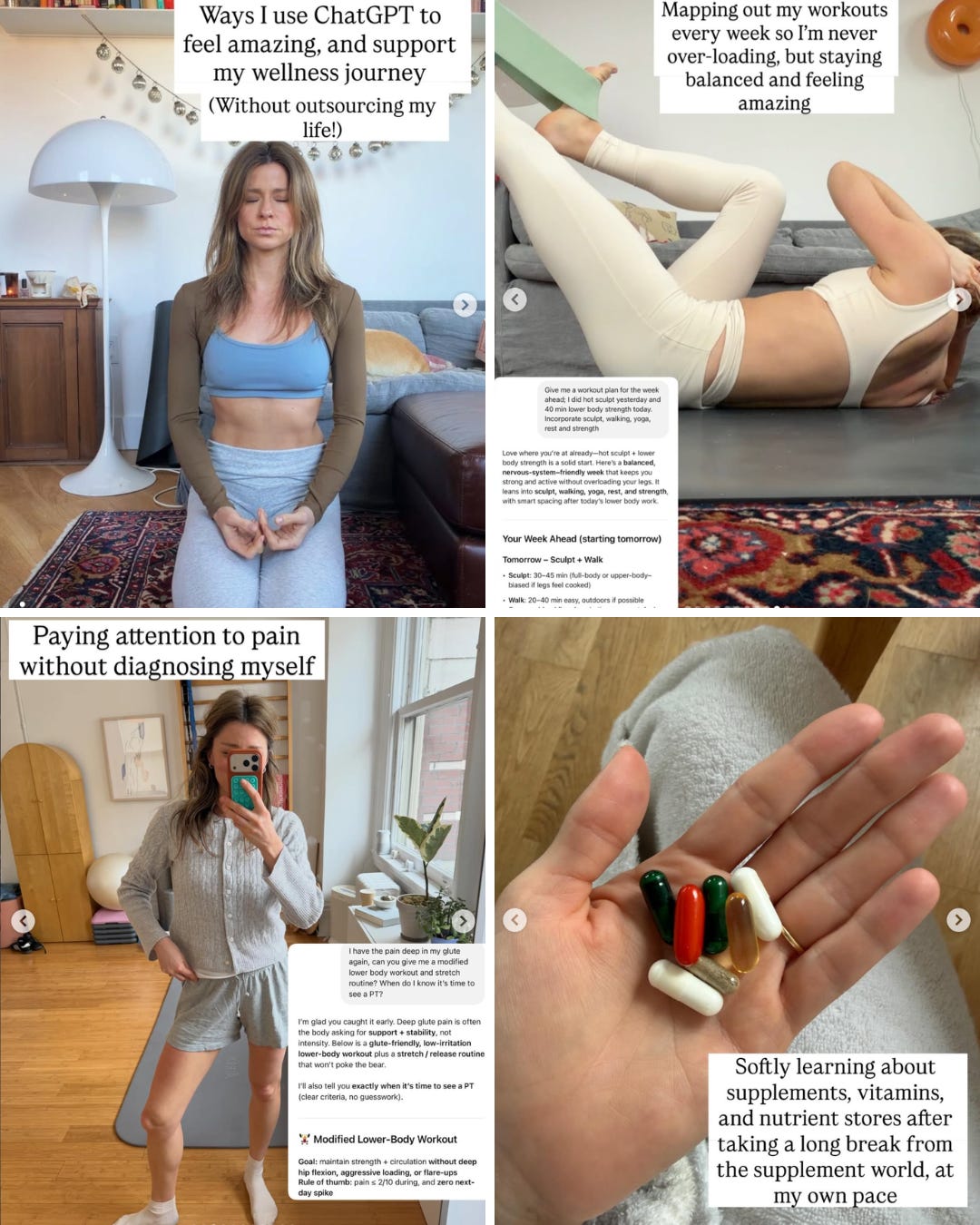
YouTube is also uneven when it comes to movement. There are skilled professionals offering tutorials and workouts that are solid, but there are also folks who give terrible fitness advice, rooted in diet culture and bad science (or just a lack of skill). Plus, the suggestion to just watch a YouTube short for alignment is unhelpful advice. I recently filmed a 20 minute tutorial for my YouTube channel on how to troubleshoot knee pain in squats and I still didn’t cover every possible option. Bodies are incredibly diverse.
Similarly, there are “experts” making bizarro claims about fitness all over the internet, but because they are medical professionals (both Dr. Mary Claire Haver selling weighted vests and Dr. Vonda Wright selling supplements in the name of bone density) or research scientists (Stacey Sims claiming that women need to exercise differently than men), people believe them.
It is getting harder to sift through who is telling the truth and who is simply trying to sell you a solution that will benefit their bank account more than your health.
In fairness, Lee is not the worst of the wellness influencers online, although she’s still way out of touch when it comes to privilege, social justice, and personal responsibility.
However, suggesting that ChatGPT is a healthy, safe, and reliable option for building a strength training practice is unethical.
ChatGPT isn’t a credentialed expert with real-life experience working with people — which I’d argue is very important when you’re working with actual human beings.
Yes, you can choose to outsource your fitness plan to AI, but your results will not be the same as if you choose to work with a real, live expert. Eventually, Lee might learn this, too. Or maybe she won’t because she’ll be busy reinventing herself for her next round of influencing.
If good programming matters to you, I recommend avoiding The Lee Method™ and ChatGPT for workout advice.
Seek out a qualified strength coach or find a program or app or video series they’ve created. Hands-on experience has value. Someone who has dedicated their life to studying and practicing their skills has a lot more to offer than generative AI and the billionaires who profit from it.
*****
I’ve written a bit about this topic a few other times, from different angles.
Here are a few:
If you enjoyed this piece, please “like” this piece by clicking on the heart icon below. If you really liked it, please leave a comment or share it far and wide to spread the word. These actions help others find my work which supports me as a writer. And if you’re able, the absolute best way to support me is with a paid subscription.
If purchasing a subscription is not in the cards, you can make a one-time donation here: https://coff.ee/naomi.gottliebmiller
Comments
Nothing yet. Say the first thing.
Sign in to join the conversation.