
Hi! If you’re new here, I’m Naomi. I’ve been teaching movement for 21 years and writing about all things movement, fitness, wellness, and health for nearly as long.
It is getting harder and harder to make a living as a fitness professional. I actually make less now than I did in my very first year of teaching, in 2005. The same thing is true of writing — I have 30% fewer paid subscribers today than I did 1 year ago. This piece required an enormous amount of research and time, which I try to squeeze in around teaching my classes, working with clients, writing additional freelance articles, and raising my kids.
If you value this kind of work, please consider supporting it. A “like” and a comment go a long way. Sharing goes even further. And a paid subscription makes it possible for me to pay my bills.
Some quick business before we get to the article: My app, Strength in Midlife: A Daily Movement App for Aging Well, is currently 20% off. The sale runs through July 3rd and it’s a great way to help build consistency with movement, something Sarah mentions is super important in this article! Check it out here.

A few weeks ago, someone asked me how I would introduce strength training to a person in their 60’s or older. She read the piece I wrote about somatic strength and was curious to know a good beginner’s approach to lifting weights for someone who is older and wanting to avoid injury.
I think this question and the answer to it, hinges on how we perceive older women and our beliefs about their capacity for strength. I think it’s totally reasonable to assume that someone who is older and newer to something, whether it’s strength training or learning how to play an instrument, might need a different approach.
But I also think the underlying concern is that strength training is somehow unsafe, especially for older women who we might presume are weaker in their post menopause state. This isn’t entirely true, by the way. Women actually lose less muscle mass than men as they age. The bigger issue is that they often start with less, so they have less to lose. So if nothing else convinces you to start picking up and putting down heavy things, please let that be it. But I digress.
My immediate response to the question of how to work with a strength training newbie in her 60’s was that you do it the same way you’d work with someone in their 30’s or 40’s. You might just start a little smaller and slower, but the rules for building strength and increasing bone density are the same regardless of the age of the person lifting weights.
They don’t drastically change just because someone is older or a woman.
In order to increase bone density, you have to stress your bones by putting load on them. Not just once, but several times. Then you repeat it. And after a little while, you increase the load to continue challenging the bones.
This is why things like yoga and pilates are great movement practices, but not great for bone density or even for building strength in the long term. You’re not repeating the stress or increasing it. When you do Warrior 2, you’re only holding up your own body. And you’re never adding anything to it, nor are you repeating it more than once or twice over the course of a class.
Anyway, when it comes to working with folks who are newer to lifting weights, they’re not starting with a 100lb deadlift, regardless of their age. That’s crazy.
Instead, you meet them where they are and let them start with whatever they’re willing to try lifting.
The idea is to start in a manageable place and give them room to grow.
I was confident in my answer because I know how building strength works, but my experience is also limited. I typically work with women, my age or older, who are still physically active. They might be newer to strength training, but they’re not new to exercise.
I wanted to speak with someone who has experience working with folks who are not as active, who might have physical limitations, or who might actually be frail.
And that’s why I reached out to Dr. Sarah Court.
Although I’ve never actually met Sarah, she’s the co-host of one of my favorite podcasts about movement, the Movement Logic podcast, which is a fantastic, evidence-based podcast that has helped me tremendously in both my work as a movement professional and as a health/fitness journalist. Often when I am writing about anything related to fitness or perimenopause, I hear Sarah’s voice or her co-host, Laurel Beversdorf’s voice, in my head.
The reason I wanted to reach out to Sarah specifically is that she is a Doctor of Physical Therapy and on the podcast she frequently talks about working with the types of clients who have very different needs than my own. People who have difficulty climbing stairs or getting up from a chair or even moving around a room in their house.
In her capacity as a physical therapist, she works with folks who have either orthopedic or neurologic conditions – meaning everything from a sprained ankle to Parkinson’s disease.
When I ask her about how to work with women who are older and potentially frail, she tells me that worrying about working with someone who is dangerously frail is highly unlikely for those of us who teach public movement classes, online or off – including gentle yoga. The reality is that folks who are that deconditioned probably aren’t showing up to a local yoga studio or pilates studio or a crossfit box to take a class. “Those are rehab patients,” she says. “Those are the ones where (when I work with them) we take an hour to maybe stand up and walk across the room and come back. That’s a different category.”
Instead most of the folks in their 50’s, 60’s, or older, who are showing up to movement classes as beginners, either stopped exercising in their 20’s or 30’s or maybe never really had a movement practice to begin with. But if they’re showing up, they’re not likely frail. For these folks, Sarah says, safety isn’t the concern but conditioning might be.
All that means is that people who are newer to strenuous movement aren’t as used to it, so their capacity is lower. Going back to the Warrior 2 example, if you’ve never done Warrior 2, holding it will likely feel a little awkward and difficult at first. You might manage a few breaths before you have to release from the pose.
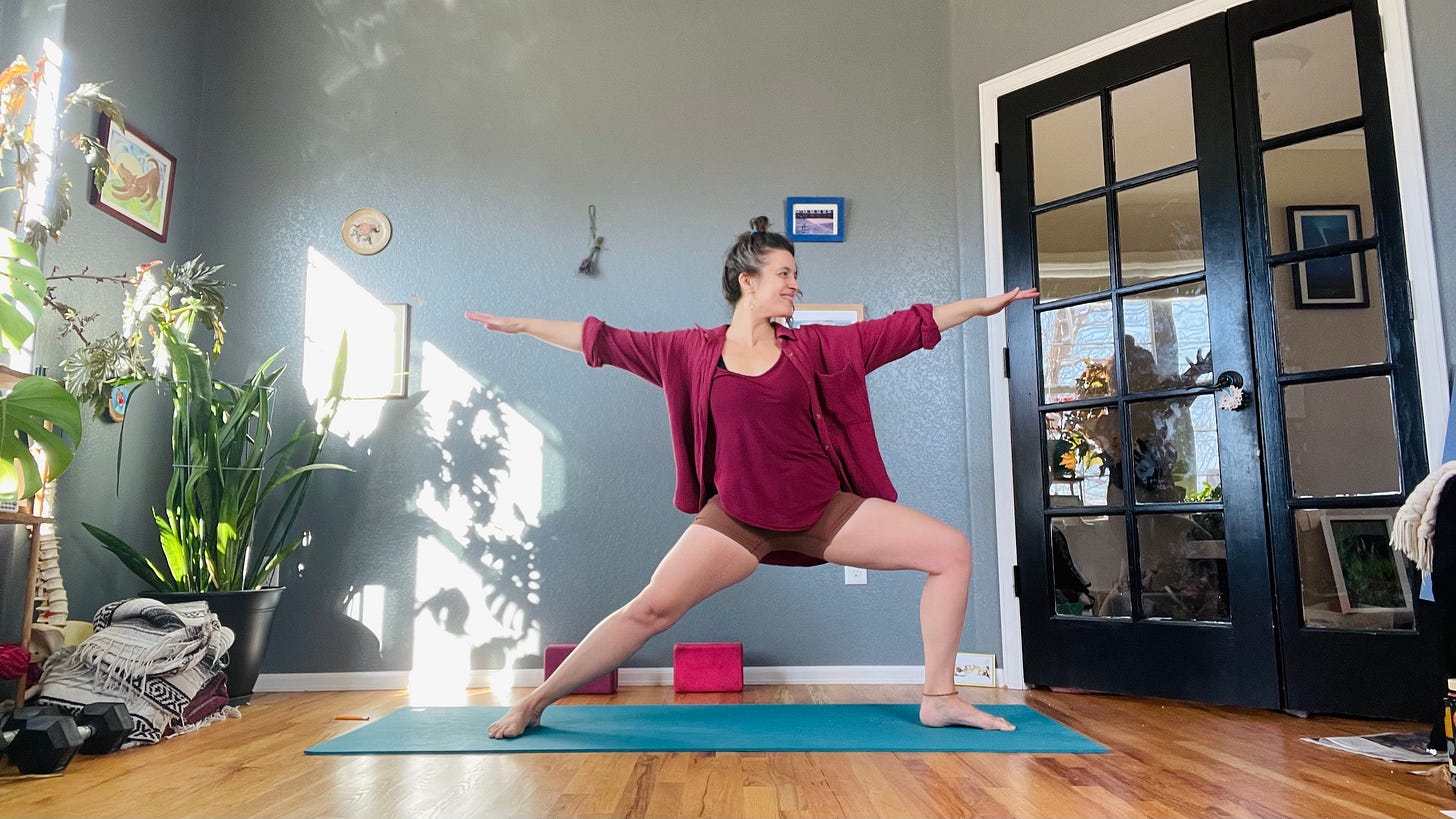
But if you do Warrior 2 everyday for a few weeks, you will be able to hold it for a little longer everyday. Your body starts to get used to the pose and the feeling of holding it. You are training your body to do Warrior 2, so holding it might still feel hard, but that hard feeling doesn’t happen as quickly.
This is why, as Sarah explains, bodyweight exercises actually do make an impact, strength-wise, for beginners. It just doesn’t last.
“Bodyweight is not going to be meaningless in the beginning,” she says.” The big problem is that people don’t understand that it has to change. Giving somebody 3 sets of 10 sit-to-stands or body weight squats, where you’re just tapping down to the bench, might be meaningful to somebody’s strength week one and week two, but certainly by week five, it’s not.”
This is where the concept of progressive overload comes in and it’s what often trips up people in the yoga world, because progressive overload doesn’t really exist in yoga practices (or in pilates, unless you’re using a reformer. And even then, the machine has limits to how much tension you can increase).
Progressive overload means that in order to continue to build muscle or bone, you have to increase the stimulus or challenge to your muscles and bones. If the stimulus stays the same (i.e. bodyweight exercises), you’ll maintain the strength you have – which is great. You just won’t grow your strength. Or increase bone density.
When I mention to Sarah that I get a lot of pushback when I write about the fact that yoga does not build strength long term, she says, “people don’t really understand the difference between this idea of feeling stronger and the actual biomechanical change of becoming stronger.”
What a lot of folks feel is the conditioning aspect, like how I described Warrior 2. You get better at the task and it might even build a little strength in the beginning, “but it will not increase beyond that.”
It’s also really hard to calculate the physical impacts of something like holding a yoga pose or doing an exercise in pilates, but working with weights is measurable. “What’s fun about lifting weights is that you can say, ‘two months ago, my deadlift was 20 pounds and now it’s 40 pounds. That is a demonstrable change,” Sarah explains.
But weights can be intimidating and people have a strong sense of fear when it comes to movement generally. Adding hand weights or kettlebells or barbells to a movement practice can increase the concern that you’ll do something wrong and harm your body.
Additionally, in my own yoga training and so many yoga classes I’ve taken over the years, we were told that if someone folded forward the wrong way they could hurt their back. So if fear is already baked into the yoga world, imagine the damage people think weights can do?
The first thing to know is that lifting weights isn’t intrinsically dangerous. In fact, it’s a little more dangerous to not lift weights, especially if your goal is to have sturdier, less fragile bones as you age – but I’ll get to that.
Lots of people are worried that they’ll injure themselves if they lift something too heavy. But there are 2 important things to consider:
Most of us are capable of lifting much heavier things than we realize.
And if something is actually too heavy, you won’t be able to lift it easily or at all, which is a clear sign that you probably shouldn’t lift it anyway, especially if you’re newer to lifting weights.
Sarah explains the latter this way, saying, “There is no exercise that is inherently dangerous. It’s just whether you are prepared for it or not. And the way that people get hurt in strength training is they pick up things that they aren’t prepared for.”
She says that part of the problem is in how strength training is depicted online or from a pop culture standpoint. “The images of weight training that we are fed are these big dudes, sweating and turning purple in the face, as if that’s what strength training looks like – as if that’s the only thing it looks like. I just think it’s important to stop fearmongering it.”
I ask her if strength training is dangerous for anyone and she responds, “if I’m going to be scientific, I have to say yes, but then I get to qualify, which is that the number of people it is dangerous for is so small that it is almost not meaningful to the general population. And the circumstances in which strength training is dangerous is again, such a small chunk of people it is nowhere near general population levels. These are people who are extremely sick.”
While we don’t talk about folks with chronic illness specifically, we do talk about osteoporosis. I explain that I’ve received pushback from medical professionals and “regular folks” alike, when I’ve written about the success of the LIFTMOR trial, which demonstrated that high intensity strength and impact training are safe and effective for improving bone density in older women, even if they have no history of exercise and low bone mass. So I ask Sarah how she might respond to someone saying “I can’t do this or I can’t make any improvements because I have osteoporosis?”
Sarah explains that osteoporosis is a bit misunderstood. We tend to view osteoporosis broadly, rather than specifically. “There’s a big range in terms of having an osteoporosis diagnosis, “ she says. “The medical image of the osteoporotic woman is this very frail, stooped over lady who is one bad fall away from breaking every bone in her body. But there’s lots of people who have osteoporosis who are actually decently active and mobile, and they’re not a fall risk.”
Some folks who have osteoporosis might have a genetic predisposition, while others might be the result of lifestyle choices. Osteoporosis alone isn’t a reason for concern, but other factors can increase the potential danger of having lower bone mass.
In regard to whether it’s safe for women with osteoporosis to lift weights, she says that context matters.
“Lifting weights makes you stronger, which makes you less susceptible to falling. So what I say, what a lot of people say is that, osteoporosis by itself as a diagnosis is not enough information to decide whether or not you should lift weights. and people are acting like it is, but it’s not. It’s one piece of the puzzle of who that person is, but it’s not the whole thing.”
So if someone is already physically active, but not lifting weights, and they have no other health concerns (cardiovascular issues, neurologic issues), lifting weights with osteoporosis is probably fine.
But if they are legitimately frail and severely deconditioned, you’re not likely to start with deadlifts or overhead presses. And again, these are folks who should be seeing a clinician like Sarah.
For the average person in their 60’s, lifting weights poses far less potential harm than the alternative. “I run into people’s resistance a lot and it’s generally fear-based because this is not something that this person has encountered before or experienced before and they’ve heard a lot of messaging about the danger,” Sarah says. She adds, “There’s much more messaging about the danger of certain exercises and there’s nowhere near enough messaging about the danger of not exercising.”
That might sound extreme, but the reality is that regular movement — any type of movement — can dramatically improve your quality of life, particularly in the final 10 years of life. This is something Sarah has seen firsthand working with clients individually, but it’s also supported by science.
Regular movement significantly improves joint mobility and slows age-related muscle loss, preserving muscle for longer as you age. And that’s just for starters. “I don’t think we have done a sufficient job impressing on people the value that exercise has on the quality of the end of their life, like the last 10 years of their life, and whether they want it to be like in a wheelchair or whether they want to be independent and functional,” Sarah says. “And we’ve done a really shitty job explaining how exercise for most people – and again, there are exceptions – but for most people, how exercise is what differentiates those two paths. We’ve done a really poor job getting people to understand that.”
According to a CDC study from 2022, most Americans don’t move enough or even at all. While this is based on whether or not people are meeting the federal physical activity guidelines (as established by the Department of Health and Human Services), both Sarah and I are less concerned about people meeting those specific guidelines and more interested in getting people to integrate movement more regularly into their lives. “We’ve overcomplicated (exercise) to the point that I think a lot of people have gotten frustrated and given up, where the reality is literally doing any exercise is so much better than doing no exercise,” Sarah says.
“The other part that we are not doing a great job of explaining is what consistency actually is and what it looks like. It doesn’t mean you do your whole perfect program every week. It just means you understand that this is something that you do as part of your life and you engage with it on a regular basis.”
The point is twofold: a little bit goes a long way and consistency is key. In fact, studies suggest that the greatest boost in health is when someone goes from fully sedentary to slightly active. Think adding a daily walk or doing 5 minutes of stretching everyday.
When I ask Sarah what advice she’d give to someone who wants to start strength training but don’t know where to start, her best advice is to first just aim to get moving more regularly and the most effective way to do that is to find something you actually like. “As much as we can get into which ways of exercising are the best way to achieve certain outcomes, it does still come back to this idea of consistency and literally doing anything. We all tend to be more consistent with things that we enjoy.”
She suggests tapping into your curiosity and trying out all sorts of things to see what moves you. That could be a beginners yoga class or a pilates class or a tap dancing class (I swear she said that, not me, but you know how I fee about it). If you have the funds, maybe do a session or 2 with a personal trainer at a gym. Join a group that does local hikes. You have no way of knowing until you try, but if you find something you really enjoy, you’re far more likely to stick with it.
But swinging back to the original question, “what is a good beginner’s approach to lifting weights for someone who is older and wanting to avoid injury,” Sarah’s answer is similar to my own. “It’s actually much better to just underwhelm and under load in the beginning because part of what you have to help them do is recognize their own strength in themselves and show them that they’re improving.”
She adds that for clients who are nervous about lifting, you’re not pushing or forcing. You let them lead the way, while also showing them that some of the actions you want them to do are already familiar or not as hard as they think. That might look like having them sit in a chair and stand up, then say, “congratulations! You just did a squats. Can you do a few more?” If you want someone to scale up, eventually adding weights, sometimes you have to scale in the other direction for perspective.
To give an example of how she works with older clients who might be nervous to lift, Sarah shared a story about doing weight training with her mom, who would get nervous whenever Sarah suggested adding more weight to a lift. “A tactic that I use a lot of the time is that I have the person prove to themselves that they can do it. So I said to her, let’s do your deadlift at this weight that you’re currently doing. And I want you to just do as many as you can and stop when you feel like you can do two more. I think I was trying to take her from like 30 pounds to 35 pounds. And she did something like 25, 30 pound deadlifts. And I was like, wow. So do you see how, if we had five more pounds, but I only want you to do just eight of them, you probably can do it?”
She explains that often people are worried about not knowing what might happen and assuming the worst, which comes from a fear-based place. “Sometimes you have to give them that evidence. They literally have to prove it to themselves. There has to be a lot of trust and with a brand new person (to strength training) you have to build that trust. So you build the trust by letting them run it, essentially.”
*****
Massive thanks to the marvelous, Dr. Sarah Court for speaking to me at length for this article. Dr. Sarah Court is a Doctor of Physical Therapy, and provides in person and online sessions that blend her decades of yoga, Pilates, strength training, and physical therapy experience. She is the co founder of Movement Logic® with Laurel Beversdorf, where they co-host the Movement Logic: Strong Opinions Loosely Held Podcast, and also teach a 6-month online barbell course to help women build strength for life. She was diagnosed with breast cancer in 2021, and after her experience with surgery and chemotherapy, she created a FREE online video exercise series for people going through, or recovering from cancer treatment, that progresses from simple yoga to lifting weights. Sarah lives in Los Angeles, and you can find her at sarahcourtdpt.com or on Instagram at @sarahcourtdpt.
*****
If you enjoyed this piece, please “like” it by clicking on the heart icon below. If you really liked it, please leave a comment or share it via Notes. These actions help others find my work which supports me as a writer. And if you’re able, the absolute best way to support me is with a paid subscription.
If purchasing a subscription is not in the cards, you can make a one-time donation here: https://coff.ee/naomi.gottliebmiller
I’ll happily give you a year subscription here if you donate $50ish via the link above.
Comments
Nothing yet. Say the first thing.
Sign in to join the conversation.