
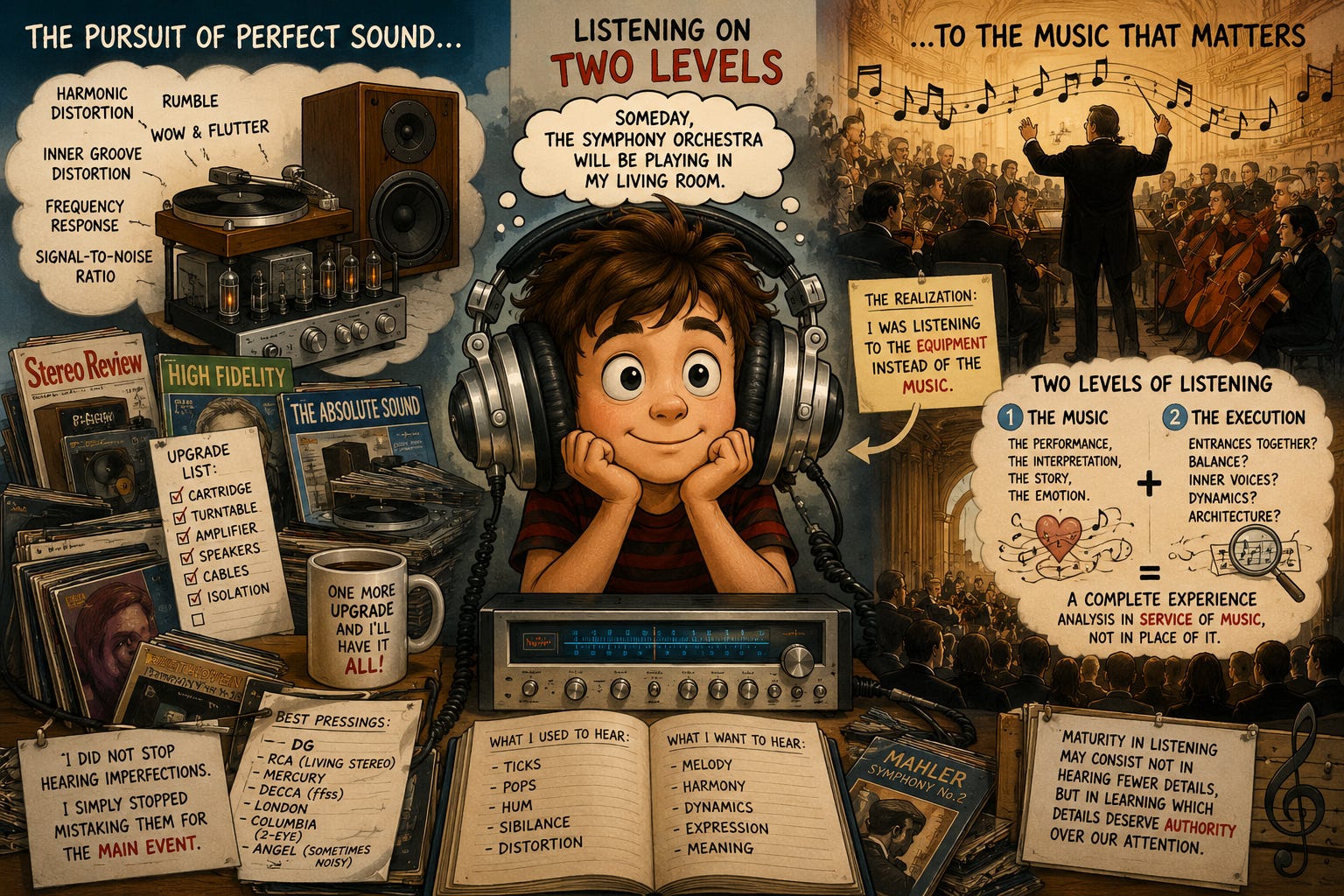
There is probably a generation of men who experienced the heyday of hi-fi audio who can still remember the smell of stereo stores. Some men wander through hardware stores simply to handle tools and inhale the faint scent of oiled steel. Others linger in new car showrooms where rubber, upholstery, and fresh paint combine into a strangely intoxicating perfume of modernity. For a certain kind of music lover, stereo stores produced their own sensory world. There was the faint odor of electronics warming under fluorescent lights, walnut veneer speaker cabinets polished to furniture-grade perfection, and turntables suspended like scientific instruments. Salesmen spoke in reverent tones about cartridges, tracking force, and frequency response.
I was one of them.
By the age of twelve or thirteen, I had become transfixed by audio equipment. Not casually interested. Transfixed. While other children memorized baseball statistics, I memorized specifications for receivers and turntables. I learned about harmonic distortion, wow and flutter, rumble, signal-to-noise ratios, and inner groove distortion long before I knew anything useful about mortgages, taxes, or women.
The goal seemed noble enough. I wanted the symphony orchestra in my living room.
Not metaphorically. Literally.
The dream sold by the audio magazines of the era was seductive. Somewhere out there, hidden behind better cartridges, cleaner pressings, superior amplifiers, and more revealing speakers, was musical nirvana. If one assembled the system properly, one could supposedly close one’s eyes and feel transported to Symphony Hall or Carnegie Hall. The violins would shimmer. The brass would blaze. The timpani would strike with terrifying realism. Reviewers described systems with language that bordered on religious revelation.
And I believed them.
I spent hours reading equipment reviews and recording reviews. I studied the quality of different pressings with the seriousness of a graduate student preparing a dissertation. Deutsche Grammophon sounded one way. RCA shaded another. Angel records often seemed noisy. Some pressings were “warm.” Others were “clinical.” I attended audio shows where grown men wandered hotel rooms carrying jazz records like sacred texts, nodding solemnly as if evaluating nuclear reactor designs rather than loudspeakers.
Whenever a few extra dollars became available, I upgraded something.
A slightly better cartridge.
A more powerful receiver.
Speakers with flatter frequency response.
A turntable promising lower rumble and improved speed stability.
Each purchase brought a brief period of excitement. Then, inevitably, dissatisfaction returned. The improvement never quite delivered what had been promised. There was always another veil to be lifted, another imperfection to eliminate, another reviewer insisting that true realism remained one purchase away.
In retrospect, the psychology resembles addiction more than hobbyism. Audiophilia often presents itself as the pursuit of music, but it can quietly become the pursuit of dissatisfaction. The system is never complete because completion would end the chase itself.
The strangest part was that as my equipment improved, my enjoyment of music often declined.
At first, I listened to Tchaikovsky or Brahms. Eventually, I listened to surface noise.
A tiny tick during a quiet passage would suddenly dominate my attention. Pops became intolerable intrusions. Slight distortion in a loud orchestral climax became more emotionally important than the climax itself. I began evaluating recordings less by interpretation or musical insight than by microphone placement and sonic smoothness.
I had stopped listening through the equipment to the music and had started listening at the equipment itself.
That realization arrived one day while reading an article discussing audiophiles who become so obsessed with sound quality that they cease engaging with music emotionally. The phrase struck me with uncomfortable force because I immediately recognized myself in it.
The tick had become more important than Brahms.
Oddly enough, this realization did not make me abandon listening. It made me understand that listening itself occurs on multiple levels.
One can listen to the equipment.
One can listen to the music.
And sometimes one can do both simultaneously.
That insight would later shape the way I approached music reviewing.
When reviewing a concert, I am listening at two levels all the time. Part of me is still the boy obsessed with technical detail. Were the entrances together? Were the inner voices balanced properly? Did the brass overpower the strings? Were the dynamics carefully observed? Did the conductor maintain architectural coherence across long spans of music?
That analytical layer never disappeared.
But another part of me is listening for something larger and less measurable. Is the performance communicating a musical argument? Does the interpretation sustain tension? Is there momentum, atmosphere, mystery, transcendence, humor, terror, nobility? Does the music feel alive?
Good reviewing requires both forms of listening. Too much technical focus and criticism becomes sterile bookkeeping. Too much emotional surrender and the reviewer ceases to evaluate anything at all.
The challenge is balance.
Audiophilia taught me to notice detail, texture, balance, and spatial relationships. It sharpened perception. What took longer to learn was that perception alone is not wisdom. Analysis can deepen experience, but it can also consume the experience it was originally meant to illuminate.
This is hardly unique to stereo equipment. Wine enthusiasts sometimes become more interested in detecting notes of blackberry and leather than simply enjoying the wine. Film enthusiasts freeze-frame transfers looking for compression artifacts. Photographers obsess over pixel-level sharpness while forgetting to look at the image itself.
Experts often become specialists in noticing flaws.
Classical music itself encourages this tendency. Conservatory training, competitions, and criticism can create listeners who hear almost exclusively in terms of error detection. A cracked brass note, a missed entrance, an imperfect bow change — all become disproportionately magnified. Yet live music has never actually been about perfection.
Anyone who regularly attends symphony concerts knows this. Audience members cough. Brass players miss notes. Ensemble entrances occasionally blur. Conductors misjudge balances. Concert halls color the sound unpredictably. And yet, despite all of that, the musical experience can still be overwhelming.
Perhaps that is what ultimately cured my audiophile obsession.
Real orchestras are imperfect too.
Over time, my listening changed. The goal was no longer to recreate a flawless illusion of reality in my living room. It was to encounter something meaningful through listening, even if the experience contained imperfections.
Maturity in listening may consist not in hearing fewer details, but in learning which details deserve authority over our attention.
I still notice the details. I still hear balance problems almost immediately. I still mentally evaluate acoustics, ensemble precision, and orchestral texture while attending concerts. The analytical layer remains active.
I did not stop hearing imperfections. I simply stopped mistaking them for the main event.
No posts
Comments
Nothing yet. Say the first thing.
Sign in to join the conversation.