
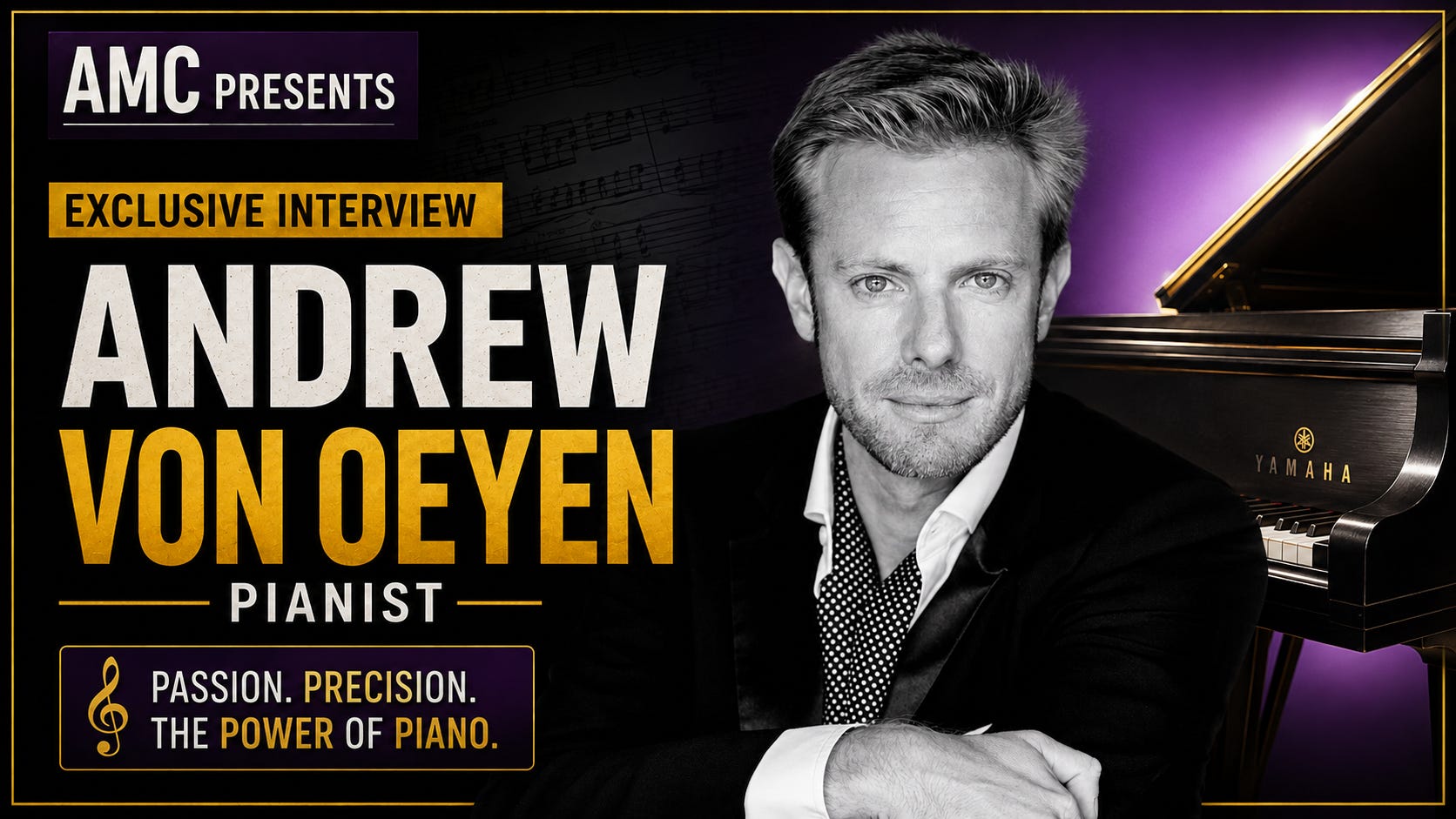
For pianist Andrew von Oeyen, performance at its best involves a peculiar disappearance of conscious effort. Technique, memory, collaboration, and interpretation have been prepared in advance so thoroughly that the performer can simply inhabit the music. “Those are the best performances when you’re literally, you’re in the moment,” he says. “You’re not thinking about what’s coming up or you’re not thinking about what you just did. You’re literally living inside the music.”
That description offers a useful way of understanding von Oeyen as a musician. His approach combines rigorous preparation with a desire for freedom, and a respect for classical tradition with considerable openness about how classical music might change. Whether discussing memorization, working with an orchestra, unconventional performance spaces, or the increasingly visual presentation of classical music, he repeatedly returns to the same underlying priority: whatever surrounds the performance should ultimately serve the music.
Von Oeyen has developed an unusually broad repertoire, something he attributes in part to studying with teachers representing several different pianistic traditions. At Juilliard, his teachers included Herbert Stessin and Jerome Lowenthal, while earlier studies exposed him to still other approaches. Rather than emerging from a single pedagogical lineage, he sees that diversity as central to his development: “I feel that I’m not a product of just one style of piano playing and comfortable in one kind of repertoire.” He describes having encountered Russian, Austro-Germanic, and French schools of playing, giving him different ways of approaching the keyboard and the literature written for it.
Memory is an important part of the freedom he seeks in performance. Music learned when young, he says, can remain remarkably durable: pieces may need interpretive reconsideration after an absence, yet the notes themselves often remain firmly embedded. For von Oeyen, performing without a score therefore has a practical artistic purpose. “I feel freer. I feel I can just listen better. I can pay more attention to my sound than if I have the score.”
He makes no doctrine of memorization and has no objection to pianists using scores. What matters is whether the performer has sufficient security to play freely. Anxiety about memory can become more distracting than the printed page itself. His preference for playing from memory is consequently personal rather than prescriptive: “At the end of the day, I care how it sounds.”
A concerto soloist may occupy the visual center of the stage, but von Oeyen describes concerto playing as fundamentally collaborative. The quality of an orchestra changes what a pianist can do because accomplished orchestral musicians anticipate phrasing, maintain rhythmic stability, and listen actively to the soloist. “They just feel where the music is going,” he says. “And they really listen to what you’re doing. And that makes your job so much easier.”
Rehearsal with a conductor can establish tempi and interpretive agreement, although von Oeyen recognizes the excitement that can come from less preparation. “Sometimes magic happens that way,” he observes. “Sometimes the lack of rehearsal really creates this energy and spontaneity.” For complex works with extensive tempo changes and strong performance traditions, however, preparation gives conductor and soloist a common framework from which that spontaneity can emerge.
Professionalism also means adapting when circumstances are less than ideal. An orchestra may be unable to sustain a desired tempo, or individual players may have practical needs that require adjustment. Von Oeyen regards compromise as part of making music with other people. “At the end of the day, it’s a collaborative process,” he says. His goal is to make “the music sound as good as possible,” even when that means abandoning an interpretation he might otherwise prefer.
Von Oeyen’s international career has given him an opportunity to observe striking differences among classical-music cultures. He is particularly enthusiastic about performing in Japan, where he points to excellent halls, instruments, technicians, organization, and knowledgeable audiences. His explanation for the vitality of classical music there is refreshingly straightforward: “Again, that’s because of education.”
That principle extends well beyond any single country. “At the end of the day, I think it just comes down to, again, education and what you’re exposed to,” he says. Where music education is valued, he sees greater potential for concert attendance, subscriptions, listening, and recording consumption. The health of classical music therefore depends partly upon creating familiarity with it long before someone is expected to purchase a concert ticket.
Von Oeyen also sees encouraging signs in the willingness of musicians and organizations to experiment with presentation. Classical music had relied upon familiar formulas for a long time; he sees musicians increasingly exploring social media, different venues, new forms of presentation, and new ways of talking about their work. “People are really trying all kinds of things to spur interest in what we do,” he says, adding that some experiments succeed and others do not. The willingness to experiment itself strikes him as hopeful.
That experimentation raises a more complicated question. Classical music now exists within a culture dominated by images, video, screens, and social media. Von Oeyen welcomes the greater attention being paid to visual presentation, while recognizing a potential danger: “The only risk of this is that we start to train our audiences to listen with their eyes instead of their ears.”
His solution is integration rather than retreat. Lighting, projections, clothing, and other visual elements can contribute to a performance when they are artistically congruent with the music. “If we can combine the two, I think that can be really powerful,” he says. He has experienced performances in which lighting and projections worked effectively with the music and welcomes the move away from an endlessly repeated visual formula of tuxedos, bow ties, orchestral shells, and traditional concert staging.
The venue itself can also change the relationship between performer and listener. Von Oeyen points approvingly to concerts in homes and other unconventional spaces. House concerts particularly interest him because their intimacy reconnects contemporary listeners with the environment in which much nineteenth-century chamber music was originally experienced. A recital in a residence becomes “a very different kind of experience,” both socially and acoustically.
He is similarly enthusiastic about films accompanied by live orchestra. Hearing musicians perform the score while the movie is projected changes the experience of something normally fixed and reproducible. “It makes the film come alive,” he says, while also drawing attention to a part of filmmaking audiences can easily overlook: the score itself. For orchestras, such programming can also provide valuable revenue, something he regards as a legitimate part of sustaining the institutions that make large-scale musical performance possible.
What emerges from von Oeyen’s thinking is an appealing balance. He values rigorous technique, memorization, excellent instruments, knowledgeable audiences, strong music education, and the accumulated traditions surrounding great repertoire. At the same time, he welcomes visual experimentation, unusual venues, film concerts, social media, and other attempts to change the way classical music reaches an audience.
The connecting principle is quality. Innovation works when it draws attention toward the musical experience rather than becoming a substitute for it. As von Oeyen puts it when discussing the increasingly visual character of performance, such experimentation is valuable “if the number one value is the music making itself.”
Perhaps that explains why his description of being “inside the music” is so revealing. Everything else—the training, memorization, rehearsal, instrument, conductor, hall, lighting, and presentation—is preparation for the moment when all of those things recede. What remains is the experience von Oeyen describes so simply: listening, responding, and living inside the music.
Take the survey and let them know what you think about the future of live classical music:

The ideas, judgments, and conclusions in this article are my own. I use AMC digital assistant Luchino Discounti to help organize material, refine language, and verify information.
No posts
Comments
Nothing yet. Say the first thing.
Sign in to join the conversation.