
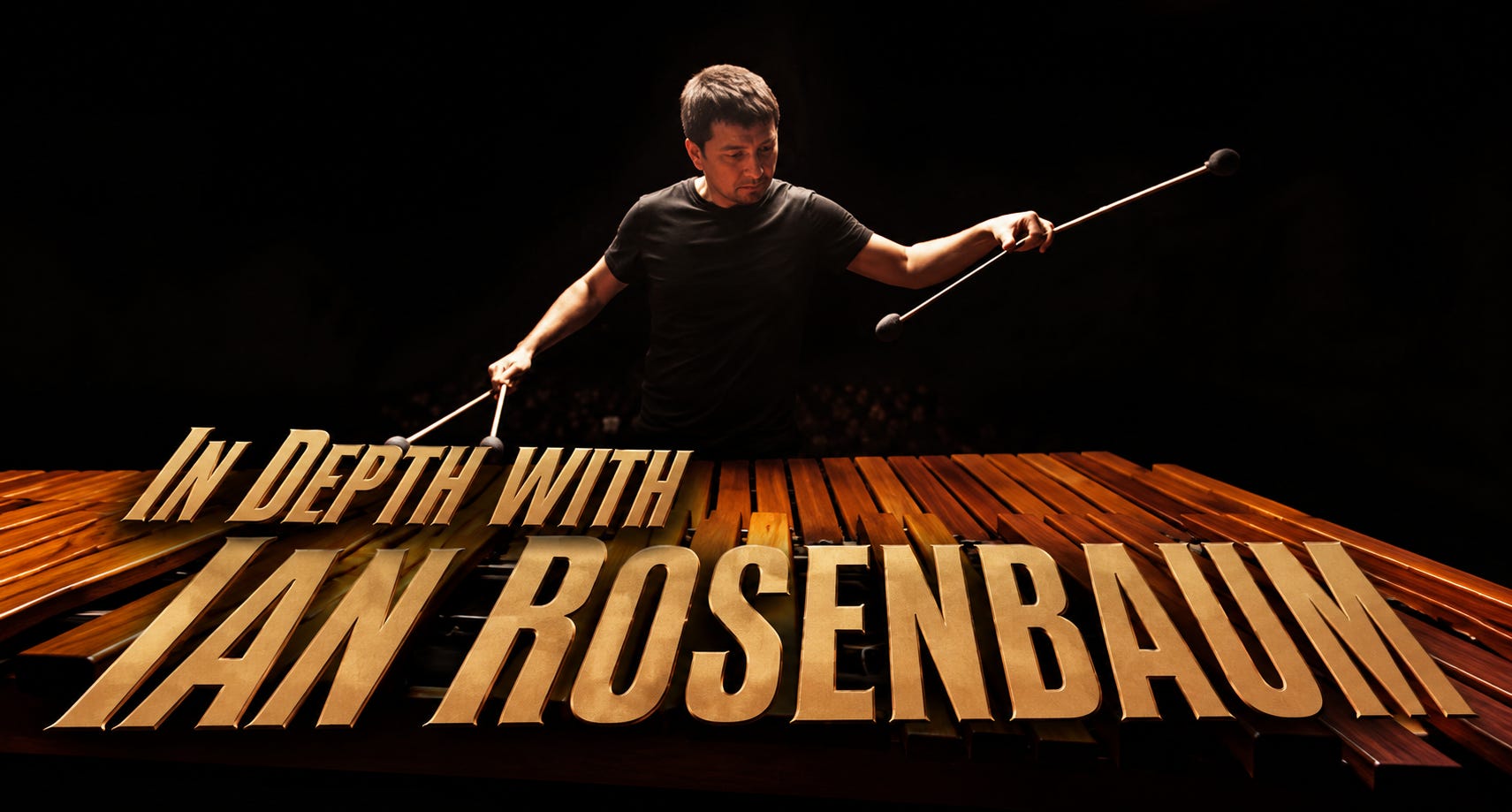
Few percussionists working today have done more to expand the possibilities of chamber percussion than Ian Rosenbaum. Known internationally as a soloist, chamber musician, recording artist, educator, and member of the Grammy-nominated ensemble Sandbox Percussion, Rosenbaum has become one of the leading advocates for contemporary percussion music and collaborative composition. Alongside an active performing career, he has also emerged as an important pedagogue, mentoring younger musicians while helping shape the next generation of percussion performance practice.
In recent seasons, Rosenbaum joined the faculty of the Manhattan School of Music, adding another dimension to a career already defined by artistic versatility. His work moves fluidly between performance, commissioning, recording production, and teaching, all connected by a larger belief that contemporary music thrives through collaboration rather than hierarchy.
Across several conversations with Atlanta Music Critic, Rosenbaum discussed the artistic philosophy behind Sandbox Percussion, the creative process surrounding the ensemble’s Grammy-nominated collaboration with composer Andy Akiho, the changing role of recording technology in classical music, and the deeper emotional and psychological questions raised by contemporary composition. What emerged was not simply a portrait of a percussionist, but of an artist deeply invested in how music is built, communicated, and experienced.
Rosenbaum’s artistic direction became clearer during his studies with legendary percussion teacher Robert Van Sise, whose influence extended well beyond technical training. Under Van Sise’s guidance, Rosenbaum developed a deep interest in chamber music and the highly personal forms of communication it demands.
“I really loved playing chamber music in small groups… I love the intimacy of those sorts of experiences.”
That intimacy became central to his musical identity. While orchestral performance offers scale and sonic power, chamber music created something different: direct human interaction between musicians and audiences.
“There’s nothing in between you and the audience. There’s no conductor, there’s no huge orchestra… it feels a lot easier to communicate what you’re trying to say.”
That emphasis on communication would later become foundational to Sandbox Percussion itself. Rosenbaum explained that long-term chamber music success depends as much on emotional compatibility and trust as on technical skill.
“It really doesn’t matter if someone is the best percussionist in the world or the fifth best percussionist in the world. If the best percussionist in the world is really not fun to work with… the fifth best percussionist is better in every situation.”
The comment helps explain why Sandbox Percussion has developed into one of the most respected percussion ensembles working today. The group’s identity is built not only around virtuosity, but around collective artistic problem solving and unusually close collaboration with composers.
Those collaborative instincts reached a new level through Sandbox Percussion’s work with composer Andy Akiho on Seven Pillars, the large-scale percussion work that became a Grammy-nominated recording and a finalist for the Pulitzer Prize in Music. Rosenbaum openly acknowledged the project’s transformative effect on the ensemble’s career.
“One of the reasons for all of the success that we found in the past few years is this big project with Andy Akiho called Seven Pillars.”
That success culminated in Sandbox Percussion receiving the Avery Fisher Career Grant, one of classical music’s most prestigious recognitions for emerging artists and ensembles. Rosenbaum recalled learning about the award almost accidentally after organizers struggled to reach him because of an incorrect phone number.
“You don’t apply and you don’t even know that you’re under consideration.”
Rather than folding the unrestricted grant into the ensemble’s normal operating budget, Sandbox chose to direct much of the funding toward future artistic development. A major portion will support a new evening-length percussion quintet by Akiho, written for the four members of Sandbox plus Akiho himself performing alongside them.
The project grew naturally from Akiho’s own frustrations while watching performances of Seven Pillars from the audience.
“Every time he comes and watches us play Seven Pillars, he wishes that he was on stage playing with us.”
That anecdote captures something essential about Rosenbaum’s artistic world. The boundary between composer and performer has become increasingly fluid. Contemporary percussion music often develops through shared experimentation, rehearsal discoveries, and evolving sonic ideas rather than through a rigid top-down model.
Rosenbaum spoke enthusiastically about the ways contemporary composers continue to reinvent traditional instruments. For him, Akiho represents one of the most original voices in that movement.
“He specializes in inventing new ways to play his instruments.”
The examples Rosenbaum described sound almost theatrical: cellists attaching clothespins to strings to create gong-like sonorities, pianists swiping credit cards across strings, percussionists constructing entirely new instruments for specific works. Yet Rosenbaum emphasized that these techniques are not gimmicks. They emerge from a search for sounds capable of expressing ideas unavailable through traditional orchestration alone.
Percussionists, he noted with amusement, have become especially comfortable navigating that experimental world.
“We’re the guys that the composers always feel like they can throw anything at us if it doesn’t exist yet.”
That openness has helped percussion music evolve rapidly over the last two decades. Rosenbaum credited ensembles like So Percussion with helping legitimize percussion chamber music as a serious professional field.
Before that shift, percussion ensembles often relied heavily on arrangements or educational repertoire. Today, leading composers actively write ambitious original works for percussion groups, dramatically expanding the repertoire and raising the artistic profile of the medium.
The conversation eventually turned toward recording technology, an area where Rosenbaum’s thinking becomes especially revealing. For Sandbox Percussion, recordings are not merely archival documents of performances. They are carefully constructed artistic objects.
The recording process behind Seven Pillars illustrates that philosophy. The album was assembled over roughly a year in multiple states and acoustic environments during the pandemic.
“If you listen to what the recordings of Seven Pillars actually sound like… they sound nothing like what the album sounds like.”
Working closely with producer and engineer Sean Dixon, the ensemble manipulated sounds extensively during post-production.
“We would take the sound of a percussion instrument like a woodblock and turn it into a shotgun blast or something.”
Rosenbaum clearly views studio production as its own form of composition. The recording becomes a distinct artistic medium rather than a substitute for live performance.
At the same time, he remains acutely aware of the importance of acoustic space in live music making. During one exchange about overly dampened concert halls, Rosenbaum agreed that excessive sound absorption can destroy ensemble blend and rob music of vitality.
“The sounds can’t blend together. You’re not getting any feedback from the space.”
Those observations reveal an artist constantly balancing two worlds: the immediacy of live performance and the limitless sculptural possibilities of recorded sound.
Rosenbaum’s reflections on minimalist composers Steve Reich and Philip Glass opened another dimension of the discussion: the psychology of musical perception.
Of Reich, Rosenbaum spoke with particular admiration.
“He completely invented, completely created a new genre of writing.”
What fascinates Rosenbaum most is Reich’s extraordinary control over gradual change and listener expectation.
“Those tiny changes… happen right when you are done listening to the last thing.”
Glass, however, creates a very different experience for performers.
“Glass is so much more difficult… staggeringly difficult compared to Reich.”
Rosenbaum described performing Glass almost as a trance state, requiring complete concentration over long spans of subtle rhythmic transformation. His comments suggest that minimalist music is less about repetition than about heightened perception, forcing both performer and listener to become acutely aware of tiny shifts in texture, pulse, and harmony.
Underlying the entire conversation was Rosenbaum’s resistance to simplistic interpretations of music. He does not believe emotional meaning exists in fixed or objective ways.
“I don’t think that a certain piece has objectively the emotion of love in it.”
Yet he equally rejects the idea that contemporary music is emotionally detached. Instead, he views musical meaning as a dynamic interaction between composer, performer, and listener.
“That is what is so special about it and why it’s such a universal language.”
That perspective also shapes his defense of contemporary music against critics who dismiss it too quickly.
“They haven’t seen a good new music concert.”
For Rosenbaum, the contemporary music world is not an isolated avant-garde niche. It is an enormous, rapidly expanding ecosystem filled with composers, performers, and ensembles exploring entirely new approaches to sound and collaboration. His own career sits near the center of that movement, bridging performance, education, recording, and artistic experimentation in ways that increasingly define what classical music looks like in the twenty-first century.
Ian Rosenbaum discussed his dual career as performer and educator, including his teaching role at the Manhattan School of Music.
Chamber music became central to his artistic identity through studies with Robert Van Sise.
Sandbox Percussion received the Avery Fisher Career Grant following the success of Seven Pillars.
The ensemble plans to use part of the grant to commission a new evening-length work from Andy Akiho.
Rosenbaum described contemporary percussion as a field built around experimentation and collaboration.
Seven Pillars required extensive recording manipulation and nearly a year of post-production work.
Rosenbaum views recording and live performance as distinct artistic mediums.
He praised Steve Reich for redefining musical structure through gradual transformation.
He described performing Philip Glass as an immersive and highly demanding experience.
Rosenbaum argued that many listeners misunderstand contemporary music because they have not encountered its strongest performances.
Video interviews and more thoughtful essays on classical music can be found at:
Atlanta Music Critic
Atlanta Music Critic on YouTube
William Ford Substack
Atlanta Music Critic Patreon
No posts
Comments
Nothing yet. Say the first thing.
Sign in to join the conversation.