
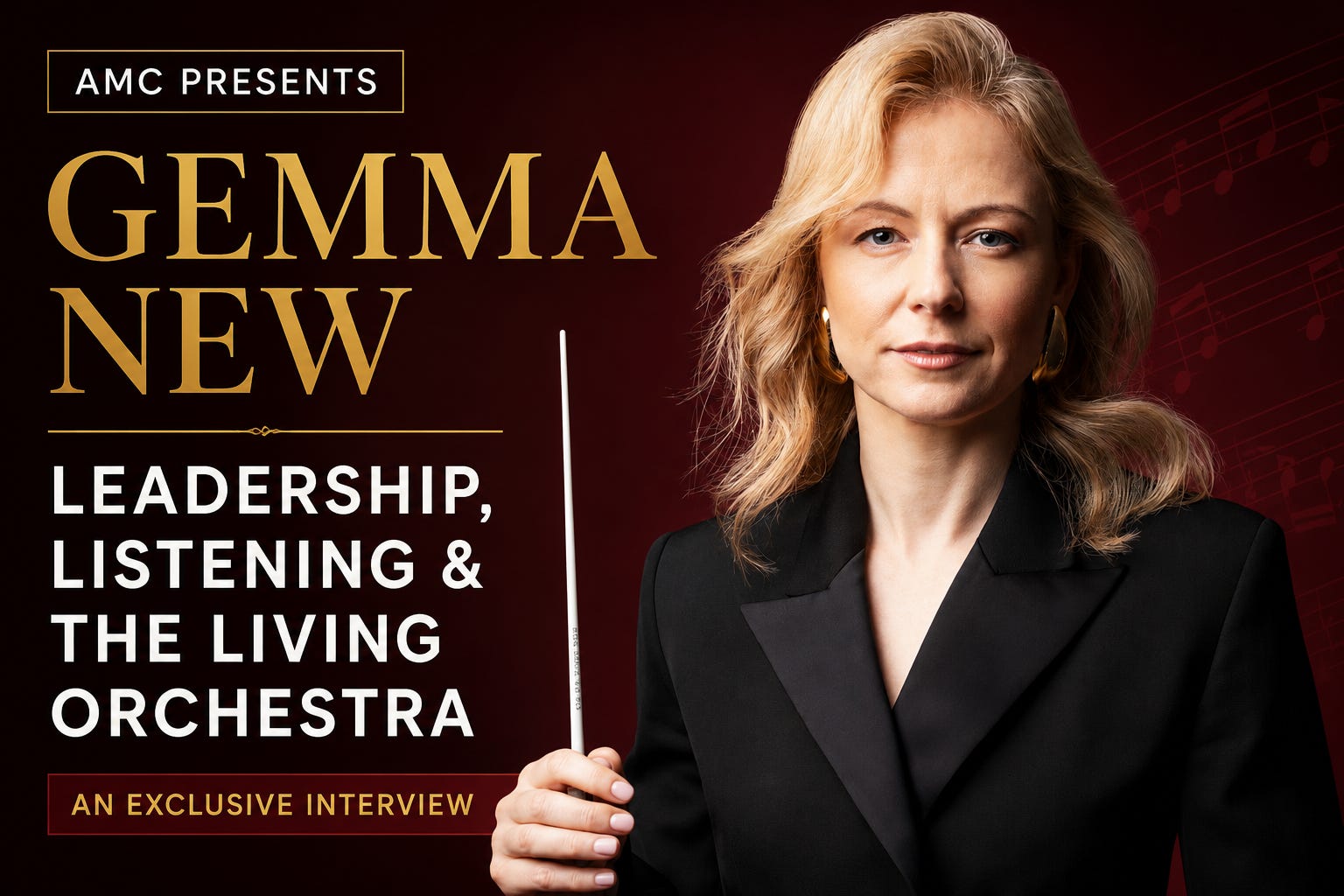
Conductor Gemma New has built an international career through a combination of technical command, intellectual curiosity, and a striking ability to adapt to the unique personality of every orchestra she encounters. As artistic advisor and principal conductor of the New Zealand Symphony Orchestra and the first female principal guest conductor of the Dallas Symphony Orchestra, New has emerged as one of the most visible conductors of her generation.
Yet despite the scale of her career, New speaks about music-making in deeply practical and collaborative terms. During our conversation, she repeatedly returned to ideas of preparation, communication, and responsiveness rather than personal mystique.
Growing up in New Zealand, music was woven naturally into daily life. “There was music on all the time,” she recalled, noting that her mother still performs violin in community orchestras.
New began violin at five and piano at seven, eventually joining youth orchestras that proved transformative. One experience in particular crystallized her future.
“At the age of 12, we were playing Pictures at an Exhibition,” she said. “At ‘The Great Gate of Kiev,’ with 200 young people playing at the top of their lungs, I thought that I want to be involved with this for the rest of my life.”
Conducting entered the picture a few years later. At fifteen, after leading an ensemble performance for the first time, she immediately recognized the fit.
“I told my best friend, ‘I want to be a conductor. This is it. This is where I belong.’”
What attracted her was not simply the sound of the orchestra, but the structure behind it. She described score study as both analytical and logical, an approach informed partly by her interest in mathematics.
“Looking at the score, seeing everyone’s parts, fascinating,” she said. “I love the analysis because I also love mathematics.”
New’s formative years included extensive orchestral experience as both player and assistant conductor. A pivotal moment came during her time with the National Youth Orchestra of New Zealand, when conductor Jacques Lacombe unexpectedly invited her to conduct during sound checks on tour. That experience eventually led to her acceptance at the Peabody Institute.
At Peabody, she studied with conductors Gustav Meier and Markand Thakar, whose approaches differed dramatically.
“They both taught completely opposite ways of conducting,” New explained. “So you are creating a toolbox of tools that you can take out at different points, either gesturally or philosophically.”
That idea of flexibility has remained central to her philosophy. Conducting, in her view, is not about imposing a single interpretive identity onto every ensemble. Instead, it involves understanding the culture, traditions, and communication style of the orchestra in front of you.
“No, I don’t think so,” she said when asked whether orchestras have become homogenized. “There are very different styles depending on where you are. And it even doesn’t have to be geographical. It can just be the ethos of the orchestra that you’re at.”
She described hearing striking differences between orchestras in France, Italy, and Canada, particularly in matters of sustain, phrasing, and transparency. In Italy, she noted, “there’s this fiery nature. Things explode.”
By contrast, she found French orchestras often favor lighter textures and more transparency, especially in repertoire such as Maurice Ravel.
New also spoke in unusually concrete terms about orchestral sound and balance. Even something as seemingly mundane as string count becomes, in her hands, a matter of artistic architecture.
“Every single week I’m asked, ‘For this future program, what do you want for the string count?’” she said. “I need to know what do you usually do, how big is your hall, what are the acoustics, what is tradition in the orchestra.”
During her nine years as music director of the Hamilton Philharmonic Orchestra, she adjusted ensemble sizes substantially depending on repertoire and practical realities. She even expressed strong preferences regarding orchestral seating.
“I don’t like uneven desks,” she explained. “I think that there should always be pairs, like Noah’s Ark.”
Her discussion of Mahler revealed another side of her artistic temperament. Rather than framing the composer primarily in terms of technical challenge, she emphasized the emotional investment musicians bring to the music.
“If an orchestra is doing Mahler just once a year, they can’t wait and they prepare for months,” she said. “They come with the most genuinely beautiful spirit.”
One of the most revealing parts of the discussion centered on what conductors actually do during performance.
New strongly rejected the common notion that conducting is largely choreographic theater.
“I get quite upset when people say that it’s choreography because I don’t think it’s that at all,” she said. “Every time that we go through the same section of music, you’ll find that my gestures are very different because I’m reacting differently to what we’ve done before.”
For her, conducting remains an active, constantly evolving exchange between podium and orchestra. Gestures shift in response to what players need in the moment, whether anticipatory support for an entrance or subtle adjustments to pacing and energy.
“It’s always really a conversation back and forth,” she explained.
That responsiveness extends to rehearsal strategy as well. In an ideal week, she said, the conductor gradually moves from broad observation toward greater specificity before ultimately backing away again during performance.
“In the concert, actually, you can then back off again,” she noted. “Things are more subtle because you have this trust.”
Over the course of a decade assisting major orchestras, New absorbed lessons from a wide range of conductors, including Gustavo Dudamel, Esa-Pekka Salonen, Leonard Slatkin, David Robertson, and Andris Nelsons.
Of Dudamel, she admired the sheer communicative range of his technique.
“Some conductors just show the vowels,” she said. “But I thought he had the whole alphabet in his hands.”
Despite spending much of her professional life immersed in classical repertoire, New admitted that listening habits outside work can be surprisingly simple.
“When I’m relaxing, I actually just listen to Taylor Swift,” she said with a laugh.
Toward the end of the conversation, New reflected on programming philosophy, emphasizing trust between conductor, orchestra administration, and audience.
“When you program a concert, I don’t think as a conductor you should go in and say, ‘I want to do this piece,’ especially if you don’t know the orchestra,” she said.
Instead, she believes artistic planning succeeds when repertoire choices emerge from a broader understanding of the orchestra’s culture, audience, and season design.
“It has to be what’s right for the audience and the musicians and the time,” she explained.
That collaborative instinct may ultimately explain why New has connected so successfully with orchestras across multiple continents. Beneath the technical command and international résumé lies a conductor deeply interested in listening, adapting, and building trust, one rehearsal at a time.
Highlights from the Interview
Gemma New traces her decision to pursue music professionally to performing Pictures at an Exhibition as a child in youth orchestra.
She believes orchestras retain highly individual sonic identities shaped by tradition, geography, and institutional culture.
New strongly rejects the idea that conducting is “choreography,” emphasizing that gestures constantly evolve in response to the orchestra.
She views score study as both artistic and analytical, comparing aspects of conducting preparation to mathematics.
Her programming philosophy prioritizes audience, orchestra culture, and collaboration with artistic administrators.
For more interviews, essays, and commentary on classical music, visit Atlanta Music Critic.net.
Support the channel at Patreon/ Atlanta Music Critic
YouTube channel: Atlanta Music Critic YouTube Channel
No posts
Comments
Nothing yet. Say the first thing.
Sign in to join the conversation.