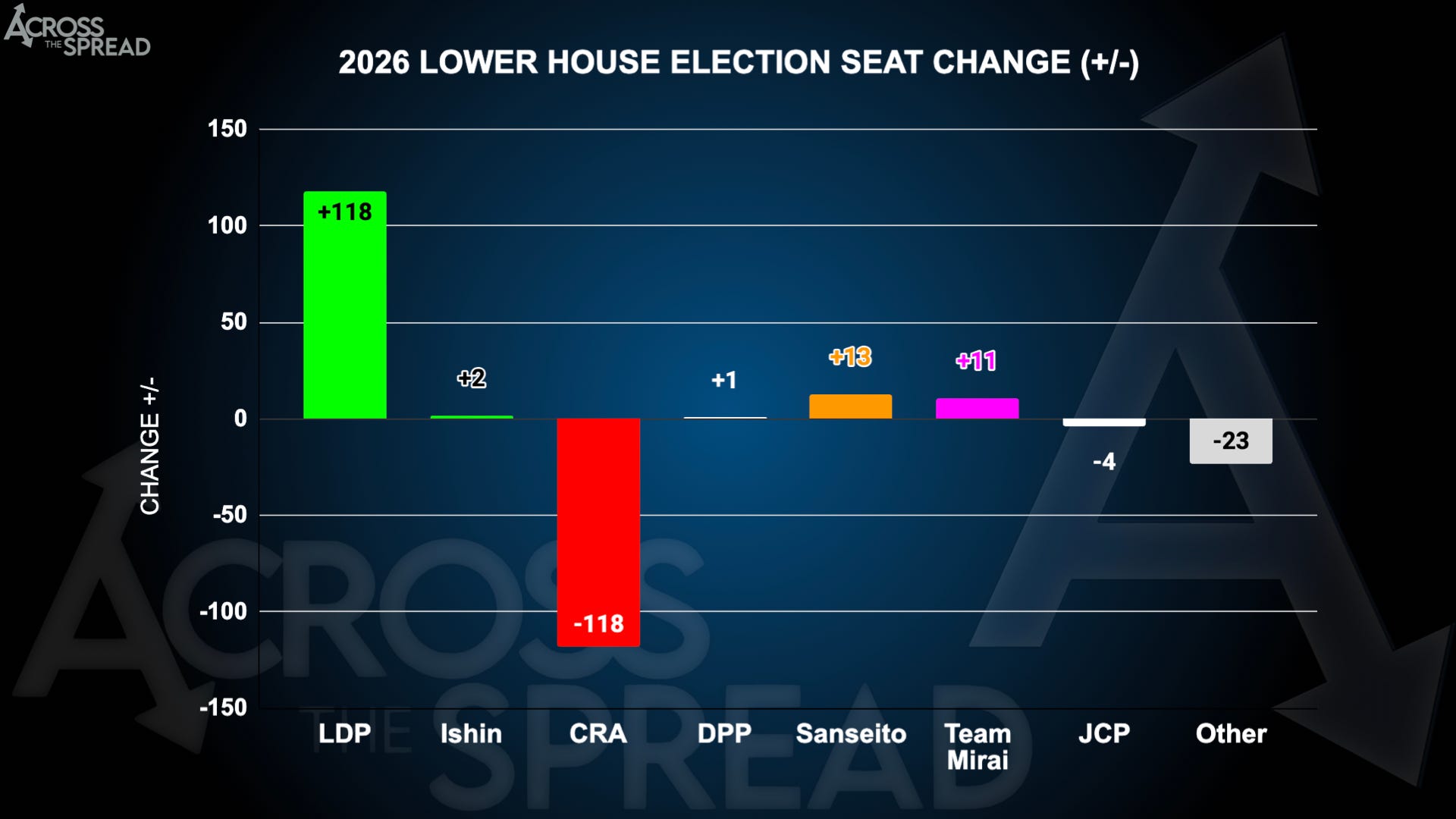
Quick cross asset market commentary following PM Takaichi’s blowout snap election victory resulting in LDP winning 316 Lower House seats, enough to overcome a ⅔ supermajority alone. With coalition partner Ishin’s 36 seats (a gain of +2), the ruling coalition’s immense command leaves just 113 of the 465 total Lower House seats for the rest of the opposition parties combined.
Takaichi absolutely crushed it. Not the LDP, but Takaichi alone - in fact, Takaichi crushed it for the LDP, DESPITE the LDP. She took back all of the LDP seats that Ishiba had lost, all of the seats that Komeito had pulled out, and even added more than the new coalition partner Ishin Party contributed to pull her across the 233 simple majority line to become PM - combined.
Now, Takaichi is indeed solely responsible for the wins - but elections are zero-sum. And a resounding victory at this scale of running up the scoreboard also comes at the hands of some seriously talented losers. So, I do have to point out that which I had discussed in my Part 1 article - the contributions of the CRA Party.
The CRA is, in the most literal sense, a party of losers doing what they do best - lose. I know Takaichi has unbelievable poll figures - but I always have a healthy skepticism of polling data. The formation of CRA in clear panic reaction to this extremely popular Takaichi calling for a snap election, and their completely empty criticisms against Takaichi for calling a snap election in the first place (“running elections costs taxpayer money…”) - this/they are what/who showed me how popular and powerful Takaichi is.
And again, reinforced this election being purely about Sanae Takaichi, the individual, as Prime Minister. For or against. The “against” option is a 20-day-old party whose founding members maintain separate party structures in the upper chamber, whose flagship policy position was abandoned before the ink dried on the merger agreement, and whose fiscal platform is funded by a sovereign wealth fund that exists exclusively in PowerPoint.
Well, turns out that spectacular clowns don’t make for votes. The CRA merger “party” went from 167 combined seats between Komeito Party + CDP in their 20-day long history of existence, to 49 when votes were counted, for a loss of -118 seats.
Which happens to be the number of seats that LDP gained.
This doesn’t mean LDP directly took CRA’s seats away in a clean 1-for-1 manner - they’re scattered, although of course many LDP gains were at the expense of CRA’s well deserved losses. What it does mean is what I said from my article above (which I published before any of the election results came out), summed up with the following, also from the same article:
I’m just going to be direct, no intention of being harsh - this is a political merger of losers.
…this is exactly what I’m talking about.
Nonetheless, Takaichi has scored a direct mandate to implement her policies without any opposition hurdles for the next few years.
Even though I had expected a supermajority as the likely outcome, these results - the biggest win in modern Japan history, are actually making me have to dive in and fundamentally revisit / rethink some key points and takeaways from my Part 2 that I had prepared to release upon plugging in the finals. Which is what I am doing as we speak, and will publish once done. Just put it this way - right now, global leaders, be they allies, adversaries, democratically elected or dictators, they all saw what Takaichi just did and are thinking over what it means for themselves respectively, some will find it makes no difference, and others are back to the drawing board. Like China and the United States and UST holdings - that’s not some timing coincidence, and that didn’t exist in my head, or on paper, pre-election.
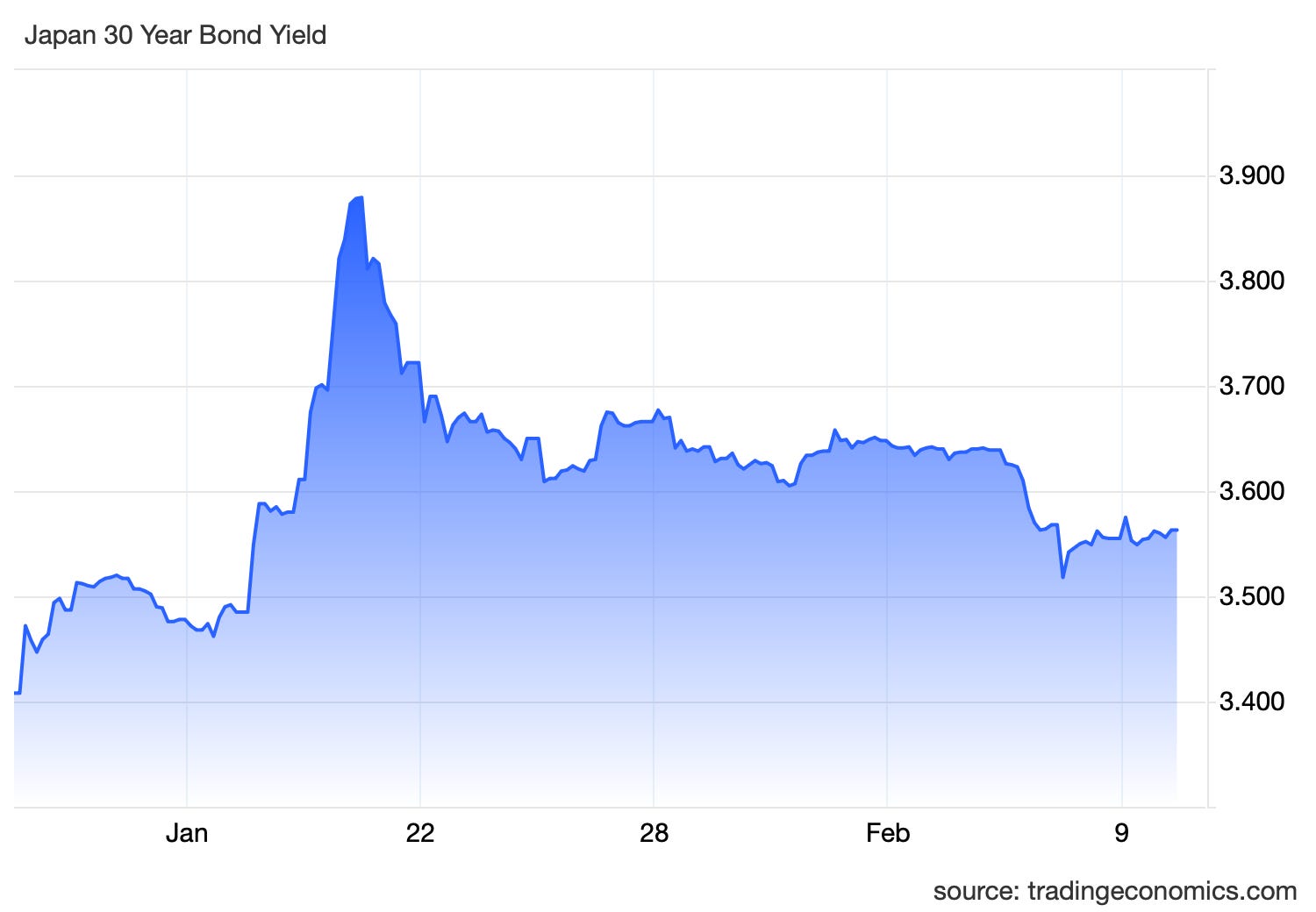
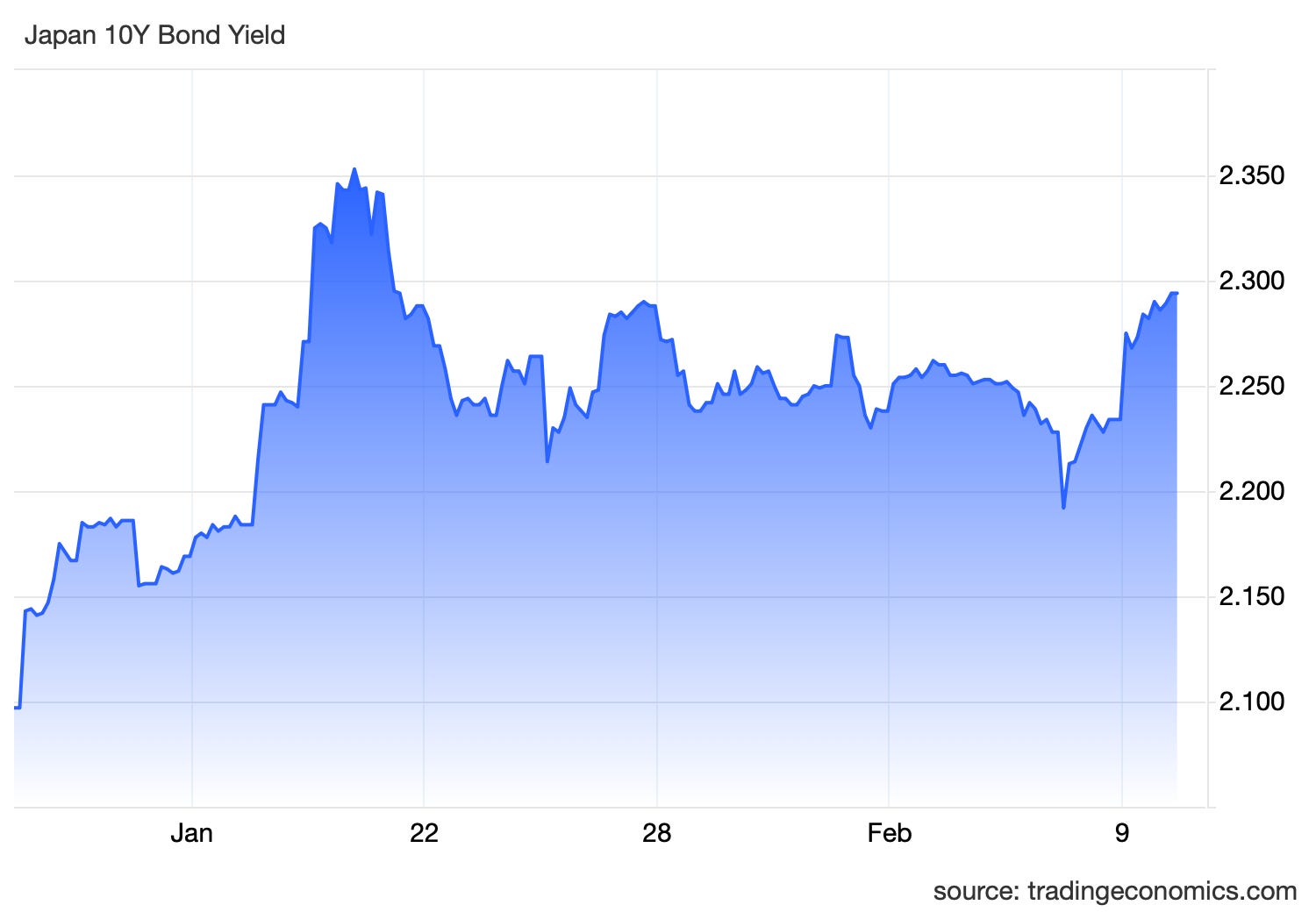
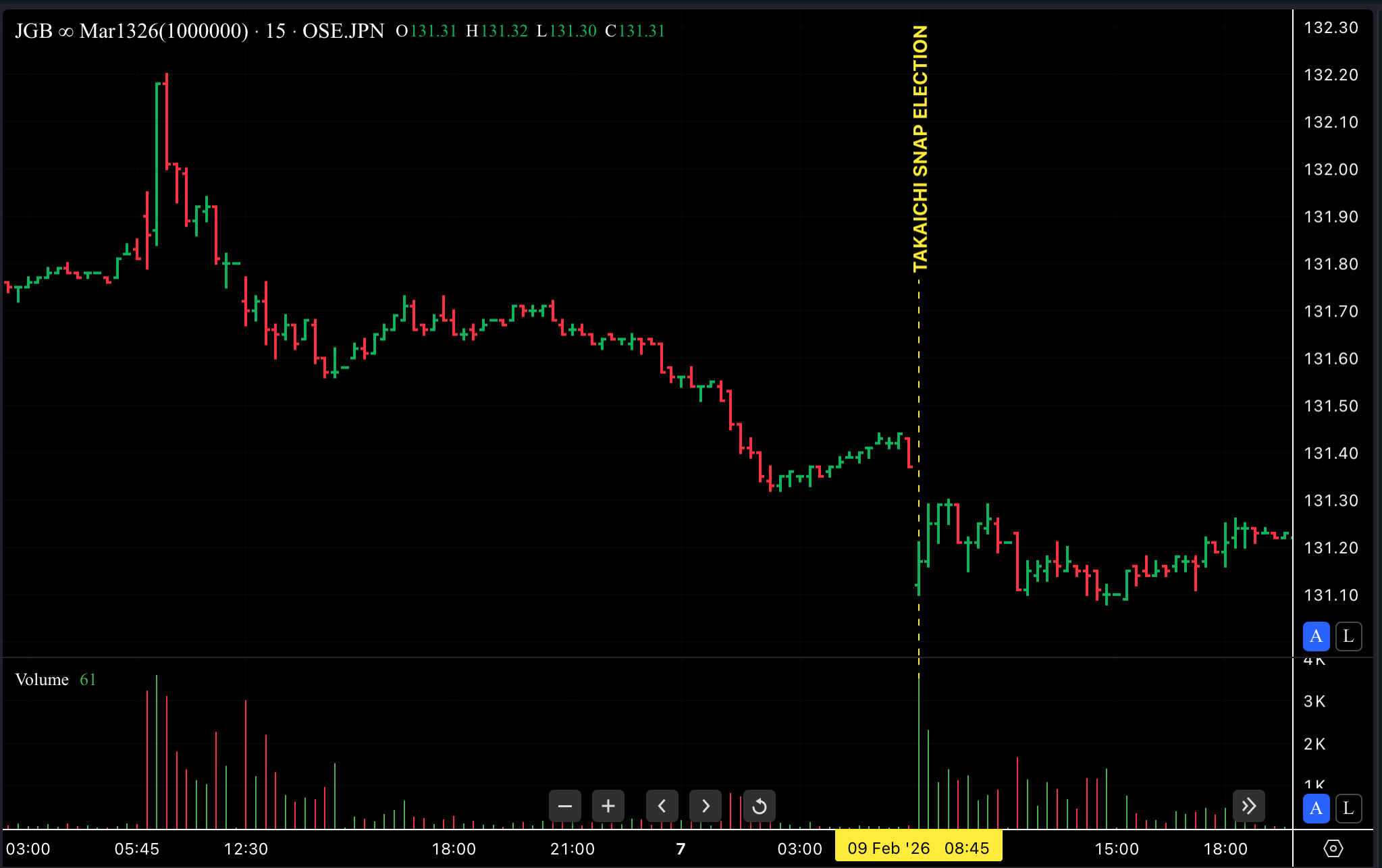
In the meantime, I just want to quickly address the immediate market reactions - because there is a lot of simplistic nonsense market commentary being spouted out there right now to indulge. By I mean this broader notion of “Looks like Japan elections ended up being a big nothing burger for markets…” as USDJPY and JGB yields declined.
Before getting into each asset class - let me just remind you - Sanae Takaichi was Prime Minister of Japan before these elections - there is no regime change that occurred, nor one that was even a potential option up for debate which now needs to be unwound. Any market reactions would be about magnitude, but directionally consistent.
FX:
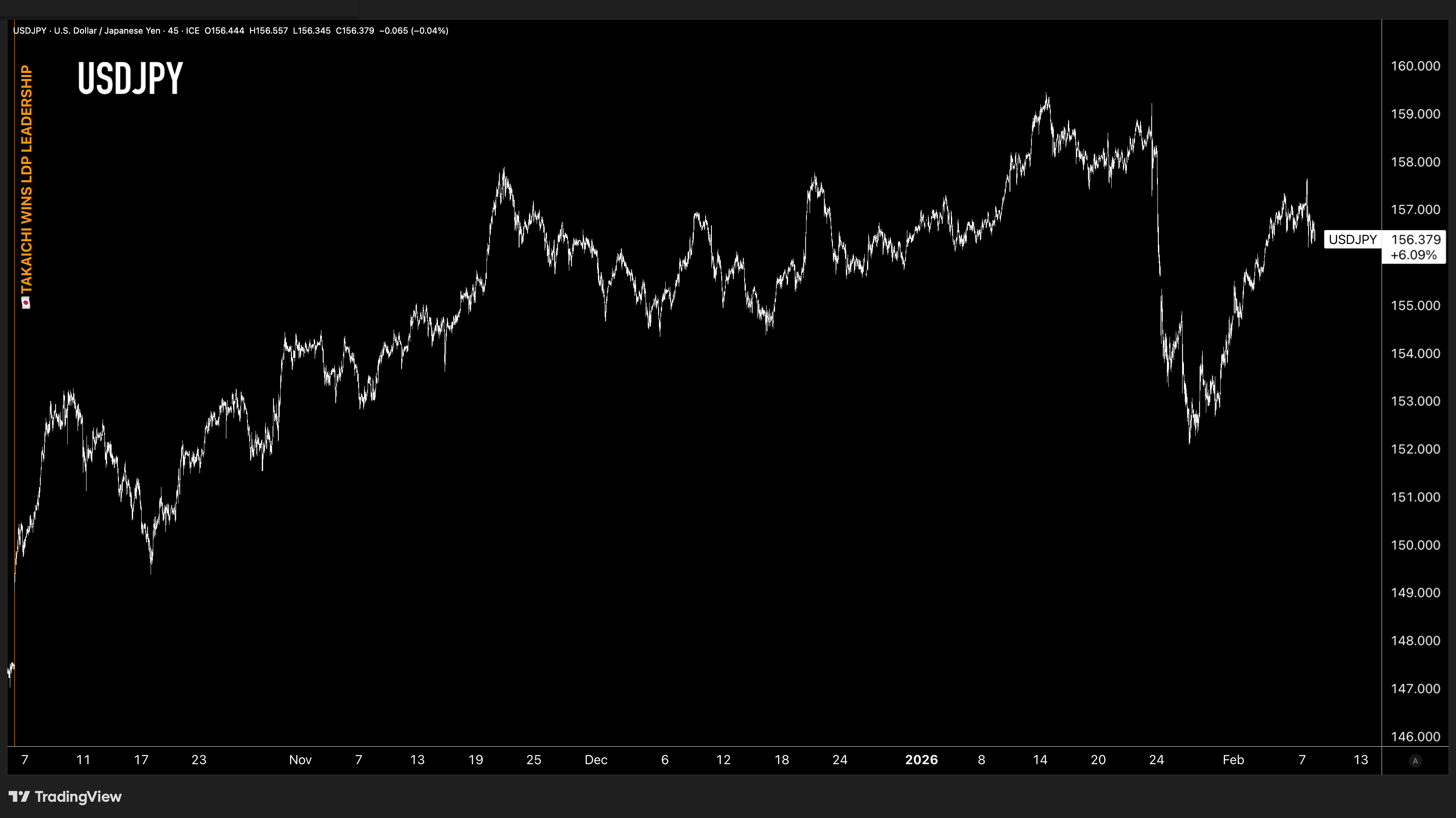
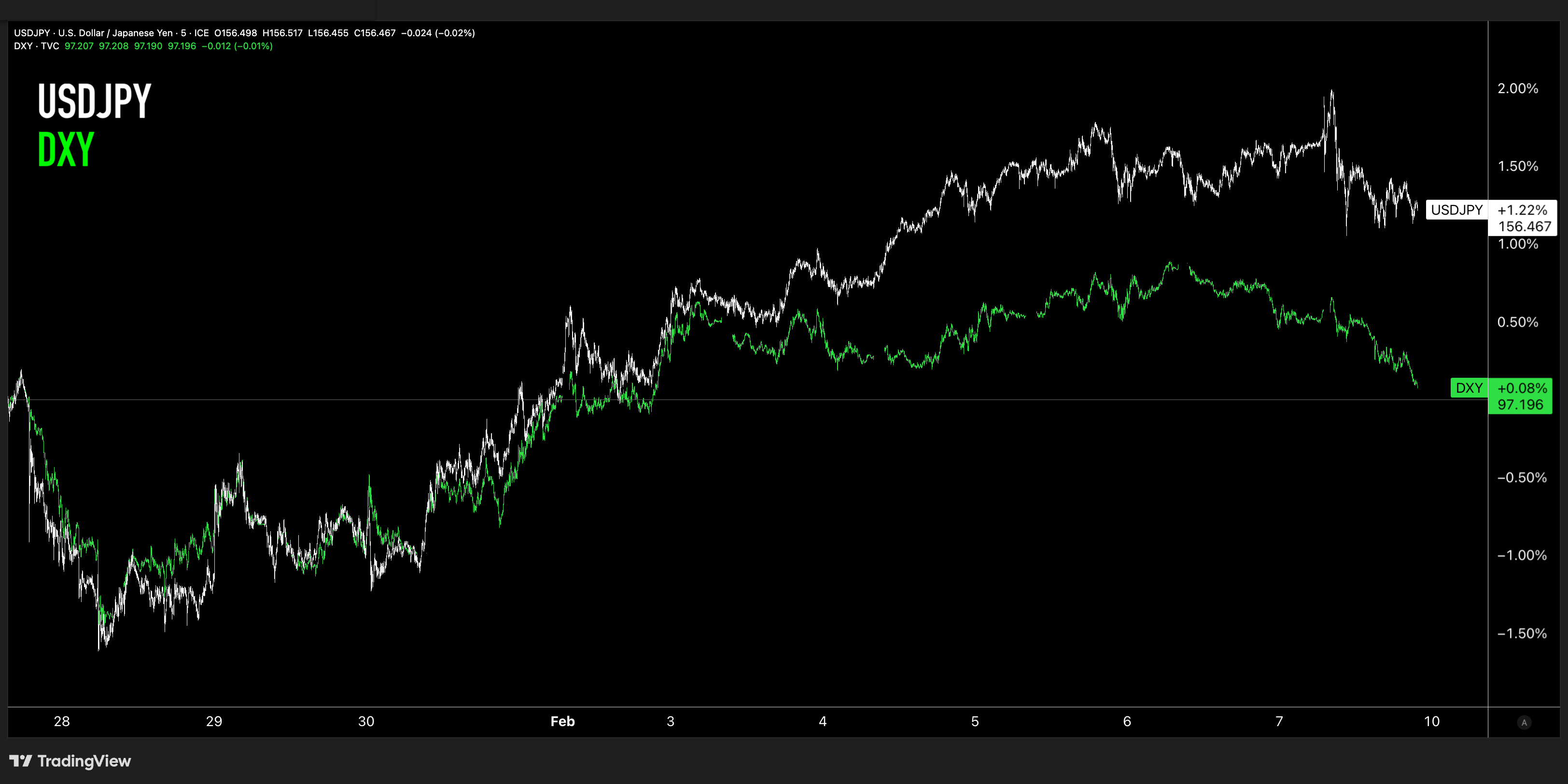
Sunday night, as election results were still coming in, MOF’s Katayama was already on the airwaves arresting any potential next-day jump in USDJPY - as well as newly empowered Takaichi herself in post-election interviews. USDJPY opened higher on Monday Asia open in the mid-157 range, and climbed to just under 158. MOF’s Katayama reappeared around 9AM to jawbone JPY strength, as did MOF Vice Minister of FX Meddling Mimura, squeezing as much fear out of still very dollar-yentervention-nervous markets as possible. USDJPY saw long position profit taking from the recent pre-election +6 yen reversal, a reasonable exit point and reason for short term traders at this juncture (including yours truly).
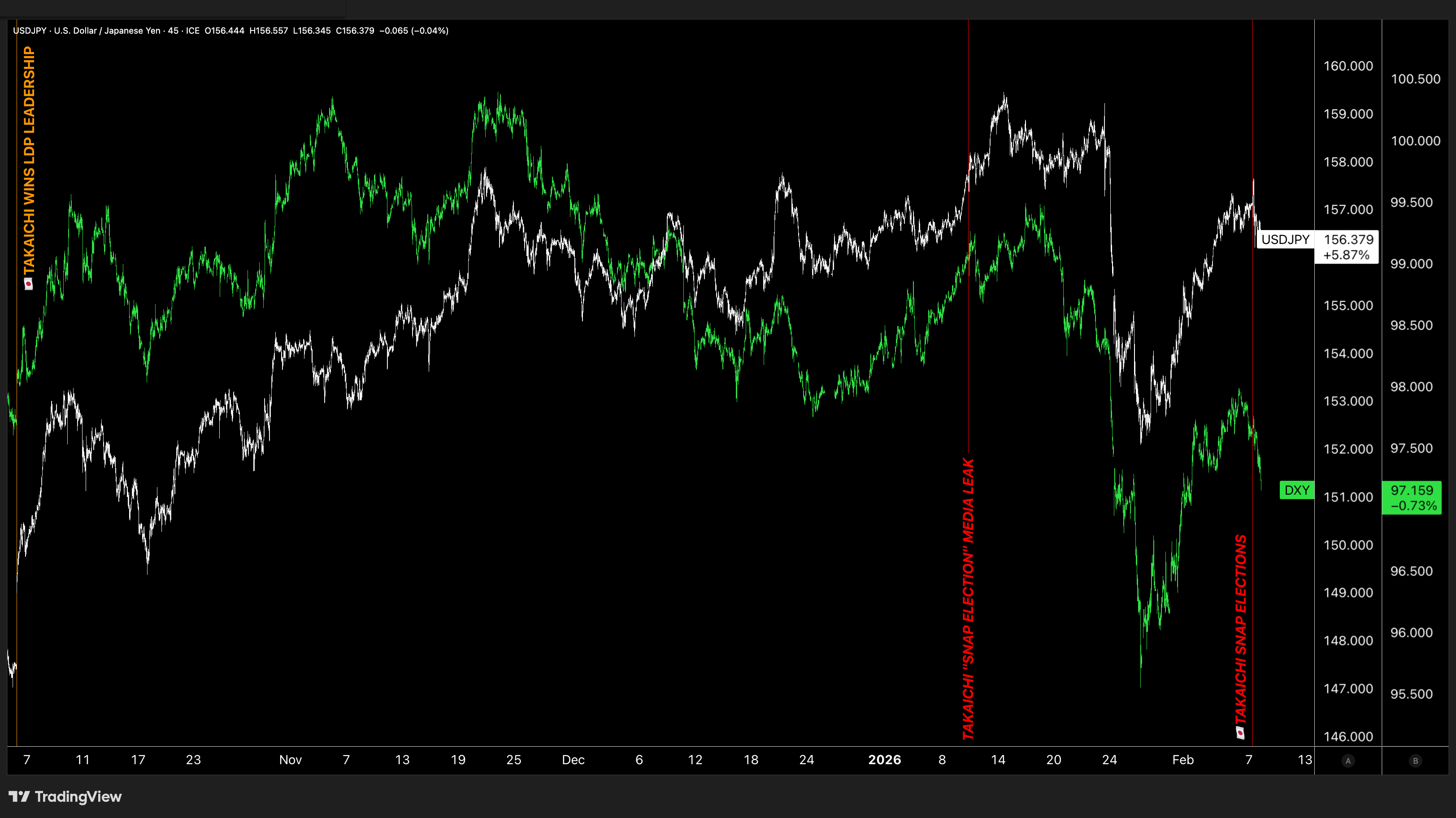
USDJPY is still in the high-150s, the upper end of the +6% range from when Takaichi won LDP leadership on October 4th.
And yes, that’s by and large a JPY-sell move, rather than a USD bid move. Broader USD is basically flat from the start of the Takaichi Era, including the fishy business of “rate checking” that occurred before the election.
And the post-rate-checking / pre-election USDJPY recovery was in part a USD strengthening move to start - but the past week heading into Japan snap election day, it was additional JPY weakness that propelled USDJPY cross above DXY. And that’s the near term election premium for which profit taking is understandably occurring upon.
Markets will continue to be wary of, and self govern a USDJPY 160 ceiling. I will get into this more in depth in the coming Part 2 piece in the context of the “NY Fed dollar yentervention rate check” - but for the immediate, there isn’t anything that the election itself would catalyze for a major repricing in spot JPY vs USD at this point. Other JPY pairs are a different story, or stories plural, given a dispersed landscape across FX. CHFJPY keeps hitting ATHs is a completely different story from AUDJPY, with RBA recently re-joining BOJ as the only two majors currently hiking rates, which is a completely different story from GBPJPY as the UK political leadership is finding its political leadership in an inverse position vs that of Takaichi’s.
Immediate term - rangebound within the 150s with a 160 cap that would blow through if not for intervention-terrified market sentiment that will take time to dissipate.
JGBs
This is where the “turns out no impact from Takaichi elections” citing “JGB long-end is flat/down after election results…” is pure markets and policy ignorance.
And I’ll even attribute the rise in 10Y JGB yields to a futures driven move.
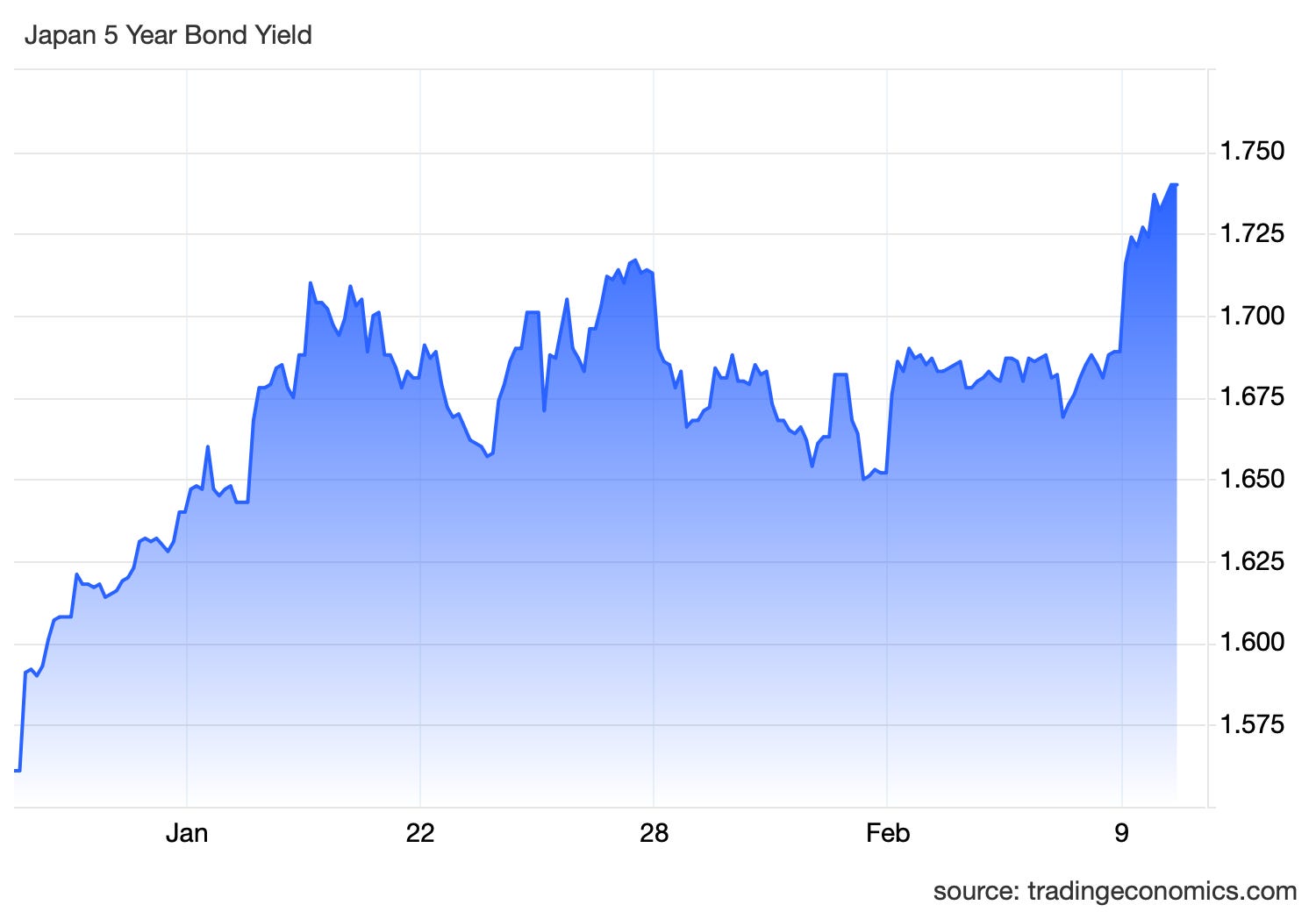
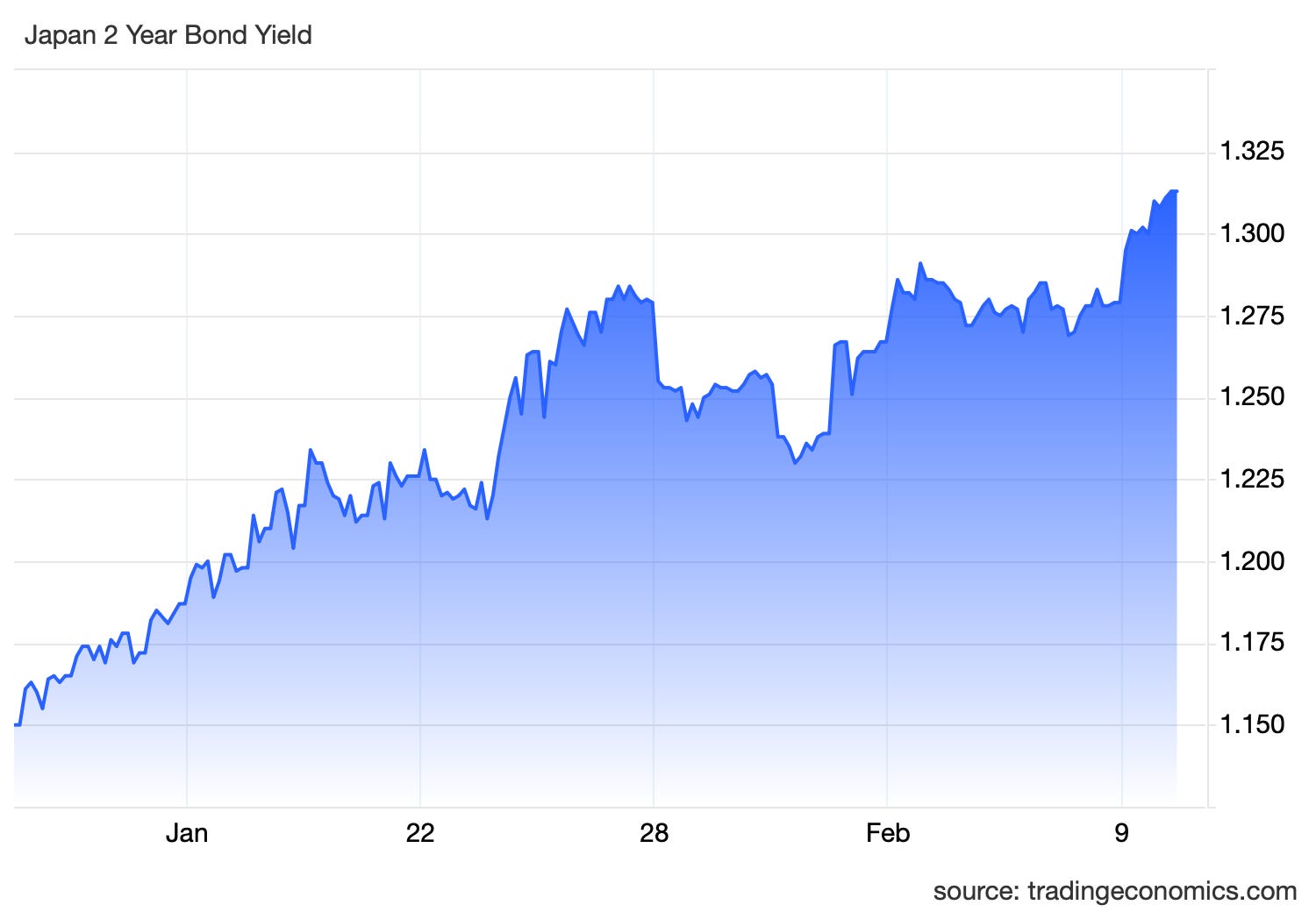
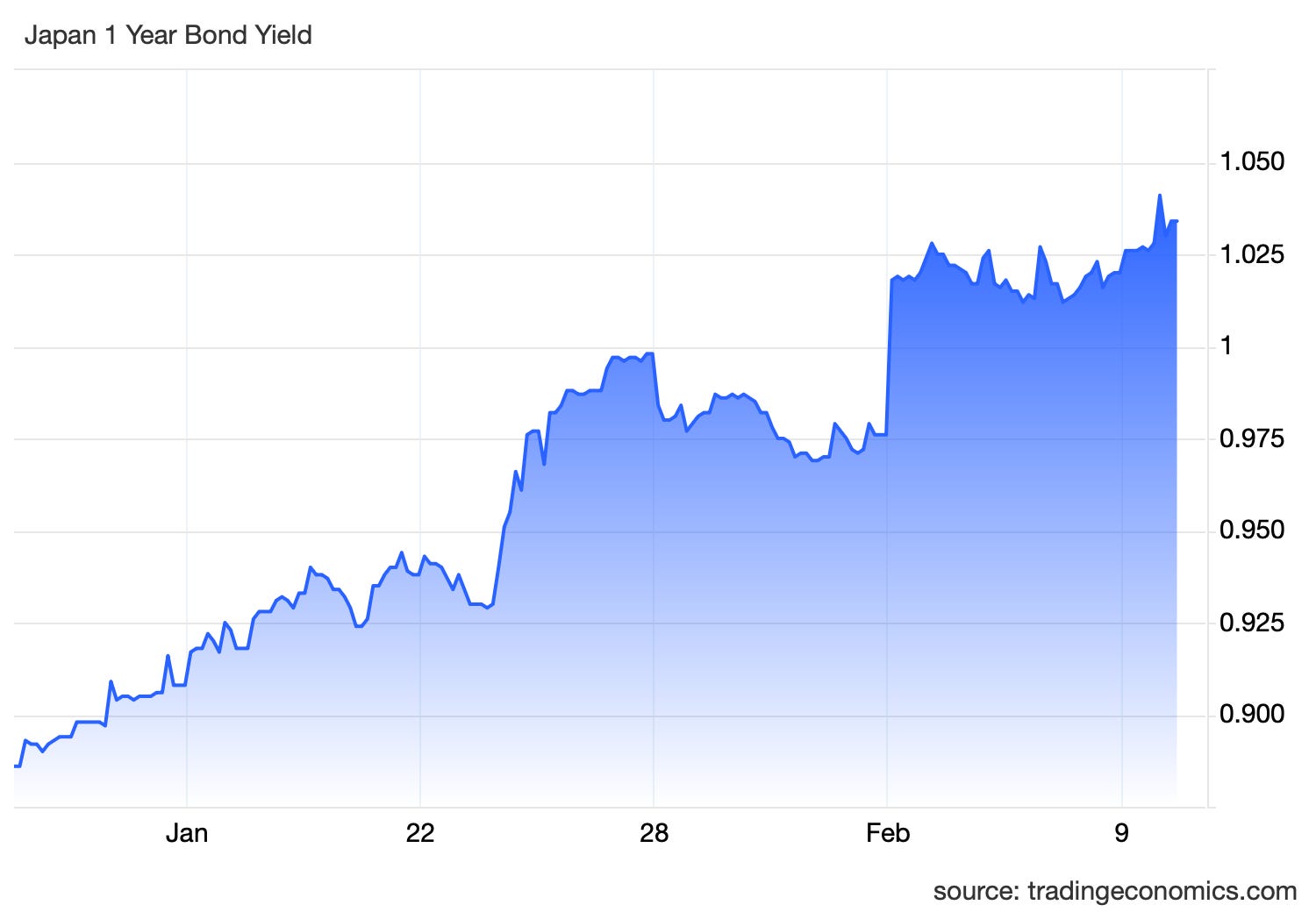
And why exactly would long-end yields move on Takaichi’s election sweep? Because of what - “fiscal spending?” Well if you were actually paying attention rather than just throwing generalities out there, you’d know that MOF’s Katayama is keeping clear of long-end issuance in their JGB funding plan, and are packing it all into shorter-duration maturities: 5Y, 2Y, and T-bills of 1Y and less.
And hence, we actually did get a JGB market response that corresponds to Takaichi’s election victory if you knew where to look.
5Y JGB yields - new all time record highs.
2Y JGB yields - new 3-decade highs.
52-week JGBs also multi-decade highs.
Read this if you doin’t know what I’m talking about with front-end issuance:
And if you’re citing the recent long-end JGB yield blowup episode that shook global fixed income in January and therefore aren’t familiar with market dysfunction, read this:
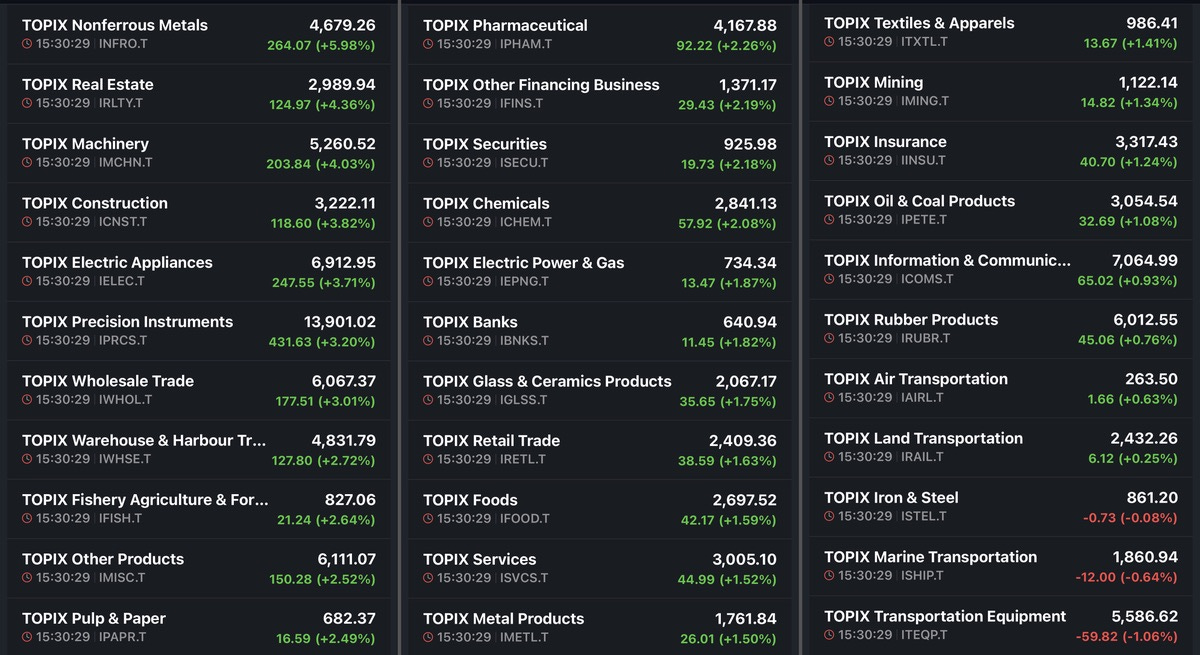
Equity markets are where the biggest and most visible market reaction to Takaichi’s sweeping victory hit.
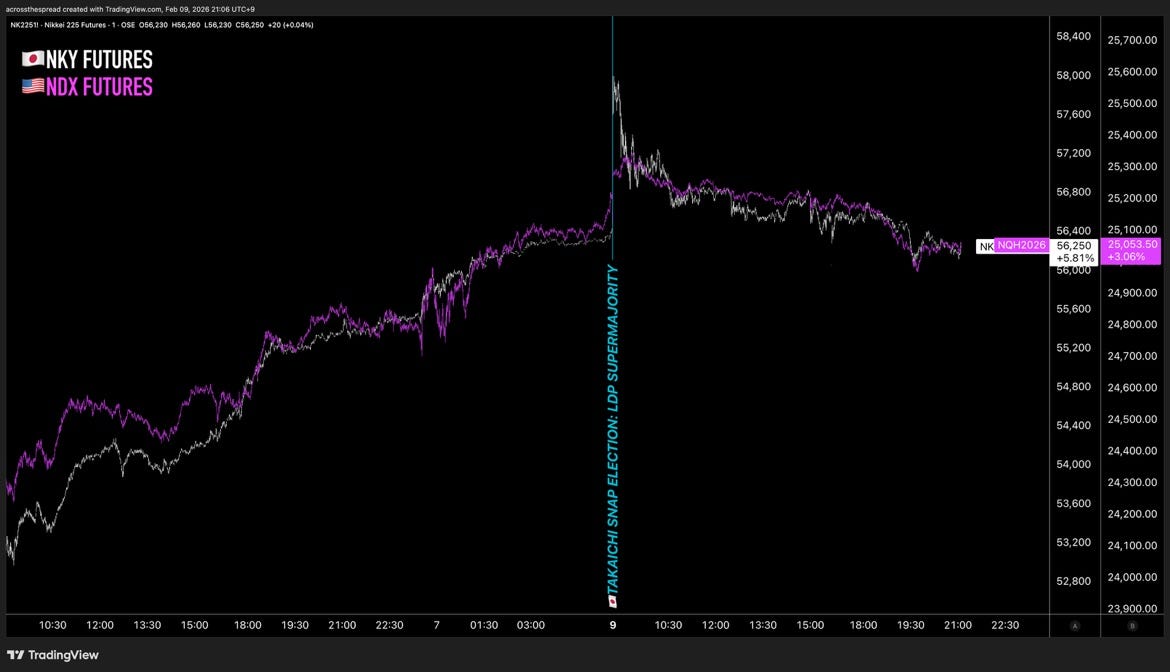
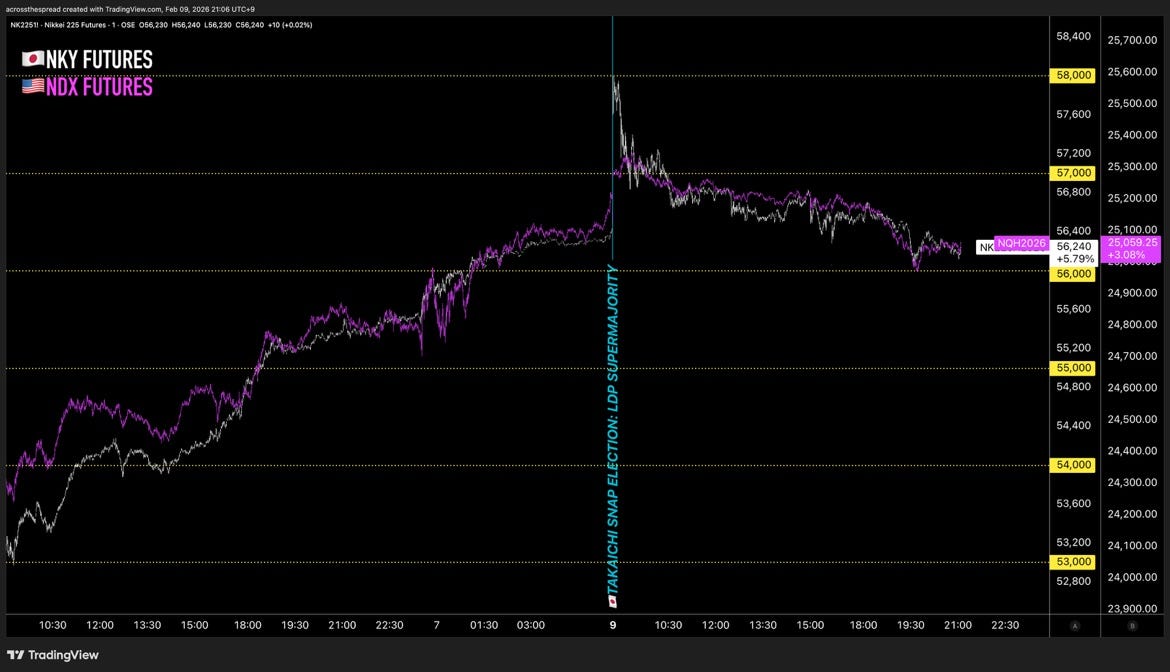
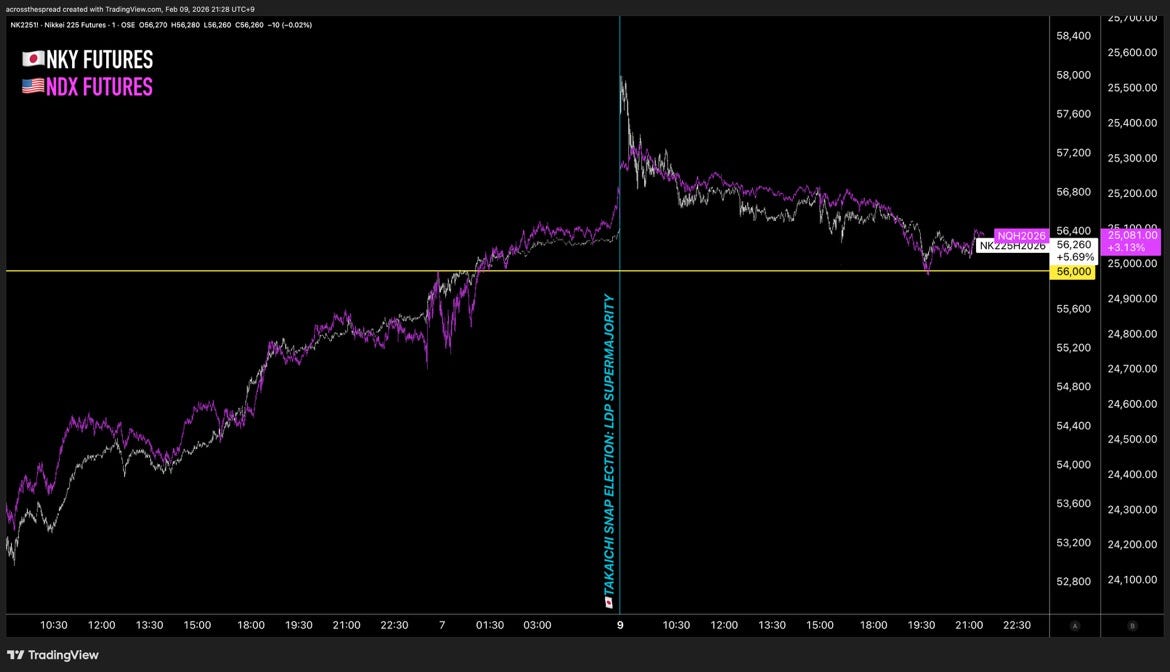
NKY cash index up nearly +4% in the first half hour of trading is exactly what I was referring to in that second scenario I posted about above, regarding the “risk-on move go vertical” part. And the “at open” part refers to NKY futures spike and crash -3.5% from its open peak right back down.
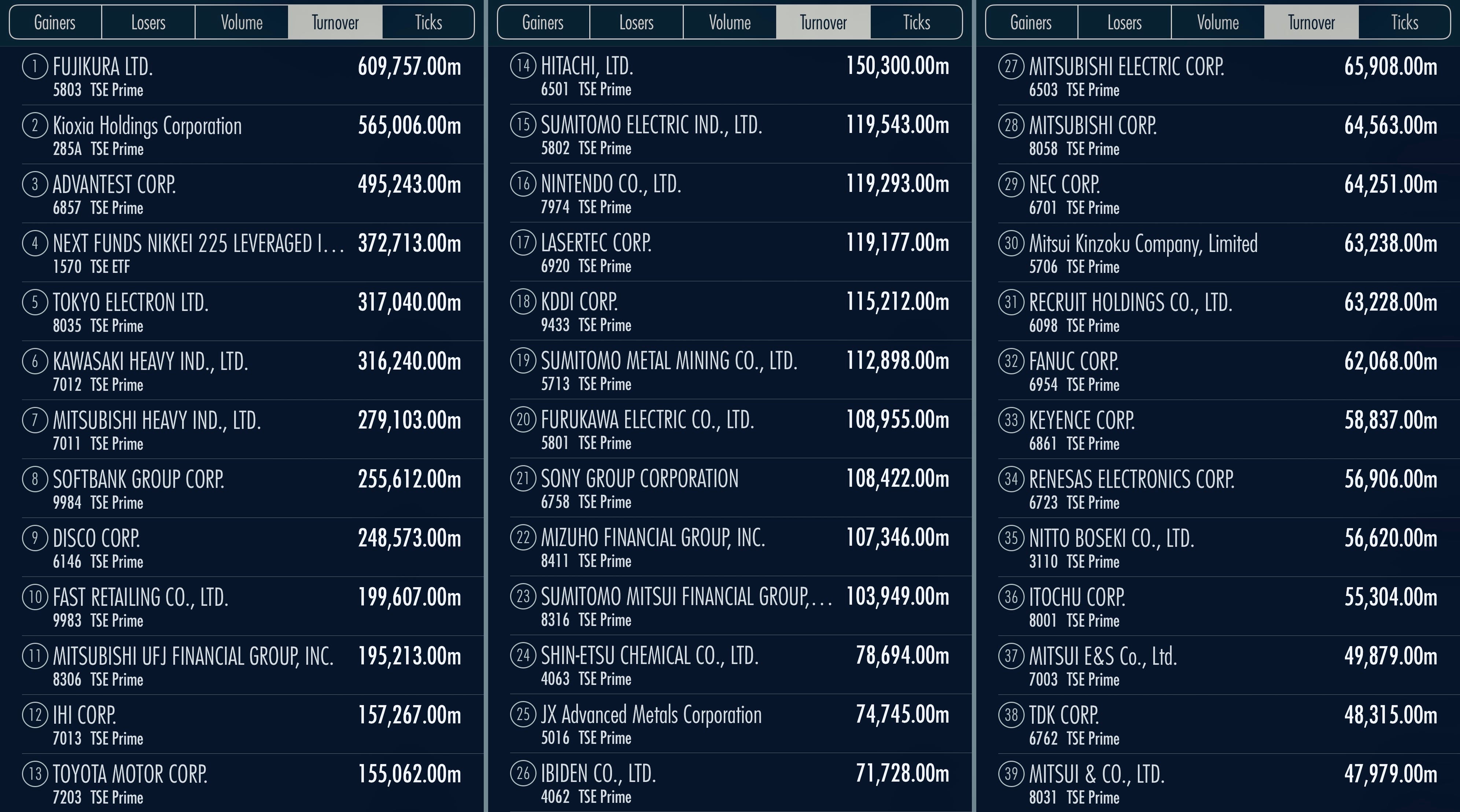
So, yes - Japan equities massively rallied off of the “Takaichi Trade.” But if you look at single stock activity on the day, it really wasn’t too much of a pure Takaichi Trade picture. Yes, the likes of Mitsubishi Heavy and other “Takaichi stocks” did well - but much of the NKY’s index gains were off of Fast Retailing (UNIQLO) and its massive rally and massive weighting.
Here’s the reality of what’s going on - not just with Japan equities, but US and global equities around the Takaichi snap election.
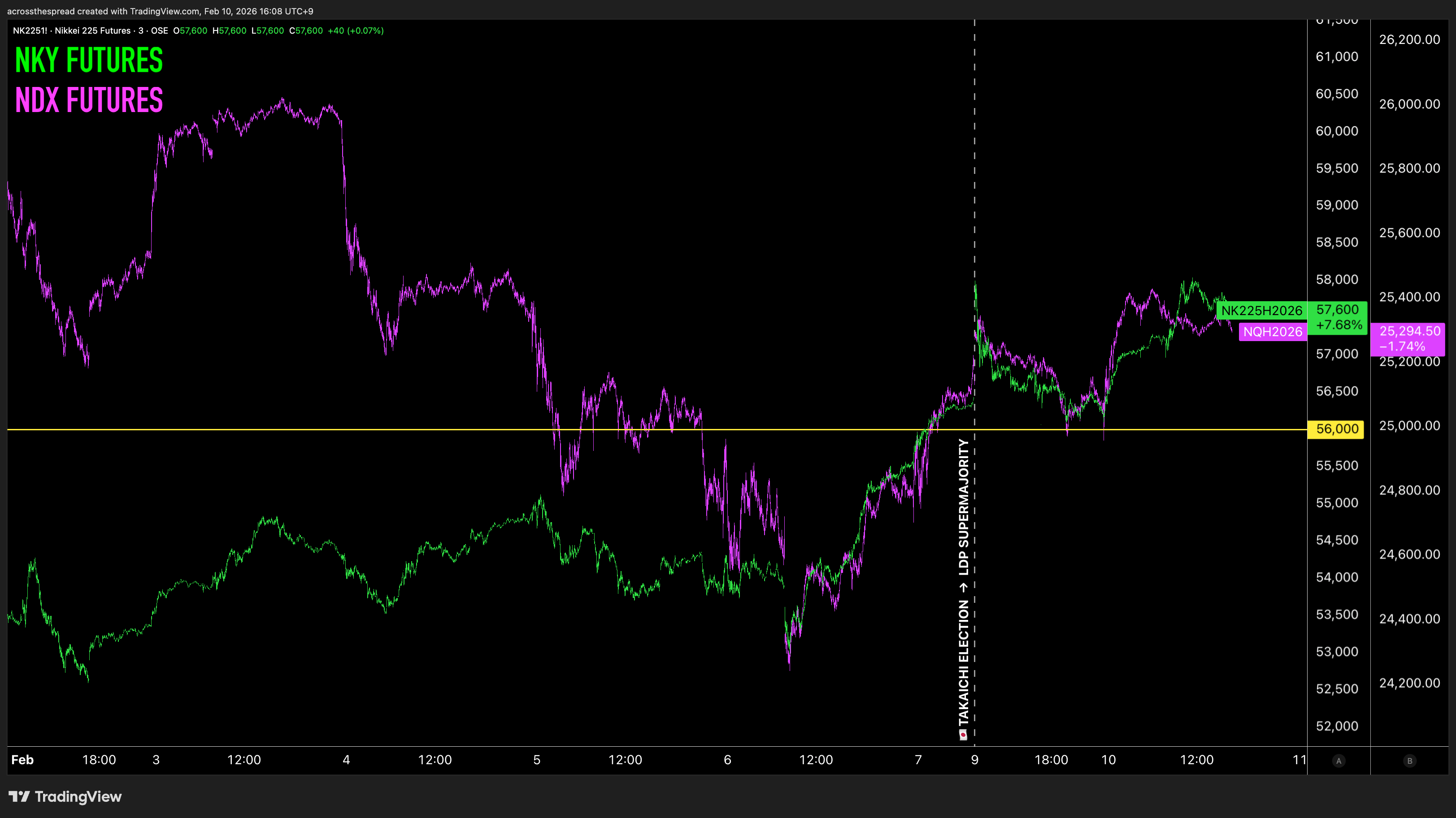
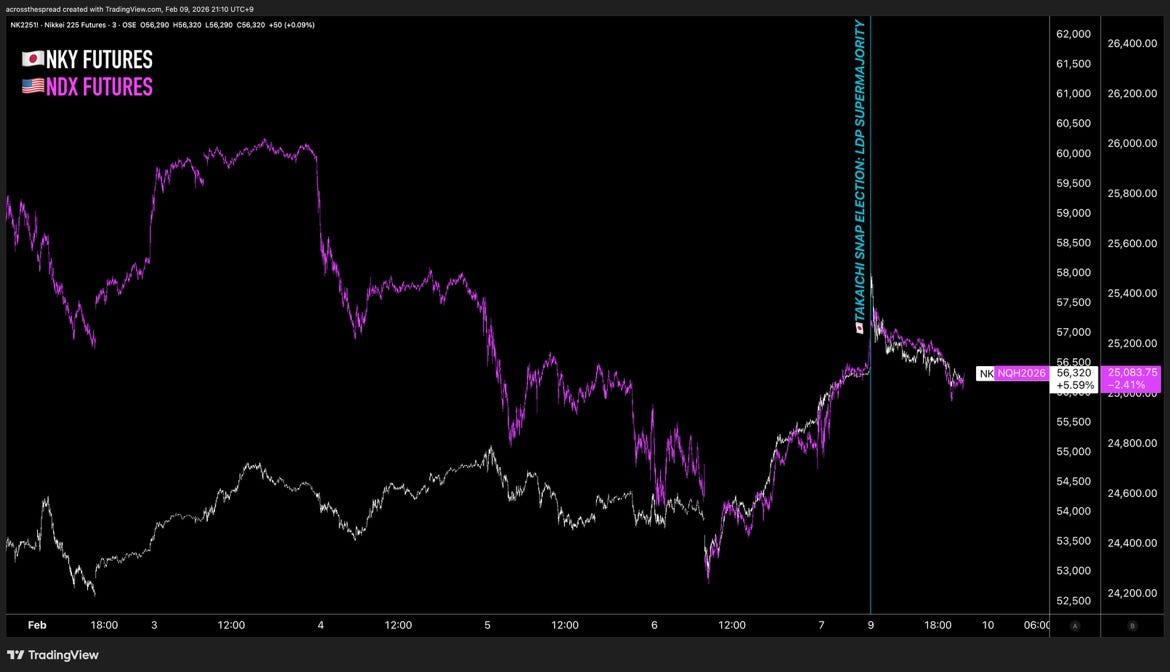
Global DM indices are being driven by NKY futures, and NKY futures, while certainly being directionally ignited by the Takaichi development, is more so governed by NKY technicals.
To my US traders - recall Friday’s big turnaround rally that clawed back some of the week’s losses - the move that had no real explanation behind it?
Yeah, that was a NKY futures driven move, which was an election play into the weekend.
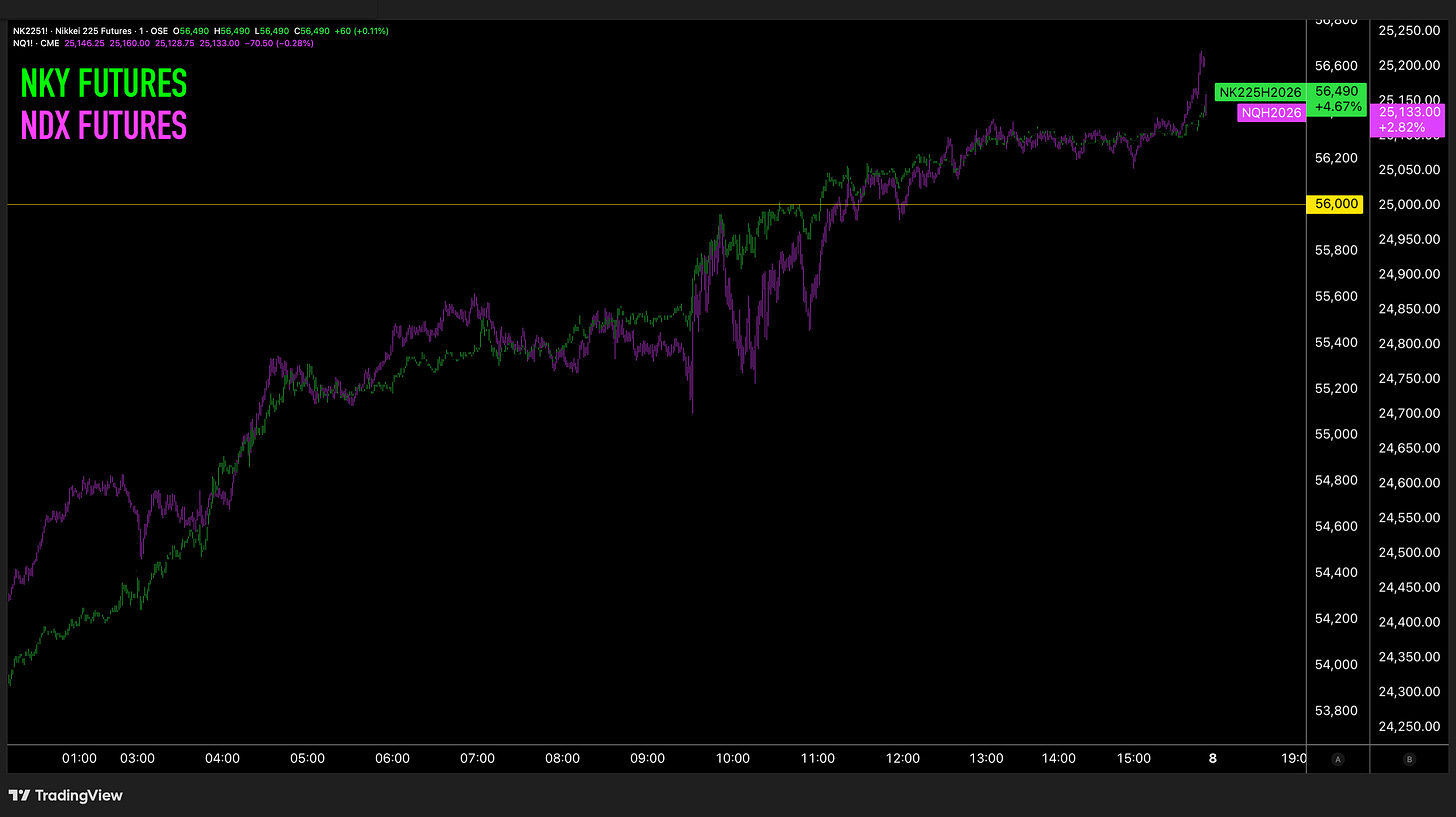
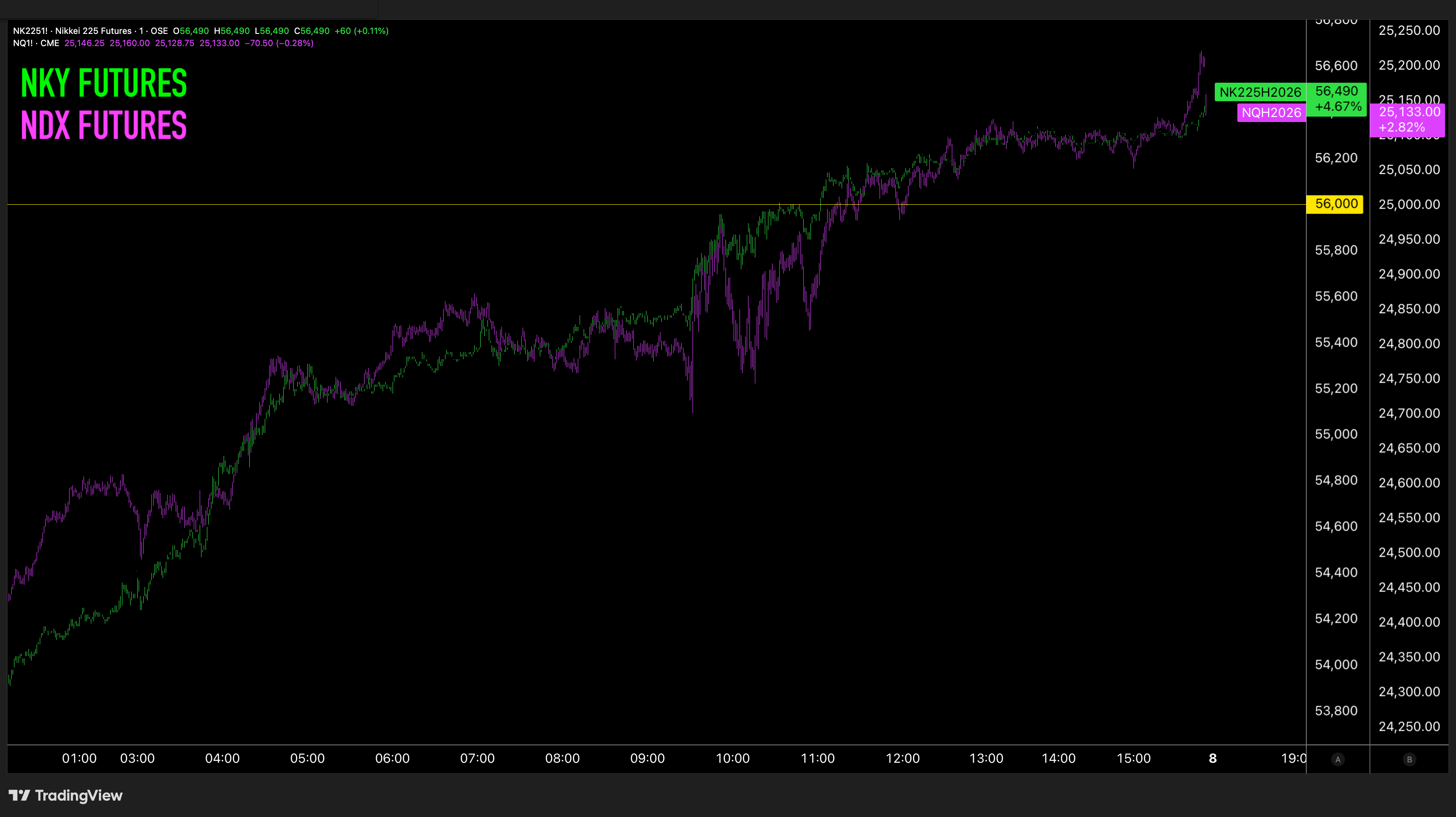
While NDX futures had a +3.5% day from session lows hit during Asia hours until US close on Friday was certainly impressive, it was driven by the +6% move on NKY futures. NDX is currently completely glued to NKY futures price action, with lower beta.
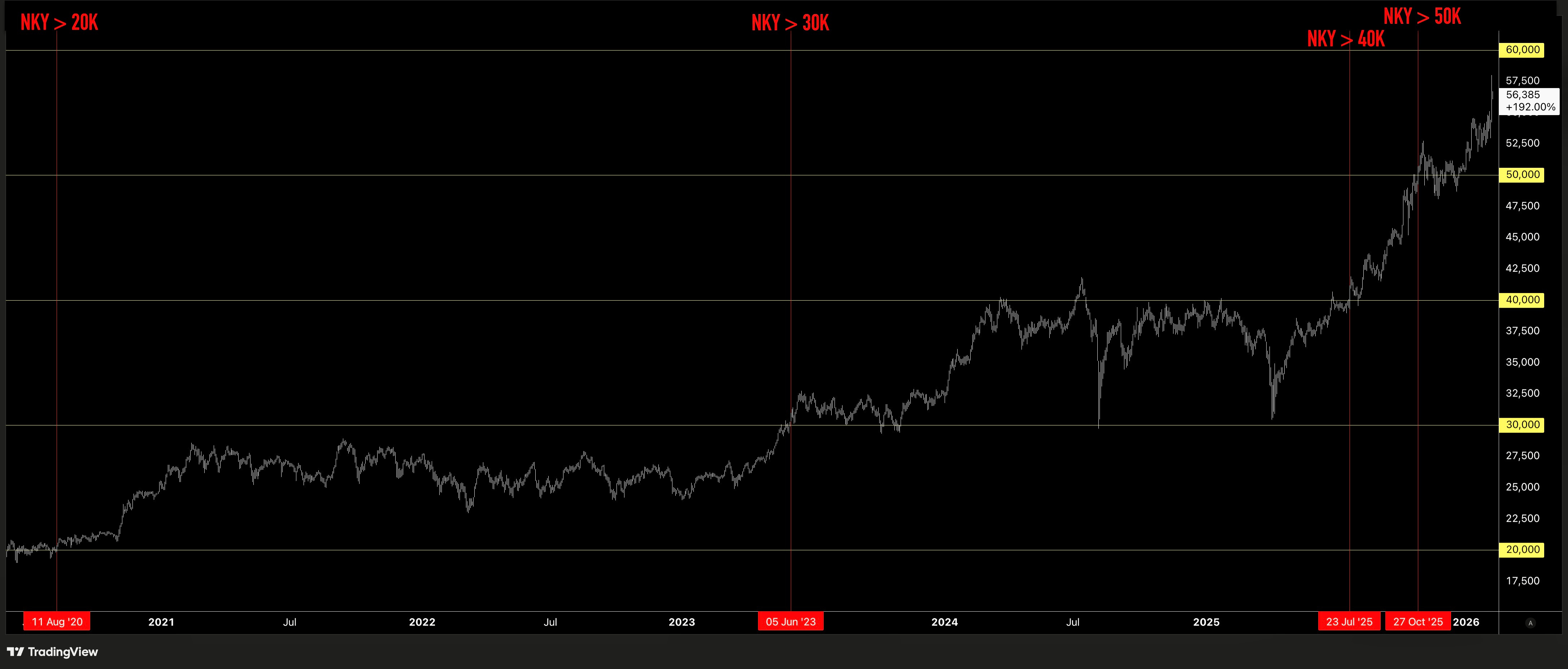
And NKY futures, as us NKY futures traders know all too well, are extremely disciplined to round-levels of support and resistance - which is why you hear us / the Japan trading community talk in / point to 1,000 pt increments for short term, and 10,000 increment levels in longer term.
NDX on Friday rallied the way it did because it was following NKY futures’ 1,000 level increment caps and breakouts - I mentioned this in my prior article:
NKY futures not only breaking new record highs, but breaking clear into the 56k level, ending +4.70% on the day (vs NDX +2.2%, SPX +2%). If you look at the intraday price action, you’ll clearly see when, and in what manner US indices’ upside performed - its pretty clear - NKY 56K was upside resistance for everything else - and so was its breakout
That framework of NKY futures support and resistance applying to US indices (NDX) still holds in the immediate aftermath of the Takaichi election.
Particularly 56,000 on NKY futures - this is support for US index futures.
That will support NDX in the immediate-term, or it will not, and if not, will crash NKY and NDX. “Crash” as in - reverse the insane +9% NKY rally that happened in just over 1 trading session on either side of the Takaichi election.
Polls just closed for the most consequential Japan election to global markets in decades. The political and markets backdrop for a landslide LDP Takaichi win, covering 6 months of Japan blowing up a 70-year political system in real time - all of which is critically necessary to understand market behavior that has been underway, in order to understand what comes next.
That’s it for now.
Thanks for your patience and stay tuned for more on the Takaichi Mandate Part 2.

Comments
Nothing yet. Say the first thing.
Sign in to join the conversation.