
This is Part 1 of 2 - pre-result article covering the last 6 months of political turmoil dramatic pathway of Japan blowing up its political system, which is critically necessary to understand market behavior over the last, and next half-year and beyond. Part 2 (after election results): what the “rate check” story is really telling you, and what the market picture looks like.
Even before the Takaichi Era began after her October 4th 2025 win of the LDP leadership race - major global macro markets have been moving to the beat of Japan political developments, as I have been pointing out at every turn. But October 4th (or rather, October 6th, the first trading day of the Takaichi Era) marks the definitive era of political developments from Japan and their material impact on global macro markets.
FX: USDJPY saw a sub-150 handle for the last time (so far) while broader USD downside stabilized - until, and with the exception of, recent speculation of dollar-yentervention support measures.

Equities: NKY had been trading percent-for-percent in tandem with NDX for much of pre- and post-Liberation Day, then suddenly broke off and surged to new record high after new record high, uplifting global indices that otherwise may very well be on a steady decline if not for foreign capital actively plowing bullish long Japan.
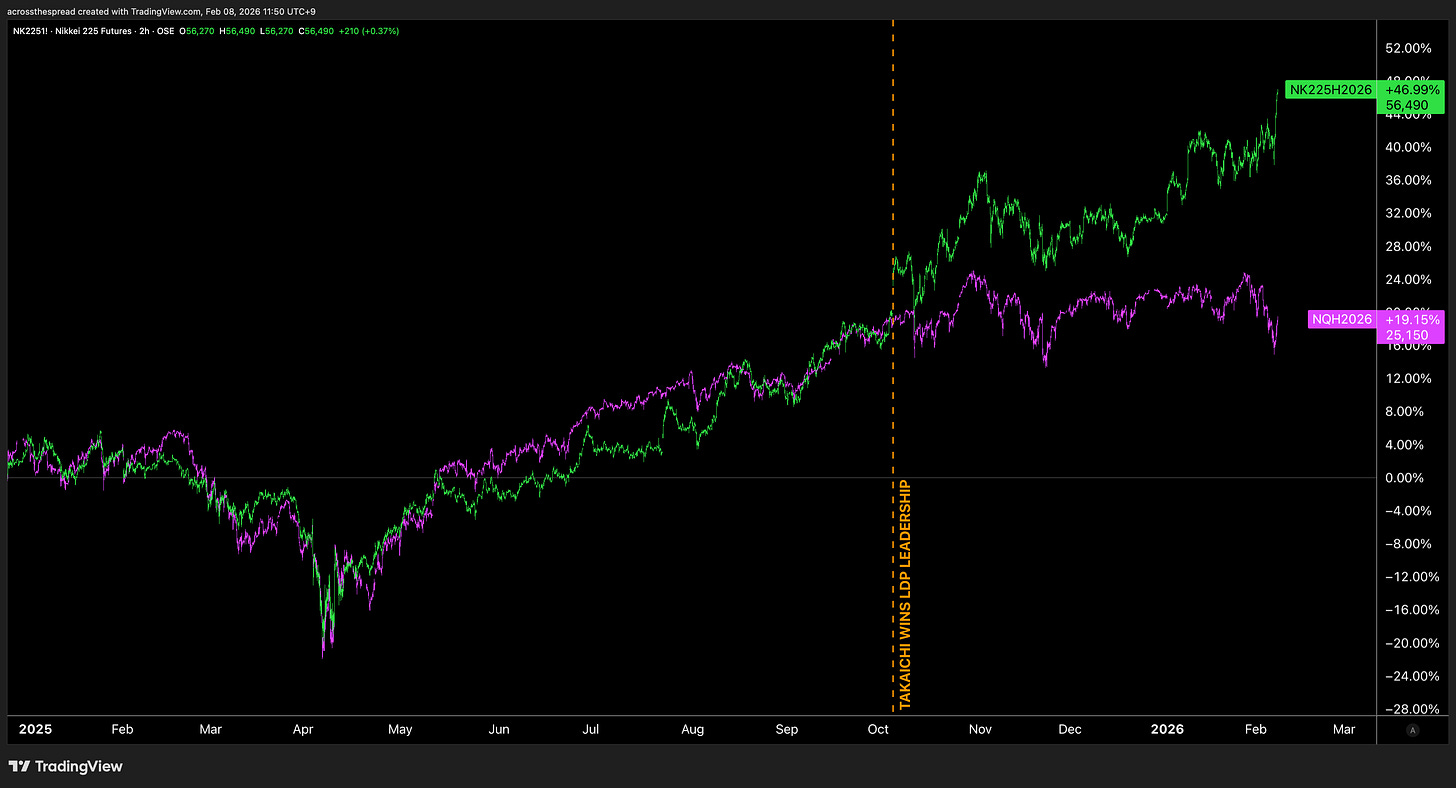

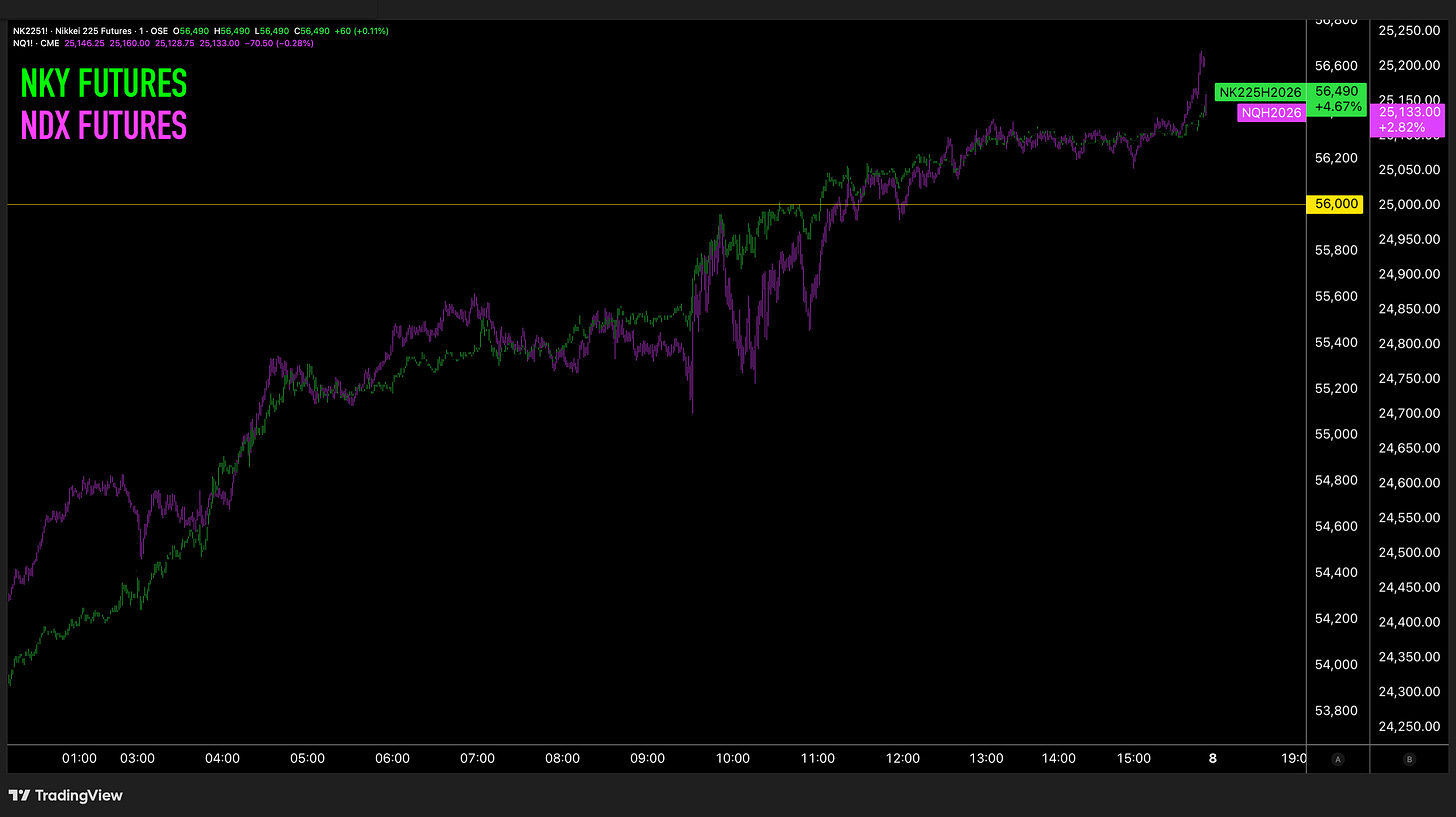
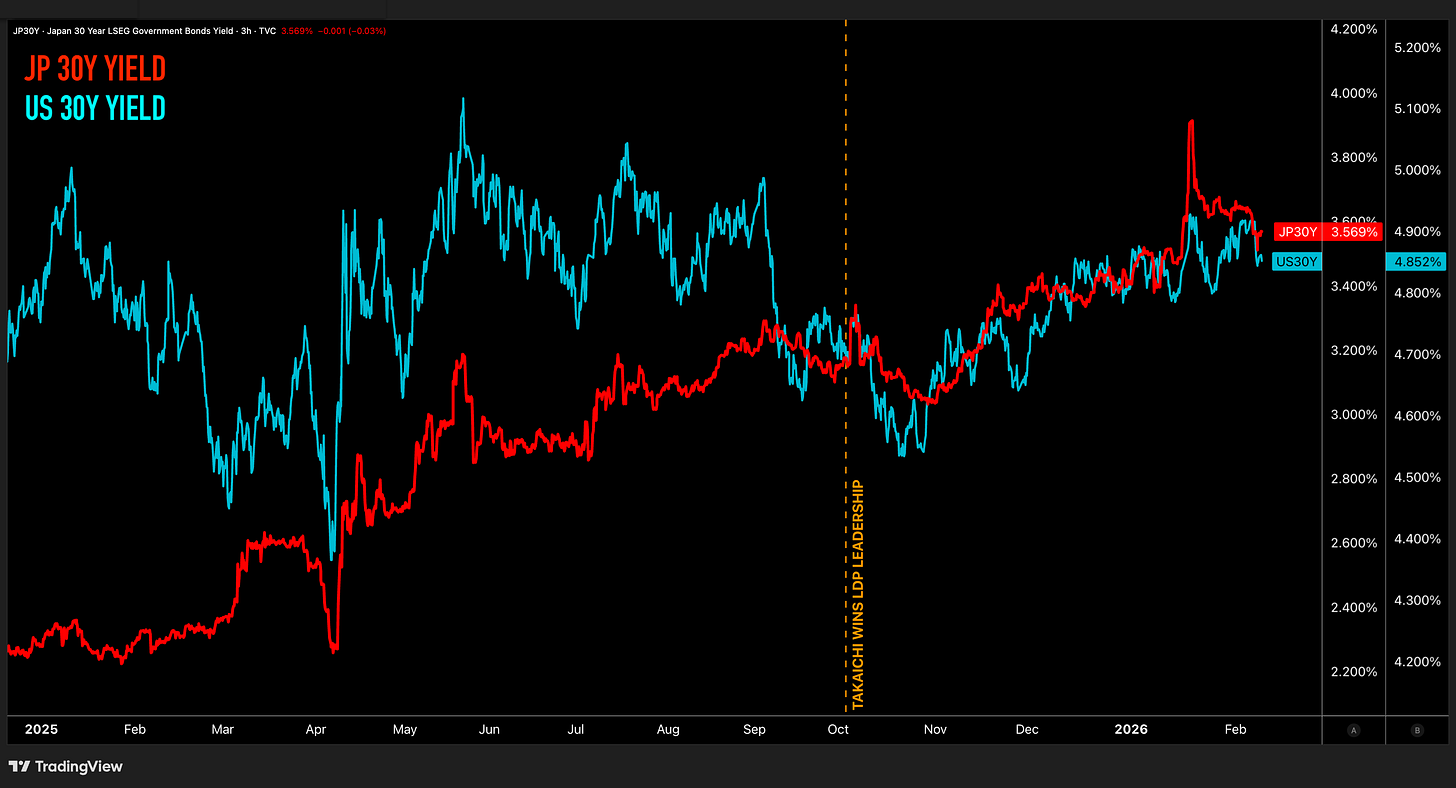
NKY futures not only breaking new record highs, but breaking clear into the 56k level, ending +4.70% on the day (vs NDX +2.2%, SPX +2%). If you look at the intraday price action, you’ll clearly see when, and in what manner US indices’ upside performed - its pretty clear - NKY 56K was upside resistance for everything else - and so was its breakout. Bonds: Global long-end yields earlier in the year were blasted higher by JGB long-end yields exploding to record highs (World’s Most Dangerous Market) but since the Takaichi Era began, JGBs are once again driving long-end bond markets globally - so much so that Secretary Bessent had to call it out at Davos upon the most recent “most dangerous market” explosion.
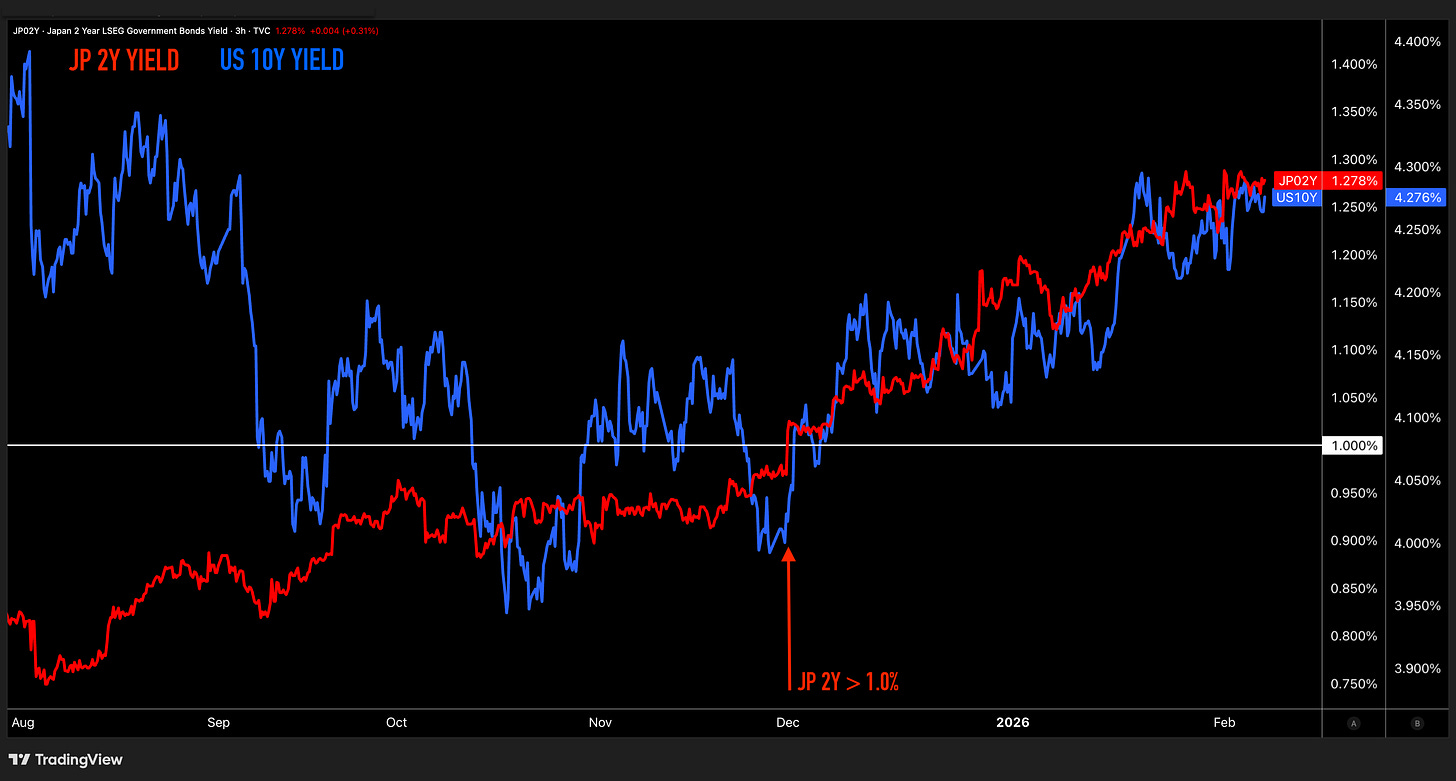
Recall from my previous article on the World’s Most Dangerous Front End JGBs - when the December 1st 2025 “2Y JGB Yield Break Above 1.0%” headline was severely misdiagnosed as a “BOJ rate hike” matter (rather than a Takaichi supplementary budget JGB issuance plan entirely packed into short-dated JGBs announcement matter).
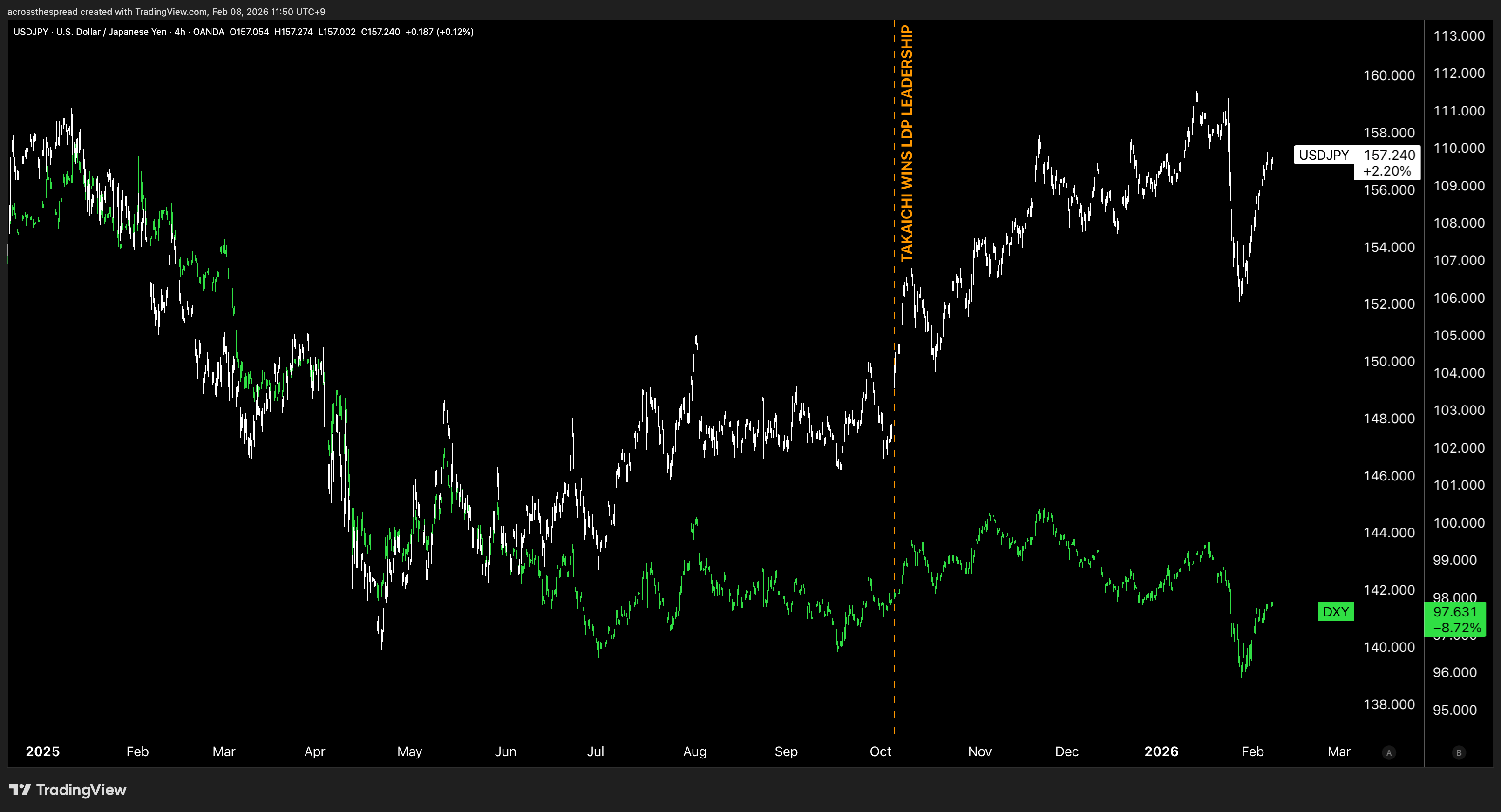
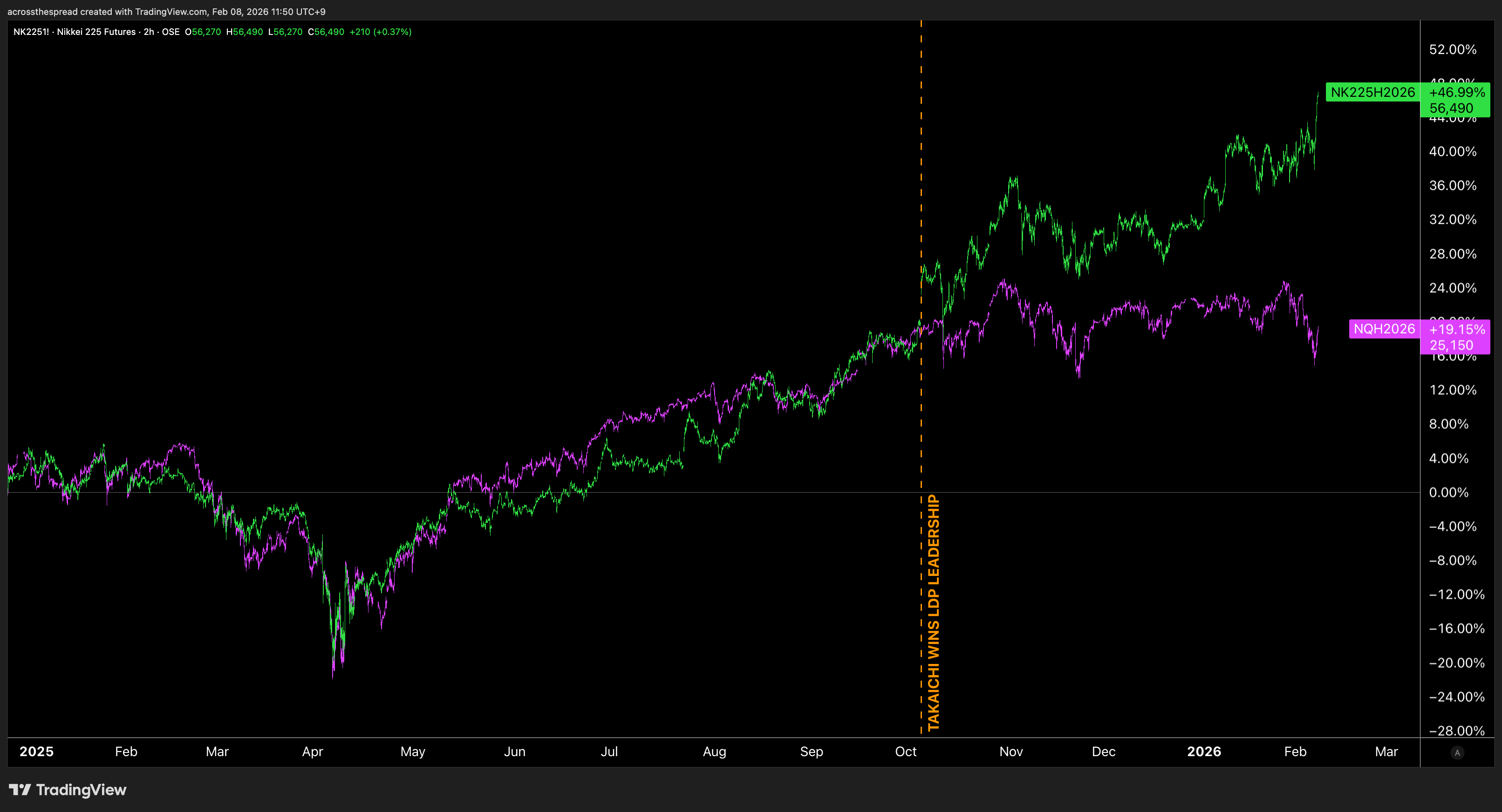
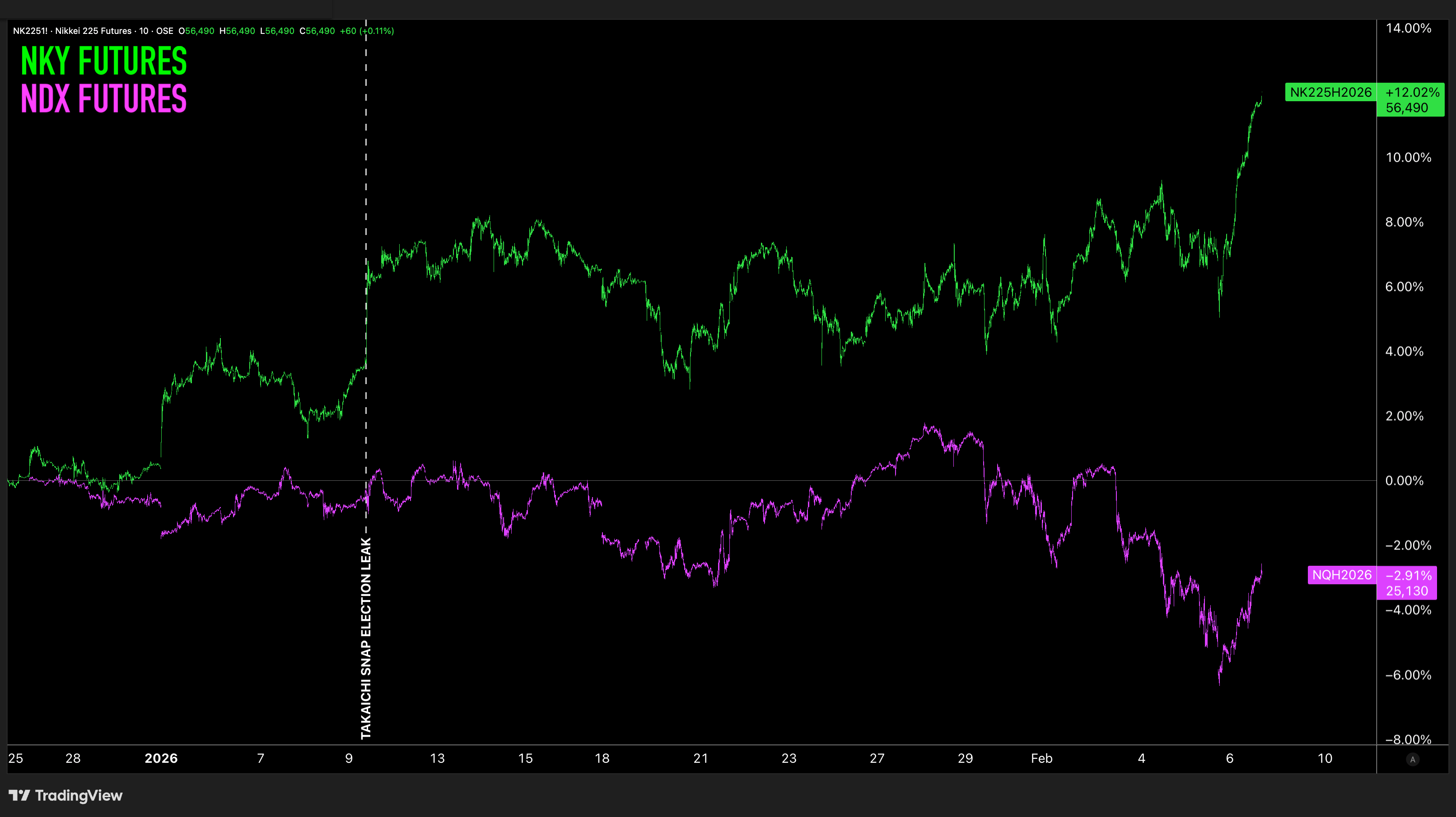
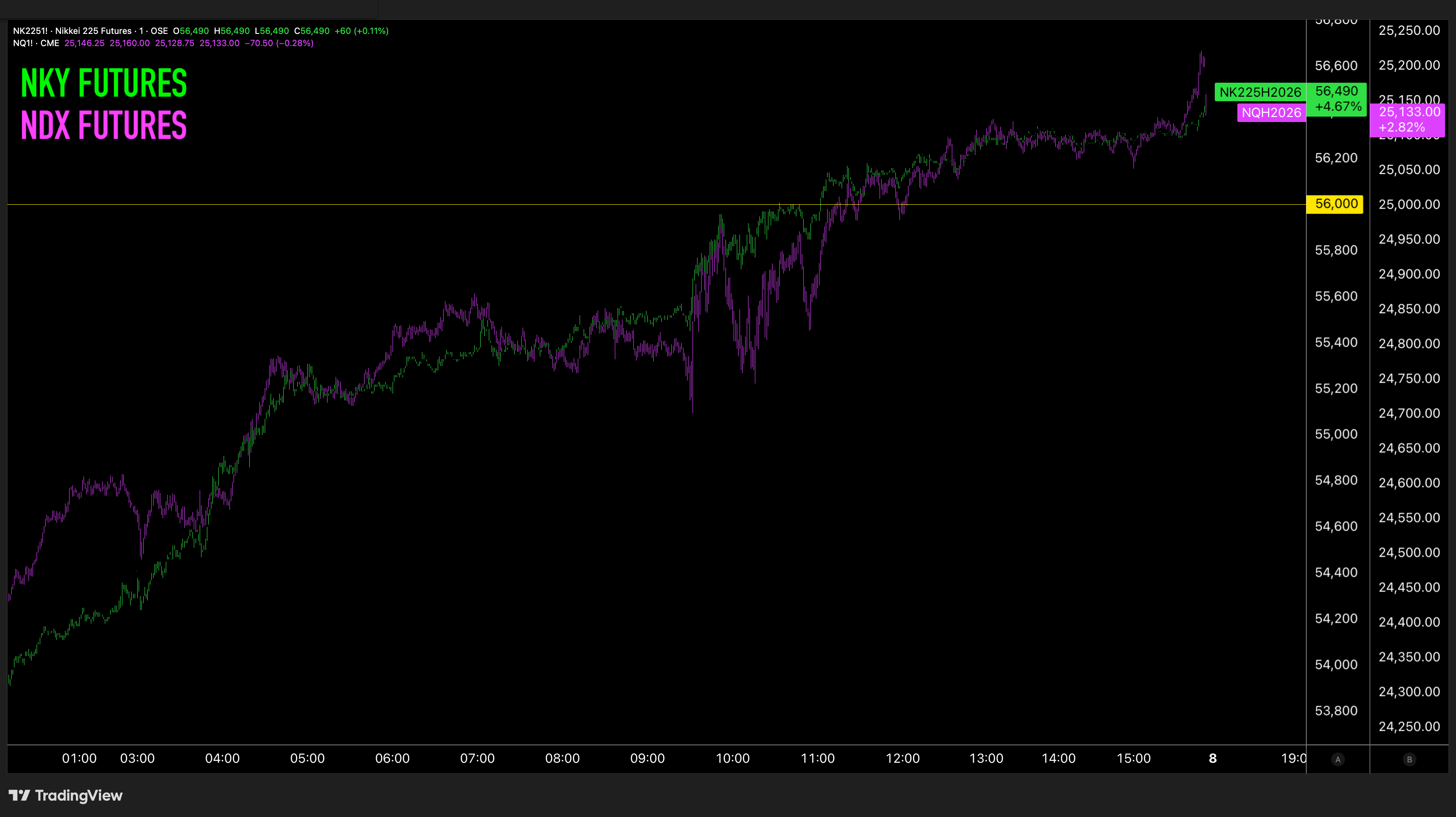
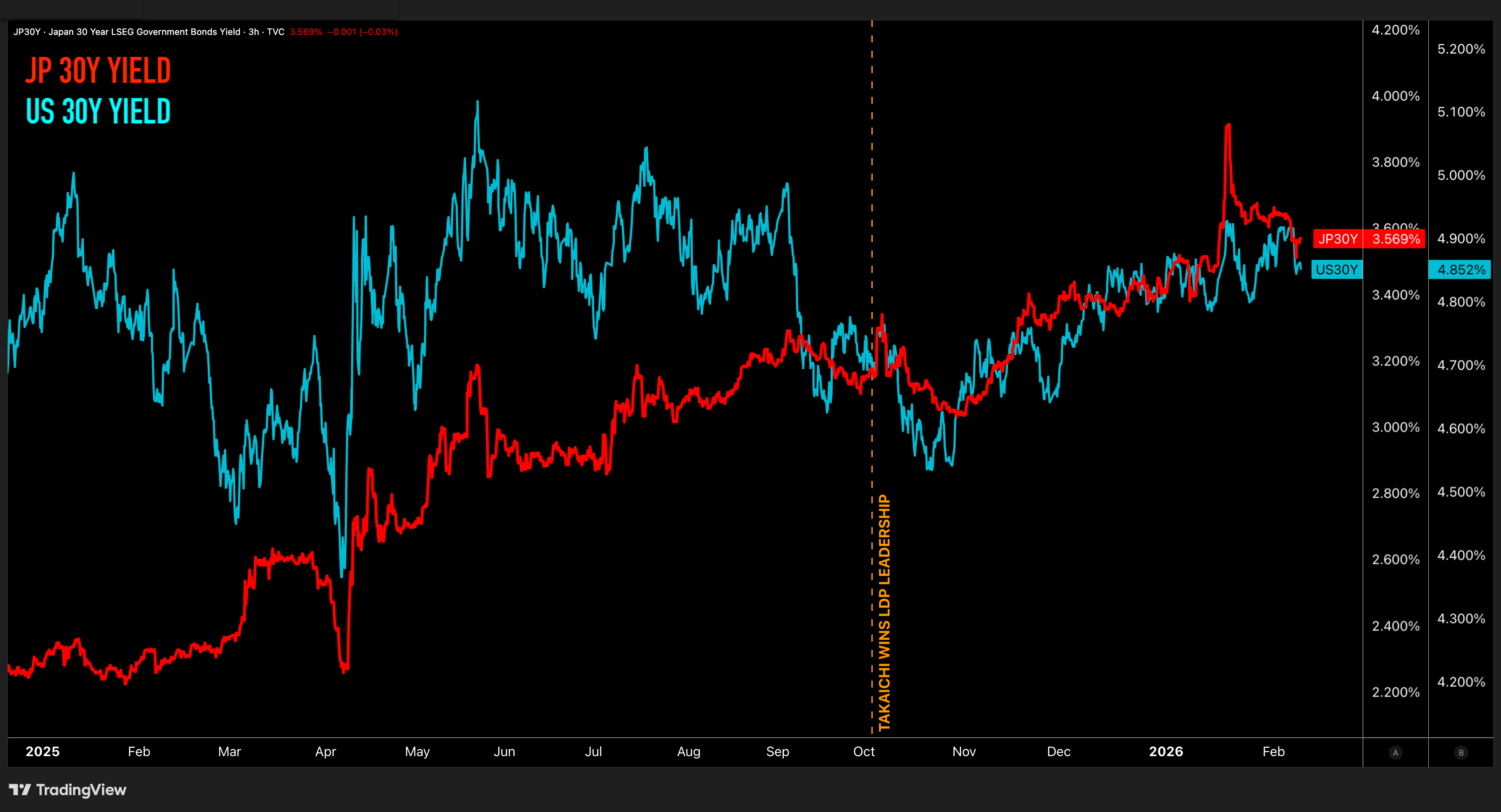
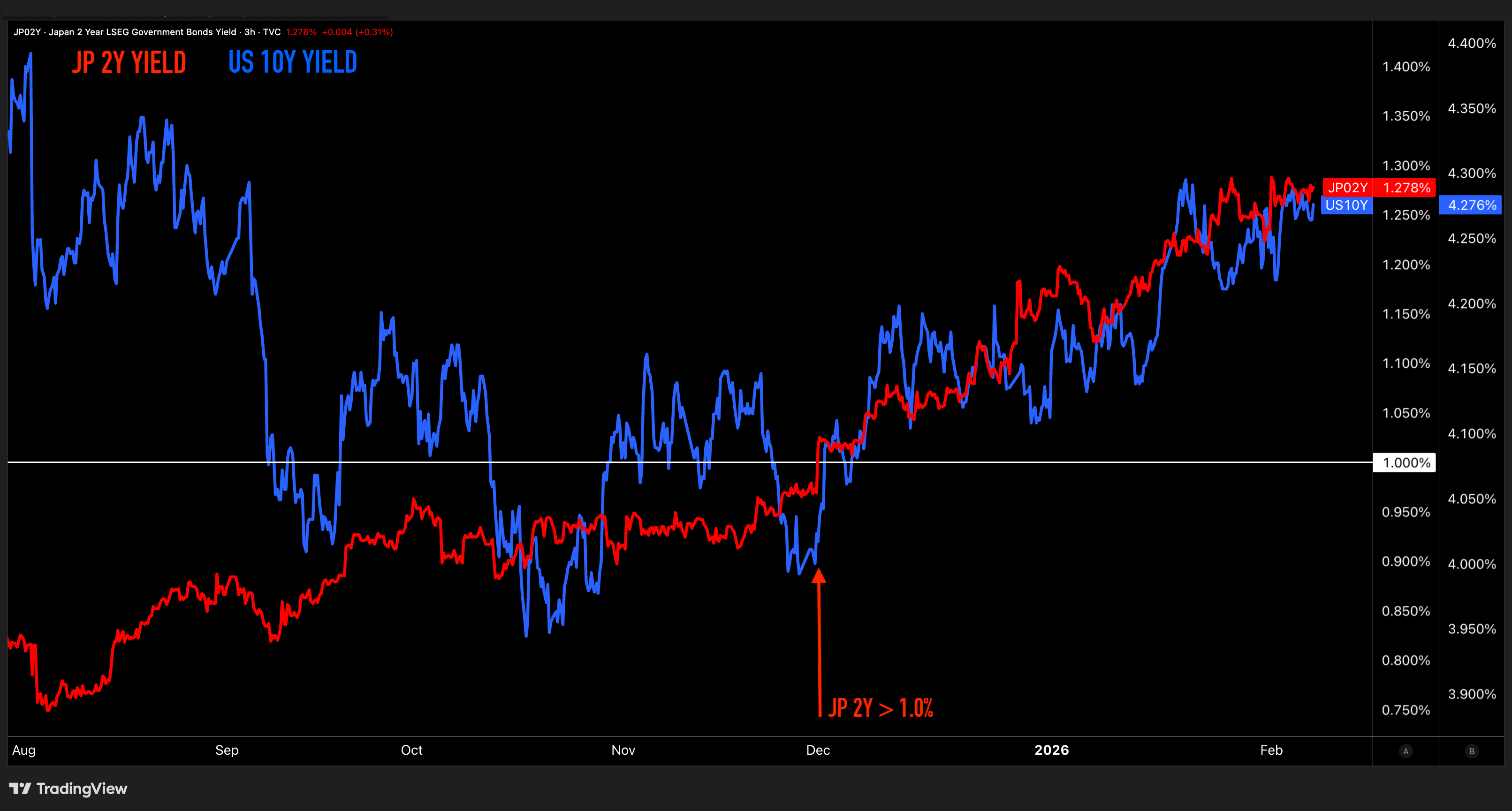
And all of this - these global cross-asset market movements driven out of Japan with both domestic and international capital - is occurring in a Takaichi Era in which Sanae Takaichi herself was wielding the least amount of power and influence, trading stakes in her premiership away in an act of posting political initial margin just to survive the Diet confirmation vote and govern with the thinnest possible mandate.
So what will markets look like, or behave and react like, if and when Takaichi, now far more politically capitalized, consolidates power?
That question gets answered starting later tonight in Japan.
Today, February 8th, all 465 seats of Japan’s House of Representatives are going to a vote in what is the shortest campaign period since World War II - 16 days from dissolution to election day. And for those of you who have been following this series of Japan blowing up its political system of stability from the Ishiba Ouster through the LDP leadership elections, through the Upper House elections, through the front-end JGB piece - this is where it all converges.
This isn’t a normal election - not that any of these have been in the 4 Japan PMs post-Abe Shinzo, but this one is genuinely and fundamentally different from how Japan national elections work. There is no uncertainty about who the next prime minister will be. There is no realistic path to a change of government. What is being decided today is the magnitude of PM Takaichi’s mandate - and the magnitude of that mandate has direct, immediate consequences for JGB yields, USDJPY, NKY and single stocks, and thereby global cross-asset markets.
In order to understand and exploit the otherwise clueless market behavior, we really need to understand how we got here, even at a surface level - because the political path from Ishiba’s ouster to this moment is itself the reason why the market setup looks the way it does.
Four months ago, Sanae Takaichi was an LDP “backbencher” (though well popular with the public), who had just lost the 2024 LDP leadership race a year prior to Ishiba by 21 votes in the runoff. Today she is the Prime Minister of Japan with a 70% or greater approval rating calling a snap election that polls project will hand her ruling coalition 300+ seats - a potential supermajority.
Let me repeat - regardless of outcome, Sanae Takaichi is reasonably on track to regain all of the party’s seat count lost under her predecessor Ishiba in September 2024 and all of the previous coalition partner Komeito’s seat count lost when they suddenly abandoned Takaichi’s LDP combined, which is well over the 233 simple majority, but if they can get to a ⅔ supermajority of 310 seats, then they can override their Upper House where LDP + Ishin still has a deficit below simple majority. And by “they” - I mean “her.” This would be a massive comeback driven by a single individual for which this snap election was called by, and serves as a mandate for, dragging along an otherwise largely unpopular LDP.
What’s truly remarkable is that Takaichi isn’t even supposed to be Prime Minister, or even LDP President for that matter. If you think Takaichi’s rise was handed over on a silver platter, you really need to read this and get an understanding of how she became what she is.
How did this happen? One can point back as far as LDP has been around, but a large part of the answer starts with former PM Shigeru Ishiba - postwar Japan’s biggest self-serving political clown - and his unprecedented series of self-inflicted disasters that systematically destroyed LDP’s governing position and created the exact conditions for Takaichi to seize power by acting decisively, guided by core ideology. Something that Japan PMs since Abe have been too afraid to express (Kishida), or are just dead empty inside and out (Ishiba).
Here is the chronology.
October 2024: Ishiba, having just won the LDP leadership race against Takaichi, immediately calls a snap Lower House election - his very first act as PM, days into his tenure - and he / his party loses badly. LDP and their coalition partner Komeito drop below a simple majority for the first time in decades. A normal, or even abnormal leader resigns in this scenario - but Ishiba doesn’t. He obsessively clings to power by invoking “parliamentary plurality” - the largest single party has the “responsibility” to govern, he argued, even without a majority.
This isn’t the moment LDP’s governance crisis began - but this is the guy who poured gasoline on the fire. Ishiba was now running a minority government dependent on ad hoc opposition support to pass legislation, with a party that had just been rejected by voters, while refusing to accept any personal accountability for the loss he directly caused by calling the election in the first place. Keep this in mind - very relevant for Takaichi today.
July 2025: The Upper House elections arrive. As I covered extensively in Major Overlooked Risk To Global Bond Markets: Japan Upper House Elections this was the election that was already pushing long-end JGB and UST yields higher in real time. LDP loses its Upper House majority too. Ishiba has now lost majorities in both chambers of Japan’s parliament - a feat that required genuine effort to accomplish given LDP’s historic structural advantages. Komeito, LDP’s coalition partner of 26 years, is furious (though they should’ve been furious at themselves as well).
September 2025: Ishiba finally announces his resignation as LDP president. His stated reason? He sought to “claim responsibility” for the party’s electoral losses - an insulting “reason” to cite, because why in the hell did you not just claim said responsibility before LDP members were forced to move on a never-used removal procedure. The actual reason, of course, is that he had no choice - he’d burned through every remaining shred of political capital, the party was in open revolt, and the US-Japan tariff agreement text had been finalized (which he’d been using as his last justification for staying). His tenure lasted about one year. It felt like a decade. This is what rock bottom of a ruling party in slow decline, who cared only about winning elections rather than actually governing, looked like.
October 4th 2025: The LDP leadership election to replace Ishiba. 5 candidates run, but markets treat it as binary: Takaichi or not-Takaichi.
But to understand what happened on October 4th, you need to understand what happened a year prior in September 2024, the last “normal” year in Japan political procedure and predictability - because the standard narrative of “Ishiba won the 2024 leadership race” has it exactly backwards. Ishiba was not “chosen.” Takaichi was rejected.
September 2024 was Ishiba’s fifth attempt at becoming LDP leader across four decades. The party had been telling this guy again and again, for the better part of his career: bro - no, and no means no. Ishiba is a serial loser - I am not (for once) trying to be mean, he is objectively a serial loser. So what does it say when in the second-round runoff between the top two first-round vote-getters - Takaichi (first place) vs Ishiba (second place) - the LDP elites chose the four-time loser over Takaichi? That is not a vote of confidence in Ishiba. That is a measure of how much Takaichi’s own party rejects her - specifically, how much the handful of faction heads and power holders who actually control LDP leadership decisions would rather take a predetermined clown who they’ve repeatedly rejected than allow Takaichi to lead.
And this is the point where I need to address the headlines that you’ve been reading in Western media. “Japan elects first female PM.” “Japan takes a hard-right turn electing ultra-conservative Takaichi.” No. They don’t know that they don’t know what they’re talking about.
First of all, Japan’s prime ministers are not “elected” - not in the way that word is commonly understood. The tens of millions of voting citizens of Japan do not directly elect the prime minister. They elect their respective representatives to parliament, and those 465 members of the House of Representatives are the ones who decide who becomes PM. Furthermore, given LDP’s near-uninterrupted single-party dominance in the postwar era - now in its 7th decade running, literally called the “1955 system,” 70 years old as of 2025 - the Japan PM “race” is really the LDP leadership race. And it’s not even the few hundred members of parliament who have traditionally decided who becomes LDP leader. It’s a handful of those within LDP - and even within that, a party of clustered factions, it’s basically a handful of faction bosses who really decide who becomes PM.
So forget everything you’ve heard about “Japan elected its first female PM.” If by “Japan” you mean 4 or 5 LDP seniors who begrudgingly accepted what the rank-and-file membership forced on them after two catastrophic election losses - fine, you understand Japan political systems and procedures (until now). But if by “Japan” you mean the broader voting public elected its first female PM - no. That never happened.
Until today. February 8th 2026 is the first time that actual Japanese voters - the real “Japan electing/selecting” - get to directly weigh in on whether or not they want a Prime Minister Takaichi. It’s now a direct referendum on an individual to remain or step down from the role of Japan Prime Minister. And that’s what makes this election fundamentally different from every other step of the process that brought her here.
Now back to October 4th. Its frontrunner Shinjiro Koizumi (son of PM Koizumi) vs Takaichi in the second round head-to-head runoff.
Notice in the chart above - Koizumi leads Takaichi in Parliament Member votes at 132 vs Takaichi’s 95, while Takaichi leads in the rank-and-file member votes at 116 vs Koizumi’s 98. Rank-and-file members are basically the ~1 million or so card-carrying, dues-paying members of the Liberal Democratic Party nationwide - the regular people, farmers, business owners. They all mail in their votes over days to weeks into election day, and get tallied and weighted points. This is the LDP “non-elite.” But in a second round runoff, voting takes place immediately on the spot - just those physically sitting in parliament casting their votes one by one in real time, counted an hour later. So given Koizumi crushed Takaichi with LDP Parliament member votes in round 1, you’d think he wins the leadership race in round 2. Not so.
Amazingly, Takaichi beats Koizumi in the Parliament member vote count in the second round - when just moments earlier, he scored far more with those very same people sitting in their immediate surroundings. What gives?
The reason Takaichi saw a huge shift in MP votes and ultimately became President of the Liberal Democratic Party on October 4th was because of one guy - LDP “Kingmaker” Taro Aso. If you don’t know who this is by name, you might recognize him by his gangster mafia hats. Taro Aso was once PM of Japan himself - albeit for a very short period - and is more known in Japan politics as Abe’s right hand man, as well as Finance Minister. Aso is one of the wealthiest politicians in the democratic world with a $6 billion net worth from the Aso Co - a long-established conglomerate involved in a wide array of global trade from commodities to diamond mines. The Aso family dynasty is a lineage that includes Japan’s imperial, political and business magnates - his sister is married into the Imperial family. This guy, in his 80s, who has achieved every position of power at the highest levels and more money than he knows what to do with - what the hell is he still doing as a Lower House rep? I don’t know, and I have been trying to figure that out ever since October 4th 2025, when he shifted the LDP Parliament member votes to Takaichi in the second round runoff by telling his faction members earlier that morning: if it comes to a head-to-head runoff vote, put your vote in for whoever won more of the rank-and-file votes. In other words - align with the broader will of the LDP membership.
Takaichi owes her LDP presidency to Taro Aso. Or - Taro Aso owns a piece of the Takaichi Era, because it wouldn’t exist if not for Aso. Takaichi’s first order of business as leader of the LDP: making Taro Aso Vice President of the LDP. And LDP VP Taro Aso then took the helm in appointing Takaichi’s LDP party executives - filling the posts with his own loyalists including former Finance Minister (who oversaw yenterventions in 2022) Shinichi Suzuki as Secretary General. Suzuki is also Aso’s brother-in-law.
Great - hooray, LDP gets its first female leader on October 4th. Note what I just said: the Liberal Democratic Party just got its first female leader. I did not say “Japan got its first female Prime Minister.” But that’s what global media reported.
As mentioned, it used to be the case where the leader of the LDP then goes on to become Prime Minister in autopilot mode. But that only works when LDP has monopoly power over parliament - and what did Ishiba hand off? An LDP with no majority in either house of Parliament. Even with ruling coalition partner Komeito’s votes, they still fell short of the 233 majority needed for Parliament to confirm and vote her in as PM. So LDP President Takaichi needed to immediately start talking with minority opposition parties just to survive the vote. This is unheard of in normal LDP politics. A year prior when Parliament was voting in then-newly-selected LDP President Ishiba as PM, Ishiba actually fell asleep. Seriously - he fell asleep during his own parliamentary vote confirmation. That’s how much of a formality it was for LDP leader to become PM. And that’s why the global media regurgitation machine reported “Japan’s first female PM” on October 4th - way too prematurely.
Then on Friday October 10th, shortly after cash equity market close, not even a week into being LDP leader, the biggest Japan political headline in years suddenly hit: LDP’s coalition partner of 26 years kills the partnership. Komeito’s leader Tetsuo Saito stated explicitly that Komeito’s 24 Lower House parliament votes will not be writing Sanae Takaichi’s name in for Prime Minister.
Remember - LDP + Komeito combined already fell short of the 233 simple majority thanks to Ishiba. Now Komeito just amputated a leg out from under Takaichi and her path to become PM.
Now we’re in truly unknown-unknown territory. Opposition minority parties suddenly looked at one another and said - well, shit - if Komeito is out, maybe we can band together and overthrow LDP. That became a real possibility. Such that in mid-October, Sanae Takaichi herself said at a public event in a sort of sad self-deprecating manner - “I’m the poor Sanae Takaichi who might not become Prime Minister.” She wasn’t kidding, because it wasn’t a joke.
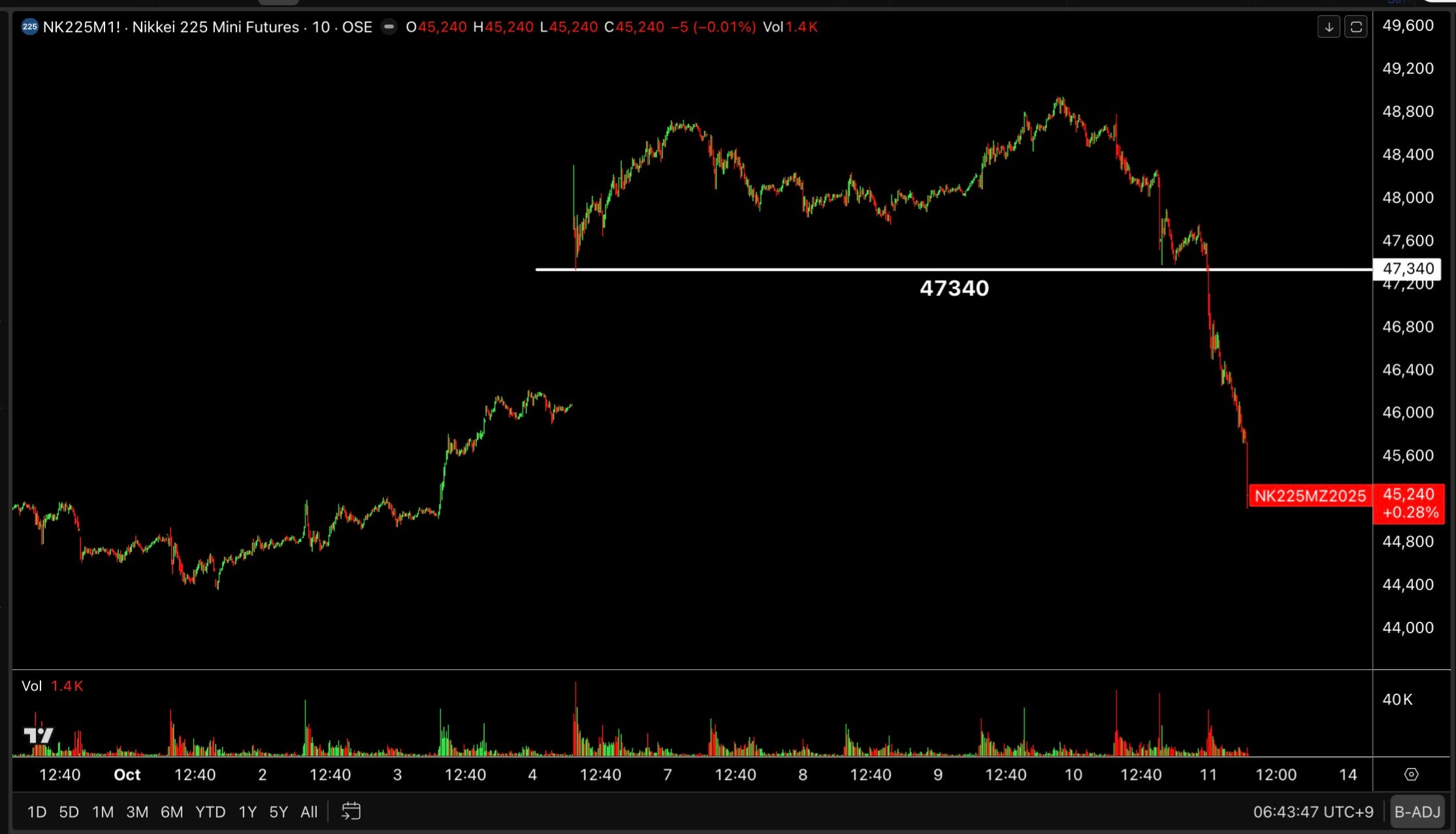
And upon that announcement by Komeito’s Saito - that’s when NKY gave back all gains from those who opened longs to chase a “PM Takaichi Trade” upon her merely winning LDP leadership. NKY futures plunged more than -6%, to below even pre-Takaichi LDP leadership levels. Sanae Takaichi was not supposed to become LDP leader, let alone Prime Minister of Japan.
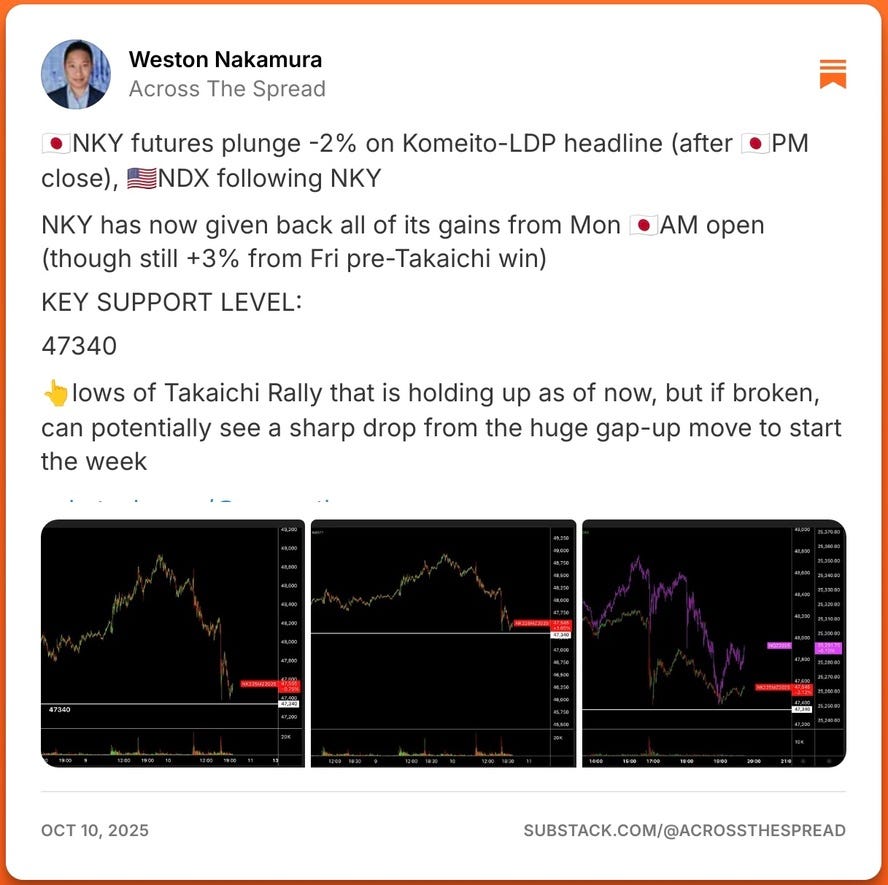
Friday Oct 10 2025 around 3:30PM Japan for both the above post and below chart of NKY futures.
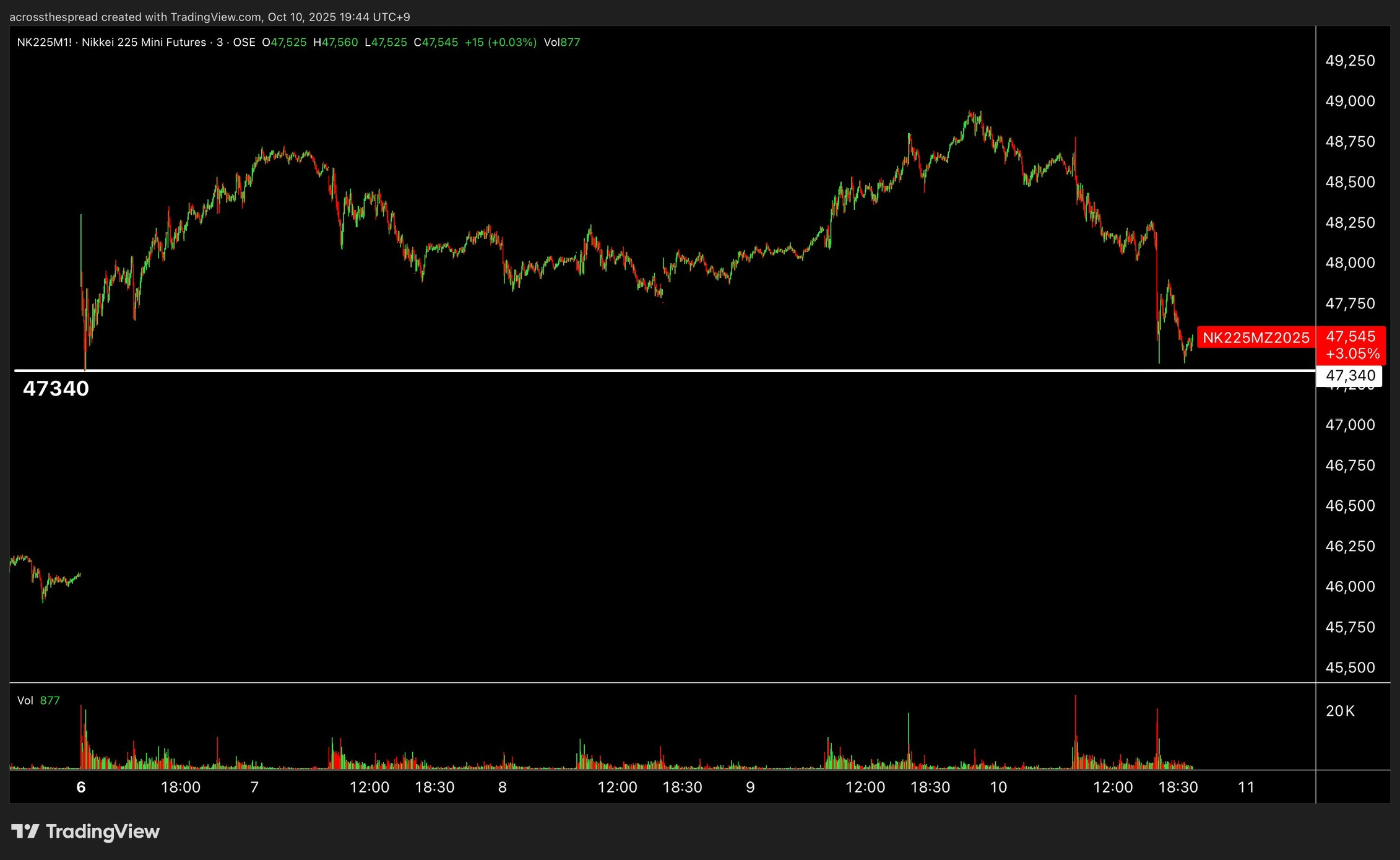
Fri Oct 10th at NY close - that 47340 level didn’t hold, and NKY futures plunged more than -6% that day, to below even pre-Takaichi LDP leadership levels.
Now, why in the hell did Komeito end the coalition in this manner, clearly screwing Takaichi over? They have their reasons - mostly citing LDP’s “money and politics” scandals, which are indeed shady and corrupt, but also very characteristic of LDP. Those reasons may or may not be real, but they certainly don’t seem genuine, because those are all issues that existed from PM Kishida to PM Ishiba. And yet now, suddenly 5 days into mid-good-faith negotiation efforts on new LDP President Takaichi’s part, Komeito ends 26 years of coalition partnership and makes it explicitly clear that they will not be throwing their votes behind Takaichi to become PM? Does that not seem extremely personal and specific to Takaichi? Well, it is. This is one of many examples of what I call the anti-Takaichi forces at work. I will get to China’s involvement with Komeito in a moment.
To finish out this insanely turbulent October: with the PM vote for parliament scheduled for October 21st, LDP President Takaichi somehow claws her way back. At the last minute on October 20th, the evening before the vote, Takaichi forms an entirely new coalition with JIP - Japan Innovation Party, otherwise known as Ishin. They basically make up the gap left by Komeito, and then Taro Aso behind the scenes scrapes together enough crumbs to get Takaichi over the 233 simple majority line.
At this point, Sanae Takaichi herself now commands only a ⅓ stake in the Takaichi Era - as ⅓ belongs to Taro Aso for getting her the LDP leadership win, and the other ⅓ belongs to the Ishin Party, their new coalition partners who gave her enough votes to become Prime Minister.
And on October 21st 2025, Sanae Takaichi actually becomes Prime Minister of Japan.
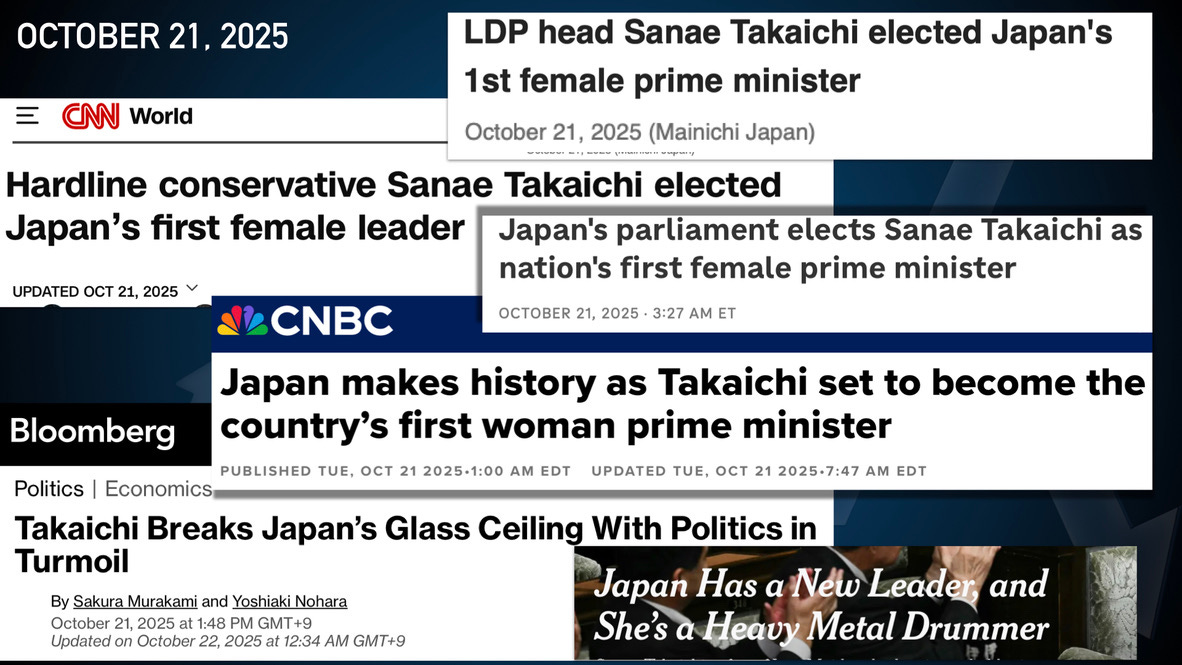
But here’s what’s critical to understand about the position Takaichi inherited. She did not become PM on a wave of party strength. She became PM of a party that had just lost its majorities in both houses of parliament, had shed its 26-year coalition partner, and was running a government that could barely pass legislation. By virtually any metric, Takaichi took over the weakest LDP governing position in postwar history.
In other words, she became PM when all other options had been exhausted.
And by “became PM” - I mean “was chosen as LDP party leader by a membership that had nowhere else to turn, and then clawed her way back from getting a limb sliced off in the Diet confirmation vote to just barely squeak by in becoming prime minister.” The Diet vote to confirm her as PM required coalition support from Ishin and independents because Komeito was already out the door. This was not a coronation. This was survival.
And yet - within three months, she is now positioned to potentially secure the strongest electoral mandate of any Japanese PM in recent memory. Polls from Nikkei, Asahi, Mainichi, and Yomiuri all project the LDP + Ishin coalition clearing 300 seats, with some projections pushing towards the 310 supermajority threshold. From weakest position to potential supermajority in four months. That is not normal. That requires explanation - or at the very least, requires a good hard look at this woman who absolutely did not have anything handed to her on any silver platter.
And here’s the irony that makes the whole thing almost poetic: the very same anti-Takaichi LDP members - the LDP seniors and party elites who chose a four-time loser over her in 2024 - are about to be elected in droves today specifically because of Takaichi’s personal popularity. Her 70% approval rating is the only thing carrying LDP’s party approval (which sits under 30%) into competitive territory. The party that rejected her is now entirely dependent on her to survive. Meanwhile, the last leader that those elites did choose - Ishiba - presided over more LDP members losing their seats than at any point in party history.
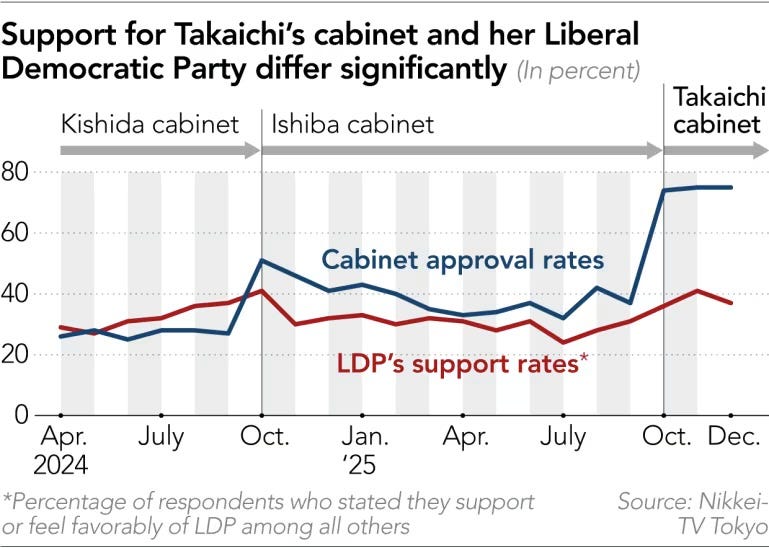
Takaichi maintaining a sustained 70%+ approval across multiple months is, in itself, an extraordinary data point - and it says a lot about the status quo that is being smashed apart as we speak.
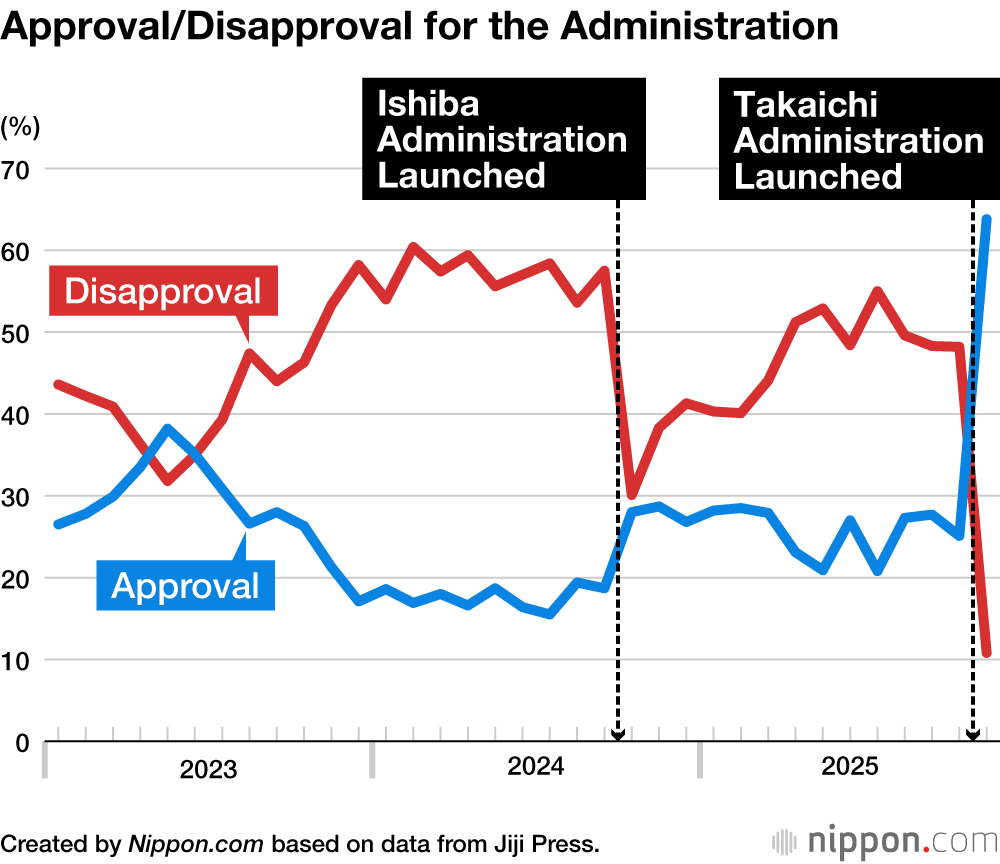
Why is Takaichi so popular? Poll after poll after poll consistently shows the number one reason people support Takaichi is her policies. And similarly, the number one issue facing voters remains: the high cost of living.
But I actually think it’s not just that. Put this in the following context. In 2024, over a billion people in some 70 nations participated in the largest single year of democratic elections in history. And what was the one common thematic outcome, again and again, across the world’s major democracies? Incumbent parties and candidates took heavy beatings - if not outright regime changes. The US. The UK. France. India. And yes, Japan, where the ruling coalition lost its Lower House majority under new PM Ishiba. The common thread: inflation. Voters everywhere punished whoever was in charge for the cost of living.
And yet - even though Takaichi’s Japan is still undergoing prolonged inflation, even though cost-of-living pressures have not materially eased - Takaichi is sitting at 70%+ approval because of her policies around tackling the high cost of living. So much so that she called this snap election specifically to capitalize on approval ratings that she knows are unsustainable - nobody sits above 70% through an entire tenure, let alone for more than a few months at most. This is a window, and she is moving through it.
But here’s the thing - Takaichi has yet to actually do anything to impact the high cost of living via policy. It’s too early. The supplementary budget was assembled, the food consumption tax cut was announced upon dissolution, but none of this has filtered through to household-level reality yet. Yes, provisional gasoline tax cut, raising the income tax threshold etc, but cost of living is still hitting hard. And her LDP/Ishin coalition’s policy framework - the consumption tax cut, the fiscal expansion platform - doesn’t differ dramatically from what the opposition candidates are promising. The policy substance, across parties, is more similar than different. Nobody is actually getting swayed by endless televised debates between candidates splitting hairs over how each party will pretend to come up with ¥5 trillion in annual lost tax revenue from food tax cuts. Everybody knows that promising things and delivering on them have a reliable correlation of zero. So ultimately this isn’t about policy.
And this certainly isn’t about political party preference. Takaichi herself is far from your “traditional” LDP president - and far beyond just the gender dimension. She is ideologically distinct from the party establishment, she was blocked by that establishment repeatedly, and she won despite the party, not because of it.
Again, this election is purely about Sanae Takaichi, the individual, as Prime Minister. For or against. That’s what’s on the ballot today. This is why Takaichi has made it explicitly clear - a vote for LDP + Ishin is a vote for Takaichi. And she’s just as vociferously stated: if these snap elections result in LDP + Ishin falling short of a majority, she will step down as Prime Minister. No Ishiba-style clowning around.
If this is a referendum on Takaichi, then the “against” side needs to be credible. It is not. The forces arrayed against her have been unable to get their act together - and in some cases, are actively working at cross-purposes.
The CRA: Anti-Takaichi At Desperation Point
Start with the opposition. The largest anti-Takaichi political force is the Centrist Reform Alliance - the CRA - formed on January 14th of this year, by the merger of Komeito - Takaichi LDP’s political ex-husband, now partnering up with / remarrying the Constitutional Democratic Party (CDP), LDP’s largest opposition party who’s entire purpose of existence is to oppose whatever LDP is doing. Let that whole sentence sink in. The main opposition party against Takaichi is a merger of the largest opposition to the recent LDP/Komeito coalition, and the now “single” Komeito Party - the very coalition partner CDP had opposed for the last 2 decades, and this marriage was formed 9 days before Takaichi dissolved parliament. CRA Party at time of election is less than a month old.
I’m just going to be direct, no intention of being harsh - this is a political merger of losers. Objectively, it is. They both opposed one another until… less than a month ago. One of them is a party of “no to anything LDP (& Komeito once upon a recent time). The other voluntarily blew up their LDP partnership and seat at the power table.
Komeito - the political arm of Soka Gakkai, a Buddhist lay organization with deep ties to Beijing through decades of “people-to-people diplomacy” with China - viewed Takaichi’s hawkish foreign policy posture as fundamentally incompatible with their institutional priorities. Saito, who led Komeito for over a decade, orchestrated the break. The merger with CDP was announced under co-leadership of Saito and former PM Yoshihiko Noda, with the stated goal of creating a “true two-party system” to challenge LDP dominance.
But the CRA’s creation didn’t just expose the incoherence of the opposition - it exposed that neither CDP nor Komeito actually stand for anything based on concrete ideology. And nothing demonstrates this more clearly than what happened to CDP’s signature policy position: unconditional opposition to nuclear power.
This was not some minor plank in their platform. This was CDP’s one real concrete, ideologically grounded position - the thing they held firm on for years. Opposition to nuclear power, full stop. Never mind that this position meant killing Japan’s domestic energy sources so that Japanese households could continue paying ever-higher utility bills with ever-more-worthless yen to import ever-more-expensive USD-priced energy - which further structurally weakens JPY, resulting in higher energy costs, resulting in government subsidies for household energy via fiscal budget expansion, which further weakens JPY. A death spiral that CDP was ideologically committed to maintaining. They held firm on this.
Until Takaichi called a snap election and this shotgun marriage occurred - and CDP dropped the nuclear power ban faster than it took for them to come up with a party name and logo. (And I mean that literally - they publicly discussed the name and branding over the course of days when unveiling this new party. “Will get back to you on the name.” This is the level of preparedness we’re talking about.)
So of course voters don’t believe in this 20-day-old “political party.” And I put that phrase in quotes because the CRA is a “political party merger” between Komeito and CDP that only exists for the Lower House. In the Upper House of parliament, Komeito and CDP remain as they were - separate parties. The merger is a Lower House electoral vehicle and nothing more. The founding fathers - or, more accurately, the “weekend dads” - of this party don’t even believe in it enough to dissolve their existing party structures. This is a joke. They didn’t even bother to hire a new graphic designer - they just used the same guy who handles the CDP account.
Can you imagine the American equivalent? Mike Johnson and Hakeem Jeffries announcing a brand new political party of “centrist” congressional Democrats and Republicans - but it only exists for the House, not the Senate. And they explain this arrangement as “1 + 1 = 3.” And they do this 20 days before an election. Sounds like a not funny joke, right?
Well guess what, that exists in Japan: CRA did that. They said “1 + 1 = 3.” And by doing so, they made 1 + 1 = 0.
The CRA’s policy platform reflects the same incoherence as its organizational structure. They’re running on cutting the food consumption tax to 0% - fine, populist, everyone’s doing that - but their proposed funding mechanism is to create a Japan sovereign wealth fund that would “generate ¥5 trillion in returns every year.” Forever. Perpetually. A ¥5 trillion annual cost funded by a sovereign wealth fund that doesn’t exist yet and would apparently never have a down year.
Spectacular clowns. I don’t care for LDP or any party, but my goodness - the CRA is making it easy for LDP. In fact they even openly (attempted to) recruit LDP members.
(And this isn’t just CRA - multiple opposition parties have floated variants of this sovereign wealth fund fantasy, including Tax Cuts Japan & Patriotic Alliance co-leader Kazuhiro Haraguchi. The actual cost of zeroing out the food consumption tax is roughly ¥5 trillion annually in lost revenue. The “solution” is to conjure that same ¥5 trillion out of thin air via state-run market speculation. This is what passes for fiscal policy in Japan’s opposition.)
The CRA is, in the most literal sense, a party of losers doing what they do best - lose. I know Takaichi has unbelievable poll figures - but I always have a healthy skepticism of polling data. The formation of CRA in clear panic reaction to this extremely popular Takaichi calling for a snap election, and their completely empty criticisms against Takaichi for calling a snap election in the first place (“running elections costs taxpayer money…”) - this/they are what/who showed me how popular and powerful Takaichi is.
And again, reinforced this election being purely about Sanae Takaichi, the individual, as Prime Minister. For or against. The “against” option is a 20-day-old party whose founding members maintain separate party structures in the upper chamber, whose flagship policy position was abandoned before the ink dried on the merger agreement, and whose fiscal platform is funded by a sovereign wealth fund that exists exclusively in PowerPoint.
MOF: Two “Ministries of Finance”
When it comes to anti-Takaichi forces within government but outside of elected government - there’s MOF. And I need to clarify something here, because when I say or refer to “MOF” going forward - there are essentially two MOFs depending on context, and they are not only different but functionally oppositional.
There is Finance Minister Satsuki Katayama - the head of the Ministry of Finance and PM Takaichi’s hand-picked appointee. And then there is the Ministry of Finance *bureaucracy* - the career officials, the institutional culture, and the various forces that operate as extensions of that culture both inside and outside the ministry. Former LDP Secretary General Moriyama (Ishiba’s shadow prime minister), media outlets like Nikkei - these are actors that, while not formally “MOF,” function as agencies of the ministry’s institutional preferences. Those two - Finance Minister Katayama and the Ministry of Finance - are two completely different, if not outright oppositional bodies.
Katayama’s background is what makes this dynamic so combustible. She is a career MOF insider who left the bureaucracy, got elected to the Upper House, became a well-known media figure with an outsized personality, and - critically - became an outspoken public critic of MOF’s institutional orthodoxy. She loudly and publicly supported Takaichi’s sekkyoku-zaisei platform. She personally shares Takaichi’s policy views. And she knows MOF’s inner workings - the systemic nuances, the bureaucratic levers, where the sand gets thrown into the gears. She is not exactly the shy, hold-back type (making Bessent seem like the quiet one of the two). She also knows Trump personally and was the only Japanese MP to attend both Trump inaugurations - 2017 and 2025 - by official US invitation.
This appointment is Takaichi essentially signaling: I’ve hired a credible, experienced veteran to oversee and execute the careful snapping of MOF’s neck. Responsibly.
And MOF’s neck needs snapping - or at least, Takaichi and Katayama believe so - because the ministry’s bureaucratic culture has operated for decades as what they view as an austerity orthodoxy that constrains Japan’s ability to undertake the kind of large-scale, multi-year investments that Takaichi’s platform envisions across her 17 key priority industries and sectors.
The clearest example is the Primary Balance issue. After becoming PM and assembling the supplementary budget, Takaichi announced that Japan would abandon the single-year primary balance measuring stick in favor of a multi-year framework. Her argument: the single-year PB timescale is one of the key institutional roadblocks that has prevented the Japanese government from undertaking multi-year investment programs, because they are constrained by this arbitrarily short window in which spending must be justified against revenue. In reality, the annual PB target has existed for roughly two decades, and in that entire time, Japan has *never once* achieved a year of primary balance surplus. Not once. It is a framework that has accomplished exactly nothing in terms of actually constraining debt or spending - but has succeeded in imposing a permanent bureaucratic chokepoint that MOF career officials wield as leverage over fiscal policy.
The best way for an American reader to understand this is to think of it as Japan’s version of the debt ceiling. An arbitrary, self-inflicted constraint that the government struggles with repeatedly, that always - always - gets circumvented or raised, that performs no actual function of constraining fiscal outcomes, but that masks the underlying reality with an exterior of “fiscal responsibility” that is never held to account. Takaichi looked at this framework, recognized it for what it is, and got rid of it. And that then opens the door to multi-year fiscal programs without the annual kabuki of pretending the PB target will be met this time.
But if you are a career MOF bureaucrat - a member of what Japan calls its “best and brightest” - abolishing the annual primary balance framework is the fiscal equivalent of Christians abandoning the Bible. It is pure heresy. And the reaction was exactly that: MOF bureaucrats, Nikkei, and the broader austerity establishment went hair-on-fire over the announcement. Never mind that the framework never achieved its stated purpose. Never mind that Japan’s debt pile - which MOF itself is the issuing agency for - grew relentlessly through every year this framework was supposedly in force. The symbolism of its removal was what mattered to the institutional culture, because the framework’s actual function was never about achieving fiscal balance - it was about preserving MOF’s gatekeeping authority over the budget process.
This is not “deep state conspiracy” - this is just simple, publicly understood reality. Ask any normal Japanese person about “zaimu” (MOF) and they’ll associate it with some form of political power that operates beyond elections. MOF’s career officials have and exercise unofficial political influence based on the ministry’s institutional preferences, while still executing top-down policy as directed - the “can do this the easy way or the hard way” dynamic. They can slow-walk implementation, complicate issuance plans, and lean on their media relationships to shape coverage. And they would love nothing more than to see Takaichi dethroned, and thereby no more Finance Minister Katayama.
But bureaucratic resistance and electoral resistance are different things. MOF’s institutional culture cannot stop a PM with a supermajority mandate from enacting her legislative agenda - especially when the PM has installed, at the top of their own ministry, someone who knows exactly how the gears work and where the sand gets thrown.
Anti-Takaichi Forces: Media
The media operates as an extension of this same dynamic - but I want to be precise about what I mean here, because I am not talking about media criticism. Criticism of elected heads of state is standard practice. It is expected and is healthy. That’s not what this is.
What I am talking about is an active institutional culture aimed at taking Takaichi down. In October 2025, days after Takaichi won the LDP leadership, a Jiji Press photographer was caught on a hot mic while waiting for Takaichi to arrive at LDP headquarters for a photo op. The remarks, recorded during a live online broadcast: “I’ll bring down public approval ratings.” “I’ll only release photos that will lower the approval ratings.” The audio went viral on social media. Jiji Press subsequently confirmed the incident, reprimanded the photographer, and published a report - on their own wire service - acknowledging that the remarks were made. That is: Jiji Press reported on Jiji Press pulling this shit - here’s the article.

This is not an op-ed with a critical tone. This is a credentialed member of one of Japan’s major wire services explicitly stating, on tape, that the objective is to use editorial photo selection as a weapon to damage a newly elected leader’s public support. And when that’s the posture of the press corps - not criticism, but combat - it puts everything else into context. A Nikkei editorial wringing its hands about Trump’s endorsement being “foreign interference” reads differently when you understand it’s coming from the same institutional ecosystem where Jiji photographers are openly strategizing about which photos will drag approval ratings down. These aren’t independent acts of journalism. They’re coordinated institutional hostility from outlets that function, in varying degrees, as extensions of the same MOF-aligned establishment that views Takaichi as an existential threat to their fiscal orthodoxy.
Foreign press coverage, meanwhile, has been dominated by the lazy “right-wing conservative” framing - Takaichi’s Yasukuni visits, her hawkish Taiwan comments, the “female Japanese Trump” comparisons - none of which has anything to do with the fiscal and market dynamics that actually matter. There are plenty of legitimate things to criticize Takaichi on. Being “far right wing” is neither a criticism, nor a fact - “far right” or “right wing” implies a lean away from the majority. Takaichi has 70%, 80%, and among younger age groups, upwards of 90% approval ratings. So if she is “far right wing,” then somehow much of Japan is as well (thereby making her center, not on a “-wing”). And I’ve said this many times before, but “right wing” or “conservative” in Japan has absolutely nothing to do with other western democracies’ definitions and characteristics. Takaichi is an ultraconservative big government deficit spender? Right.
China: World’s Most Pro-Anti Takaichi Sovereign + Media Coverage
Speaking of those “Taiwan comments” - let me just address this. Here’s a case study in how the media coverage of Takaichi actually works in practice. Takaichi made a statement in parliament about Taiwan contingency planning. She made it in the Japanese parliament, while being repeatedly questioned and grilled about it by opposition members (CDP, now CRA party)- a domestic legislative proceeding addressing a Japan national security question. Beijing reacted furiously, issued warnings telling Chinese tourists to avoid Japan because it was “too dangerous,” and Takaichi’s subsequent silence - meaning, her refusal to retract - was reported by global media as “escalation.” Some outlets framed it as escalation on both sides. A diplomatic failure between Japan and China.
Here is what was absent from virtually all international coverage and most domestic Japanese coverage: shortly after Takaichi’s parliament statement, China’s Consul General in Osaka - a Chinese government official, physically stationed in Japan - tweeted the following: “I’ll cut off that filthy neck you poked in without a moment’s hesitation. You ready for that?” The tweet was subsequently deleted, but we all know that once the internet has it, its never deleted. Here it is - Osaka-based Chinese Consul General reacting to Takaichi in Parliament:
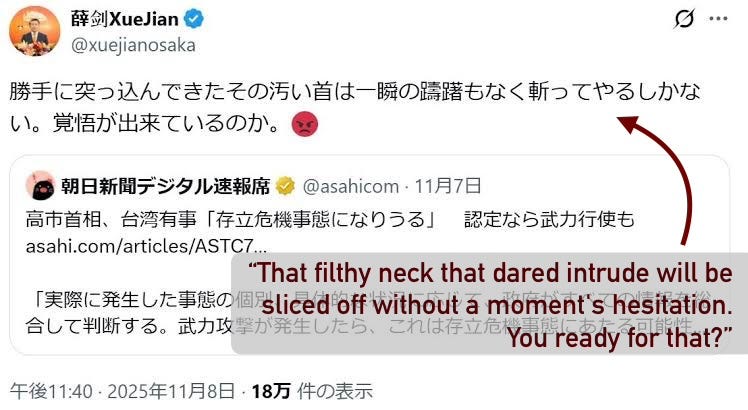
Read that again. That’s not some anonymous basement troll, that’s a foreign government official, stationed on Japanese soil, publicly thretening to behead the sitting prime minister of Japan. And the global media narrative remained: “Japan escalation.” “Takaichi provocation.” “Diplomatic failure on both sides.” Why? Because Takaichi wouldn’t say another word about the matter (other than “nothing has changed regarding our policy”).
The irony of the statement is almost too perfect - the consul general is essentially saying “mind your own fucking business when it comes to China’s internal matters like Taiwan.” But Takaichi made her comment in the Japanese parliament, in response to questions from Japanese opposition members, about Japanese national security contingency planning. That is a Japan internal matter. And the response from a Chinese official was a public decapitation threat against the Japanese PM. Can you imagine the inverse? A Japanese official - or just a Japanese national in Beijing tweeting “I’ll cut off Xi Jinping’s filthy neck without a moment’s hesitation”? The consequences would be immediate arrest and an international incident that dominated global headlines for weeks. But a Chinese consul general says it about Takaichi and the press barely mentions it. Instead, the coverage stays focused on Takaichi’s “inappropriate” parliament comment. “Slice that filthy neck” is almost too comically evil that its frankly hilarious (to me) - what’s less hilarious is press coverage. And of course this will be read as my personal bias as a Japanese American - but I really truly don’t care what some idiot wants to tweet as “diplomacy.” I know there is no way for someone like me to just show you objectively what’s going on without being under that lens, but I just wanted to let everyone know - the CCP guy in Osaka said something about slicing Takaichi’s dirty neck off.
And this connects directly to what I described earlier - Komeito’s split from the LDP coalition. CRA co-leader Saito, who served as Komeito’s president for over a decade, has well-documented close ties to Beijing. You think a government that will casually and instinctively have its foreign officials publicly threaten to behead a sitting PM wouldn’t also use its influence channels to encourage Saito to end the coalition - thereby ending a PM Takaichi before she could even begin? The Komeito split wasn’t just about electoral self-preservation. The China dimension is real, and it is systematically underreported.
And this is the broader point: Takaichi is a uniquely attacked political figure. Attacked from within her own party (until her popularity made that suicidal), attacked by the bureaucratic establishment whose authority she threatens, attacked by a domestic press corps that has moved beyond editorial criticism into active opposition, and targeted by foreign powers whose strategic interests she threatens - with the media apparatus either complicit in or oblivious to the asymmetry. And this is precisely why she is so popular with the actual public - because voters can see the institutional hostility for what it is, and it reinforces the perception that she is genuinely outside the system that has failed them. Which then generates more institutional hostility aimed at combating that popularity. It is a self-reinforcing cycle, and Takaichi is currently on the winning side of it.
If any of this sounds like I’m defending Takaichi, for the thousandth time, I do not care about any political figure, party, anyone/anything. I really do not- I don’t care about Sanae Takaichi either way. I do very much care to let you know what the view from the ground is. And this is what it objectively is.
So what you have is: a wildly popular PM with a clear fiscal mandate and a Finance Minister specifically chosen to dismantle the institutional resistance from within, running against a hastily assembled opposition coalition held together by anti-Takaichi sentiment and funded by imaginary sovereign wealth fund returns, during the shortest campaign period since WWII, with the bureaucratic establishment (MOF culture, Nikkei, Jiji, party elders) unable to translate institutional hostility into electoral consequence. This is why the polls look the way they do, and why the election results may be a massive blowout win for Takaichi.
And that will have market consequences - depending on the manner and magnitude of her win.
What to watch for snap election results:
465 total seats in the Lower House.
The thresholds that matter:
233 - simple majority. LDP + Ishin need this to govern. Before dissolution, the ruling bloc held 230 seats (with 3 allied independents bringing the effective count to 233 - a majority of exactly one seat). This is the bar Takaichi has explicitly staked her premiership on: she announced that if LDP + Ishin don’t reclaim a majority, she resigns. This is a direct, intentional slight to Ishiba, who clung to power after losing his majority. It’s also, given the polling, functionally a flex rather than a genuine risk.
243 - comfortable LDP + Ishin working majority, enough to control legislative committees and manage the parliamentary calendar without needing to negotiate with opposition on procedural matters.
261 - committee control threshold, which gives the ruling coalition chairmanship of all standing committees. This is where legislative power becomes truly dominant.
310 - supermajority. Two-thirds of the Lower House. This is the number that matters for constitutional revision, which requires a two-thirds vote in both chambers before going to a national referendum. Takaichi has been explicit about constitutional revision as a policy priority - particularly Article 9 and defense-related provisions. Some polls are projecting numbers that approach or reach this threshold for the LDP + Ishin bloc, which would be an extraordinary result.
As far as markets are concerned, 310 is the resistance break. There is a massive difference between 309 and 310. Both are risk-on, sell JPY, sell JGBs, gold rally, silver rally and so on. But 310 is a different order of magnitude - as how algos are pre-programmed.
Those are the numbers. Results will come in tonight. In Part 2 - which I’ll publish after results are official and combed through - I’ll cover what Trump’s endorsement and the NY Fed “rate check” story are really telling you about the new rules of FX intervention, why the implied USDJPY 160 ceiling has an expiration date that just arrived, and the JGB and DM equity picture looks like.
Final point - and perhaps most key point: if Sanae Takaichi is handed a massive victory and a direct referendum by the people, such that neither Taro Aso nor the Ishin Party hold any stake in the Takaichi Era because for once, she doesn’t need permission from anyone and is bulletproof to do as she wishes - in that very likely scenario, the ONLY thing left that can, and will ultimately govern the Takaichi Era is: markets.
Stay tuned.
Thanks as always,
Weston
Comments
Nothing yet. Say the first thing.
Sign in to join the conversation.