
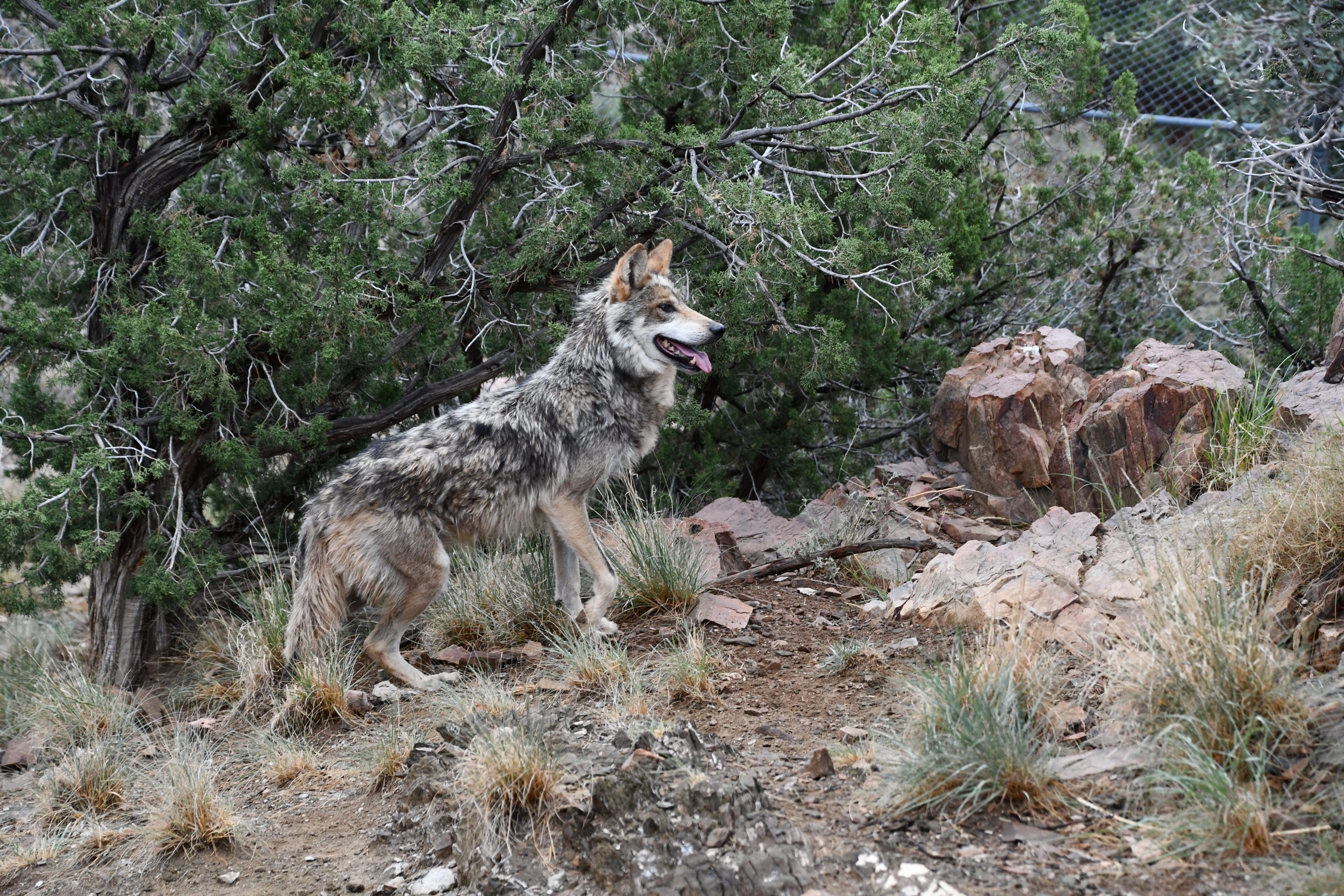
We’ve been worried about Bill Nelson handling endangered Mexican gray wolves since at least 2013, when, while employed by Wildlife Services but while off duty, Bill Nelson killed a 40-pound female Mexican gray wolf he “thought was a coyote.” At the time, and since, it seemed unfathomable that a “Wildlife Specialist” with a history of handling wolves would be allowed to claim mistaken identity. There was an investigation, but no charges were filed because of the McKittrick policy (which discourages prosecution when a shooter claims to have mistaken a protected animal for another species), and Nelson continued working for the agency until he retired. This despite the reasonable expectation that recognizing the difference between a coyote and a Mexican wolf would be a prerequisite for obtaining (and keeping) a job with USDA Wildlife Services in New Mexico.
After Nelson retired from Wildlife Services, he landed a position with the U.S. Fish and Wildlife Service as a contract trapper, despite the objections of conservation groups. He held a contract until at least 2022. He was also listed on the agency’s section 10(a)(1)(a) permit, the document that identifies the individuals who may legally handle wolves. And he’s apparently continued working as a hired wolf killer for ranchers, as evidenced by his name on a lethal take permit issued last summer. (It’s not clear if this was fulfilled or by whom, and we’re not linking to the permit here, because it names private individuals who aren’t on any government’s payroll.)
Last summer, he also worked as an Public Safety and Depredation Control Officer for Catron County, which is when he made another deadly mistake.
According to the Albuquerque Journal report, Bill Nelson illegally trapped a Mexican gray wolf last summer on public lands and “accidentally” killed him by wrapping a heavy sleeping bag around his head while attempting to remove him from the leghold trap. The wolf, the breeding male of the Frieborn Pack, choked on his own vomit and suffocated to death during the ordeal.
According to the Catron County report of the incident, Nelson first contacted the Sheriff’s office at 8:14am to say there was a wolf in a trap and he was waiting for help to release the wolf. According to the Catron County’s report, Nelson called back 12 minutes later at 8:26am to say the wolf had died. According to the incident report from New Mexico Department of Wildlife, Nelson claimed he also spent 20 minutes trying to revive the wolf, which is somewhat hard to reconcile, with just 12 minutes between alive and dead, and with his professional ambitions to kill wildlife, but ok. His attempts at CPR were apparently significant enough to register as blunt-force trauma in the necropsy.
But anyway, the wolf died, and the Frieborn family of wolves lost their patriarch.
To be fair, wolves do die in traps on a regular basis. Just last March, a male member of La Ventana pack died after being trapped by authorized personnel in a collaring operation. Traps are stressful, incredibly painful, and considered something of a “necessary evil” by the folks who believe that the best wolves are “managed” wolves (i.e. with collars constantly monitoring their movements). But this is the first wolf that I’ve heard of that was smothered in a sleeping bag.
Anyway, you can imagine that the US Fish and Wildlife Service wouldn’t seek to prosecute Mr. Nelson for killing the wolf – after all, having been on the 10(a)1(a) permit means they think he’s capable of handling wolves, and hey, accidents happen. Without a witness willing to testify otherwise, this was considered an honest – if sloppy – mistake.
But what about the trap? It was set on public lands, about 300 yards from the nearest private property line, where Nelson was supposed to be catching coyotes. Three football fields distance onto the National Forest, where traps are banned under Roxy’s Law, § 17-11-1 N.M.S.A. 1978. He apparently had four other traps set on private land, but there is no location data in the incident reports we reviewed, so there’s no way of really confirming that claim; we’ll just, again, have to take his word for it.
Apparently, the New Mexico attorney general is willing to take Mr. Nelson’s word for quite a lot, because rather than prosecute him for allegedly breaking Roxy’s Law, the AG merely required him to download the OnX mapping app onto his phone (presumably so he could distinguish between public and private land), and to stay out of trouble for six months.
It’s unclear whether Mr. Nelson continues to work for the county as a trapper, or whether Catron County continues to hold a “take” permit for trapping wolves on private land, which expired at the end of June.
It is, however, abundantly clear (to us) that Mr. Nelson shouldn’t be allowed to get anywhere near Mexican wolves ever again.
Greta Anderson is the deputy director for Western Watersheds Project.
No posts
Comments
Nothing yet. Say the first thing.
Sign in to join the conversation.