
When people hear Physical AI, they often picture humanoid robots working in factories, warehouses, hospitals, or homes. Humanoids have become the industry’s most visible symbol, but the reality is still much earlier.
Millions of industrial robots operate worldwide, while humanoids represent only a tiny fraction of the global robotic fleet.
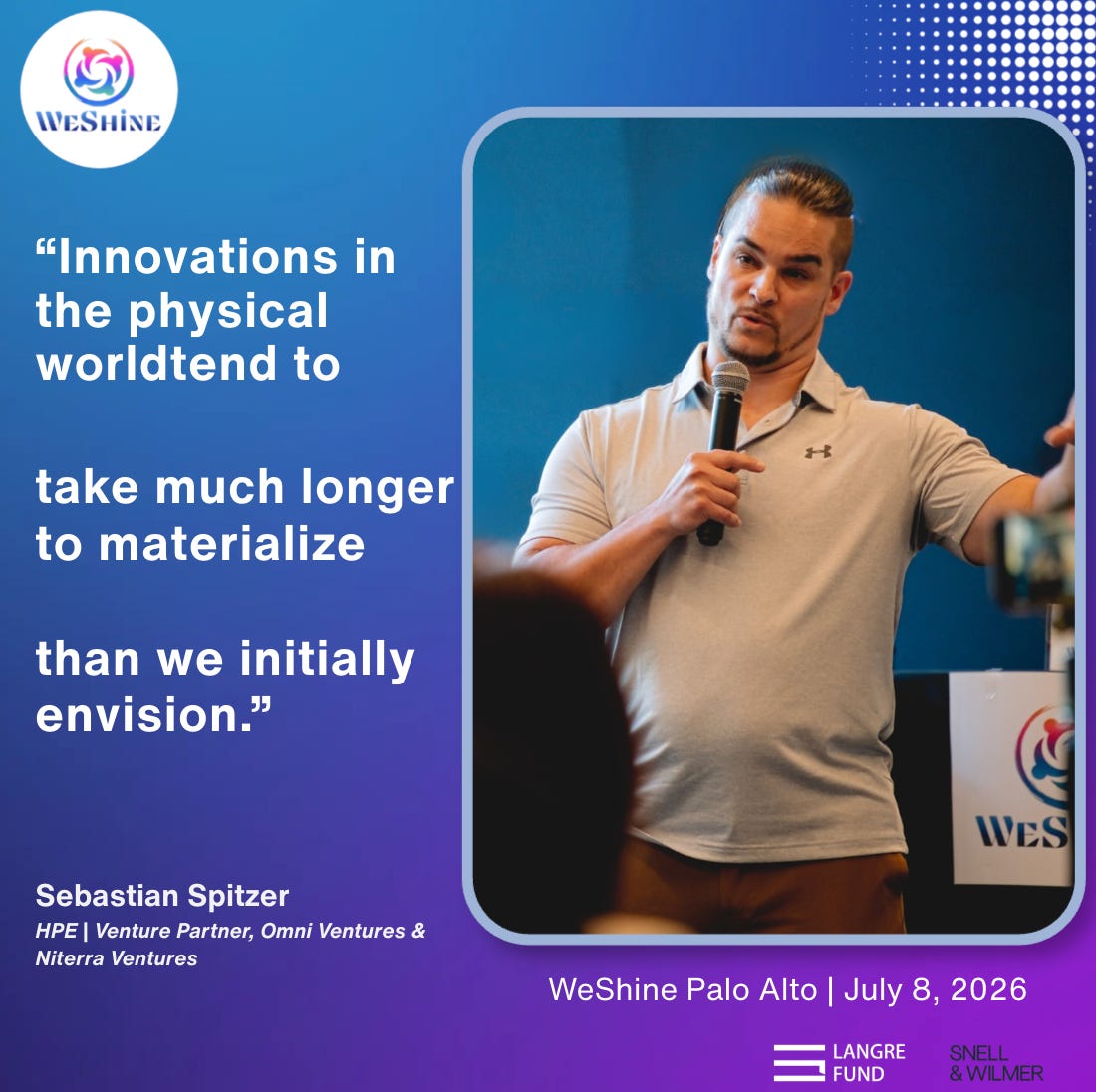
During his keynote at WeShine’s AI Infrastructure & Robotics event, Sebastian Spitzer offered a useful interpretation of this gap: slow adoption does not mean the opportunity is disappearing. It means the market is still extraordinarily early.
Software has conditioned founders and investors to expect rapid adoption. A digital product can be distributed globally through the cloud, while an AI application can reach millions of users without requiring changes to the surrounding environment.
Physical systems operate under different rules. A robot, vehicle, or industrial machine must be manufactured, delivered, installed, tested, maintained, and integrated into an existing workflow.
Software scales through replication. Physical technology scales through production and deployment.
Sebastian drew on his experience in the automotive industry. More than a decade ago, autonomous vehicles and electric mobility were already presented as inevitable parts of the future. Yet fully autonomous vehicles still represent only a small portion of transportation activity.
Robotaxis now operate in selected cities, but most vehicles remain human-driven. Electric vehicles have achieved broader adoption, yet replacing the entire vehicle fleet still requires years of infrastructure development, manufacturing, regulation, and changing consumer behavior.
The lesson is not that these technologies failed. The lesson is that transforming physical systems takes much longer than introducing digital tools.
Although humanoids dominate today’s headlines, the concept of Physical AI is much older.
Sebastian described self-driving vehicles as an early example because they connect digital intelligence directly to physical action. An autonomous vehicle perceives its surroundings, makes decisions, translates those decisions into movement, and continuously adjusts based on feedback.
This is the core of Physical AI: intelligence moving beyond the screen and producing consequences in the real world.
The terminology may be new, but the engineering challenge is not. What has changed is the maturity of AI models, computing infrastructure, sensors, simulation tools, and investor interest.
Physical AI is therefore not starting from zero. It is entering a new stage in a much longer technological journey.
Large language models benefited from enormous amounts of text, code, images, and documentation already available online. The distribution infrastructure was also in place through laptops, smartphones, browsers, and cloud applications.
Once a capable model became available, millions of people could begin using it almost immediately. No factory needed to be redesigned, and no machinery needed to be installed.
Physical AI does not have that advantage.
A robot cannot simply download a complete understanding of every warehouse, hospital, farm, construction site, or factory. Each environment contains different layouts, lighting conditions, objects, workflows, safety requirements, and human behaviors.
The real world is not one standardized dataset. It is millions of specific environments, each producing its own long tail of exceptions.
Physical AI systems require data that must often be actively created through real-world interaction.
Robots need to understand movement, force, balance, depth, contact, object properties, environmental changes, and unpredictable human behavior. Collecting this data may require hardware, sensors, operators, repeated experiments, and significant supervision.
The data is also highly specific. A robot trained in one warehouse may not perform equally well in another. A system that handles standardized objects may struggle when packaging is damaged, lighting changes, or items are positioned differently.
These edge cases often determine whether a system can move from a controlled demonstration into commercial deployment.
This creates an important strategic insight: the strongest Physical AI companies may not have the largest general-purpose models. They may have the deepest operational understanding of one specific environment.
Their competitive advantage may be hidden in thousands of failure cases that outsiders cannot easily observe or reproduce.
Physical AI is not only an AI problem. It is a systems-engineering problem involving machine learning, mechanical design, electrical engineering, control systems, sensors, actuators, batteries, manufacturing, and safety.
Every component affects the others. A more powerful model may require more computing, which produces additional heat. Cooling adds weight, while weight affects mobility, energy use, durability, and battery life.
A decision that improves intelligence may create a mechanical or economic problem elsewhere in the system.
In software, an error can often be corrected through an update. In hardware, a design mistake may require new components, supplier changes, manufacturing adjustments, or physical replacement.
This makes Physical AI companies harder to build, but also harder to copy. A complete robotic system supported by proprietary data, specialized hardware, supplier relationships, and deployment experience can develop a stronger moat than a software feature alone.
Every robot depends on motors, chips, batteries, sensors, gears, cameras, actuators, and precision components.
A prototype may work with expensive or specialized parts. Producing thousands of units at a commercially viable price is a different challenge.
Companies must secure reliable suppliers, maintain manufacturing consistency, control quality, provide replacement parts, and support deployed machines. A robot may be technically capable of performing a task but still be too expensive or difficult to maintain at scale.
This means some of the largest opportunities may exist beneath the robot itself:
Simulation, synthetic data, and testing
Sensors, actuators, and specialized components
Fleet management and diagnostics
Maintenance and manufacturing infrastructure
The future of Physical AI will be built not only by robot companies, but also by the companies creating the infrastructure around them.
A chatbot can produce an incorrect answer and still remain useful. The user can retry, verify the result, or ignore it.
Physical AI has a much lower tolerance for failure.
An autonomous vehicle cannot misunderstand its surroundings five percent of the time. A robot working near employees cannot make unpredictable movements. A machine inside a factory cannot regularly damage equipment or interrupt production.
A robot that succeeds 99 percent of the time may sound impressive, but if it performs thousands of actions every day, the remaining one percent may still create an unacceptable number of failures.
The challenge is not showing that a robot can perform a task once. It is proving that the robot can perform that task safely, repeatedly, and economically under imperfect conditions.
Changes in lighting, damaged objects, blocked sensors, network failures, and unexpected human movement often separate an impressive demonstration from a dependable product.
The winners in Physical AI may not be the companies with the most dramatic demonstrations. They may be the companies with the most dependable systems.
Customers do not purchase robots because they look futuristic. They purchase lower costs, higher productivity, improved safety, consistent quality, reduced downtime, or relief from labor shortages.
The robot must therefore compete not only against other robots, but against the customer’s current process.
Can it operate long enough? Can employees use it easily? Can it recover when something goes wrong? Can it be repaired quickly? Does the financial return justify the deployment?
A compelling prototype attracts attention. A reliable machine creates economic value.
For founders, the strongest opportunity may not be another general-purpose humanoid robot. It may be one specific workflow where intelligence can create measurable value.
That could mean addressing a dangerous task, a labor shortage, expensive downtime, a difficult data problem, or a deployment bottleneck. Starting narrowly allows a company to master one environment, build proprietary data, and improve reliability before expanding.
For investors, Physical AI companies may require different expectations from traditional software startups. Development cycles are longer, deployments are slower, capital requirements are higher, and early margins may be lower.
Important signals include whether pilots convert into production, reliability improves over time, deployment costs decline, customers expand their usage, and each installation strengthens the company’s data advantage.
The central question is not simply whether the prototype works. It is whether the company is steadily reducing the distance between prototype and production.
August 5 | 5:30 PM–8:30 PM | Palo Alto
“Physical Intelligence and AI Infra” VC Insights• Founder Pitches
Registration: https://luma.com/l56dhiul
Follow WeShine on LinkedIn for real-time updates, founder resources, and community announcements. We look forward to continuing the conversation.
We shine together ✨
— The WeShine Team
Located in Silicon Valley, WeShine is a nonprofit driving innovation and supporting entrepreneurs. We connect founders, technologists, investors, and industry experts to turn ideas into impactful realities. Through online seminars, meetups, incubation programs, talent initiatives, and global startup events, we provide the resources and networks entrepreneurs need to grow. Join us and be part of a community where visions shine brighter.
No posts
Comments
Nothing yet. Say the first thing.
Sign in to join the conversation.