
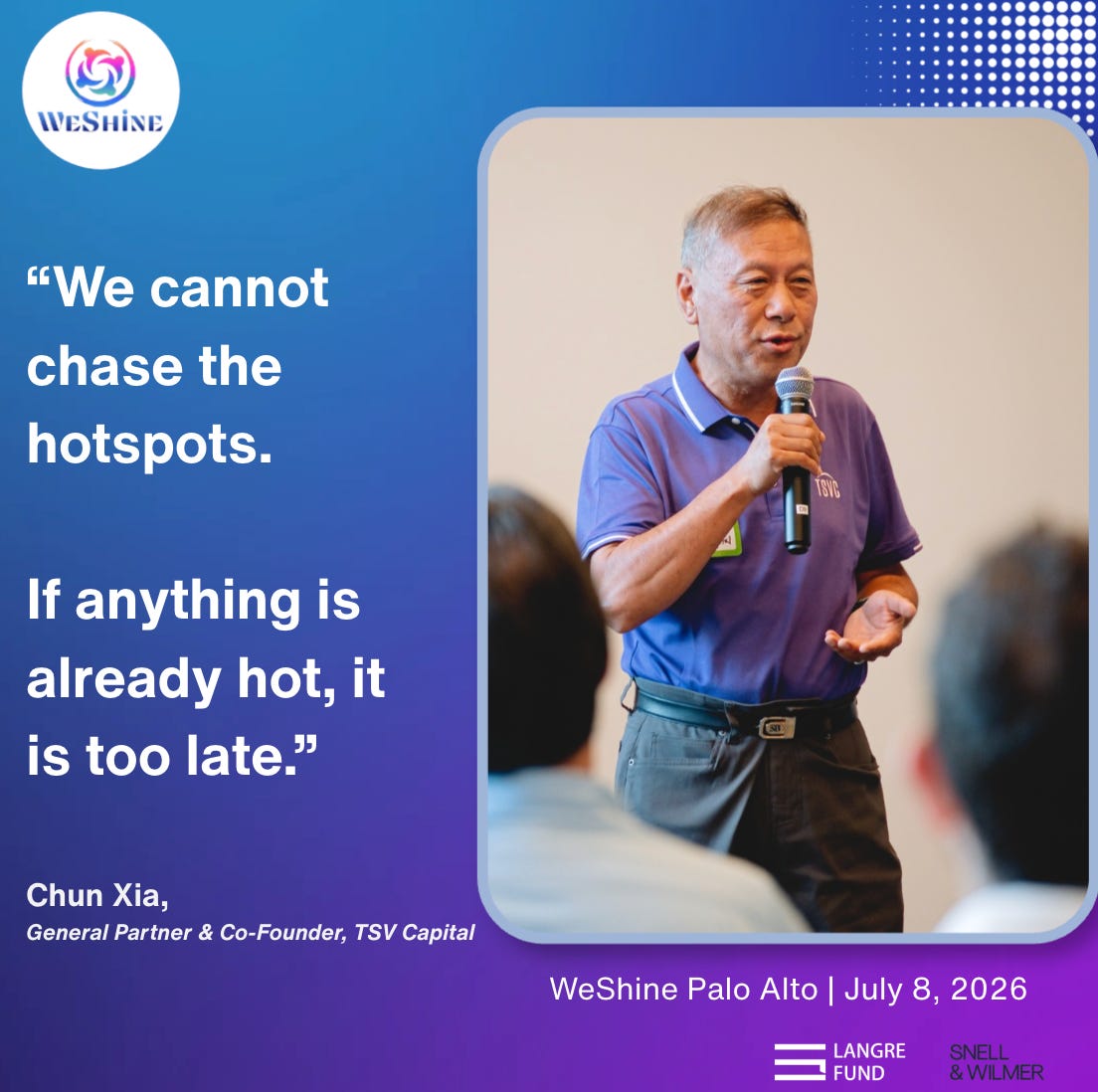
At WeShine’s July 8 AI Infrastructure & Robotics Night, Chun Xia, Co-Founder and General Partner at TSVC, posed a question that founders and early-stage investors should be asking more often:
When everyone is focused on what is already hot, what is still missing?
For seed-stage investors, recognizing today’s most popular category is not enough. Once a market becomes crowded and heavily funded, much of its earliest opportunity may already be gone. The more difficult task is identifying what could become important three, five, or even ten years from now.
Rather than focusing on model size, benchmark performance, or the competition among foundation-model companies, Chun framed the next generation of AI opportunities around two fundamental limitations: the difficulty of bringing intelligence into the physical world, and the need to preserve human agency, rights, relationships, emotion, and meaning in an increasingly automated society.
From these two gaps, he outlined seven opportunities that could shape the next era of AI.
Language-model errors are often recoverable. In robotics, manufacturing, mobility, healthcare, and autonomous systems, however, one unusual situation can cause equipment damage, operational disruption, or serious safety risks.
The hardest Physical AI problems often appear in rare edge cases after long periods of real-world deployment. A warehouse robot may encounter damaged packaging, blocked pathways, unexpected human behavior, or changing lighting conditions.
These exceptions are expensive to collect, difficult to simulate, and rarely shared. Over time, they become proprietary operational knowledge and a powerful barrier to entry.
In Physical AI, the moat may not simply be the model. It may be the accumulated knowledge of what goes wrong and how the system should respond.
The second limitation is even more fundamental. Regardless of how capable AI becomes, society must still decide where machine authority ends and human authority begins.
Who makes the final decision? Who controls personal data? Whose interests does an AI system serve? Can a machine optimize a person’s life without weakening that person’s autonomy? Should AI ever determine what gives human life meaning?
These are not technical problems that disappear when models improve. They are questions of governance, rights, power, culture, and identity. Chun’s seven opportunities can be understood as different responses to this central challenge.
Most conversations about AI and employment focus on replacement. Chun proposed that automation will also create a new category of work: the black-collar worker.
The idea comes from the role of a referee on a soccer field. The referee does not play the ball, but watches the entire system, interprets events, identifies violations, and intervenes when necessary. In an AI-driven workplace, black-collar professionals may supervise autonomous agents, investigate unusual behavior, review high-impact decisions, and raise the red flag when automated systems move beyond acceptable boundaries.
As AI performs more visible work, the value of human oversight, judgment, escalation, and accountability may increase. This could create new professions and markets around AI auditing, agent supervision, monitoring, compliance, governance, and safety.
Many companies are building agents to automate tasks, but the deeper question is not only what an agent can do. It is whom the agent serves.
Today’s platforms often make money through engagement, advertising, transactions, data collection, or ecosystem control. An agent built within that structure may appear helpful while still serving the commercial interests of the platform.
Chun proposed a trusted personal agent that represents the individual. It would understand the user’s preferences, responsibilities, relationships, boundaries, and long-term goals while coordinating with other specialized agents.
This turns the personal-agent opportunity into a question of digital sovereignty. Who owns the agent’s memory? Can users move it between providers? Can they understand why it made a recommendation? Can the agent reject actions that conflict with their interests?
The most important agent company may not be the one that builds the largest platform. It may be the one that earns the deepest individual trust.
Today’s media economy rewards platforms that capture attention. Generative AI could intensify this problem by producing unlimited personalized content, but it could also reverse the model.
Personal agents could compare sources, remove repetition, evaluate relevance, and prepare concise briefings based on the user’s priorities.
This would represent a shift from an attention economy to an intention economy. Users would define their objectives, and agents would organize information around what genuinely matters.
The winning media product may no longer be the feed that captures the most time. It may be the intelligence layer that gives people their time back.
Social platforms are effective at creating connections but less effective at building meaningful relationships.
Agentic social systems could remember the context of previous conversations, recognize shared interests, identify when an important relationship has gone quiet, or suggest a timely introduction based on a genuine shared goal.
The purpose should not be to automate more outreach and create more noise. The deeper opportunity is helping people build fewer, stronger, and more relevant relationships.
Future social products may measure collaborations formed, conversations continued, trust developed, and relationships strengthened rather than followers, clicks, and time spent.
Most AI systems understand humans primarily through language, but emotion is also expressed through tone, hesitation, silence, facial expression, physiology, timing, and social context.
Chun distinguished this opportunity from AI companions designed to imitate affection. The more meaningful goal is to create systems that responsibly recognize emotional context and help humans understand one another.
Applications could emerge in healthcare, education, leadership, coaching, conflict resolution, and team collaboration.
However, emotional data is deeply sensitive. A system that recognizes fear or vulnerability can support a person, but it can also manipulate them.
The strongest Emotion AI companies may therefore be those with the clearest protections around consent, privacy, interpretation, and influence.
Industrialization reduced physical labor and helped create a vast fitness economy. As movement disappeared from everyday work, people had to reintroduce it intentionally through gyms, sports, coaching, nutrition, and wellness.
Chun suggested that AI may create a similar shift in cognitive life. As machines perform more writing, planning, analysis, research, memory, and problem-solving, people may gradually exercise less patience, judgment, creativity, self-awareness, and independent thought.
Just as the decline of physical labor created demand for fitness, the decline of routine cognitive labor may create a new mind-and-heart economy focused on attention, resilience, emotional regulation, reflection, creativity, purpose, and mental development.
Technology changes what humans must practice intentionally. In the AI era, that may increasingly include the capacities of the mind and inner life.
Modern education was designed largely to prepare students for industrial and information-based workplaces. It emphasizes memorization, standardized problem-solving, deadlines, and measurable outputs.
But these are precisely the tasks AI is becoming increasingly capable of performing.
Education must therefore reconsider its purpose. Instead of training people to compete with machines at machine-like work, it should develop judgment, curiosity, emotional literacy, ethical reasoning, communication, adaptability, and self-knowledge.
Students must learn how to use AI, but also when not to use it. They need to distinguish assistance from dependence, information from understanding, and convenience from growth.
Education may become one of the most important systems for preserving human agency in an AI-driven world.
Seven Opportunities, One Connected System
These seven opportunities form a connected system. As AI takes on more work, humans will need stronger oversight and personal agents that protect their interests. Those agents could reshape media and social platforms around intention, trust, and meaningful relationships rather than attention and engagement.
As automation expands, emotion, mental well-being, and human-centered education will become increasingly important. Together, these opportunities point toward a broader shift: from AI designed simply to perform human tasks to AI systems built around human interests.
The next major AI opportunity may not come from building another interface on top of a foundation model. It may come from solving the problems that better models alone cannot remove.
Founders should ask: What exceptions are being ignored? Where is human judgment still essential? Who does the product truly serve? Does it strengthen human agency, or quietly weaken it?
For investors, the most durable companies may be those building proprietary real-world knowledge, trusted relationships, or human-centered systems that cannot be replicated simply by improving the underlying model. The strongest opportunities may emerge where technical capability meets physical and human complexity.
Chun Xia is Co-Founder and General Partner at TSVC. This article is based on his keynote presentation at WeShine’s July 8 AI Infrastructure & Robotics Night.
August 5 | 5:30 PM–8:30 PM | Palo Alto
“Physical Intelligence and AI Infra” VC Insights• Founder Pitches
Registration: https://luma.com/l56dhiul
Follow WeShine on LinkedIn for real-time updates, founder resources, and community announcements. We look forward to continuing the conversation.
We shine together ✨
— The WeShine Team
Located in Silicon Valley, WeShine is a nonprofit driving innovation and supporting entrepreneurs. We connect founders, technologists, investors, and industry experts to turn ideas into impactful realities. Through online seminars, meetups, incubation programs, talent initiatives, and global startup events, we provide the resources and networks entrepreneurs need to grow. Join us and be part of a community where visions shine brighter.
No posts
Comments
Nothing yet. Say the first thing.
Sign in to join the conversation.