
I preached this morning at St. John’s Episcopal Church in Grand Haven, Michigan, my parish for the past five years. My text was the Gospel passage, John 20:19-31, on “Doubting Thomas.”
+In the Name of God, the Father, the Son, and the Holy Spirit, Amen.
Many of us in this country have been riveted on the story of the kidnapping of Nancy Guthrie, the 84-year-old mother of Savannah Guthrie, an anchor on NBC’s Today show. At the beginning of February, Nancy was abducted from her home in Tucson, Arizona, and she still has not been found.
Last Sunday at Good Shepherd New York, where Savannah Guthrie is a member, she spoke about what it feels like to observe Easter in the middle of this nightmare. “That [event of Jesus’ resurrection] is what is most crucial to us,” she said. “We celebrate today the promise of a new life that never ends in death.
“But,” she went on, “standing here today, I have to tell you, there are moments in which that promise seems irretrievably far away — when life itself seems far harder than death.”
Guthrie’s words struck me powerfully. We know exactly what she’s talking about, don’t we? Yes, we celebrate that Jesus was raised from the dead, but as we look around at what difference it actually makes in our lives, the answer often seems to be, “Not much.” Just this week, I heard from a friend about his mother having a heart attack. Another friend is going through a nasty divorce. Another is hospitalized. And the world itself is on fire, in many places quite literally. Many of us heeded Pope Leo’s call to make yesterday a day of prayer for peace in Iran, but that peace is nowhere in sight. And so we resonate with Savannah Guthrie: “life itself seems far harder than death.” Where is the hope of resurrection?
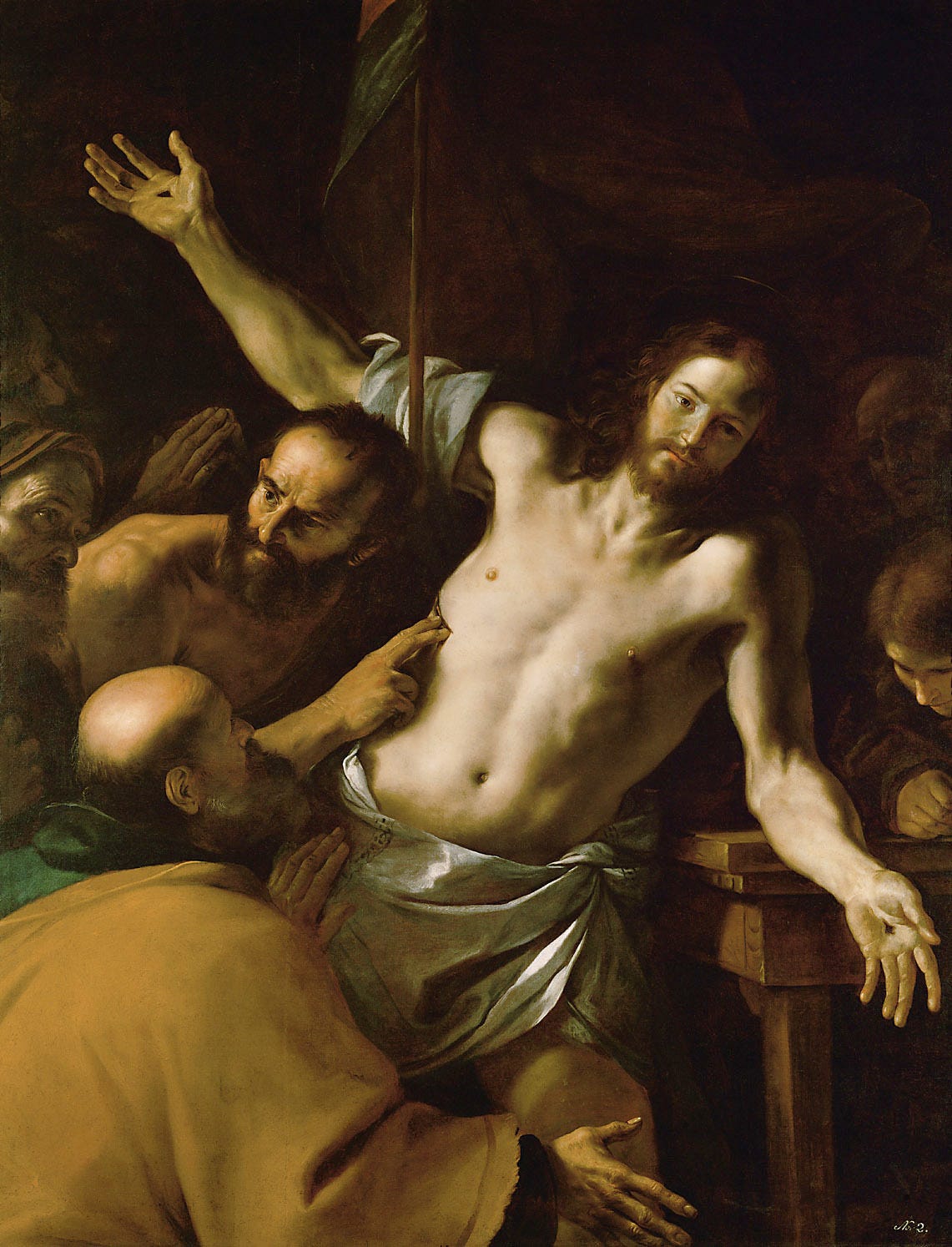
Our Gospel this morning is about the disciple of Jesus famously known as “Doubting Thomas.” Before I get to the story we just read, I want to remind you of something Thomas said earlier in the Gospel of John. You’ll remember that Jesus had a special friendship with a group of siblings who lived near Jerusalem in Bethany, Mary and Martha and Lazarus. At a time when Jesus’ popularity — and infamy — was soaring, Lazarus died. And as Jesus prepared to make his final appearance in Jerusalem, he told his disciples: “Let us go to Judea again.” To the disciples, this was a suicide mission. “Rabbi, the Jews were just now trying to stone you, and are you going there again?” But Jesus is determined: “Our friend Lazarus has fallen asleep, but I am going there to awaken him.” Jesus has the power to raise the dead — so much so that he can refer to death casually as if it were an afternoon nap. But Thomas, “Doubting Thomas,” after realizing that Jesus will not be dissuaded from heading into the heart of danger, says, “Let us also go, that we may die with him.” Thomas has just heard Jesus say that he intends to reverse death, but all he concludes is, “Death is certain. There’s no hope.” And so he says, “Let’s go die with him.”
That is what it feels like sometimes during this Easter season. We can say the words, “Christ is risen.” But what we feel is, “There’s nothing but death for me.” Susan Bigelow Reynolds, a professor of Catholic Studies at Emory University, wrote recently in Commonweal magazine that cynicism may be especially rife in our culture right now because of how the optimism of our younger selves lives forever on the Internet. We can look back at old social media posts and find ourselves saying things like “Yes we can!” and “Change is possible!” and it now makes us cringe, given how unfulfilled our hopes turned out to be. “In a cynical age, earnestness is a liability. Better to harden our hearts from the jump than to look back from the desert and realize with humiliation how naïve we once were.”
And so in our Gospel this morning, Thomas is determined not to give in to naïveté. The other disciples tell him, “We have seen the Lord!” But Thomas hardens his heart, refusing to be humiliated, and says, “Unless I see the mark of the nails in his hands and put my finger in the mark of the nails and my hand in his side, I will not believe.” On each evening after that conversation, I picture Thomas wistfully congratulating himself on his skepticism. He wishes Jesus had been raised, but every day that goes by confirms that his instinct to resist believing was right.
After a week, Thomas is again with the disciples, and the door to the house is shut. But “Jesus came and stood among them and said, ‘Peace be with you.’ Then he said to Thomas, ‘Put your finger here and see my hands. Reach out your hand and put it in my side. Do not doubt but believe.’”
In order to understand what happens next, we need to rewind for a moment and remember what Thomas said earlier in the story. After Jesus raised Lazarus, after Jesus and his disciples arrived in Jerusalem for the last time, on the evening of the supper before Jesus’ arrest and trial, Jesus told his disciples that he would be going away to prepare a place for them. “And you know the way to the place where I am going,” he said.
To which Thomas responded, “Lord, we do not know where you are going. How can we know the way?” Jesus said in reply, “I am the way and the truth and the life. No one comes to the Father except through me. If you know me, you will know my Father also. From now on you do know him and have seen him.” Jesus tells Thomas, in effect, that to see him is to see the One he knows as “Father.” To see Jesus is to see God.
And so back to our Gospel reading this morning: As the risen Jesus shows Thomas the scars (or glorified wounds) in his hands and his side where the spear pierced him, Thomas perhaps remembers what Jesus told him on Maundy Thursday, and now he exclaims with dawning recognition, “My Lord and my God!” Jesus, Thomas’s Lord, has shown him the Father. Jesus has revealed who God is. Jesus has shown him the way into the heart of God.
As I was thinking about Doubting Thomas and about Savannah Guthrie’s Easter message this past week, I watched an interview that Ben Sasse did with Ross Douthat for The New York Times. Sasse, who served as a US senator from Nebraska, was diagnosed late last year with Stage 4, terminal pancreatic cancer. Like Savannah Guthrie, Ben Sasse is a Christian, and he spoke about his faith in this interview he gave for the Times. Douthat asked him, “Do you think you’re ready to die? Do you feel ready?”
Sasse echoed St. Peter in his reply. You remember when Jesus asked his disciples if they wanted to walk away from him in disappointment, and Peter said, “Lord, to whom can we go? You have the words of eternal life.” And so Ben Sasse said, “I don’t feel ready [to die]. But to whom would I go? [In the Bible] we’re told that we get to approach the Almighty, we get to approach the divine and call him ‘Daddy,’ ‘Abba, Father.’ That’s pretty glorious. And I know that that’s what I need.”
Doubting Thomas knew that that’s what he needed, and he came to understand that that’s what Jesus had opened up for him. To believe in Jesus and follow him is to have a relationship with God where you can call God “Father,” where you can know the Creator of the universe as “Daddy.” It’s no wonder when Thomas saw the risen Jesus that he burst out, “My Lord and my God!”
Savannah Guthrie knows that that’s what she needs as well. In the midst of the agony of not knowing if her mother is dead or alive, she said, “I still believe. And so I say with conviction, ‘Happy Easter’… It is the darkness that makes this morning’s light so magnificent, so blindingly beautiful.”
As Pope Leo said in his Easter message, quoting St. Augustine, “If you fear death, love the resurrection!” Jesus Christ is risen from the dead. He died on a cross where he bore all our guilt and grief — and bore it away. He trampled down death by death. And three days later he appeared alive to his disciples and said, “Peace.”
Although you may look around at a world where there seems to be precious little trace of his victory — even so, friends, love the resurrection! Love and trust the One who has triumphed, who will one day come again and wipe away your tears and make all things new.
Alleluia! The Lord is risen! The Lord is risen indeed! Alleluia!
Amen.
No posts
Comments
Nothing yet. Say the first thing.
Sign in to join the conversation.