
I preached this morning in a chapel service at Western Theological Seminary, where I teach:
+In the Name of the Father, the Son, and the Holy Spirit. Amen.
In our Romans class yesterday, my students and I had the happy experience of having a Zoom conversation with the author of one of our core textbooks, Beverly Gaventa. One of us asked her a question about preaching, and this is my recollection (not a verbatim quotation) of something she said: “Preach from the text about what God does, how God is active in the world.”
Her point, I think, was that it is so easy to focus on historical, cultural, literary, or other curious aspects of the biblical text that may be eminently worth focusing on in other contexts or for other purposes but should not overdetermine what a Christian preacher feels compelled to say. Preaching is for pointing hearers to God. As Fleming Rutledge famously says (in what someone has called “Rutledge’s Rule”), “it is God, not human beings, who should be the subject of the sermon’s main verbs.”
After our class, last night, and to prepare for this, my last sermon as a faculty member here at Western, I went back and re-listened to the homily that my beloved teacher John Barclay preached at the service when I was ordained a priest, in which he charged me:
Please, please speak often, speak eloquently, and speak creatively about God — God, first and foremost, not as the object of our searching and praying but as the subject of verbs, as an agent, as the agent in our lives, as the creative source and power in all that is working for good.
I speak here as a member of the laity: we are hungry…
What we, what we all, need to hear is not how we can turn things around for the better, not how we can dig deeper into our own inner resources. What we need to hear is that the life of Jesus, the resurrection life of Jesus, is active in our lives, that God is at work, that the power of God is not constrained by our physical and emotional weakness. So we need you, Wesley, to speak in every sermon about the power of God who gives life to the dead and calls into existence the things that do not exist.
So that is what I hope to do today, as we move toward the table on this Maundy Thursday: I want to speak to you about God and how God is with us.
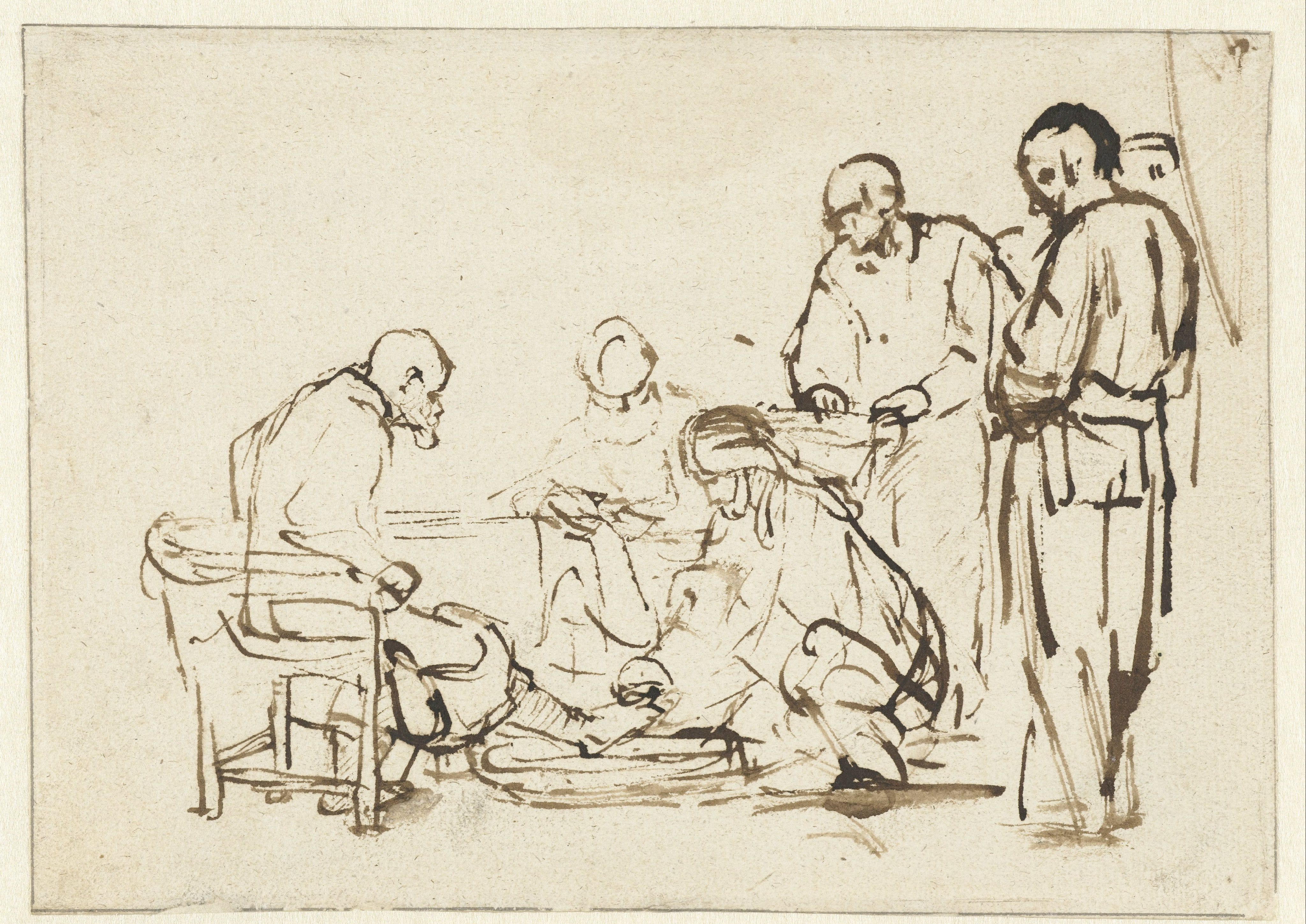
Many sermons on our text for today — the account in John 13 of Jesus’ washing his disciples’ feet and then giving them the mandate to love each other — focus on us and how we are called to imitate Jesus. In the words of Marianne Meye Thompson, “the ethical dimension of the text seizes the spotlight, and does so in a way that virtually ignores the text’s christological, or soteriological, dimension.”[1] We shouldn’t of course commit the opposite error and ignore the text’s ethical imperative, but I do want to shift the spotlight this morning to Jesus’ action itself.
This text gives us a homely, intimate scene. Jesus is with his friends at supper, his last before his arrest and execution. At one point he gets up, removes his outer clothing, ties a towel around his waist, and begins to wash his disciples’ feet and dry them with the towel. “On the worn shiny / boards the water runs, salt / with refuse from dark roads.”[2]
When Jesus comes to Peter, he meets resistance: “Lord, are you going to wash my feet?” The way the pronouns are placed in Greek suggests that we read this with italics or say it with emphasis: “Are YOU going to wash MY feet?” Peter cannot stomach the thought that his Lord and Teacher would stoop to a position of subservience before him, the learner. To which Jesus responds, “You do not know now what I am doing, but later you will understand.”
“Later” must refer to the period after Jesus’ death and resurrection, after enough time has gone by for Peter to register the link between what Jesus did there with the water basin and the towel and what he did on Good Friday. Looking back, Peter will be able to see that by washing his feet, Jesus was giving a sort of dramatized preview of the Cross.
This story is about God’s love as it is displayed for us in God’s self-giving all the way to death. “Having loved his own who were in the world, he loved them to the end.” Michael Gorman has even gone so far as to say that Paul might have had this story in mind when he wrote about Jesus “who, because he existed in the form of God, did not regard equality with God as something to be grasped, but emptied himself, taking the form of a slave, assuming human likeness. And being found in appearance as a human, he humbled himself and became obedient to the point of death — even death on a cross” (NRSV altered).
And what Paul wrote after that may be the secret clue to the meaning of Jesus’ self-emptying: If Jesus is then exalted and receives the Name that is above all names, then that means that Jesus’ death is a window — the window — into the very existence and character of God. “God proves his love for us in that while we still were sinners Christ died for us.”
So, friends, that is what we remember on this holy day. God was so determined to save us that he willingly took on the most cosmic role reversal imaginable. Because Jesus is God’s own Son, because he is (so to speak) God’s spitting image, he humbled himself in extremis by washing his disciples’ feet — and by washing them entirely, body and soul, through his agony on the Cross. He loved us to the uttermost. He loves us still today.
“O Jesus, we adore You. O eternal God, we adore You. Our Redeemer, present here in this Sacrament, we adore You… Life and death of Jesus, present from all eternity in the immutable knowledge and will of the eternal Father, we adore You… Jesus, truly present with us whose lives You already knew and loved during Your life and suffering, we adore You.”[3]
Amen.
[1] Marianne Meye Thompson, “‘His Own Received Him Not’: Jesus Washes the Feet of His Disciples,” in Ellen F. Davis and Richard B. Hays, eds., The Art of Reading Scripture (Eerdmans, 2003), pp. 258-73 (260).
[2] Rowan Williams, The Other Mountain (Carcanet, 2014), p. 35.
[3] Karl Rahner, Watch and Pray with Me (Herder & Herder, 1966), pp. 15-16.
No posts
Comments
Nothing yet. Say the first thing.
Sign in to join the conversation.