
I’ve had multiple DMs and messages asking me to elaborate on my experience as a guide at Alpha School. It’s been four weeks now, and I would love to share my thoughts, struggles, and mistakes.
First I will share a little background on my journey. Prior to becoming a guide at Alpha, I was a public school teacher for 10 years. Before that I worked with a small micro-school to expand their accelerated math program, and prior to that I was a homeschool mom to my two older kids, who are now in college. I found Alpha when I was researching intelligent tutoring systems and adaptive programming through my doctoral program. At the same time I was also looking for a school for my now 4 year old, who, for anyone wondering, was an absolute surprise but also such a blessing.
I want to briefly address two of the common misconceptions about the “AI School” before I dive into what the last four weeks have been like.
People hear “AI school” and assume students are being taught by chatbots. There are no chatbots in the AI-backed programs Alpha uses. The “AI” part of the academic program refers to the adaptive nature of the apps. For example, if a student frequently misses a particular concept in math, the program will assume the student has a knowledge gap that needs to be addressed and will create a “hole filling” plan. When the program is satisfied that the student has sufficiently understood the material, it offers a test to unlock harder content. This is something a worksheet or a whole-class lesson simply cannot do. Teaching to the Zone of Proximal Development (ZPD) is indisputably the most effective way to assimilate knowledge, and adaptive programs keep every student in that zone all the time.
The afternoons are spent in hands on workshops. Some use AI as a tool; others involve no technology at all. I’ll share more about those below, because the workshops are where some of the best guide work happens.
Students do not spend all day on screens. The whole point of the AI-backed programs is to minimize screen time. Screentime at Alpha is intentional. It is not merely a babysitter. As a public school teacher, technology in my district was used as a way to manage boredom while teachers focused on students who needed additional help. I taught at both the middle and high school level, and can tell you with certainty that the students in my public school district spend more than two hours a day on screens, often on unproductive websites such as games and YouTube Shorts.
Many people get hung up on the wording of “teacher” versus “guide.” We are not called teachers because we do not directly teach content. Regardless of the label, we are greatly invested in our students and are always seeking opportunities to make their learning experience better.
I have seen some critics claim how easy it must be as a guide to just sit back and monitor the technology all day. This couldn’t be further from the truth. Guides are constantly interacting with students. Even during the academic block when students are working in the programs, we are watching, analyzing, and pulling students aside as needed. Johnny’s been on that program for a while now — what’s going on? Is he staying there because it’s a preferred subject and he doesn’t want to move on to a challenging subject area? Is he stuck on a concept? We are still circulating around the room. We are looking at the student who might be just clicking through the assignments while bouncing around in her chair. She needs a break. But a break does not consist of “go have some free time.” It’s a 1:1 talk or activity with her guide. Every action and discussion is intentional, reminding students that they are in charge of their learning, that they can do hard things, and that we are there to support them.
I had a student who was really frustrated by the reading program. He was previously at a private school and was used to the golden rule that 70% is passing. That is not the standard at Alpha. So when he would take a test and get a 70, he would get really frustrated that he had to go back and redo part of the material. As guides, we refer to this as a coaching opportunity. It’s not simply saying, “go try again” or “you will do better next time.” It’s a detailed conversation in which the student does the majority of the speaking and the guide scaffolds the conversation. The end result is the student arrives at the conclusion that rushing through assignments, hoping to get a 70, is not good practice.
While it is true that we don’t have to be content experts as traditional teachers are, we do need to be experts on motivation. The only way to successfully do this is to know key details about each and every student: what motivates them, what is hard for them, what is easy for them, their personality, how they will react to obstacles and challenges, and the lever that unlocks them when they are stuck. You spend every moment from drop-off to pick-up with your students. You eat lunch with them. You learn about their lives outside of school. This is very different from my previous job, where I didn’t have time to get to know 150 high school students. At Alpha, you build a relationship with your students, but you are also fostering independence at the same time. The goal is not for Johnny to come to you every time he needs something. It’s to build his confidence so he can take risks and try new approaches. The goal is not to prevent failure. It’s to teach students how to accept it, move past it, and try again.
The afternoon workshops are where students learn the life skills that many say can’t be “taught,” such as grit, teamwork, leadership, creativity, and critical thinking — and yes, sometimes they involve AI and even chatbots. One of the workshops I did with my students was App Architect, where students build an app that solves a problem or helps the community. Some did use an AI chatbot that I built specifically for this workshop. It was set up with specific guardrails so it would not hand them the exact prompt to build the app, since prompting was one of the skills they were working on, but they could bounce ideas off of it. Another was Toy Inventors, where students designed toys using Meshy (an AI program), then 3D printed them. And one of my favorites, Suture Survivors, involved no AI at all: students learned to suture like surgeons using actual surgical equipment. During workshops, guides are not just sitting back and monitoring. We are asking questions, challenging students to try different approaches, and watching the dynamics of the group interactions.
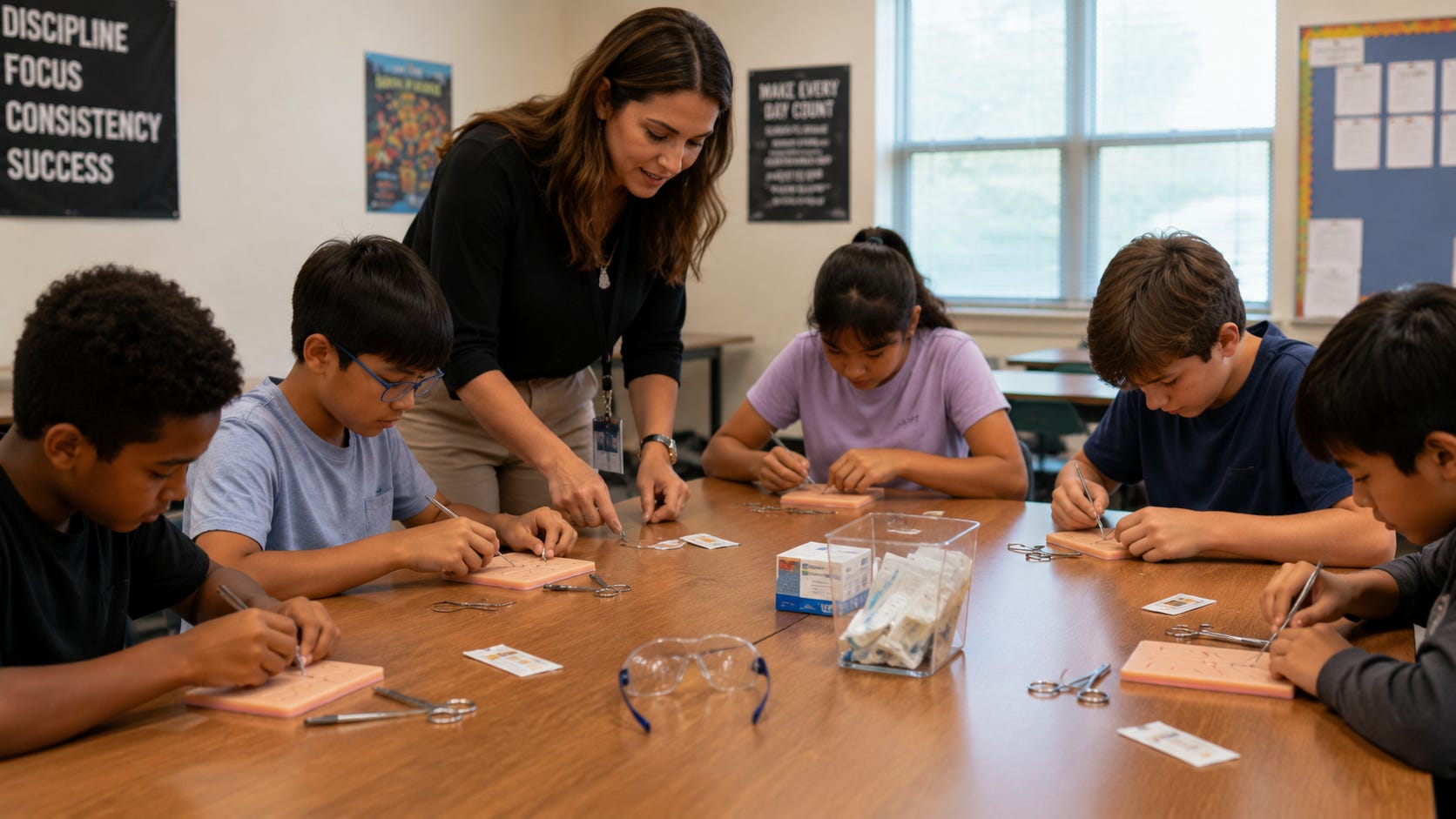
The low student to guide ratios and focused time spent with students, allows us to truly know our students. During the regular school year, we would use this knowledge to design workshops that target the specific life skills a group of students needs most. And of course, it allows us to create custom motivation strategies for each child, because what motivates one student may bore another. Not every student would find making slime exciting; some would prefer to go fly a drone or go on a nature walk. This is the part many miss about Alpha. You don’t make generalizations about student behavior and motivation. Absolutely everything is personalized. The academics, the attention, the motivation system, the rewards, and the challenges. Each child receives a custom experience while still participating with their group of peers.
There was definitely an adjustment from teacher to guide. I have taught math for ten years. I have a master’s degree in math curriculum and instruction. I could pretty much walk into any math class and teach whatever concept was on the board. Yes, I still had some prep work for teaching, but I wasn’t constantly learning content. Alpha summer is very fast paced compared to the regular school year. You are leading new workshops weekly, which means you are completely switching topics every week. This did stretch my brain. It’s a different way of thinking. The teacher in me approached the week by wanting to become an expert on whatever I was leading, plan for every obstacle that might arise, and think through every single step. For example, when I taught the suturing workshop, I watched numerous videos to master the art before leading it. In retrospect, I should have taken a deep breath and just learned alongside the students, modeling what it looks like as an adult to learn a new skill.
It’s an entirely different planet than traditional teaching in another way, too. Traditional teachers are often trained by administration to rescue students the moment things get hard, to alleviate “anxiety.” Teachers who bring that instinct with them are going to struggle as guides. My homeschool years probably saved me here; I’d already learned that rescuing a kid from struggle robs them of the win. You have to be willing to do exactly what Alpha asks: hold kids to high standards while giving them high support. There will be times when you hear “this is impossible,” “I don’t like this,” “it’s too hard.” This is especially true during summer at new campuses, where most of the students are coming from traditional schools and have never experienced Alpha before.
One thing that is also very different is job security. In most states, it is very difficult to fire a teacher after the first three years. You pretty much have to commit a felony to be removed as a teacher in public schools. That is definitely not the case at Alpha. There is no tenure. Guides can be fired at any time. Does that make me nervous? Absolutely not. I am a big fan of this policy. The expectations for guides are extremely high as they should be. Every guide is fully locked in and engaged with our students 100% of the time. Each one of us went through the multi-step hiring process including a
CCAT (similar to an IQ test). It actually makes for a great work environment. When everyone you work with is striving for excellence, the culture is exceptional.
Am I regretting leaving my cushy tenured teaching job? Not for a second. Being a guide is incredibly rewarding. To see the transformation students experience in just five short days is truly unbelievable. They come in almost completely dependent on adults to transmit knowledge to them and leave as independent thinkers and problem solvers, eager to show off their new skills to others. Now more than ever I am convinced that Alpha is truly the future of education, and I am thrilled to be part of Alpha’s mission of transforming education for a billion kids.
No posts
Comments
Nothing yet. Say the first thing.
Sign in to join the conversation.