
I jokingly coined the term “fine art gaze” during a regular lengthy late-night conversation with my kindred spirit—Jess. The fine art gaze (think of it like the male gaze, the female gaze) refers to the phenomenon that in fine art arenas (galleries, art museums, MFA programs, biennials, art fairs), an artwork is examined, interpreted, and evaluated as a fine art piece. And the very action of this gaze itself, in return, continues to shape the taste and value of the hierarchy, thus upholding the power of the art institution.
To call something an artwork and place it in an art gallery or museum is power. Curation is power. There is power in deciding what gets platformed and what doesn’t. For instance, an extreme example would be: if a curator just randomly decides that a newly excavated Indigenous tribal urn is “fine art” and puts it in a contemporary art museum, they would be embroiled in controversy.
Because of that, “fine art” or “fine artist” is often a self-proclaimed label; fine artists are often driven by their internal desire to tell their own stories. To claim to be a “fine artist,” a person is putting themselves out there declaring that— A. there is a certain degree of intellectual depth in their work; or B. there is some political statement being made.
A fine art piece always carries an undergirding message. The art becomes the vessel for thoughts. Even if formalist artists reject the conceptual interpretation of their work, in this era, not having a conceptual message is political. In “The Artworld,” which is a canonical essay in our field, Arthur Danto laid the groundwork for the institutional definition of fine art:
‘‘What in the end makes the difference between a Brillo box and a work of art consisting of a Brillo Box is a certain theory of art. It is the theory that takes it up into the world of art, and keeps it from collapsing into the real object which it is… Of course, without the theory, one is unlikely to see it as art, and in order to see it as part of the artworld, one must have mastered a good deal of artistic theory as well as a considerable amount of the history of recent New York painting… It is the role of artistic theories, these days as always, to make the artworld, and art, possible. It would, I should think, never have occurred to the painters of Lascaux that they were producing art on those walls. Not unless there were neolithic.”
To be a fine artist not only means allowing the “fine art reading” of your work but also means bracing oneself for the critique of the “FINE ART-ness” of your work. Furthermore, the fine art gaze is never vestibular, it is net-like; the audience could potentially disapprove your works in several layers: A. your visual B. your concept C. the way you connect your visual and concept.
To bring back to the tribal urn example I just mentioned, one of the reasons why this is offensive is that the urn is not an art piece available for critique. It may be “art,” but certainly not “fine art.”
I often succumb to the power of the fine art gaze. I think we all do, more or less. I once carved some wooden hares, but it seemed like I needed to bestow them some deeper value for them not to be viewed as “craft.” When people part my rubber duck curtain to enter my studio, they often ask me “Is it décor or is it art?” To which I often respond, “It’s décor, but it could be art.”
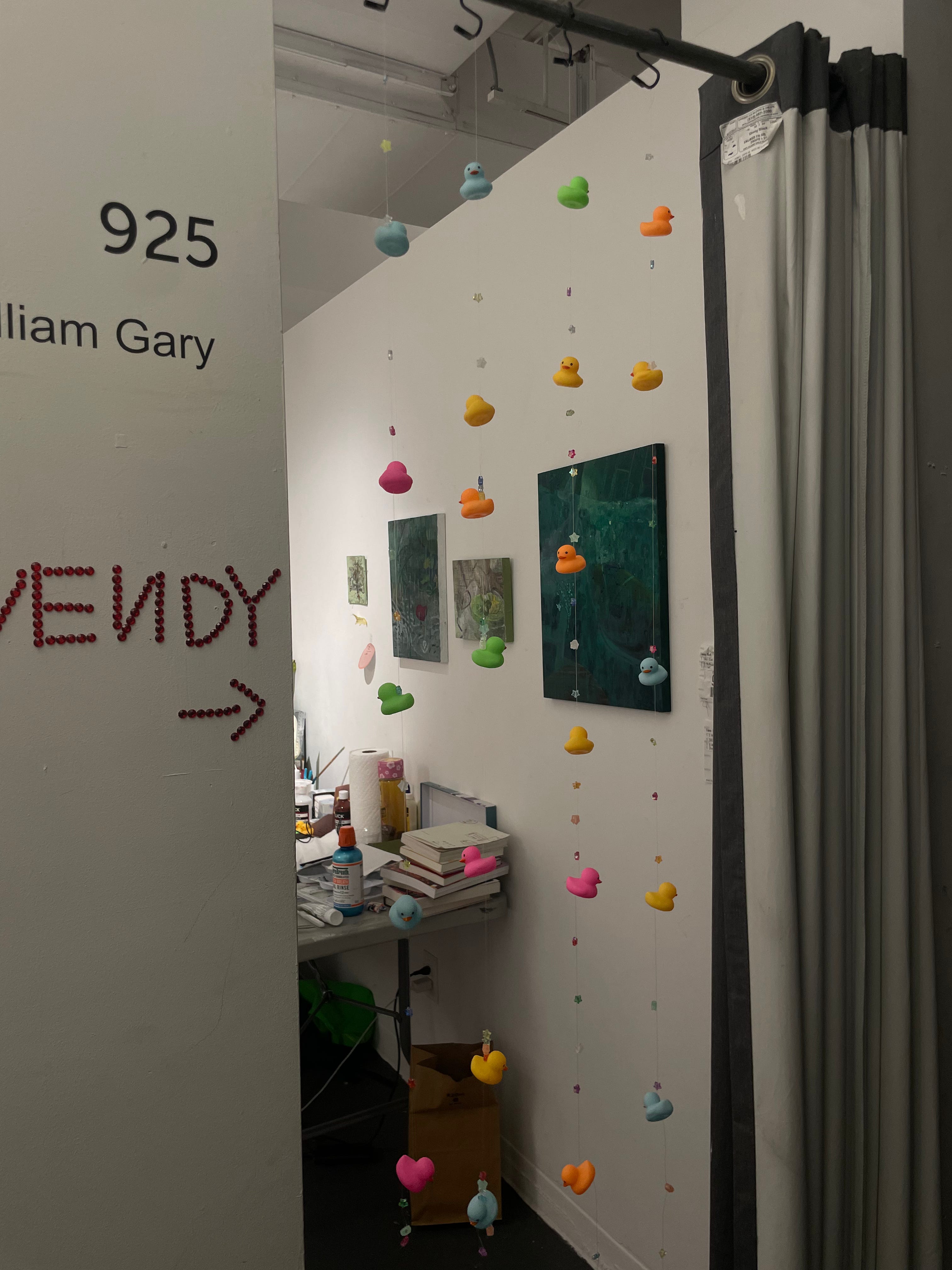
It seems like for something to be labeled and respected and honored and validated as “fine art,” I can’t just make something that is pretty, but rather need to at least complete some introspective digging of myself, provide some sort of intellectual framework for that, or dedicate enough time in the production that it doesn’t seem like I didn’t try hard (like just taping a banana on the wall).
We as fine artists conform to the fine art gaze. Fine art occasionally flirts with pop culture and consumer culture; but at the end of the day, our field asserts its autonomy by exalting originality, rareness, avant-garde, intellectualism, and authenticity. To be labeled as “kitschy” or “gimmicky” is no different than a Chinese college girl being called ā yí— you are annoyed because of the ingrained ageism, but you are also in no position to deny it.
Fine art gaze is more of a problem in the MFA programs, where we position ourselves as learners. The full name of my program is Master of Fine Arts (the degree) – Fine Arts (the major). Some schools divide their MFA fine arts program into concentrations. For instance, BU painting. Whereas in SVA, we don’t have a painting department, or a sculpture department (although fine art photography itself is a stand-alone department). Yes, sometimes I do need to remind myself that I chose a fine arts program. Because of that, SVA naturally emphasizes more on the “thinking,” instead of the technique.
For my non-artist friends reading my blog, here is my basic understanding of a few categories in the arts.
Studio Arts: Usually the opposite of “Digital Art, ”“Computer Art,” or “Design.” Back at Colby, my major was Studio Arts (Painting concentration); and to major in Art at Colby, we must declare the concentration of either “Studio Art” or “Art History.” At Colby, Studio Art highlights a hands-on experience. Everything revolves around the studio, and every magic happens here. The studio is the planet.
Visual Arts: A form of art that has a visual presence. This is a relatively general term and can be used interchangeably with studio arts.
Fine Arts: Usually the opposite of “applied art” (like pure math vs. applied math). Although in the art world, we don’t really say “applied art.” In practice, “applied art” usually means one of the following: “vanity art,” “fan art,” “illustration,” design,” etc. Fine art can be non-studio based, e.g. street photography, NFT, etc. Fine art is conceptual and often commands a level of situated knowledge.
Contemporary Art: I firmly believe that as long as you are still alive and produce artwork that addresses contemporary issues, you are a contemporary artist. Contemporary Art is often used interchangeably with Fine Art, with the former underscoring the state of being relevant to the present.
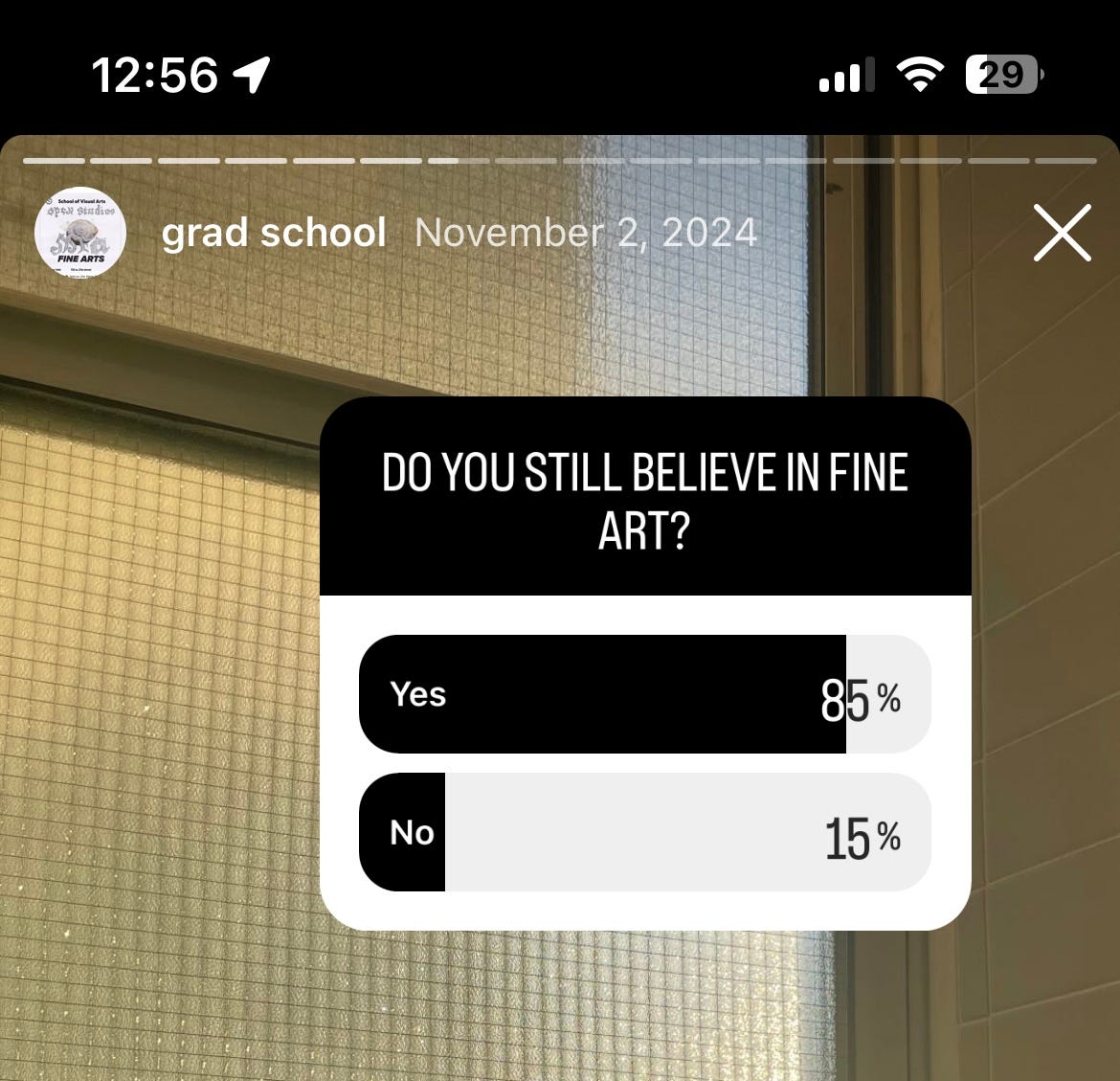
Do I still believe in Fine Art?
On a regular night, I took off my contact lenses and experienced regular discomfort—soreness, headache, dryness, etc. While some people have no issue wearing contact lenses an entire day, I have a rocky relationship with this thin wet silicon hydrogel flake. I don’t like wearing it, but at times, I feel the need to perform beauty. I feel like people treat me differently when I wear glasses. Some even comment that I give off an entirely different vibe when I wear glasses.
Then, an influx of thoughts popped up: performing beauty, doing gender, how American and Chinese cultures hold different attitudes towards nerdiness, how lens manufacturers instill the idea of beauty through marketing, how it affects our health… So I thought, wait, maybe I could make a sculpture about contact lenses. I could create something that resembles the blurriness we experience when wearing contact. However, the very next second after conceiving this idea, I was struck by a gut-clenching uneasiness—I have become the version of myself that I have always been wary of. I recalled coming across one Weibo post by a content creator that I followed. She basically said that something traumatic happened to her and her first reaction was: “woah, if I make a video about this, I bet it could blow up.” And then she realized that content creating has turned her into this monstrous machine that ferociously churns human emotions to output ruthless numbers, that, as her career took off, a part of her genuine self has become irretrievable.
I think I face the same dilemma. I feel compelled to generate work. Am I creating art because I do feel the internal “calling,” or am I just creating art because I am caught on a wheel that never stops? Am I adopting a certain methodology because I think “the canon” would love it? To what extent has my life become art?

My friend, who is a recent grad of Pratt, reassured me that it’s totally normal, and in fact, we as artists are encouraged to be cognizant of everything around us. I totally agree with that. However, it also doesn’t sit right with me to conveniently extract my life experience for content. Authenticity is my core value. Therefore, I fear that my artistic identity erodes all the raw moments of my real life. As an autobiographical artist, I fear that if I put on the lenses as an artist (lenses mentioning again, CooperVision please consider sponsoring me), I’d ineluctably manufacture more problems and drama. I originally started making cathartic paintings to channel my pains and feelings. I am so used to watering the greedy, carnivorous flowers with my own blood. I am addicted to the immense frisson when I tear and tug my organs from my chest, toss them on the table, and shock my viewers by supplying them with a feast of myself. I think I need to un-art myself.
To un-art myself means to be critical of the fine art way of thinking. I don’t feel genuine when I follow the formulaic way of “fine art thinking”: identify a phenomenon, an item, or a motif → use this as the starting point, and make an abstracted version that resembles the form of the item (if necessary, use a tricky material to demonstrate technical dexterity, because our field just loves subversion, e.g. using marble to create the illusion of soft fabrics) → attach some theoretical framework to your physical artwork → use a DSLR to document your piece in great lighting condition so that the end photo could blend in seamlessly with the pictures of artwork you download from the website of Whitney. I was talking to my friend Yue, who is also an SVA student, on this topic. She thinks that this kind of methodology is only a shortcut for people who have no artistic talents. She believes that artists with true talents do not need to approach art marking like writing an SAT essay.
Contemporary art (especially conceptual art), at times, feels very foreign to me. It feels like a western ideology being foisted on me. Sometimes, I don’t even believe in fine art. Were there any fine art pieces truly ineffable that I cried after looking at them? Yet to encounter. Anime made me cry. Movies made me cry. The other day, I was balling my eyes out at the ending of Lust, Caution by Ang Lee. Fine art, on the other hand, is by nature emotionally distant; Fine art often requires some level of situated knowledge that buffers direct emotional impact. Why did I even choose this field when I have always been a storyteller? Should I be an animator, a writer, or a cartoonist instead? I guess, in the end, it boils down to how much I am willing to trade clarity for complexity and to trade personal experience for universal connection.
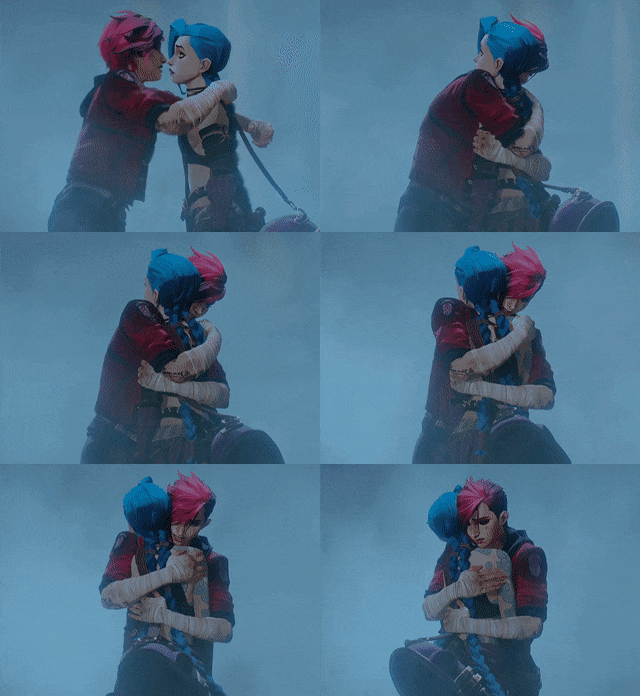
I am by no means reactionary or adversarial to conceptually driven work. My embroidery series is conceptual. I am not trying to push my opinion on others but rather to write an admonitory reflection for myself. I guess, for now, fine art is a doable placeholder for me. It fits the most. I feel like my paintings wouldn’t look good over a Restoration Hardware sofa, nor do they fit in a pop-up art market, nor do they fly on Weibo (Chinese Twitter). After all, our field is arguably the best art field that allows the greatest level of self-expression and creative freedom.
When I say I don’t believe in fine art, what I really mean is that I can’t avert the fine art gaze. I don’t believe in going to the openings and making genuine friends there. I don’t believe in fine art when the world is burning. I don’t think fine art is my solace anymore. I don’t think fine art is the answer. I think the very idea of “documentation” itself is performative and inauthentic. We are critiquing the institution until the critique of the institution itself becomes the new institution. I don’t even believe in crit, because I don’t want to offend or hurt my fellow cohort members and because I am so good at artspeak that I could easily lie. Should we critique crit?
Artist as an Identity, Artist as a Career
SVA feels like work when, every morning, I scurried to Classon Ave Station along with my rodent friends, hopping on the train laden with dreary human eyes. SVA feels like work because we don’t have a centralized campus. We don’t even have a cafeteria.
I am a late bloomer in fine art. I changed my major in my Junior year in college. I feel like I have to catch up within a short period of time. I am always aware that this is an arduous path. But it wasn’t until I actually moved to NYC and enrolled in an MFA program that I dipped my toe in the water and actually got a sense of what it is like to be a professional artist.
Our field is so small (comparatively, of course) that it really does feel like an ecosystem (last time I checked I have 121 shared followers on IG with ArtForum. 107 with Jerry Saltz. 42 with Wolfgang Tillmans.) Many of us have always been searching for food in this saltwater swamp hungrily, whether you are a dragonfly, a toad, a turtle, a heron, or an alligator (i.e. an artist, a writer, a curator, a dealer, a collector). We feed on each other and follow our own swamp rules. To climb the top echelon, you need to play their game. In other highly institutionalized academic fields, the institution is more centralized—it comprises mostly just a few conferences and major journals. In our field, the institution itself feels more nebulous, but individual artists do rely on these external validation to climb higher. Usually when people introduce an artist for a talk, they start listing their credentials that “they got X grant, exhibited at Y places, did Z residency ...” like the chef at a fine dining restaurant coming over to enthusiastically explain that the wagyu is from X place, topped with caviar from Y fish, and the sauce is of Z exotic condiment…
I think when I was in Waterville or Toronto, I never truly understood the unglamorous part of being an artist. As much as I am trying my best to resist it, those unromantic moments of being stuck in the swamp slowly wear away my passion for art.
I was hoping that MFA could be a place to shatter and then rebuild me. (My advisor was like: “no Wendy, SVA is not rigorous enough for that. You are looking at Yale if you want that experience. Ever heard of Pit Crit?” I know, I know, but Yale is super competitive and of course, I am ONE OF the Yale rejects). I have been distracting myself by working hard. I pledge myself that at SVA, I am ready to burn myself. I don’t want this expensive tuition to go to waste. Or another way to put it, I want to leverage the biggest momentum with my tuition. But when I stop, it leaves me with this huge void of emptiness.
Ms. Wei Says She’d Un-Art Herself
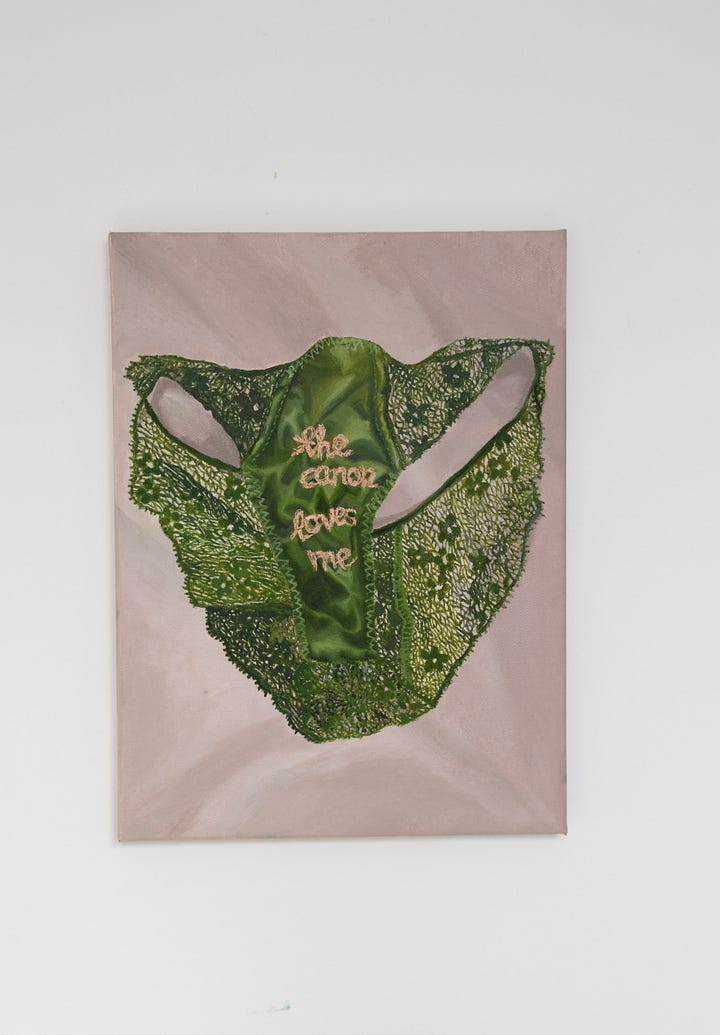
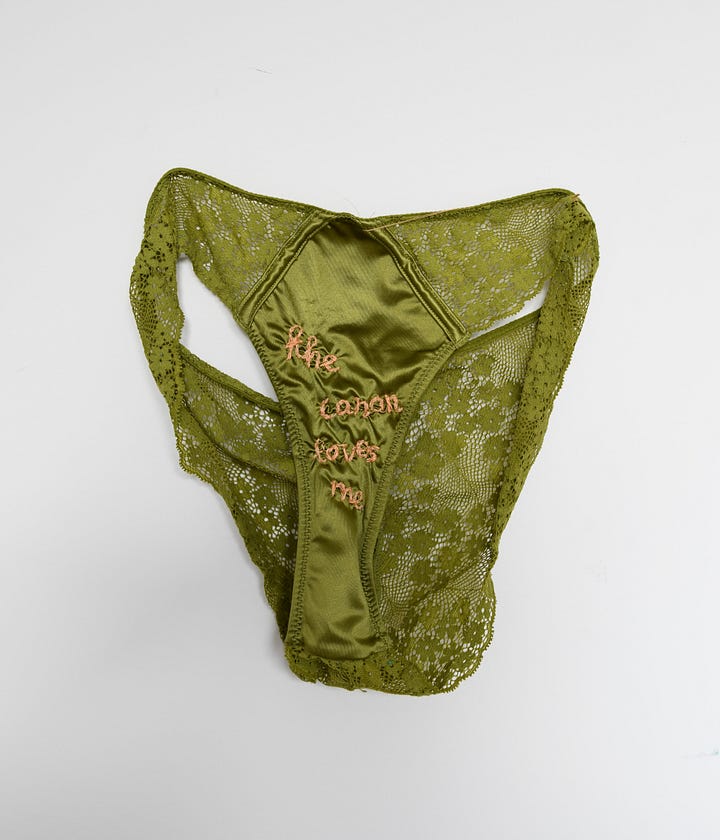
For my trompe l-oeil painting The Canon Loves Me, I first embroidered my own underwear (a lacy pantie that I wore often and I imma wear it again after my program’s annual review). And then I use the embroidery as a reference to paint. The Canon Loves Me is my attempt to depict my pathetic desire to be recognized by the art world. I may have just written 2000 words being bitter and cynical, but hey, I wouldn’t say no to a solo show in Manhattan! I think there is beauty in internal conflicts (this has long been a theme in my work). This painting is not a trenchant remark on the art world; rather, I think of it as the strident, discordant noise when the car wheel accidentally crashes an empty can. I am deriding myself. I think the-Wendy-way of making art is like an un-neutered male dog pissing everywhere he goes to assert territory– I might be generating trash, but I need to make myself heard first.
I am trying to end this long blog on a positive note, so I’ll share something I learned recently from a conversation with my friend. I was Zooming with my friend Rita the other day. Last time we saw each other in person was four years ago. She is now pursuing a PhD in BME. We both talked about the undesirable parts of our fields, and she said, “ Wendy I think we are both very lucky. Well, think about it, you could either take on a job that you don’t enjoy but pays handsomely, or you could work in a field that you are passionate about but pays little. But at least we’ve found our passion and are brave enough to pursue it. It’s a privilege to be passionate about something.” For some reason, her words are so magical. I can’t explain why but they healed something in me. I think maybe what I need right now is to reconnect with my other hobbies, and not let art dominate my entire life, hence why I am writing this blog. One of the most important lessons my liberal arts education has taught me is that asking questions is as important as finding an answer. I still have a lot of ideas waiting for me to paint and stretch. I am still excited about the action of painting. Maybe in two months I will spam your feed by writing another trashy article titled “Re-art Myself.” Who knows?
I am going to end it here and please let me know what are your thoughts on this topic. Let me know in the comment section, and have a great weekend!
爱你们! 手动爱心💗
魏
2024年1月18日于布鲁克林
No posts
Comments
Nothing yet. Say the first thing.
Sign in to join the conversation.