
Donald Trump has spent decades circling the language, symbols, and political methods of dictatorship. In June 2026, he publicly embraced a document comparing his power with Hitler, Stalin, Mao, Napoleon, Genghis Khan, and Attila the Hun. Years earlier, Ivana Trump said he periodically read My New Order, a 1,008-page collection of Hitler’s speeches kept near his bed. Those facts now collide with expanding presidential authority and weakening institutional restraints.
For readers who have can become contributing subscribers Glass Empires, I created limited discounted annual membership for the next two patrons. The annual plan costs only nickel and dime daily. Next two clicks receive 30% off
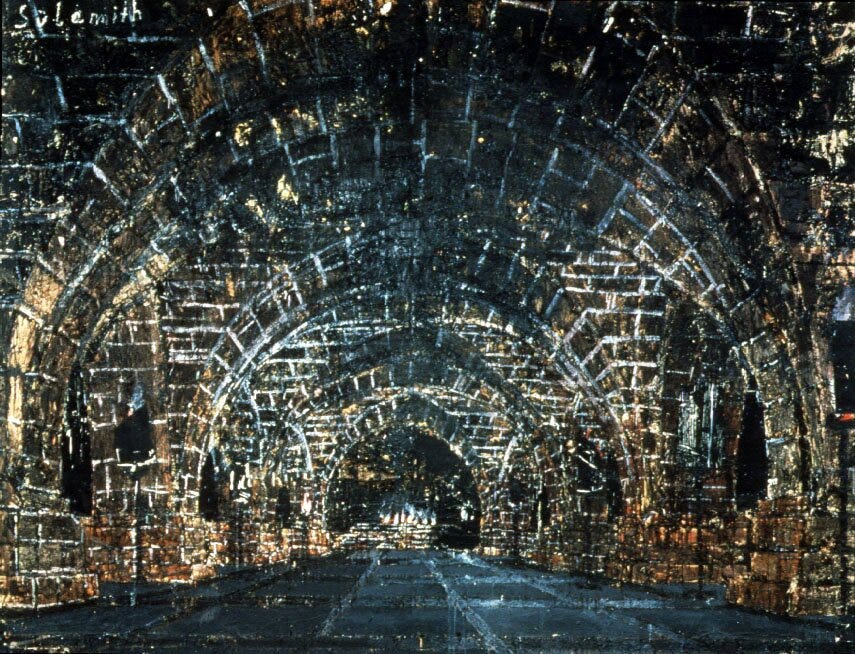
Art credit: Anselm Kiefer, Sulamith, 1983. Oil, emulsion, shellac, acrylic paint, woodcut, and straw on linen. The Doris and Donald Fisher Collection at the San Francisco Museum of Modern Art. Kiefer based Sulamith on the Nazi architect Wilhelm Kreis’s 1939 memorial hall for German soldiers. The title refers to Sulamith, the Jewish woman with “ashen hair” in Paul Celan’s Holocaust poem Death Fugue, which inspired the painting.
“I was born with the evil one standing as my sponsor beside the bed where I was ushered into this world.”
— H. H. Holmes, 1896 confession
Adolf Hitler killed himself in his Berlin bunker on April 30, 1945, as Soviet forces closed on the German capital. Less than five months later, Fred and Mary Trump likely conceived Donald Trump. Born June 14, 1946, Trump entered the world while Allied prosecutors established the evidentiary record of Nazi war crimes at Nuremberg. Decades later, Trump read Hitler’s collected speeches and repeatedly invoked Nazi Germany when describing political power and loyalty.
On June 18, 2026, Trump publicly endorsed a document comparing his power with Adolf Hitler, Stalin, Mao, Napoleon, Genghis Khan, and Attila the Hun. Trump posted the comparison on Truth Social and wrote, “Presidential Historian Dave King — Sounds good to me!”
During an interview with Maggie Haberman and Jonathan Swan, Trump showed them the document containing the comparison. Swan later said Trump read the dictators’ names aloud, focused on their use of fear, and showed no objection to the comparison. In September 1990, Vanity Fair reported that Ivana Trump told her lawyer Michael Kennedy that Trump periodically read My New Order, a collection of Hitler’s speeches, and kept the volume in a cabinet beside his bed. When Marie Brenner questioned Trump, he said his friend Marty Davis had given him Mein Kampf. Davis independently confirmed giving Trump a Hitler book but identified the volume as My New Order.
Published in 1941, the edition contains 1,008 pages of Hitler’s speeches and editorial commentary. Trump possessed an extensive collection of Hitler’s political speeches decades before entering national politics, and Ivana Trump said he read the collection periodically.
Around age five, Donald Trump was already the subject of an account of deliberate aggression toward a much younger child. Martha Burnham’s baby Dennis was in a backyard playpen when she heard him screaming and ran outside. She found Dennis being pelted with rocks thrown by five-year-old Donald Trump from the fence separating their homes. Haberman reports that Martha Burnham then dragged Trump home by the collar and told his mother what had happened.
Developmental psychologist Rebecca Waller studied 731 children and found callous-unemotional behavior between ages two and four. Those early traits predicted later aggression and rule-breaking. By age three, the pattern independently predicted antisocial behavior observed six years later. Severe deficits in empathy, guilt, and remorse can become measurable long before adolescence.
Following Kew-Forest School, a private school in Forest Hills, Queens, Trump entered New York Military Academy at thirteen in 1959 and graduated in 1964.
Cadets at the private military boarding school in Cornwall-on-Hudson, New York, studied required military history and trained with rifles and mortars under discipline modeled partly on nearby West Point. Army Colonel Theodore Dobias, a World War II veteran and NYMA training officer, became Trump’s mentor. Trump entered that curriculum only fourteen years after Nazi Germany surrendered.
Former roommate Ted Levine said a dispute at New York Military Academy over an unmade bed became physical after Levine struck Trump with a broomstick. Levine said Trump then seized him and tried to force him through a second-floor window. Two other cadets intervened and stopped Trump before he could push Levine out.
At twenty-seven, Trump formed a relationship with Roy Cohn, Joseph McCarthy’s former chief counsel during McCarthy’s anti-Communist Senate investigations; Cohn became Trump’s lawyer, close friend, adviser, and mentor for more than a decade. Reporters who examined their relationship found that Cohn taught Trump a governing method built around attack, counterattack, intimidation, exploitation of power, and refusal to apologize; Trump prized Cohn’s aggression, relied upon him repeatedly, and remained his friend even after New York disbarred Cohn for ethical misconduct.
Trump and Jeffrey Epstein maintained a close social relationship for years in New York and Palm Beach. In 2002, Trump said he had known Epstein for fifteen years and called him a “terrific guy.” He added that Epstein liked “beautiful women” and that “many of them are on the younger side.” Archival footage also shows Trump and Epstein together at Mar-a-Lago in 1992.
A 2020 FBI tip later released by the Justice Department contained an unverified allegation involving Trump and extraordinary brutality. An unnamed woman told federal investigators that Epstein trafficked her at thirteen and that she became pregnant during the abuse. She alleged her uncle murdered the newborn and dumped the body into Lake Michigan while Trump witnessed the killing. The Justice Department subsequently released that accusation as part of the federal Epstein record.
Hitler did not develop his political methods in isolation. Georg von Schönerer supplied racial nationalism, Karl Lueger demonstrated antisemitism’s electoral power, and Mussolini demonstrated how fascists could seize state authority. Mussolini’s October 1922 March on Rome then directly inspired Hitler’s November 1923 Beer Hall Putsch.
Germany convicted Hitler of high treason, sentencing him to five years at Landsberg. Authorities released the Nazi leader after eight months, allowing him to reorganize his movement. In January 1933, conservative elites persuaded President Paul von Hindenburg to appoint Hitler chancellor, believing they could control Hitler. Within months, the new chancellor dismantled constitutional restraints and used coercion to eliminate political opposition.
Political scientist Stephen G. F. Hall wrote The Authoritarian International. The subtitle is Tracing How Authoritarian Regimes Learn in the Post-Soviet Space. Hall examines how autocrats study earlier dictatorships and contemporary authoritarian regimes. Hall identifies emulation as a mechanism through which authoritarian rulers adopt tactics used by other regimes.
Over decades, Trump repeatedly associated with people who praised Hitler, denied the Holocaust, or promoted white supremacy. On November 22, 2022, Trump hosted Ye and Nick Fuentes for dinner at Mar-a-Lago. Before that dinner, Fuentes had already promoted white-supremacist politics and denied or minimized the Holocaust. Fuentes also attended the 2017 Unite the Right rally in Charlottesville, Virginia.
Ye had also posted antisemitic statements, including a threat to go “death con 3” on Jewish people. Nine days after the dinner, Ye publicly praised Hitler and expressed admiration for Nazis. Fuentes later said the Holocaust had been exaggerated, stated that he did not hate Hitler, and declared in 2023, “I love Hitler.”
In November 2025, Tucker Carlson interviewed Fuentes. Trump defended Carlson’s decision to interview him and declined to condemn Fuentes. By then, Fuentes’s Holocaust denial, antisemitism, white-supremacist politics, and praise of Hitler had been public for years.
Peter Baker and Susan Glasser reported that Trump complained to White House Chief of Staff John Kelly, a retired Marine Corps general, about American military leaders and asked why they could not behave like “the German generals” of World War II. Kelly reminded Trump that German officers had repeatedly plotted to kill Hitler. Trump answered that they had been “totally loyal.” Kelly later stated that Trump said Hitler “did some good things” and specifically credited Hitler with rebuilding Germany’s economy.
Kelly said Trump returned to the subject more than once. On January 11, 2017, he accused American intelligence agencies of conduct comparable to “Nazi Germany.” In May 2024, during a private Republican donor retreat in Palm Beach, Florida, while discussing his criminal cases, he accused President Joe Biden of running a “Gestapo administration.”
Repeatedly, Trump said immigrants were “poisoning the blood of our country.” The Associated Press reported that politicians and extremism experts identified echoes of Hitler’s writings about Aryan blood. Jon Lewis, a research fellow at George Washington University’s Program on Extremism, characterized Trump’s rhetoric as fascist, white supremacist, and dehumanizing. At a December 19, 2023 campaign rally in Waterloo, Iowa, Trump publicly acknowledged the comparison: “They said Hitler said that.”
Continuing the formulation, Donald Trump said immigrants were “destroying the blood of the country” and that “we’re going to have to get them out.” At Yad Vashem, Israel’s national Holocaust memorial in Jerusalem, on May 23, 2017, Trump commemorated six million murdered Jews and described the Holocaust as a systematic attempt to eliminate the Jewish people. In a July 6, 2017 presidential address in Warsaw, Poland, Trump discussed Nazi Germany’s 1939 invasion of Poland and the Holocaust. At Warsaw, Donald Trump also addressed the Warsaw Ghetto, the Warsaw Ghetto Uprising, and the systematic murder of millions of Polish Jews.
Ervin Staub, psychologist and professor emeritus at Massachusetts Amherst, has spent decades studying genocide, mass violence, bystander behavior, and persecution. Staub argues that people allow persecution to advance when they withdraw empathy from those being targeted.
Across these documented episodes, Trump has shown familiarity with Nazi history while describing immigrants through contamination rhetoric, praising Hitler’s economic achievements according to John Kelly, and invoking the Gestapo against American opponents.
When an individual with pronounced callous-unemotional traits gains and retains state power, private cruelty can become public policy and escalate as each abuse encounters less resistance. Successful evasions of accountability lower the barriers to more severe repression, allowing persecution to widen in scope and brutality. Each unchecked escalation makes the next easier to impose and harder to reverse. By the time the public understands what has happened, persecution may already have crossed into systematic atrocities.
“In a way, to be indifferent to that suffering is what makes the human being inhuman.”— Elie Wiesel, The Perils of Indifference, 1999.
If this investigative analysis gave you context rarely assembled in one place, please consider upgrading to paid membership. This work needs reader support to continue. Annual support is the best value with my coupon for just a dime and nickel per day. Next two contributors to independent journalism receive 30% off.
Independent Journalism at 30% Off
If you value this research and truly rare context, you can support Glass Empires through Buy Me a Coffee (BMAC). Your tips help defray production costs and the hours I spend researching, writing, and expanding my free guide library (see the shop area of BMAC). A few contributions each day keep that work moving and help me publish additional resources without placing guides behind a paywall.
Sources
Ervin Staub, University of Massachusetts Amherst faculty profile.
https://www.umass.edu/natural-sciences/about/directory/ervin-staub
Ervin Staub, The Roots of Evil: The Origins of Genocide and Other Group Violence. Cambridge University Press, 1989.
Stephen G. F. Hall, The Authoritarian International: Tracing How Authoritarian Regimes Learn in the Post-Soviet Space. Cambridge University Press, 2023.
Donald J. Trump, Truth Social post, June 18, 2026, 12:08 a.m., “Presidential Historian Dave King — Sounds good to me!”
https://trumpstruth.org/statuses/39332
Marie Brenner, “After the Gold Rush,” Vanity Fair, September 1990.
https://www.vanityfair.com/magazine/2015/07/donald-ivana-trump-divorce-prenup-marie-brenner
Michael E. Miller, “50 Years Later, Disagreements Over Young Trump’s Military Academy Record,” The Washington Post, January 9, 2016.
https://www.washingtonpost.com/politics/decades-later-disagreement-over-young-trumps-military-academy-post/2016/01/09/907a67b2-b3e0-11e5-a842-0feb51d1d124_story.html
Marc Fisher, “‘Grab That Record’: How Trump’s High School Transcript Was Hidden,” The Washington Post, March 5, 2019.
https://www.washingtonpost.com/politics/grab-that-record-how-trumps-high-school-transcript-was-hidden/2019/03/05/8815b7b8-3c61-11e9-aaae-69364b2ed137_story.html
Madison Czopek, “Germany, Scotland, Sweden: What Has Donald Trump Said About Where His Parents Were From?” PolitiFact, August 7, 2024.
https://www.politifact.com/article/2024/aug/07/german-scottish-swedish-what-has-donald-trump-said/
Paul Schwartzman, “How Trump Got Religion — and Why His Legendary Minister’s Son Now Rejects Him,” The Washington Post, January 21, 2016.
https://www.washingtonpost.com/lifestyle/how-trump-got-religion--and-why-his-legendary-ministers-son-now-rejects-him/2016/01/21/37bae16e-bb02-11e5-829c-26ff874a18d_story.html
John Roy Carlson, Under Cover: My Four Years in the Nazi Underworld of America. E. P. Dutton, 1943.
United States Holocaust Memorial Museum, “German American Bund.”
United States Holocaust Memorial Museum, “Beer Hall Putsch (Munich Putsch).”
United States Holocaust Memorial Museum, “Antisemitism in History: Racial Antisemitism, 1875–1945.”
United States Holocaust Memorial Museum, “Fascism.”
Eileen Ryan, “Violence and the Politics of Prestige: The Fascist Turn in Colonial Libya,” Modern Italy, Vol. 20, No. 2, 2015, pp. 123–135.
https://www.cambridge.org/core/journals/modern-italy/article/abs/violence-and-the-politics-of-prestige-the-fascist-turn-in-colonial-libya/F8E6415D857ED0A6CAD409F24DE17E60
E. E. Evans-Pritchard, The Sanusi of Cyrenaica. Oxford: Clarendon Press, 1949.
Robert O’Harrow Jr. and Shawn Boburg, “The Man Who Showed Donald Trump How to Exploit Power and Instill Fear,” The Washington Post, June 17, 2016.
ABC News, “Timeline of Trump and Epstein’s Relationship, and What Trump Has Said About Their Falling Out.”
U.S. Department of Justice, Epstein Library, Data Set 8, File EFTA00025010.
Will Steakin and Olivia Rubin, “Trump Hosts Kanye West, Nick Fuentes at Mar-a-Lago Dinner,” ABC News, November 25, 2022.
Associated Press, “The Rapper Ye, Who Has a Long History of Making Antisemitic Comments, Issues an Apology in Hebrew,” December 26, 2023.
Anti-Defamation League, “Nicholas J. Fuentes: Five Things to Know.”
Anti-Defamation League, “Fuentes Delivers Antisemitic, ‘Christian Nationalist’ Rant to Fellow White Supremacists,” March 7, 2023.
Associated Press, “Trump Defends Tucker Carlson After Interview With Activist Known for His Antisemitic Views,” November 17, 2025.
Susan B. Glasser and Peter Baker, “Inside the War Between Trump and His Generals,” The New Yorker, August 8, 2022.
Associated Press, October 23, 2024.
The American Presidency Project, “Tweets of January 11, 2017.”
Politico, “Trump Accuses Biden of ‘Running a Gestapo Administration’ During Private Donor Retreat,” May 5, 2024.
Associated Press, December 19, 2023.
The White House, “Remarks by President Trump at Yad Vashem,” May 23, 2017.
The White House, “Remarks by President Trump to the People of Poland,” July 6, 2017.
Maggie Haberman, Confidence Man: The Making of Donald Trump and the Breaking of America. Penguin Press, 2022.
Paul Schwartzman and Michael E. Miller, “Confident. Incorrigible. Bully: Little Donny Was a Lot Like Candidate Donald Trump,” The Washington Post, June 22, 2016.
Rebecca Waller et al., “Does Early Childhood Callous-Unemotional Behavior Uniquely Predict Behavior Problems or Callous-Unemotional Behavior in Late Childhood?” Developmental Psychology, November 2016. DOI: 10.1037/dev0000165.
Elie Wiesel, “The Perils of Indifference,” White House Millennium Lecture, April 12, 1999.
Publication Disclaimer
This publication provides journalism, political analysis, historical interpretation, and protected opinion. Nothing published here advocates, solicits, encourages, instructs, or assists unlawful conduct. W. A. Lawrence and this Substack reject violence, criminal activity, and threats against any person or institution. Readers remain solely responsible for their conduct and compliance with applicable law.
Comments
Nothing yet. Say the first thing.
Sign in to join the conversation.