
The dollar’s sharp decline after the U.S. Treasury doubled long-bond buybacks exposed a widening financial fault line capable of constricting U.S. Treasury borrowing and household credit.
For readers who have can become contributing subscribers Glass Empires, I created limited discounted annual membership for the next two patrons. The annual plan costs only nickel and dime daily. Next two clicks receive 30% off

Salvador Dalí, The Disintegration of the Persistence of Memory, 1952–1954. Oil on canvas. The Dalí Museum, St. Petersburg, Florida. Dalí breaks the landscape into suspended fragments while familiar clocks remain visible. For this article, the shattered scene mirrors a financial order that can look intact even as its foundations fracture.
On August 19, 2026, Treasury Secretary Scott Bessent doubled planned buybacks of 10-to-30-year Treasury securities from $2 billion to at least $4 billion per operation, beginning September 9. The announcement followed a surge in the 30-year Treasury yield to 5.34 percent, the highest level since 2007. Federal debt had already exceeded $40 trillion, more than double the 2017 level.
On August 20, the bond market carried the warning beyond Wall Street. Investors were selling Treasuries as inflation and record federal debt threatened the value of long-term government bonds, forcing yields higher.
Those yields set mortgage rates and other borrowing costs, forcing households to absorb the financial consequences of Washington’s fiscal deterioration. Stocks remained near record highs while the bond market sounded a different verdict, because rising borrowing costs eventually reach consumer spending and economic growth.
Venezuela demonstrates how persistent deficit financing can end in sovereign default and currency collapse once creditors lose confidence in repayment. Successive governments borrowed heavily while the bolívar depreciated and external obligations entered default. Between 2013 and 2021, Venezuela’s real economy contracted more than 75 percent, exceeding America’s roughly 30 percent Great Depression decline. The IMF attributed the collapse to fiscal deficits, hyperinflation, currency depreciation, and external default, which restricted Venezuela’s access to international borrowing.
In July 2026, Venezuela’s central bank reported monthly inflation of 19.9 percent and annual inflation of 575.9 percent. Workers and retirees lose purchasing power when wages and pensions fail to match rising prices, while lenders charge businesses more or refuse financing. Governments that cannot service sovereign debt or maintain confidence in their currency can preside over contractions deeper than America’s post-1929 collapse.
Washington is now doubling long-duration Treasury buybacks as persistent deficits and elevated long-term yields force the government to refinance a growing debt load at higher rates. On August 19, long-dated yields and the dollar fell sharply, while gold ultimately surged more than 4 percent. Treasury can ease liquidity pressure in long-dated Treasury securities through expanded buybacks, but Treasury’s long-duration purchases do not reduce the deficit or federal debt. Treasury is now intervening in the long-bond market while Washington leaves the deficits and refinancing burden behind those yields unresolved.
When the dollar persistently depreciates, investors demand higher Treasury yields because future principal and interest payments buy less. Importers must spend more dollars to purchase foreign goods, so they raise domestic prices. The U.S. Treasury Department refinances maturing federal debt at the higher yields investors demand.
Higher federal interest payments widen deficits, requiring Congress to finance more government obligations through additional borrowing. If investors lose confidence in the federal government’s ability to stabilize debt, they may demand still higher yields. Businesses pass higher import costs to consumers, reducing purchasing power for workers and retirees. Social Security recipients and pensioners buy less with unchanged monthly payments.
Businesses facing costlier refinancing cut payrolls or postpone hiring, reducing income for wage-dependent households. As those incomes fall, more borrowers fall behind on mortgages and consumer debt. Lenders foreclose on delinquent properties, while forced sellers accept lower prices for homes and stocks. As more borrowers default, banks recognize larger losses on their balance sheets. Banks then reject riskier borrowers and charge higher rates on new household and business loans.
Republican leadership is orchestrating an economic collapse. GOP officials enacted safety-net cuts in 2025 and advanced banking deregulation in 2026, dismantling safeguards built after 1929 and 2008 on a documented timetable. Republicans are cutting Medicaid and SNAP while Medicare faces reductions, Social Security approaches trust-fund depletion, and banking regulators loosen financial safeguards.
Congress has made the next financial downturn more damaging for households than 2008 by reducing protections Americans relied on during that crisis. Federal borrowing also remains historically high. Medicaid and food assistance supported millions of laid-off workers in 2007; Republicans have since cut both.
A crash mints winners. When banks restrict credit and home and stock prices fall, indebted households must sell into declining markets. After 2007–2009, institutional investors used cash and cheap financing to buy foreclosed single-family homes in bulk. Those investors acquired homes, securities, and other distressed assets at depressed prices while forced sellers lost wealth.
Federal regulators are dismantling post-2008 safeguards despite federal investigators documenting the costs of weak capital rules and supervision. On June 18, 2026, the Fed, OCC, and FDIC closed comment on three proposals easing capital requirements and cutting large-bank surcharges. Those agencies had already cut supervisory staff 30 percent and moved to publish bank stress-test models. Trump signed the One Big Beautiful Bill Act amid 2025 safety-net reductions before regulators continued capital and supervisory rollbacks.
Trump is reversing post-2008 rules on bank capital, consumer protection, and derivatives clearing. Before 2008, regulators failed to restrain subprime lending, unregulated derivatives, and 30-to-1 leverage. Net worth fell from $69 trillion to $55 trillion as unemployment doubled to 10 percent. Dodd-Frank responded with stronger capital rules, the CFPB, and derivatives clearing.
The Trump administration is restoring a deregulatory model federal investigators documented as failed after 2008. Alan Greenspan, Federal Reserve chair from 1987 to 2006, championed deregulation and financial-industry self-regulation. The Financial Crisis Inquiry Commission concluded deregulation stripped safeguards that could have helped avert catastrophe. Greenspan told Congress his faith in financial institutions policing their own risks contained a fundamental flaw.
Russell Vought took control of the CFPB on February 7, 2025, halted oversight, and sought no additional Federal Reserve funding. A federal judge ordered continued funding December 30, 2025. Regulators reduced enhanced leverage-capital requirements for systemically important banks, effective April 1, 2026. Treasury Secretary Scott Bessent stated the objective: “responsibly deregulating the financial sector to accelerate what I call the re-privatization of the economy.” The administration has made deregulation official policy.
Title II ended taxpayer bailouts: failed-bank losses fall on shareholders, debt holders, and uninsured creditors. FDIC insurance protects deposits up to $250,000 and restores access immediately. Depositors holding more than $250,000 enter the liquidation queue as creditors for the uninsured balance. In future Title II liquidations, private shareholders and creditors bear losses while insured depositors retain federal protection.
The Heritage Foundation’s Project 2025 proposes restructuring federal banking regulation. Page 705 of Heritage’s Mandate for Leadership would merge the FDIC into one regulator and substitute “competition and market discipline” for federal oversight. A 2017 Heritage report urged Congress to cut deposit coverage to $40,000 and end federal insurance. Vought, running the CFPB, helped write Project 2025.
The 1929 crash began with unchecked speculation. Investors bought stocks on margin, often posting only 10 percent, while regulators ignored securities markets and deposits lacked federal insurance. When stocks collapsed that October, margin loans came due. Thousands of banks failed, and the Depression followed. Congress responded with federal deposit insurance in 1933 and the Securities and Exchange Commission in 1934 after bank failures, uninsured losses, and unregulated speculation destroyed savings.
Federal debt equaled 16.3 percent of the economy in 1929, leaving Washington room to respond. By March 2026, the federal government owed debt equal to 100.2 percent of GDP, and the total exceeded $39 trillion by June. By June, the federal government owed more than the nation produced in a year. Trump’s borrowing further reduced the fiscal capacity available for another crisis while imposing refinancing and interest costs far beyond those Washington carried in 1929.
Trump has dissolved the CFPB or starved the Consumer Financial Protection Bureau of funds, and banks set self-determined capital floors. Anti-money-laundering reporting reaches only part of the financial activity currently subject to federal reporting requirements, and private lenders extend trillions outside federal supervision. Regulators lack the legal and supervisory power necessary to halt a run.
Naomi Klein named disaster capitalism in 2007: governments exploit post-disaster chaos to impose privatization, deregulation, and cuts voters resist in calmer times. Political leaders can exploit fear to enact those measures before opponents organize resistance. After a banking panic or market breakdown, authorities can justify federal rescue financing, while earlier deregulatory decisions escape scrutiny. Firms that lobbied for weaker regulation receive emergency lending or guarantees. Wealthy investors buy distressed assets cheaply, expanding ownership of housing and failing businesses.
Republican officeholders swore to protect Social Security, Medicare, and Medicaid. GOP leadership is engineering the next banking and credit collapse. Before the vote, the Congressional Budget Office projected 10 million people losing health coverage, lower incomes for the poorest tenth, and Social Security trust-fund depletion. Legislators read those findings and enacted the reconciliation legislation anyway, with documented knowledge of the projected harm.
Trump has spent his public life demolishing physical structures and attacking institutional constraints when they obstructed his objectives. When Trump considers a building or institutional rule an obstacle, he has repeatedly chosen removal rather than accommodation. He now commands an administration with the power to apply that same method to the institutions governing the world’s largest economy.
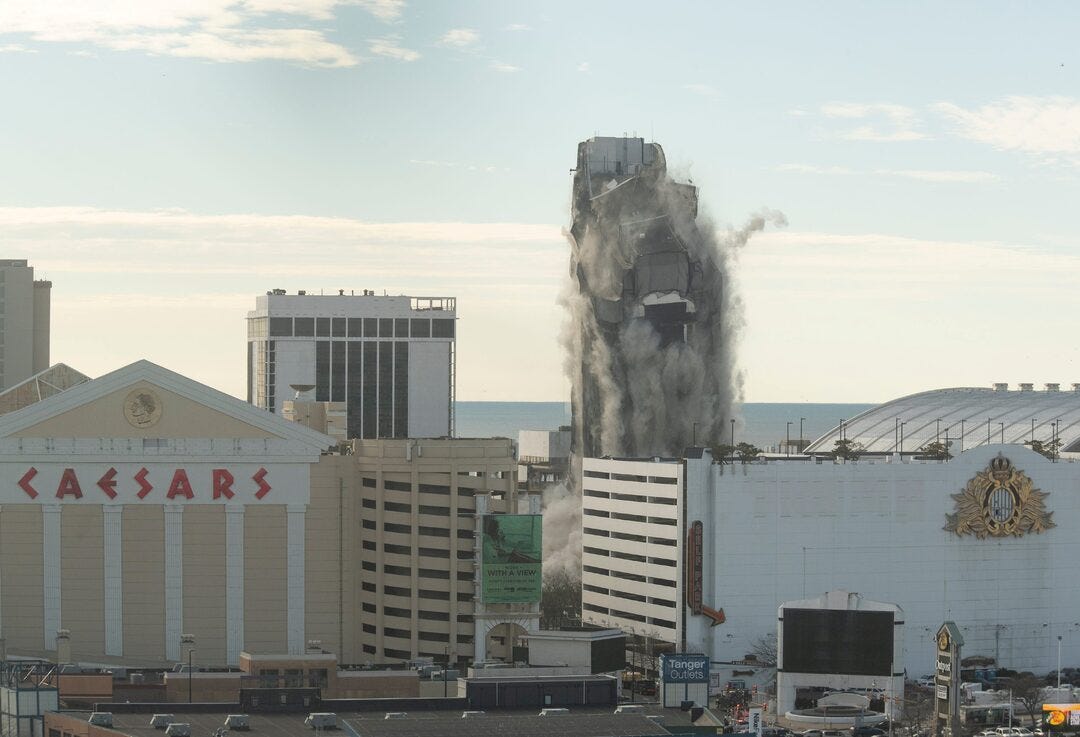
Trump Plaza Hotel and Casino collapses during its controlled demolition in Atlantic City, New Jersey, February 17, 2021. The casino opened in 1984 and was demolished after years of deterioration. Photo: Reuters.
The love of money is the root of all evil. -1 Timothy 6:10.
If this investigative analysis gave you context rarely assembled in one place, please consider upgrading to paid membership. This work needs reader support to continue. Annual support is the best value with my coupon for just a dime and nickel per day. Next two contributors to independent journalism receive 30% off.
Independent Journalism at 30% Off
If you value this research and truly rare context, you can support Glass Empires through Buy Me a Coffee (BMAC). Your tips help defray production costs and the hours I spend researching, writing, and expanding my free guide library (see the shop area of BMAC). A few contributions each day keep that work moving and help me publish additional resources without placing guides behind a paywall.
Sources
U.S. Department of the Treasury, “Treasury Announces Increased Sizes of Nominal Long-End Liquidity Support Buybacks Beginning September 9,” August 19, 2026.
Reuters, “Treasury Secretary Bessent doubles US long-bond buybacks in the face of surging yields,” August 19, 2026.
Reuters, “US debt crosses $40 trillion threshold after doubling under Trump and Biden,” August 19, 2026.
Reuters, “Gold drops after sharp gains as inflation concerns come to the fore,” August 20, 2026.
International Monetary Fund, Regional Spillovers from the Venezuelan Crisis: Migration Flows and Their Impact on Latin America and the Caribbean, 2022.
Reuters, “Venezuela looks to UK-held gold reserves for reconstruction as inflation surges,” August 12, 2026.
Board of Governors of the Federal Reserve System, FDIC, and OCC, “Agencies Request Comment on Proposals to Modernize the Regulatory Capital Framework and Maintain the Strength of the Banking System,” March 19, 2026.
Reuters, “US banks to make final push on capital rule changes as Fed wraps up consultation,” June 18, 2026.
Reuters, “As Fed leashes bank examiners, Wall Street pushes for more wins, sources say,” May 26, 2026.
Board of Governors of the Federal Reserve System, FDIC, and OCC, “Agencies Issue Final Rule to Modify Certain Regulatory Capital Standards,” November 25, 2025.
U.S. Department of the Treasury, “Treasury Secretary Scott Bessent Remarks at the Economic Club of New York,” March 6, 2025.
Congressional Budget Office, The Budget and Economic Outlook: 2026 to 2036, February 2026.
Congressional Budget Office, “How the 2025 Reconciliation Act (Public Law 119-21) Will Affect the Distribution of Resources Available to Households,” August 2025.
KFF, “Health Provisions in the 2025 Federal Budget Reconciliation Law,” August 22, 2025.
Social Security Administration, 2026 Annual Report of the Board of Trustees of the Federal Old-Age and Survivors Insurance and Federal Disability Insurance Trust Funds.
Financial Crisis Inquiry Commission, The Financial Crisis Inquiry Report, January 2011.
U.S. House Committee on Oversight and Government Reform, “The Financial Crisis and the Role of Federal Regulators,” hearing, October 23, 2008.
U.S. Bureau of Labor Statistics, “The Recession of 2007–2009,” Spotlight on Statistics.
U.S. Government Accountability Office, Rental Housing: Institutional Investor Ownership of Single-Family Rental Homes, GAO-26-108675, March 24, 2026.
Federal Deposit Insurance Corporation, “Overview of Resolution Under Title II of the Dodd-Frank Act.”
Federal Deposit Insurance Corporation, “Deposit Insurance Basics.”
The Heritage Foundation, Mandate for Leadership: The Conservative Promise, Chapter 22, Department of the Treasury, p. 705.
The Heritage Foundation, Prosperity Unleashed: Smarter Financial Regulation, 2017.
Reuters, “Consumer protection agency neutralized by Trump’s new chief,” February 10, 2025.
Reuters, “Trump’s funding cuts put America’s consumer watchdog on the brink of collapse,” December 30, 2025.
NPR, Rafael Nam, “The bond market is signaling trouble ahead. This is why you should pay attention,” August 20, 2026
Publication Disclaimer
This publication provides journalism, political analysis, historical interpretation, and protected opinion. Nothing published here advocates, solicits, encourages, instructs, or assists unlawful conduct. W. A. Lawrence and this Substack reject violence, criminal activity, and threats against any person or institution. Readers remain solely responsible for their conduct and compliance with applicable law.
Comments
Nothing yet. Say the first thing.
Sign in to join the conversation.