

“Be doers of the word, and not hearers only, deceiving yourselves.” — James 1:22
I think we could all agree that there are gatherings that entertain a generation, and then there are those gatherings that interpret a generation. One fills auditoriums. The other alters history. The difference is not measured by attendance, applause, or production. It is measured by whether Heaven visits a room or commissions a people.
FlashPoint Live in Bedford, Texas, was never intended to become another memorable evening on a crowded calendar of conferences. It was an altar where a question, long neglected by the modern Church, was placed before the people of God once again: Will you remain spectators, or will you become stewards of the hour in which God has placed you?
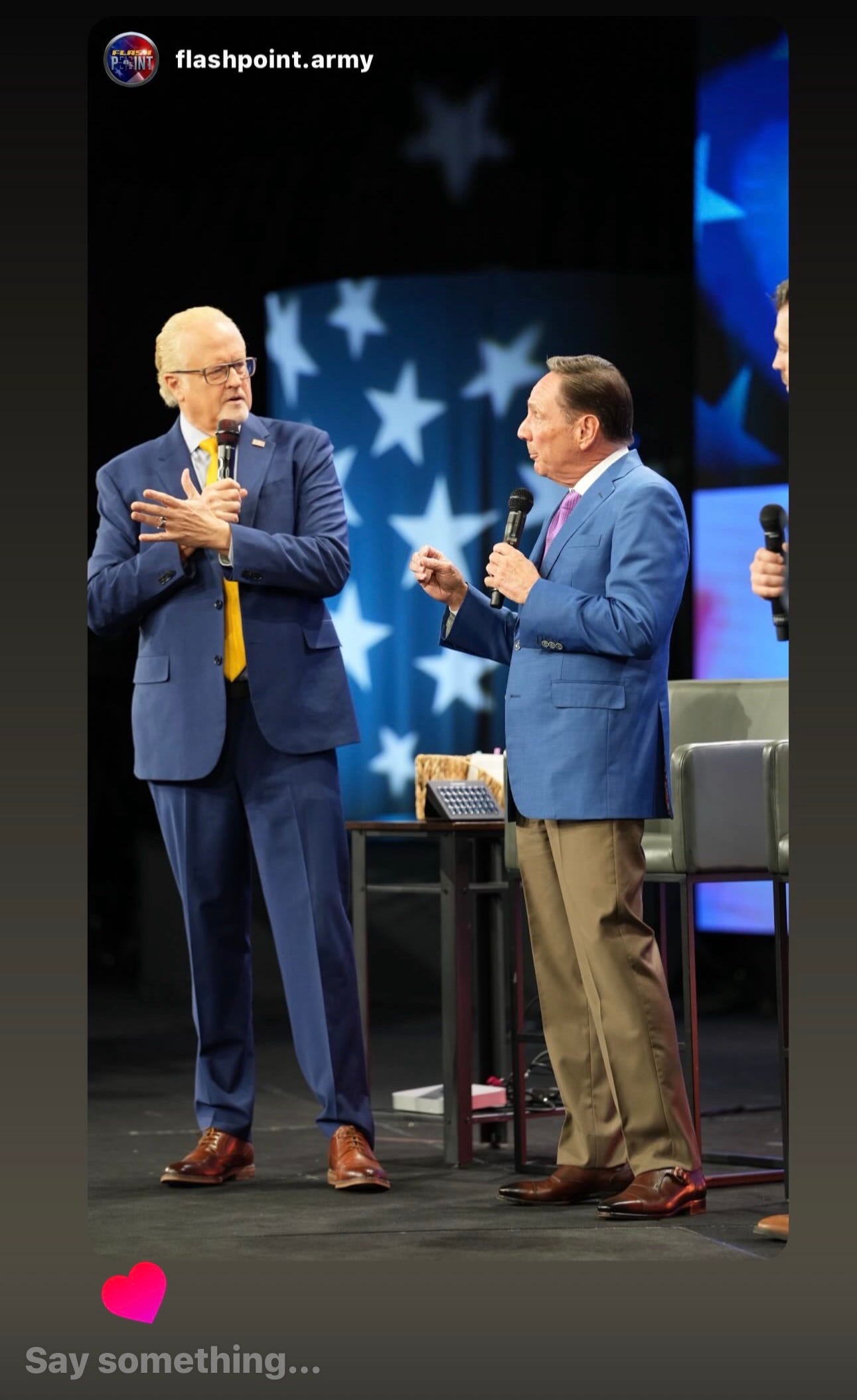
The event itself was remarkable, not because of the personalities upon the platform, but because a single burden seemed to rest upon every voice that spoke. Though each speaker carried a different temperament, emphasis, and calling, their message converged into one unmistakable declaration. The season of passive observation has ended. God is calling the Church to recover her “first love” vocation and be His active witness in the earth.
That message should not surprise anyone who has carefully studied the Scriptures. The New Testament knows nothing of a Church simply content to assemble. From the Day of Pentecost forward, believers gathered only to be scattered again. They assembled for instruction so they might return to their cities and their marketplaces with greater conviction. They worshiped together so they might bear witness everywhere they went. Every gathering in Acts ended with movement. Every outpouring produced obedience. Every encounter with the presence of God became an assignment.
We have often reversed that divine order.
I have said this ad nauseum, but must say it again: much of contemporary Christianity has unconsciously exchanged participation for observation. Sanctuaries have become theaters. Congregations have become audiences. Success has been measured by attendance rather than transformation, by production rather than discipleship, by inspiration rather than obedience. The Church has grown increasingly proficient at attracting crowds while becoming increasingly hesitant to release laborers.
Yet Jesus never commanded His disciples to admire the Kingdom; He commanded them to seek it.
He never instructed them to applaud truth; He commanded them to obey it.
Nor did He promise that the gates of hell would not criticize His Church. He promised only that they would not prevail against it. Gates are defensive structures. They do not advance. They withstand attack. Jesus Christ’s declaration in Matthew 16 was never intended to portray the Church hiding safely behind her own walls. It portrays the Church advancing against the strongholds of darkness until those gates collapse beneath the authority of the King.
That distinction changes everything.
One of the defining moments of the evening came not through an emotional crescendo but through a quiet announcement from Gene Bailey that revealed a profound shift in his vision. Reflecting upon the future of FlashPoint, he explained that the objective could no longer be merely to host inspiring events. The calling had become something deeper, something more demanding. “We’re going to feed you, train you, and equip you for what you’re supposed to go do.”
That sentence deserves careful meditation.
It is nothing less than Ephesians 4 rediscovered.
The Apostle Paul teaches that Jesus gave apostles, prophets, evangelists, pastors, and teachers “for the equipping of the saints for the work of ministry” (Ephesians 4:12). The ministers were never intended to perform all the work while the congregation watched appreciatively. They were commissioned to prepare the saints until the saints themselves became ministers in every sphere of life.
The Greek verb Paul employs is καταρτισμός (katartismos), a word signifying complete preparation, restoration, and fitting someone for their proper function. It was used of setting broken bones, repairing fishing nets, and preparing soldiers for battle. The Church, therefore, is not a theater where spectators consume religious content. It is Heaven’s training ground where disciples are restored, strengthened, and commissioned for service in the world.
This explains why the earliest believers turned the Roman Empire upside down with no political office, no financial influence, and no cultural privilege. They understood themselves to be ambassadors rather than attendees.
While it is true that we have inherited their Scriptures, the question that haunts me is this: have we inherited their spirit?
The FlashPoint Live event began appropriately, not with political analysis, but with prayer. Terry Bailey stood before the congregation and reminded everyone that discernment cannot be manufactured through media consumption, strategic planning, or human intellect. She said, “The only way that we can find out what is right, what is wrong, what is of God, and what is not, is if we press into His presence.”
That statement reaches far deeper than many realize.
Our age suffers from an abundance of information and a famine of discernment.
The Hebrew Scriptures distinguish carefully between חָכְמָה (ḥokmah), wisdom, and בִּינָה (binah), understanding. Wisdom concerns the ability to live skillfully. Understanding concerns the capacity to distinguish between realities that appear deceptively similar. Solomon did not ask God for knowledge alone, but for לֵב שֹׁמֵעַ (lev shomea), “a listening heart” (1 Kings 3:9). He desired a heart trained to hear Heaven before attempting to govern earth.
Discernment has never been the product of intellectual brilliance, but has always been the fruit of proximity.
This explains why Acts 4 records that the rulers marveled at Peter and John, recognizing them as uneducated and ordinary men. Their astonishment did not arise from academic credentials. Scripture says they “recognized that they had been with Jesus.” The authority they carried was relational before it was rhetorical.
The Church will never regain her voice until she first regains His presence.
That principle governed every revival recorded in Scripture. Israel stood at Sinai before she marched toward Canaan. The disciples tarried in Jerusalem before they preached among the nations. Isaiah encountered the holiness of God before confronting the rebellion of Judah.
Friends, private communion has always preceded public courage.
The righteous are bold as lions not because they possess unusual personalities, but because they have stood long enough before the Lion of the tribe of Judah that fear has surrendered to faith.
This is why the opening moments of Bedford mattered.
This event did not begin by asking people to become louder, but by calling the people to become nearer to God; to press into His Presence; to enter into His river.
Every lasting work of God begins there.
Everything else is only noise.
The Church Was Never Called to Watch
Every generation confronts a temptation far more subtle than open rebellion. Few believers consciously determine to abandon Jesus; far more drift into a quieter danger, one that disguises itself as faithfulness while steadily hollowing out its substance. It is the temptation to admire the Lord without following Him, to celebrate truth without embodying it, and to applaud courage while remaining safely removed from its cost. There is an immeasurable difference between spectatorship and discipleship. Spectatorship asks only for agreement while discipleship demands surrender. The first-century Church understood this distinction instinctively because every encounter with the risen King Jesus carried within it an immediate expectation of obedience. The modern Church, however, has too often mistaken inspiration for transformation, forgetting that the Kingdom of God has never advanced through those who merely appreciated its message of salvation, but through those who ordered their entire lives beneath its authority.
The Hebrew Scriptures establish this pattern from their opening pages. Covenant has never been presented as passive observation but as active participation in the redemptive purposes of God. Abraham was called to leave Ur, Moses was called to confront Pharaoh, Joshua was instructed to cross the Jordan, Deborah was anointed to summon reluctant tribes, and David was led to descend alone into the Valley of Elah while an entire army remained immobilized upon the surrounding hillsides. Throughout the biblical narrative, Heaven consistently entrusts its greatest moments not to those content to discuss history, but to those willing to enter it. The history of redemption has always moved forward because ordinary men and women answered extraordinary calls with uncommon obedience.
It was precisely this burden that seemed to settle upon every speaker throughout the evening in Bedford. Though their personalities differed and their emphases varied, every message converged toward the same unmistakable conclusion: the age of passive Christianity is over. Rick Green summarized it succinctly when he reminded the audience that God is raising up “men and women of Issachar,” believers who understand the times and know what ought to be done. That statement reaches far beyond a familiar biblical reference. In First Chronicles 12, the sons of Issachar are distinguished not by numerical strength or military prowess, but by בִּינָה (binah), spiritual discernment, the God-given capacity to distinguish the true nature of the moment in which they lived. Yet the sacred text does not stop with understanding. Their discernment immediately produced action. They knew what Israel ought to do. Scripture never separates revelation from responsibility, nor does Heaven commend perception that never matures into obedience.
Holy Engagement Is the Fruit of Holy Presence
One of the most important moments of the evening arrived almost quietly. It did not come through thunderous applause or a prophetic declaration, but through Gene Bailey’s candid explanation that FlashPoint was entering a new season. For six years, FlashPoint Live Events were gatherings that have awakened believers, connected like-minded men and women, and reminded countless Christians that they were not standing alone. Yet awakening, as vital as it is, can never become the destination. At some point every movement must ask whether inspiration has matured into action; every call resulting in mobilization. Gene’s declaration that FlashPoint was now devoting itself to also feed, train, and equip believers for the work before them was more than an organizational adjustment. It was a shift into the recovery of the biblical pattern established by Jesus Christ Himself.
This is precisely how the Kingdom has always advanced. Moses ascended Mount Sinai only to descend into the camp. Isaiah’s vision in the Temple ended with the words, “Whom shall I send?” The Upper Room was never intended to become a permanent refuge for the Apostles. Pentecost was not the destination of the Church. It was her deployment. Every authentic encounter with the presence of God in Scripture eventually becomes an assignment because the Holy Spirit never gathers God’s people to solely admire His glory. He gathers them so they may carry that glory into a world desperate for His life.
The image that lingered throughout the evening was the river. As Gene Bailey introduced the vision for River at the Ranch, he returned to the prophecy of Ezekiel 47 and the testimony shared by Dutch Sheets concerning the river of God that brings healing wherever it flows. The prophet watched as waters emerged from beneath the threshold of the Temple, deepening with every measure until they became an unstoppable current. Then Ezekiel records the remarkable consequence: “Everything shall live where the river flows.” The river did not exist to beautify the sanctuary. It existed to restore everything beyond it.
That truth reaches its fulfillment in the words of Jesus. Standing during the Feast of Tabernacles, He declared, “If anyone thirsts, let him come to Me and drink... Out of his belly shall flow rivers of living water” (John 7:37–38). Under the New Covenant, the Temple is no longer constructed of stone. The believer has become the dwelling place of the Holy Spirit. The river has not ceased flowing. Its source has simply changed its address.
Perhaps this is where the modern Church has unintentionally lost her way. We have often sought the presence of God as though it were the conclusion of our spiritual journey rather than the beginning of it. We pray for revival, long for another outpouring, and hunger for another visitation of the Spirit, all of which are worthy desires. Yet Heaven measures revival not only by what happens within the sanctuary, but by what happens after the congregation leaves it. Worship must become witness. Communion must become commission. If the river never leaves the Temple, the land beyond it remains barren.

Available for iOS and Android
This explains why the call to engagement echoed so consistently throughout the evening. FlashPoint Army Chapters are not merely another ministry initiative. They represent a conviction deeply rooted in the Book of Acts: that the Kingdom of God advances locally before it transforms nationally. Cities are changed when believers carry the life of Jesus Christ into neighborhoods, schools, businesses, churches, and civic life with humility, courage, and unwavering fidelity to the Gospel. The Church was never commissioned to simply gather faithful people into one place. No! A thousand times no. The glorious Church of Jesus was commissioned to send faithful people into every sphere of influence in every place of daily life.
The Lord has never measured success by the size of our assemblies alone. He measures it by the faithfulness of those He sends. The river does not fulfill its purpose while remaining beneath the threshold of the Temple. Neither does the Church fulfill hers by remaining safely within the walls of the sanctuary. The presence of God has always carried within itself the expectation of movement. Those who have truly stood in His presence inevitably find themselves walking into places where His life has not yet been known.
The Great Awakening Begins With Ordinary Saints
Perhaps the most encouraging truth proclaimed throughout the evening was also the most overlooked. Every speaker, regardless of his personality or emphasis, refused to leave the work of God in the hands of extraordinary people. Again and again, the responsibility returned to ordinary believers who had become fully surrendered to an extraordinary God. The Kingdom has never advanced because a handful of remarkable leaders stood upon prominent platforms. It has advanced because countless unnamed disciples returned home convinced that the Holy Spirit intended to use them where they already lived.
That conviction has marked every genuine awakening recorded in Scripture. On the Day of Pentecost, the Holy Spirit did not descend solely upon the Apostles. The Holy Spirit fell upon men and women, servants and handmaidens, young and old alike, fulfilling the ancient promise of Joel that “God would pour out His Spirit upon all flesh.” The miracle of Pentecost was not simply that one hundred and twenty believers spoke in a heavenly language. The greater miracle was that one hundred and twenty ordinary lives became vessels through whom the reign of Jesus Christ entered the world. The Church did not inherit a building that day. She inherited a mission.
Throughout the evening, that same conviction surfaced repeatedly. John Amanchukwu called the Church to abandon the slow descent of theological compromise and recover the courage to “contend earnestly for the faith once delivered to the saints.” Andrew Sedra reminded believers that discipleship cannot remain confined within the sanctuary, but must return to the public square where truth is proclaimed with conviction and charity. Miles Rutherford challenged pastors and congregations alike to refuse the subtle temptation of measuring faithfulness by popularity, declaring that God has never worked through the majority nearly as often as He has worked through those willing to walk in His authority. Though each voice carried its own distinct burden, they all converged upon one undeniable conclusion: the future of the Church will not be secured by spectators who admire courage in others. It will be secured by disciples who accept responsibility for their own generation.
This is precisely why I am convinced that the greatest mission field before us is not across an ocean, but across the street. We often imagine that God accomplishes His greatest work through dramatic assignments while overlooking the quiet faithfulness by which He ordinarily transforms civilizations. The Kingdom advances one neighbor at a time, one family at a time, one congregation at a time, one faithful witness at a time. Before Rome was ever influenced by Christianity, Jerusalem was filled with disciples who could not stop speaking of what they had seen and heard. Before nations were discipled, households were transformed.
The New Testament never separates spiritual awakening from faithful stewardship. The believer who serves Jesus with integrity in his business, who teaches his children the fear of the Lord, who strengthens his local church, who loves his neighbor, who speaks truth with humility, who prays faithfully for those in authority, and who refuses to surrender his conscience to the spirit of the age is participating in the advance of the Kingdom no less than the missionary crossing an ocean. Christ did not command every disciple to stand behind a pulpit. He commanded every disciple to bear witness.
That realization settled deeply upon my own heart as Gene Bailey unexpectedly invited me to close that portion of the evening. Standing before that congregation, my thoughts returned to the ancient confession that has anchored the people of God for more than three millennia. “Shema Yisrael, Adonai Eloheinu, Adonai Echad.” “Hear, O Israel: The LORD our God, the LORD is One.” Before Israel was ever called to possess the land, she was called to remember whose she was. Identity has always preceded assignment. A people who forget the holiness of God inevitably lose the courage to represent Him before the nations.
As I prayed that evening, one conviction rose above every other. We do not stand in this generation as frightened observers wondering whether darkness has become too great. We stand as witnesses of the risen Savior and King, Jesus Christ, carrying within us the same Holy Spirit who empowered the Apostles, emboldened the martyrs, sustained the Reformers, and strengthened every faithful generation that has gone before us. The question before us has never been whether God is still able to move. The empty tomb settled that forever. The question is whether we, His people, will once again become willing to move with Him.
For the Lord has never sought an audience. He has always sought a people through whom His glory might be revealed.
When the River Begins to Rise
As I drove away from Bedford, Texas, long after the lights had dimmed and the conversations had ended, I found myself returning to a single, persistent question: What was Heaven really saying to the Church? Conferences come and go. Platforms are assembled and dismantled. Applause fades almost as quickly as it is given. But every so often, God permits His people to gather around a moment that continues speaking long after the meeting has concluded. I believe Bedford was one of those moments.
The message was neither complicated nor novel. It was the same call that echoed from Galilee when Jesus first called ordinary fishermen to follow Him. It was the same commission given from the Mount of Olives before His ascension. It was the same mandate that carried the Apostles into Jerusalem, Judea, Samaria, and ultimately to the ends of the earth. The Lord is still calling His people out of passive observation and into faithful participation. The Church was never intended merely to admire the Kingdom. She was commissioned to embody it.
This is why FlashPoint Army Chapters matter.
They are not another organization asking for members, nor simply another gathering to attend. They represent a deliberate effort to recover the New Testament pattern of disciples who gather for prayer, biblical instruction, encouragement, equipping, civic engagement, then return to their own communities prepared to live as faithful witnesses of Jesus Christ. Their purpose is to awaken believers, equip leaders, organize local communities, and deploy ordinary Christians into the places where God has already assigned them. They exist to move the Church from passive concern to purposeful engagement, strengthening local congregations while serving neighborhoods, schools, families, and civic life through biblical conviction and biblical citizenship.
The genius of the Book of Acts was never that everyone journeyed to Jerusalem. It was that every believer carried the life of Jerusalem back into his own city. The Kingdom spread because disciples became living witnesses wherever God had planted them. FlashPoint Army Chapters seek to recover that New Testament pattern, helping believers stand together in their own communities so that prayer becomes action, discipleship becomes leadership, and biblical conviction becomes faithful service in citizenship.
If you have followed FlashPoint from a distance, perhaps this is your moment to move from observation to participation. Join a FlashPoint Army Chapter (by clicking the link below). Stand alongside other believers who desire to strengthen their churches, serve their communities, defend biblical truth with grace, and become faithful stewards of the generation God has entrusted to them. If there is not yet a Chapter where you live, prayerfully consider helping to establish one. The work before us is too great for isolated Christians, but it is not too great for a united people walking in the power of the Holy Spirit for the purpose of saving America.
For me, that was the lasting lesson of Bedford. The future of our nation will not ultimately be determined by what happens on conference platforms, but by what happens after believers return home. Revival has always advanced one obedient life at a time, one faithful family at a time, one courageous congregation at a time, and one transformed community at a time. History changes when ordinary disciples decide that obedience is more important than comfort.
The river is already rising.
The question is no longer whether God is moving, but whether we will move with Him.
Step into the river. Begin in your own community. Strengthen your own church. Serve your own city.
For wherever the people of God faithfully carry His presence, Ezekiel’s ancient promise is fulfilled once again: “Everything shall live where the river comes.” —Ezekiel 47:9.

Comments
Nothing yet. Say the first thing.
Sign in to join the conversation.