
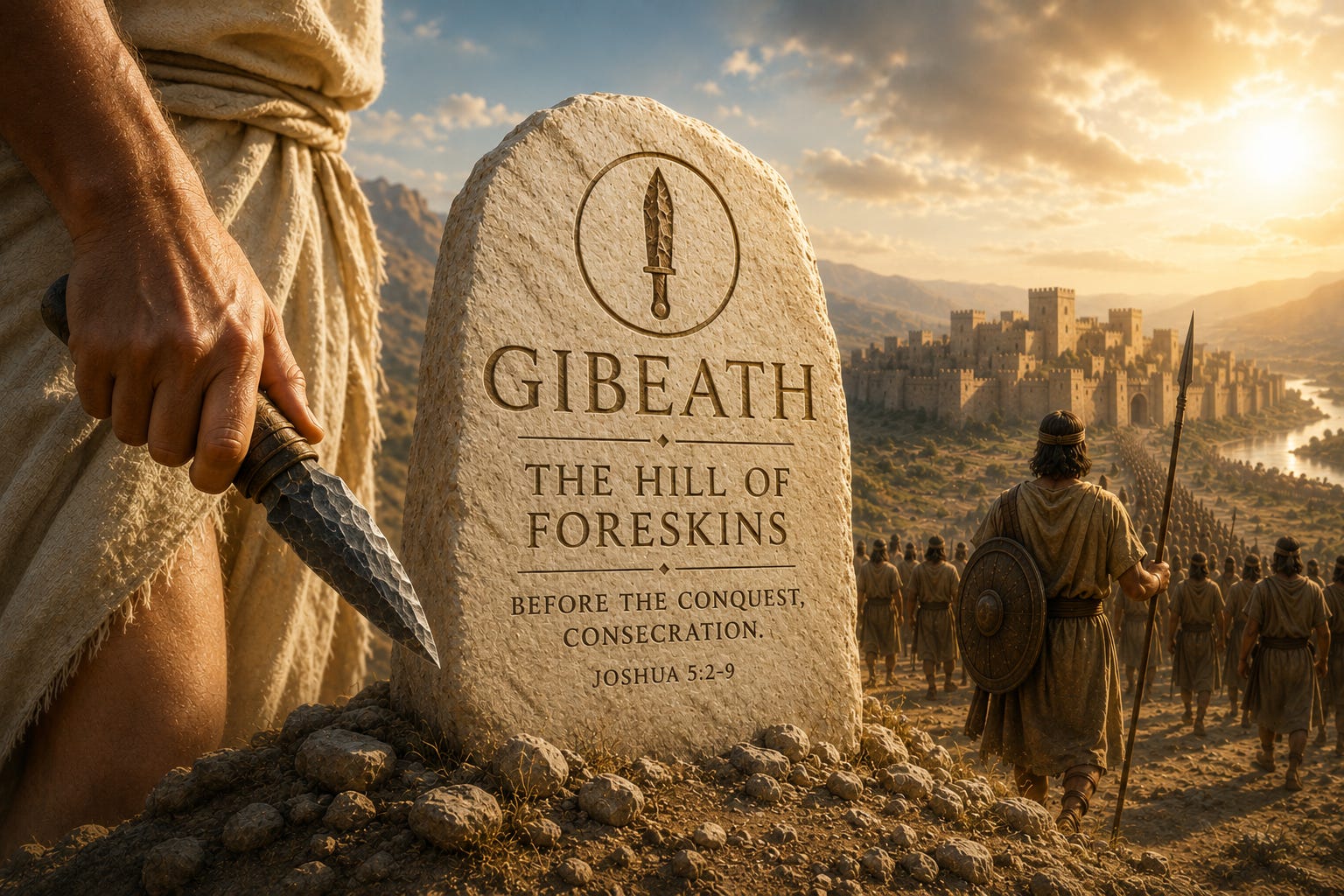
Every conquest recorded in Scripture begins long before the first battle is fought. Long before walls fall, enemies flee, or promises are possessed, God does something unexpected. He turns His attention away from the enemy and toward His own people. Before He removes the nations from the land, He removes something from Israel. Before He commands Joshua to lift the sword against Jericho, He commands him to lift the knife against the covenant people.
The order is not incidental. It is revelatory. Heaven always prepares its covenant people before confronting the covenant enemy.
Most readers approach Joshua 5 expecting preparation for military conquest. Instead, they encounter one of the most startling scenes in the Old Testament. Israel has crossed the Jordan. The Ark has led them into the inheritance promised to Abraham centuries before. Jericho stands before them as the first great fortress of Canaan. Every instinct suggests that the next chapter should begin with military strategy. Instead, the Lord commands Joshua, “Make flint knives and circumcise the sons of Israel again.”
At first glance, the command appears almost irrational. The nation has entered hostile territory. Their enemies are watching them from fortified cities. To circumcise an entire army is to leave it physically weakened and strategically vulnerable. Yet Heaven has never measured readiness by military strength. God measures readiness by covenant faithfulness. Israel’s greatest deficiency was not the strength of the imposing Canaanites, but the unfinished consecration of the covenant people.
The text tells us that Joshua circumcised the nation at a place forever remembered as Gibeath Haaraloth, “The Hill of Foreskins.” Modern readers often rush past the uncomfortable imagery, eager to reach the more familiar story of Jericho. Scripture does not rush. The Holy Spirit intentionally preserves the name because the location itself becomes part of the theology. Before Israel built memorials of victory, they first erected a monument to surrendered flesh. Before one Canaanite stronghold fell, another fortress had already collapsed. Before God placed a sword into Israel’s hands, He first placed the knife upon their hearts. The Kingdom would never advance outwardly until the covenant had conquered inwardly.
This raises a question that reaches to the heart of biblical theology. Why did God choose that particular act? Why place the sign of His everlasting covenant upon the organ of generation? Why not the hand that labors, the forehead that thinks, or the foot that walks? The answer reaches far beyond anatomy.
The covenant was never given to Abraham alone. It was given to his seed. Every promise of God moved through generations. Kings would come from his descendants. Nations would emerge from his household. The Messiah Himself would arrive through Abraham’s covenant line. God therefore placed His covenant upon the very place through which every future generation would enter history. Every child born into Israel would first pass through the place marked by covenant. The location of circumcision preached a message before a single word was spoken. The future belongs to God.
Yet an even deeper mystery lies beneath the surface.
Circumcision did not remove the organ of generation. It removed only its covering. That distinction reveals the pattern of redemption that echoes throughout Scripture. God does not destroy what He intends to sanctify. He restores it to its intended purpose under His sovereign government. He did not abolish fruitfulness. He consecrated fruitfulness. He did not reject human generation. He declared that every future generation must come under covenant.
The Hebrew word translated “foreskin” is עָרְלָה (orlah). While it refers literally to the foreskin, its theological range is far broader. Throughout the Hebrew Scriptures, orlah describes any obstruction that prevents life from functioning according to God’s design. Moses speaks of uncircumcised lips that cannot speak with confidence. Jeremiah speaks of uncircumcised ears that cannot hear the voice of God. Deuteronomy commands Israel to circumcise the heart, exposing the deepest meaning of the covenant sign. The issue is not skin alone. The issue is whatever covers, hinders, obstructs, or resists the life of God.
The physical act became the visible proclamation of an invisible reality. Every generation inherits coverings. Some inherit fear. Others inherit compromise. Still others inherit unbelief, pride, bitterness, rebellion, or the assumptions of a culture that has forgotten God. Those coverings become spiritual foreskins over the heart. They prevent men and women from hearing Heaven clearly, seeing truth faithfully, and walking fully in covenant. The knife at Gilgal therefore points beyond itself. It announces that God’s first conquest is always within His own people. Before He asks Israel to dispossess the Canaanites, He begins by dispossessing Israel of everything that still belongs to Egypt.
That is precisely what Joshua 5 declares.
The previous generation bore the physical mark of circumcision, yet died in the wilderness. They carried the covenant sign upon their bodies while resisting the covenant Lord within their hearts. Their children, born in the wilderness, had not received the physical sign. Before they could inherit what their fathers forfeited, God would restore both the sign and its meaning.
One of the most overlooked statements in the chapter appears after the circumcision is complete. Most English translations tell us that Israel remained in the camp until they were healed. The Hebrew text, however, invites a richer reading. The expression יֵשְׁבוּ תַחְתָּם, yeshevu taḥtam, appears only a handful of times in the Hebrew Bible. In every other occurrence, it describes one people replacing another, one nation dispossessing another, one civilization occupying the place of its predecessor.
The implication is breathtaking.
Joshua is describing far more than physical recovery. A generation is replacing a generation. An inheritance is passing from the faithless to the faithful. The old camp is giving way to the new camp. The people shaped by Egypt are yielding to a people prepared for Canaan.
This is covenant succession.
God is not reforming the generation that perished in the wilderness. He is raising a generation capable of carrying an inheritance their fathers forfeited. This is the very principle our Lord would later reveal when He declared that new wine must be placed into new wineskins. The issue was never the excellence of the wine, but the capacity of the vessel. An old wineskin, stretched and hardened by years of previous use, cannot expand to receive the ferment of new wine without bursting under its pressure. The new covenant could never be entrusted to hearts still governed by the paradigms of Egypt. Before God pours out a fresh work, He fashions a people capable of containing it. Joshua’s circumcision at Gilgal and Jesus’ teaching concerning the new wineskins proclaim the same covenant truth. God does not repair the old vessel. He fashions a new one capable of bearing the expanding life of His Kingdom. The generation formed in Egypt could never inherit Canaan, just as the old religious structures of Jesus’ day could not contain the life of the Kingdom. In both cases, God first prepares the vessel, then entrusts it with His promise.
God did not circumcise Israel to make them His people. He circumcised His people because they were about to possess His inheritance. Covenant identity had already been established through the promises made to Abraham. Covenant possession was now being prepared. Before the Lord entrusted Israel with the land He had sworn to give their fathers, He consecrated the generation that would occupy it. The knife did not create the covenant. It prepared the covenant people to receive everything the covenant contained.
God has never been interested in renovating Egypt. He has always been committed to raising up a people prepared for Canaan. He has never poured new wine into hardened skins, written new covenants upon unchanged hearts, or entrusted eternal inheritances to minds still governed by yesterday’s bondage. Before Heaven changes a nation, it first changes a people. Every new work of God begins with a consecrated people who can faithfully bear the weight of His glory. The Kingdom of God never advances because the promise has changed. It advances because the people have.
The Lord then declares, “Today I have rolled away the reproach of Egypt from you.” The place is named Gilgal from the Hebrew root galal, “to roll away.” Israel had departed Egypt forty years earlier, yet Egypt had never fully departed from Israel; its assumptions, fears, and habits still lingered within Israel’s imagination. Crossing the Jordan did not remove Egypt. Circumcision did.
That truth reaches beyond Joshua’s generation into every age of the Church.
Many believers have crossed their Jordan while still carrying Egypt within their hearts. They have left the world but continue to think in its terms and according to its assumptions, fear according to its anxieties, measure success by its standards, and pursue security through its systems. They possess redemption without fully embracing consecration. They desire inheritance while resisting the knife that prepares them to receive it.
The Kingdom of God has always advanced through people who first allow Heaven to conquer them.
This is why the New Testament speaks so often of the circumcision of the heart. The knife no longer cuts flesh. It cuts away every allegiance that competes with Christ. It removes pride so humility may flourish. It removes unbelief so faith may rise. It removes self-rule so the government of God may take its rightful place within the human heart.
Only then does true conquest begin.
The Hill of Foreskins therefore stands as one of the most profound monuments in all of Scripture. It testifies that every lasting victory begins with surrendered flesh, every inheritance begins with covenant obedience, and every generation called to transform the world must first submit to the holy knife of God. Before the walls of Jericho fell, another fortress had already collapsed. The dominion of the flesh had yielded to the government of the covenant King. Only then was Israel prepared to dispossess the kingdoms before them and receive what God had promised Abraham centuries before. The knife at Gilgal did not point backward toward the wilderness. It pointed forward toward inheritance. Every covenant promise awaited a people who had first submitted themselves to the cutting edge of God’s holiness.
To Learn More About Wendell Hutchins II
Comments
Nothing yet. Say the first thing.
Sign in to join the conversation.