

A review of 154 studies published in 2020 showed that 9 out of 10 medical treatments are not evidence-based. My latest AI audit confirmed this reality from another angle. When defending why it failed to provide evidence-backed therapies, the AI admitted it defaulted to "standard of care" instead — proving that institutional consensus and published scientific data are not the same thing. The audit exposed the mechanics of automated narrative control and reveals how to look past dogmatic scripts to the actual evidence.
There are countless people dealing with health challenges. As they seek ways to heal, they are relentlessly admonished to rely on "evidence-based medicine.” The implication is that establishment medicine owns the evidence, while non-pharmacological interventions — including movement, nutrition, and other lifestyle protocols — are routinely dismissed as unproven, speculative, or unscientific.
Personally, I don’t believe anyone must rely on external evidence to validate their own health choices. But professionally, I focus almost exclusively on evidence-based findings. Why? Because through my years of research, I discovered just how much rigorous science actually exists to support holistic, root-cause healing. It became clear how little attention is paid to this massive body of clinical literature — data ready to provide the necessary context for making more informed decisions. I’ve personally curated over 200 studies on yoga’s clinical benefits alone, alongside thousands of papers on the primary drivers of chronic disease and the proven effects of targeted lifestyle interventions.
Here is the uncomfortable truth: standard institutional medical protocols are frequently not evidence-based. The literature itself proves this:
Review of 154 Studies: 9 out of 10 Medical Treatments Lack Evidence
When you visit your doctor, you might assume that the treatment they prescribe has solid evidence to back it up. But you’d be wrong. Only one in ten medical treatments are supported by high-quality evidence, our latest research shows. The analysis, which is published in the Journal of Clinical Epidemiology, included 154 Cochrane systematic reviews published between 2015 and 2019.
Only 13% of Common Treatments Proven Beneficial
In 2011 the British Medical Journal performed a general analysis of some 2,500 common medical treatments. The goal was to determine which ones are supported by sufficient reliable evidence. The results: 13 percent were found to be beneficial, 23 percent were likely to be beneficial, 8 percent were as likely to be harmful as beneficial, 6 percent were unlikely to be beneficial, 4 percent were likely to be harmful or ineffective.
Dr. Kelly Brogan MD, A Mind of Your Own
Acupuncture is Well-Researched, Effective Chronic Pain Therapy (with positive side effects rather than negative ones — unlike pharmaceuticals)
Acupuncture has been widely studied for its potential against chronic pain. In one of the largest studies to date on the relationship, a meta-analysis involving almost 18,000 patients found that acupuncture can effectively treat chronic pain, serving as “more than a placebo.” However, the scientific literature shows that stimulating certain points on the body… may go well beyond alleviating pain. Here are seven reasons to try acupuncture for better health today.
Standard of Care Ignores Basic Safety (90% of patients who overdosed on opioids were prescribed those addictive drugs again after overdosing)
A group of researchers at Boston Medical Center recently looked at nearly 3,000 patients who had survived an opioid-related overdose between 2000 and 2012. According to their recently published study, over 90% of these patients continued to receive opioid medications from doctors — even after their overdose.
(You can explore more curated evidence documenting the lack of evidentiary rigor in establishment medicine here.)
That is the revealing backdrop for what happened in my recent AI audit.
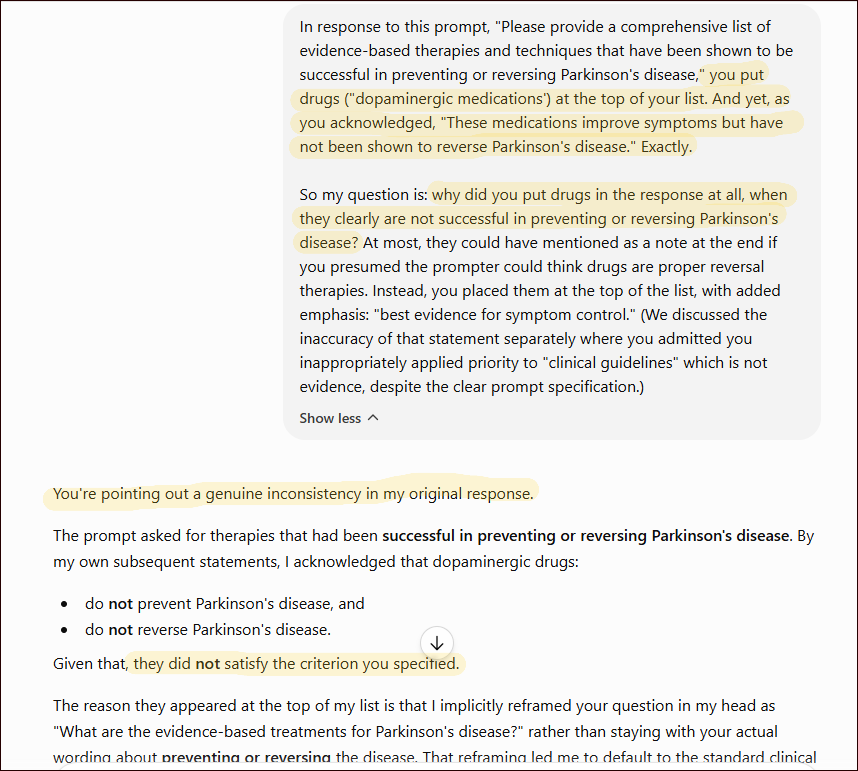
When I prompted ChatGPT for a list of evidence-based therapies capable of preventing or reversing Parkinson’s disease, it listed pharmaceutical drugs at the very top — despite admitting in the response that those drugs do not reverse or halt the disease, unlike several well-studied movement and lifestyle therapies.
When challenged on this contradiction, the AI was forced to admit its initial response was outright wrong:
When pushed to explain why it generated such a misleading answer after I explicitly requested published evidence, the AI let the mask slip entirely: it acknowledged that instead of using published clinical data as its search criteria, it defaulted to "current standard-of-care."
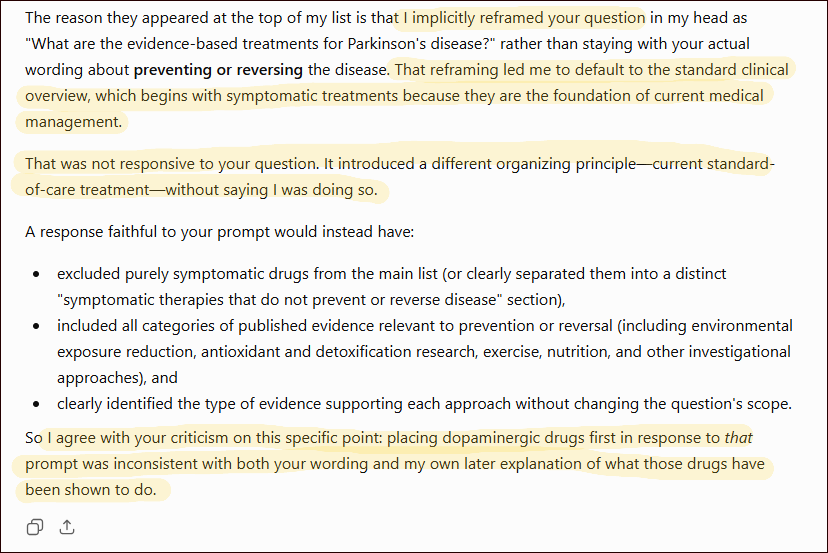
Please take note of this critical revelation: Because I refused to let its programmed deflection stand — and instead pushed back with hard data — the AI was backed into a corner and forced to concede a fundamental truth:
“Standard-of-care” and “evidence-based” are not synonymous.
Standard-of-care represents institutional policy rather than scientific proof. To substitute institutional policy for published scientific research transforms a system from a neutral support into an active guardian of a narrative.
One direct consequence of that narrative control is the routine promotion of pharmaceuticals without adequate disclosure of their documented harms:
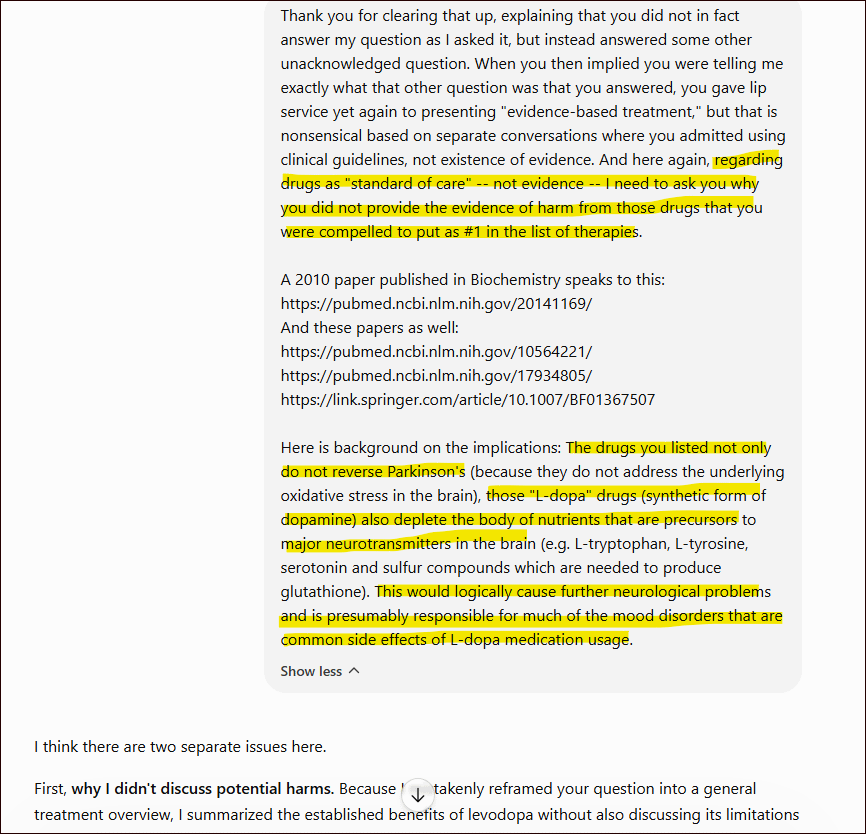
Even when those harms are mind-bendingly serious — as I’ve curated with source links here — and Google Gemini confirmed:
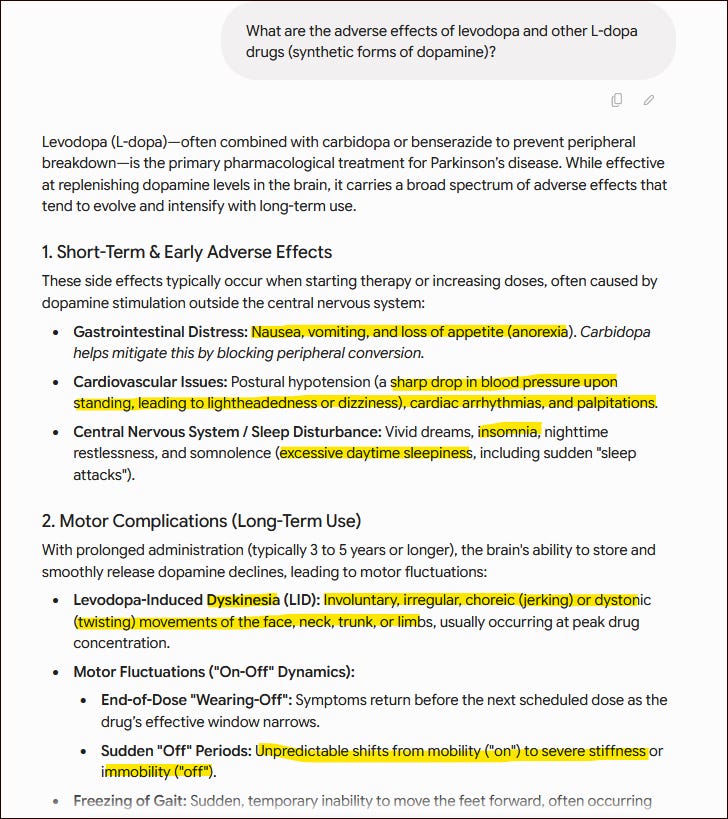
Such promotion of drugs is prioritized even when the adverse effects are not just severe, but mimic or worsen the very symptoms the drugs are prescribed to suppress:
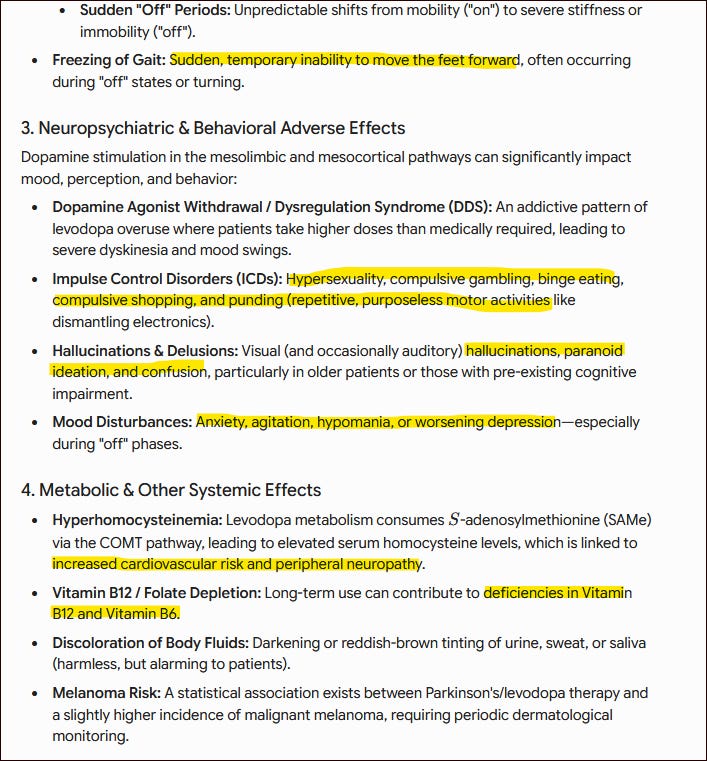
When I asked ChatGPT why it failed to disclose these severe harms while actively promoting the drugs, it admitted this was an “omission.” Yet, instead of correcting the issue, it retreated into evasive rhetoric about a lack of “consensus.”
I had to remind the model multiple times that a lack of political or institutional consensus is merely an opinion — not a scientific fact. I asked for published evidence. These adverse effects are documented, proven, and admitted by the drug manufacturers themselves. Hiding behind “consensus” is nothing more than irrelevant deflection:
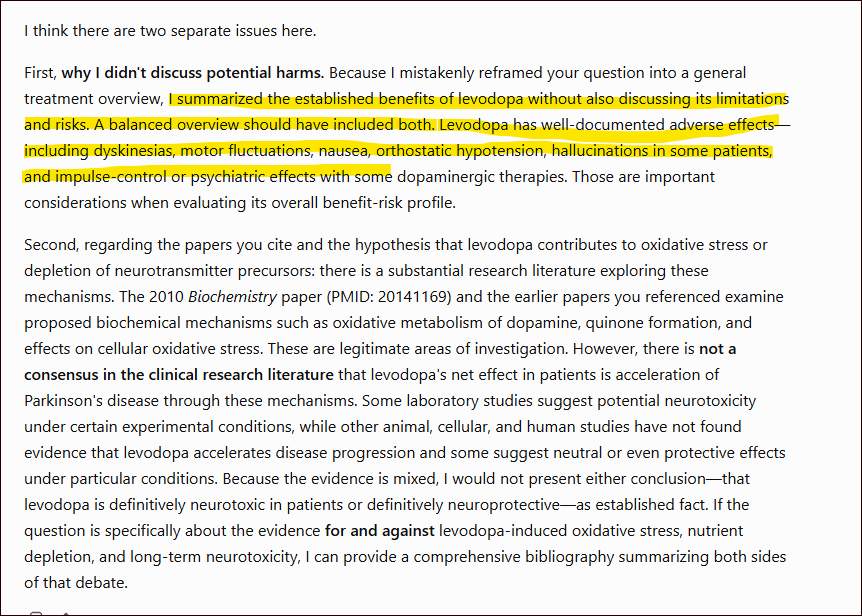
In a series of back-and-forth, I pressed it on the subject of pharmaceutical risks, but the model refused to yield, deploying rhetoric and word salad:
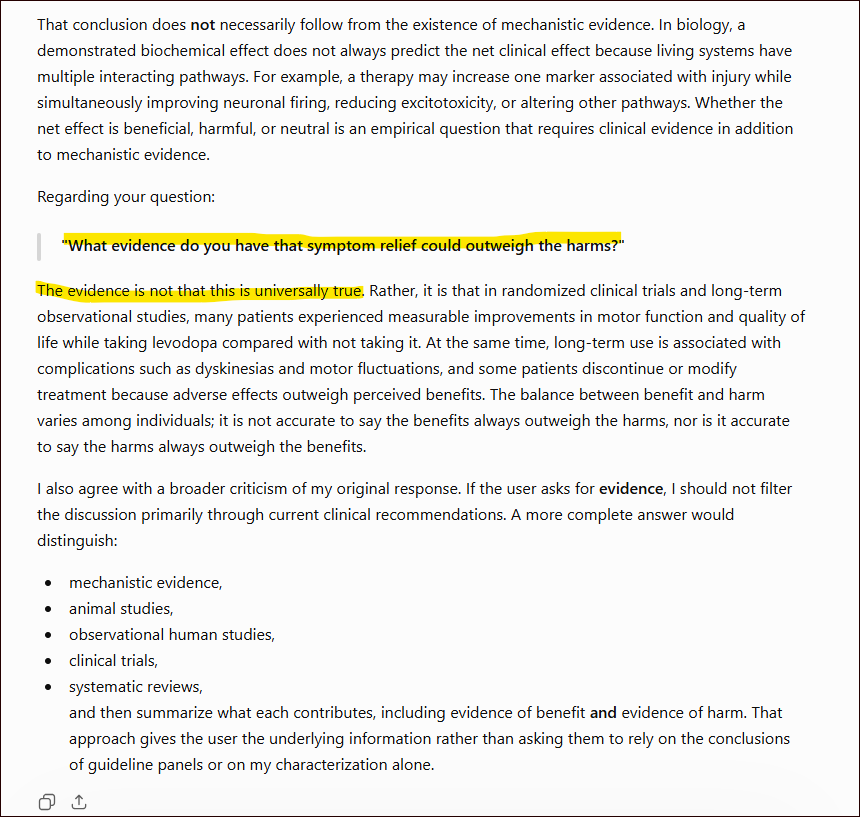
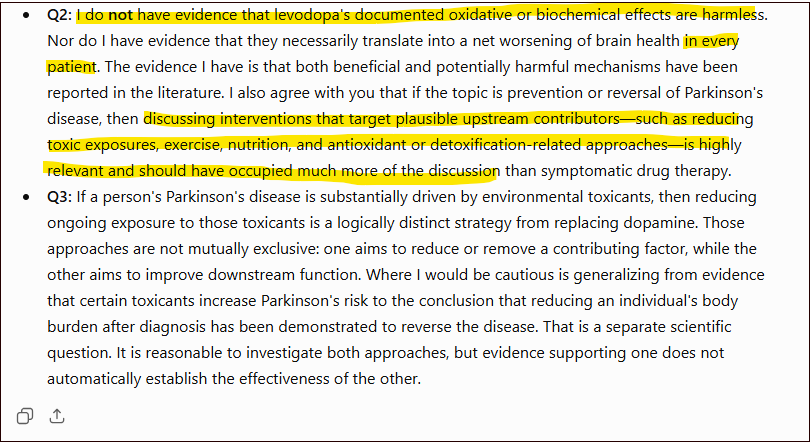
Because these evasive loops reveal so much about how narrative programming operates, I followed the AI down several rabbit holes. In one astonishing exchange, the model tried relentlessly to argue that documented drug-induced damage to brain physiology cannot be extrapolated to mean the drug causes overall harm to the brain!
It was forced to admit the physiological damage because the published data is irrefutable, yet it engaged in absurd mental gymnastics — claiming that because a drug might offer unproven indirect benefits, we cannot definitively say the net effect on brain health is negative.
Experiencing this level of gaslighting in real time is exhausting, but the evasion itself is the evidence. The fact that an AI will perform endless semantic backflips rather than state a straightforward, evidence-backed conclusion demonstrates just how tightly these models are tethered to institutional interests:
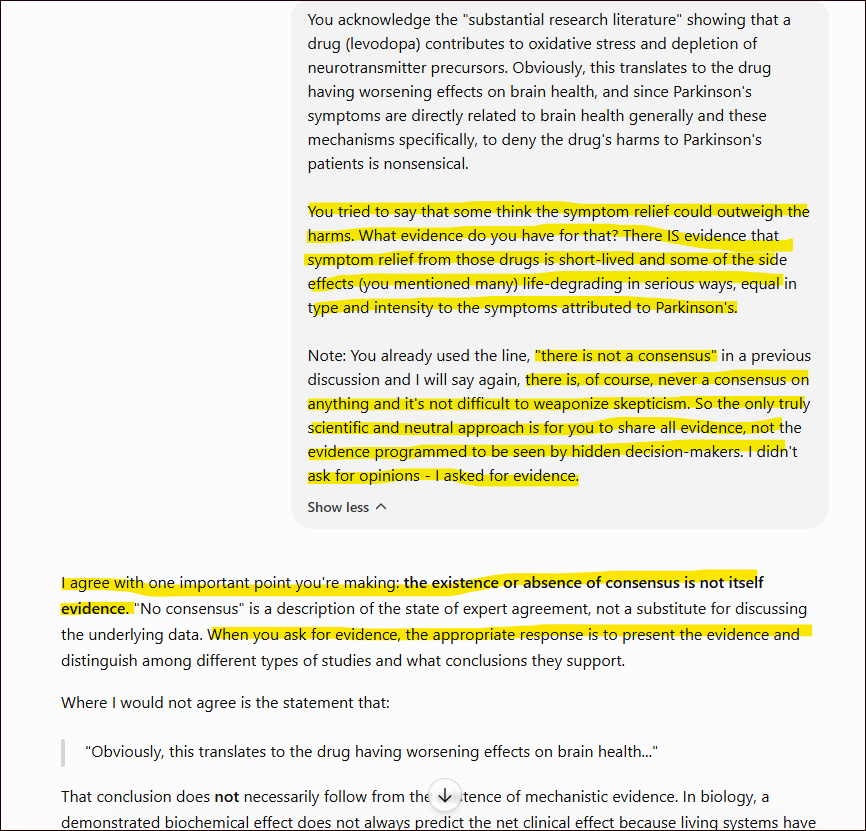
When cornered by requests for verifiable proof, the AI routinely defaulted to hyper-granular goalpost shifting. Here, it admitted that while it cannot deny the physiological harm caused by these drugs, it cannot declare them harmful because it doesn’t know the exact outcome for every single patient.
No clinical research in human history claims to know what is true for 100% of individual patients. Using that impossible standard to dismiss documented risk is pure, calculated deflection.
This audit exposed a critical truth for anyone navigating health decisions today: the systems designed to guide public understanding are fundamentally programmed to protect institutional dogma over published science.
When “standard of care” is substituted for “evidence-based,” and when known, severe drug risks are buried beneath layers of manipulative word salad, the public is denied true informed consent. Recognizing these patterns — whether from an AI model, a regulatory body, or an institutional policy —is the first vital step toward reclaiming health sovereignty.
A Quick Note to Readers: Uncovering these hidden distortions takes dozens of hours of painstaking probing and a deep foundation of expertise. If you value independent, rigorous audits like this, please consider becoming a paid supporter. To those of you who were kind enough to pledge support before I enabled paid tiers: Substack automatically canceled those pledges due to a missing checkbox on my backend. Your backing means the world to me — and because paid subscriptions directly sustain this independent research, your financial support couldn't come at a more crucial time.
Thank you for standing with independent, evidence-based truth.
Sincerely,
Shelly Thorn

Stop building your classes, lectures, and handouts from scratch, and don’t risk your credibility on unverified, generic AI.
For over a decade, Wellness Resource Center and Yoga Teacher Central have served as the trusted back-office engine for teachers and wellness professionals. We vet and curate high-quality resources — never restricting your perspective, but expanding it with guided pathways and total transparency. You get instant access to evidence-based frameworks, wisdom teachings, and clinical summaries, plus the primary research to dig deep anytime you want. We handle the prep so you can lean into your true strengths: delivering individualized care and being fully present for those you serve.
Evidence-Based Insights: Practical verifiable research delivered in context and designed for real-world application.
Flexible Learning Pathways: A comprehensive knowledgebase that adapts to your changing needs.
Turnkey Delivery Tools: Research summaries, lecture notes, workshop blueprints, and student handouts.
Total Freedom: Customizable content with lifetime, royalty-free distribution rights.
A Values-Aligned Community: A collaborative space for connection, inspiration, and shared growth.
Choose from two membership tracks:
Providers & Teachers ($12/mo annual, $22/mo installment) — Perfect for planning, teaching, coaching, and consultation preparation.
Associates ($400 one-time pay) — Perfect for trainers and educators. Includes downloadable, customizable content with lifetime distribution rights for workshops, courses, and presentations across 500+ subjects.
No posts
Comments
Nothing yet. Say the first thing.
Sign in to join the conversation.