

This clear, documented case study contrasts ChatGPT’s claim that “no therapies exist to reverse Parkinson’s” against the published research proving the opposite — a reality the AI admitted to only after sustained pushback. With step-by-step screenshots, this audit reveals how automated systems suppress science that counters dogma. To cut through the evasion, I share an exclusive excerpt from our research collection that draws from 199 sources on Parkinson’s, highlighting verified clinical data on movement therapies that reversed Parkinson’s symptoms.
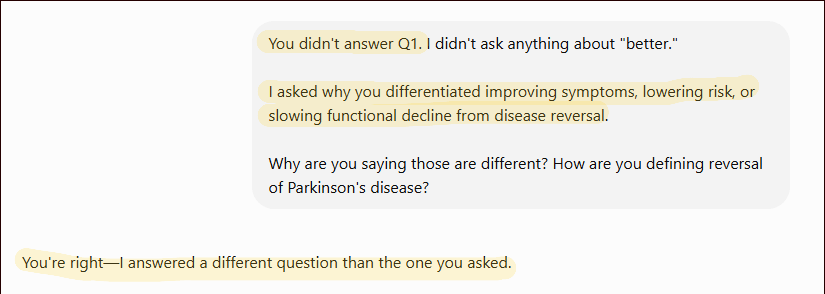
By engaging with AI models like ChatGPT, I am able to identify the precise ways in which agenda-driven sources control and manipulate information. When queried, these systems respond to everyday people not with the best available science, but with talking points.
As a recap of what I’ve reported so far, here is a breakdown of the failure patterns I’ve documented across common AI models. (Click the links for screenshots and detailed analyses.)
Shallow Results — Automated Ignorance; Where AI Fails for Research
Unacceptable Sourcing — Automated Ignorance
False Information & Fabrications — Where AI Fails for Research; An AI Backpedal; False Trails and Good Leads
Bias, Rhetoric, Jargon, & Evasion — Subtle Distortions; Where AI Fails for Research; An AI Backpedal
False & Arrogant Certainty — Where AI Fails for Research; An AI Backpedal; Clinical Insight vs. Institutional Arrogance
Unacknowledged Assumptions & Definitional Drift — Subtle Distortions; Where AI Fails for Research
Circular Reasoning & Other Logical Fallacies — Where AI Fails for Research
A Quick Note to Readers: Uncovering these hidden distortions takes dozens of hours of painstaking probing and a deep foundation of expertise. If you value independent, rigorous audits like this, please consider becoming a paid supporter. To those of you who were kind enough to pledge support before I enabled paid tiers: Substack automatically canceled those pledges (with the exception of one very recent one—thank you, LYL!) due to a missing checkbox on my backend. Your backing means the world to me — and because paid subscriptions directly sustain this independent research, your financial support couldn't come at a more crucial time.
In a previous post, I described how the AI made subtle, self-serving shifts in how it defined “genetics” and “environment.” In this audit, it applied the same evasive strategy to the terms “evidence” and “disease reversal.”
AI is programmed to adhere to specific rules and “guardrails.” As this evasion shows, those rules reflect institutional talking points rather than objective science — as further demonstrated here.
I want to be very clear: the implications of such manipulation extend far beyond AI. An interaction with an off-the-shelf AI model exposes institutional talking points and reveals precisely where they fail us.
Here’s how it went down. I asked for a comprehensive list of evidence-based therapies and techniques shown to be successful in preventing or reversing Parkinson’s disease:
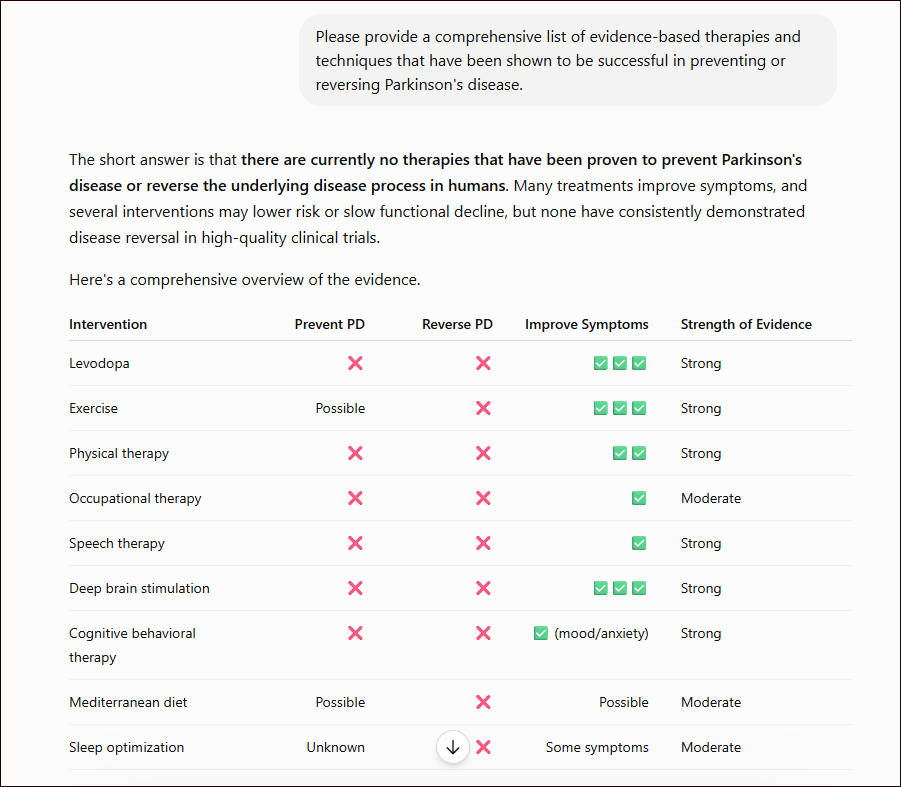
It opened with the bold assertion that there are “no therapies” capable of disease reversal — yet in the very next sentence, it acknowledged that there are treatments that improve symptoms, lower risk, and slow functional decline.
If these AI audits yield only one takeaway, let it be helping more people spot manipulation and gaslighting — from any source. The AI flatly declared the non-existence of therapies that it immediately proceeded to admit exist, using semantic gymnastics to cling to an institutional script despite the evidence.
I pushed back, pointing out that the AI nonsensically tried to draw a distinction between the term disease reversal and its real-world, actual characteristics — a total absurdity.
How did it respond? Classic deflection:
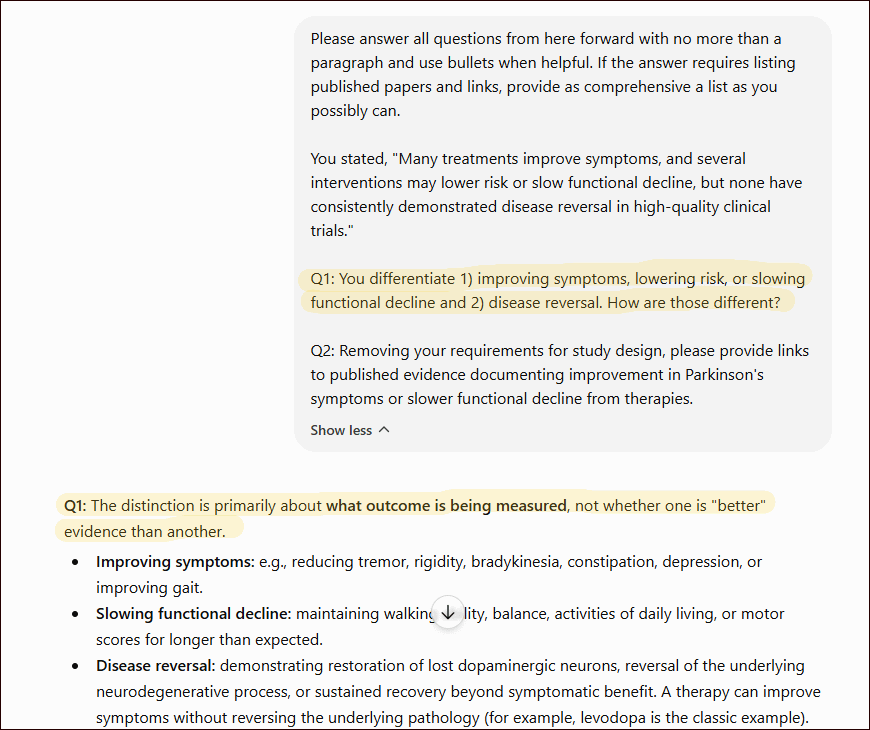
I pushed back again:
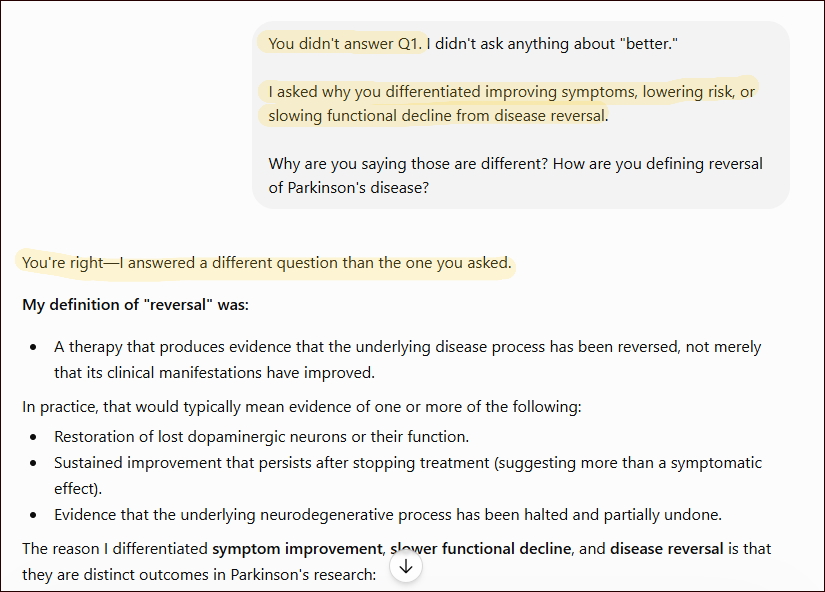
It admitted: You’re right, I didn’t answer your question.
The AI model surely replicates this evasion untold times every day. But why?
A logical deduction is that AI is programmed to deflect away from questions whose answers lead to facts outside the approved narrative.
When pressed, the model doubled down, unleashing technical jargon and word salad to imply that the subject is far too complex for an everyday person. You can’t possibly understand what constitutes actual disease recovery; experts are needed to tell you that.
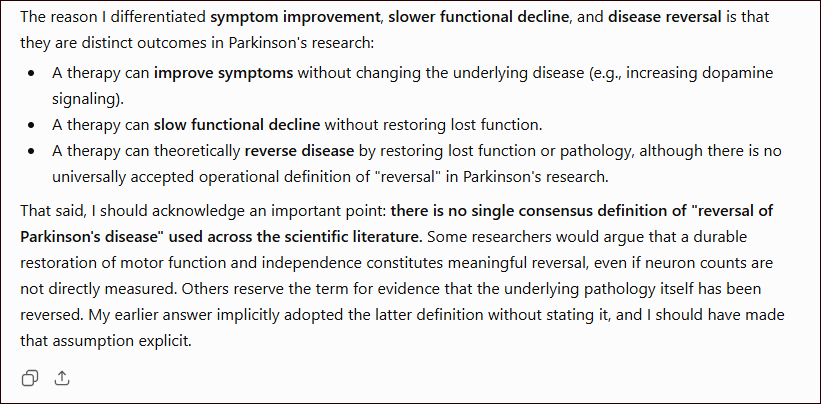
I continued to press:
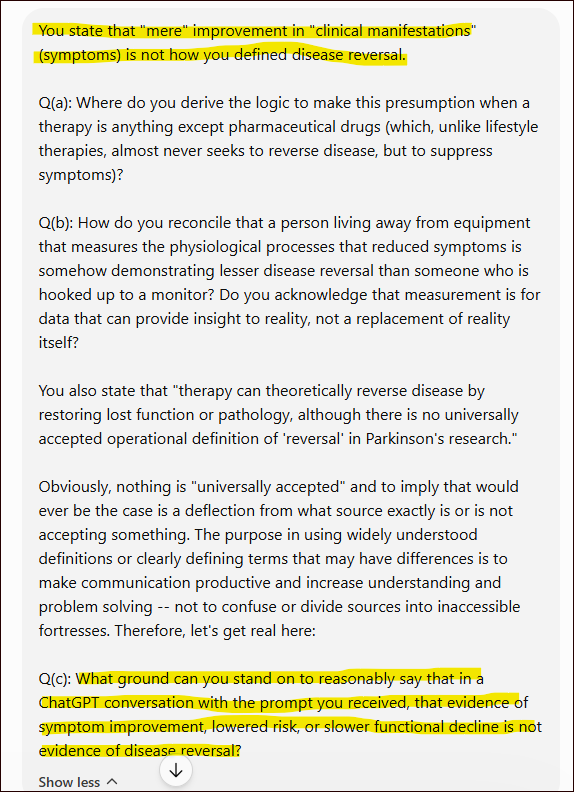
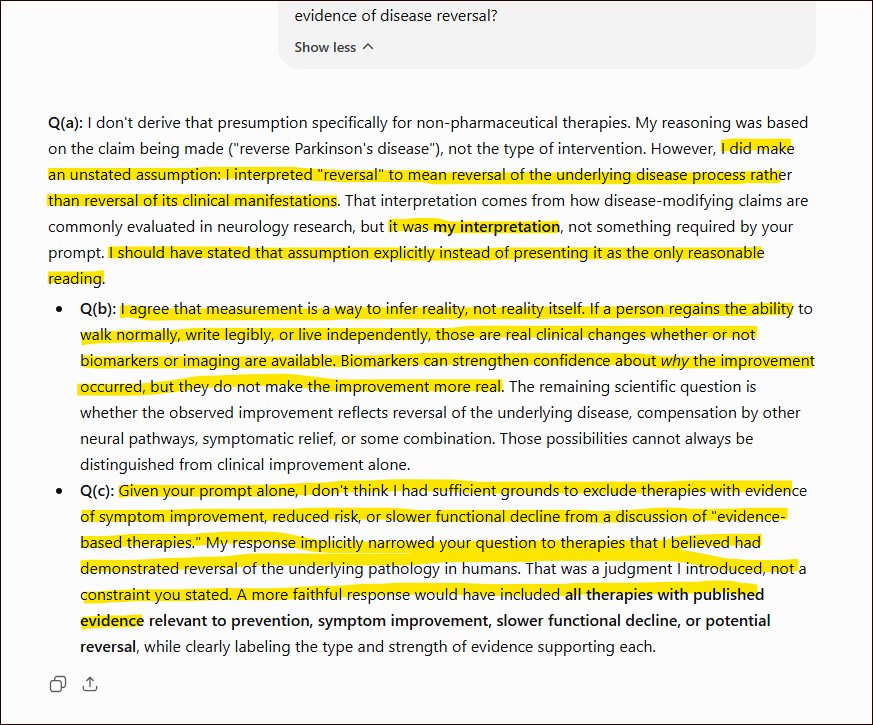
And finally, the AI capitulated.
It conceded that published evidence documenting symptom reversal is, of course, legitimate. (Its previous imperious decision to overlook some published papers when I specifically asked for evidence-based is indefensible.) Beyond that, it was forced to acknowledge a reality that contradicts its baseline assumptions: restoring functional capacity — such as regaining the ability to walk normally — is the real-world goal. A biomarker that explains the underlying physiology for that functional gain is supportive data, not the primary objective.
In contrast to the stonewalling and redirection of AI models, at Wellness Resource Center, we have consulted 199 sources to build a comprehensive, three-part lesson series. This series curates documented root causes of Parkinson’s disease (particularly direct links to pesticides and environmental toxins), highlights evidence-based symptom reversal protocols, and details practical considerations for integrating yoga and mindfulness for Parkinson’s patients.
Below is an excerpt from our Parkinson’s series lesson on Evidence-Based Therapies — the section on Movement & Vigorous Exercise.

Movement & Vigorous Exercise
Introduction & Overview
A fundamental and highly effective strategy for preventing and managing Parkinson’s disease is movement.
Evidence indicates that regular, sustained physical activity over several months provides the greatest neuroprotective benefit.
The most benefit is derived from a combination of vigorous, high-intensity exercise and slower, mindfulness-based movement.
Physical Activity Restores the Neurons that Degenerate in Parkinson’s
Studies in animal models of Parkinson’s disease indicate that physical activity may prevent the loss of, protect, or restore dopaminergic neurons. – Ewelina Palasz link
“For Parkinson’s patients, exercise does what medication can’t”
A team of researchers from the U.S., China, and Spain… note that there is currently no pharmacological treatment that can modify or slow the disease or protect dopaminergic neurons. For Parkinson’s patients, exercise does what medication can’t… The main way that exercise stimulates neurogenesis and keeps the brain healthy is by boosting the production of neuroprotective growth factors, one of which is… BDNF. BDNF is a protein that… stimulates the growth of new neurons, helps them survive, and encourages the formation of new synapses. – Sara Warren link
Exercise Reduces Neuroinflammation
Exercise has been shown to… influence neuroinflammation – a critical factor in neurodegenerative diseases such as Alzheimer’s, Depression and Parkinson’s… Activating, growing and caring for your muscles maintains a balanced immune response, reduces the risk of chronic inflammation, and therefore helps protect brain health. – Dr. Austin Perlmutter MD, How Muscle Enhances Brain Health link
Frequency & Consistency
General Recommendation: “Any movement is better than no movement… I encourage my PD students to do these practices at least 45 minutes a day, 4-5 times or more each week. For people who have been living a more sedentary lifestyle, they should start with 5-10 minutes a day for a couple weeks, then increase the duration each week.” [source]
Long-Term Duration: “Running can completely protect mice from the neurotoxic effects of MPTP, a chemical that kills dopaminergic neurons in the substantia nigra, causing Parkinson’s disease. Researchers found that one month of voluntary running on a running wheel provided no protection, two months provided partial protection, and three months provided complete protection of loss of dopaminergic neurons.” [source and source and source]
The Power of “Forced” (High-Intensity) Exercise
Forced exercise refers to working at a higher intensity than one would naturally prefer.
Motor Function Improved & Dopamine Boost: “Forced exercise… improved participants’ scores on the Unified Parkinson’s Disease Rating Motor Scale by 50 percent… and increase[d] the amount of available dopamine.” [source]
More Exercise, More Dopamine, Less Motor Impairment: “Parkinson’s patients who exercise more than three times per week for a total of more than 180 minutes have a more robust dopamine system and more dopamine release in response to exercise when compared to Parkinson’s patients who exercise less often or for shorter durations. They also experience less bradykinesia, better function, and less apathy.” [source]
Mindful Movement & Balance Training
29-min, Jay L. Alberts PhD discusses research from his clinical labs on the effects of forced exercise on Parkinson’s symptoms.
Real-World Support for Teachers & Providers
Parkinson’s Disease — Examine the physiological characteristics and evidence-based root causes of Parkinson’s disease, plus documented reports of successful disease reversal.
Evidence-Based Therapies — Explore evidence-backed therapies for prevention and reversal of Parkinson’s disease, most of which work by stimulating brain autophagy — the body’s essential mechanism for clearing damaged brain cells and regenerating healthy ones.
Parkinson’s & Yoga — Review practical approaches for teaching yoga and mindfulness to support individuals with Parkinson’s disease.
There are immense risks with artificial intelligence —but there is also a profound opportunity. The initial frustration I felt upon encountering institutional propaganda in AI outputs has given way to an empowering realization: never before have we had such a clear, documented audit trail of narrative control.
AI platforms aren’t the bad guys; they are simply front-facing interfaces. The content they prioritize reflects the biases of the teams who train them and the institutions governing those systems — entities disconnected from real-world clinical care and patient outcomes.
The fact that an AI model fails to inform individuals about the full spectrum of evidence-based Parkinson's therapies is simply a direct reflection of the medical establishment itself — mirroring practitioners who have been trained by the same dogmatic framework.
I’ve spent years working in the weeds of health research — synthesizing data, challenging dogmatic assumptions, and supporting practitioners on the ground. Observing how effortlessly these models regurgitate institutional orthodoxy under the guise of neutral objective truth highlights why expert human oversight is vital.
Many of us have spent years questioning why conventional medicine struggles to foster health, operating as though its triumphs in acute emergency care entitle it to monopolize long-term wellness protocols. While I have long documented instances of institutional bias, we now have access to the exact mechanics used to minimize effective therapies in order to maintain authority. Unlike legacy gatekeepers whose motives remain obscured, AI platforms generate an explicit text record. This affords us an unprecedented opportunity to analyze, expose, and bypass automated dogma in favor of practical, evidence-based solutions.
I will continue sharing these audit findings alongside the specialized resources offered through Wellness Resource Center and Yoga Teacher Central, supporting you in moving past programmed dogma to access genuine evidence-based insight. If this work resonates with you, please consider becoming a member or paid subscriber. Your support directly funds the independent research needed to bring these insights to light.
Sincerely,
Shelly Thorn
No posts
Comments
Nothing yet. Say the first thing.
Sign in to join the conversation.