
In today’s brief: most professionals in this industry are waiting to feel qualified: one more certification, one more course, one more year.
Meanwhile, the people getting hired and signed are showing something no certificate can show.
The problem was never your skills. It is that nobody has seen you think.
Today: why judgment beats credentials in every room that matters, and the two-page memo that makes yours visible.
Hola amigos,
I need to drive my kids to the forest as soon as they wake up, so the intro, which I always write fresh when I review the newsletter, has to be cut short today.
But I leave you the first photo my son (2 years old) took of my daughter yesterday.

The question I am asked more than any other, in DMs, after talks, and on this very newsletter is some version of the same sentence:
“What certification do I need to do what you do?”
When we surveyed the professionals on our own waitlist, 93 out of 199 said the thing holding them back was a credential that does not exist yet.
I understand the question.
I asked it myself for years, back when I was charging $20 an hour and collecting course certificates (I compiled a lot).
Almost nobody who ever hired me asked to see one.
Every door that opened, opened because someone had watched me think about their problem.
P.S. Wellness real estate and some other corners of the industry do require accreditations. Today’s newsletter is for those who, like me, kept postponing putting themselves out there just so they could feel ready.
That difference, between qualifications nobody checks and thinking somebody remembers, is today’s newsletter.
By the end of today, you will have:
Why credentials stay invisible
What one piece of visible thinking actually does as it moves through a company
The Judgment Memo: the two-page structure, section by section, below the line
Here is the story most of this industry tells itself. I am not being hired, or signed, or promoted because I am missing something: the right certification, the right degree, or the bigger following. So the answer is another course, and the confidence will arrive with the certificate.
Now think about the last time anyone made a decision about you.
The manager deciding who leads the new project has never read your certificates.
The client choosing between three proposals cannot see your coursework.
The executive who forwards one email to a colleague with the words “worth a look” is not forwarding your CV.
It is not a coincidence, amigos.
In every room where your career actually moves, your qualifications are a line of small print, and your thinking, if anyone has seen it, is the whole thing.
Most people in this industry have real skills and zero visible thinking, which means the competition is not who is most qualified but who has left proof.
The problem was never your skills; it is that nobody has seen you think.
Here is the mechanism, and it is the same one I showed you with the first holders: the first sustainability officers walked in with an emissions audit, and the first remote-work leads walked in with a policy framework. None of them walked in with a certificate.
Decisions are made on documents, and almost nobody writes one.
When a company has a problem without an owner, and Gallup’s numbers say the problems are everywhere, with global engagement stuck around 20%, what circulates internally is not applications. It is a document: a page somebody wrote, forwarded from one inbox to the next, gathering the sentence “have you seen this?”
A two-page read on a real problem, written in plain language, is the rarest document in any company because insiders are too close to write it and outsiders never bother.
A memo makes judgment checkable.
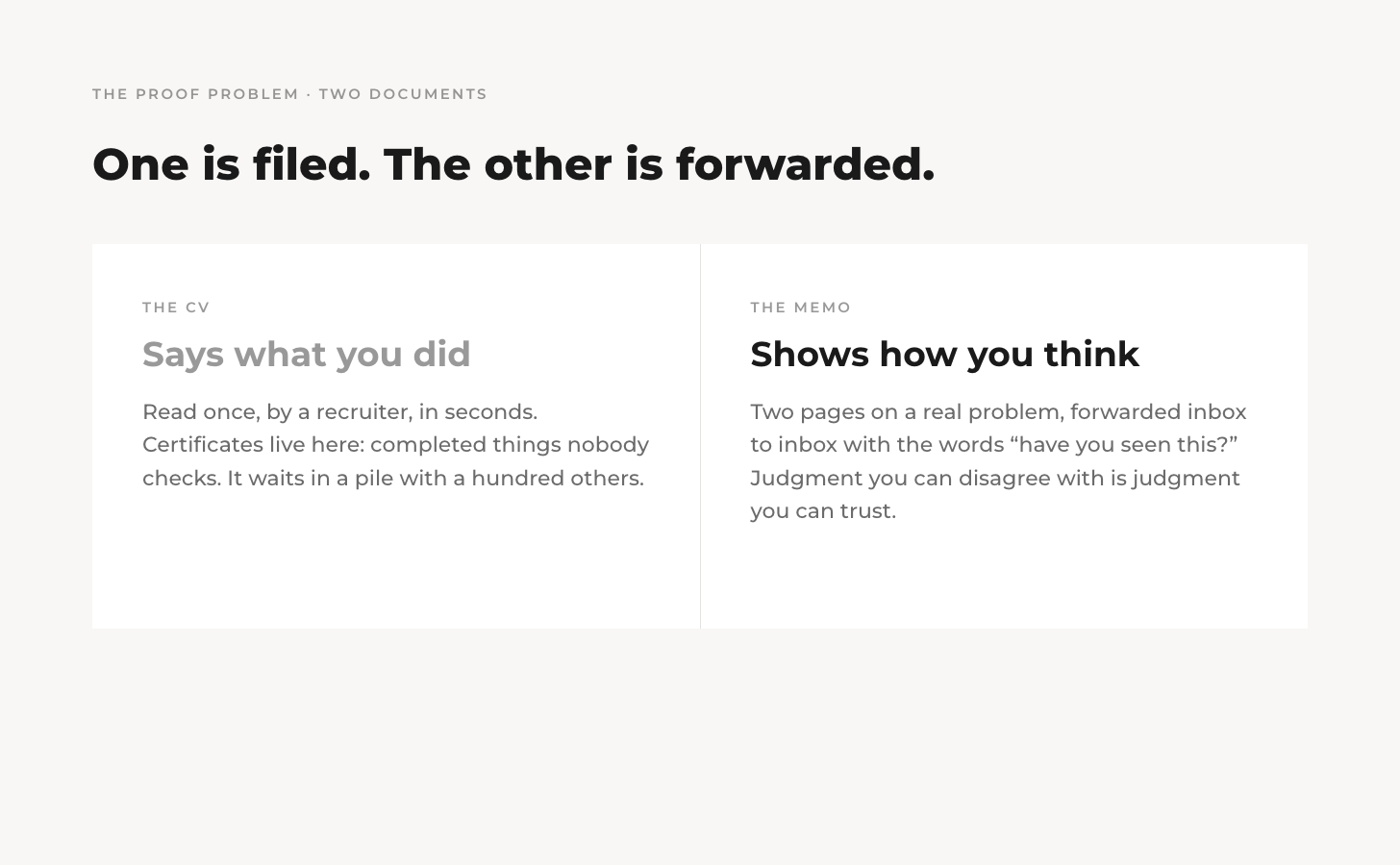
A certificate says you completed something. A memo says, “Here is the problem, here is what everyone gets wrong about it; and here is what I would do first. A reader can disagree with it, and that is exactly the point. Judgment you can disagree with is judgment you can trust.
And it works without an audience.
This is the part that matters if the word “content” makes you tired. A memo is not content. It needs no followers, no algorithm, no posting schedule. It needs one reader with the problem you wrote about. Three people receiving it is a distribution strategy.
One free move before the paywall, ten minutes.
Write down the one problem you find yourself explaining to other people in your field, the one where you catch yourself saying “everyone gets this wrong.” That sentence is your memo’s subject. If you cannot name one yet, that is not a verdict on you; it is this week’s assignment: notice what you correct.
What budget line does this sit on?
A certificate sits on your own training budget, which is why it feels safe: you are the only buyer. A memo sits next to someone else’s problem, and problems have budgets.
The reader who nods through your two pages is the same person who owns the line that pays for the fix or writes the role that owns it. On Monday I showed you when organizations decide. This is what you hand them while they are deciding.
What to stop saying? “I need one more certification before I reach out.”
What to start saying? “Here is a two-page read on your problem.”
The first sentence postpones your career while feeling like progress, but the second starts a conversation with the only person who can move it.
Below the line:
The Judgment Memo: the five-part structure, section by section
The three placement routes: the named buyer, the internal stakeholder, and the public version, and how to choose
The prompt that drafts your first memo tonight, from your own experience
The full read is $100 a year. About $8 a month.
Whatever price you join at is locked for as long as you stay. Everyone who joins today also gets a private report on their country (or a country of their choice): the opportunities, trends, industries, and predictions for the second half of 2026. That report alone is worth the price of the yearly subscription.
Comments
Nothing yet. Say the first thing.
Sign in to join the conversation.