
In today’s brief: a special edition, amigos.
Over the last two weeks I handed you four assets: the map of who pays now, the window plan, the two-page memo, and the scripted first meeting. Today they click together into one oiled machine, and I add the link no one has yet: how the small “yes” becomes a signed contract. September opens in three weeks. This is the edition to walk into it with.
Hola amigos,
Twelve days until I am back in Dubai.
I can already feel it: that first wall of warm air when you step out of the airport, the one that tells you that you are home.
Every year around this time, the same feeling comes with it: the quiet is about to end.
And every year I watch two kinds of people in my circle meet that moment. One walks into September feeling fresh, but with an empty folder. The other walks in with five documents.
The difference in what happens over the next ninety days isn’t energy. It’s what they’ve already put together.
Today I hand you all five.
That word, assembly, is today’s brief.
And by the end of it, you’ll have:
The Contract Chain: the five links between a stranger and a signature, on one map
The audit: which links you already have, and the one almost everyone is missing
The Final Link: how a small yes becomes a signed contract, scripted below the line
Expectations vs. reality: Here is how most of this industry thinks a contract happens… Somewhere out there is a lucky conversation: the right person, the right mood, and the right pitch, and if you have enough conversations, one of them turns into money. So the plan becomes volume, the mood becomes hope, and the strategy is basically to throw spaghetti at the wall.
Now look at how the people who sign corporate work week after week actually operate. There is no lucky conversation in the system. There is a sequence: they know who is buying now, they move when diaries are open, they arrive with a page that shows judgment, they run the meeting as a diagnosis, they leave with a small yes, and they use evidence to turn that small yes into the next step.
Remove any step and the sequence stalls.
Contracts are not won. They are carefully assembled.
If you’ve been reading these briefs for the past two weeks, you already have most of the machinery. You may just not have noticed because I gave it to you one piece at a time.
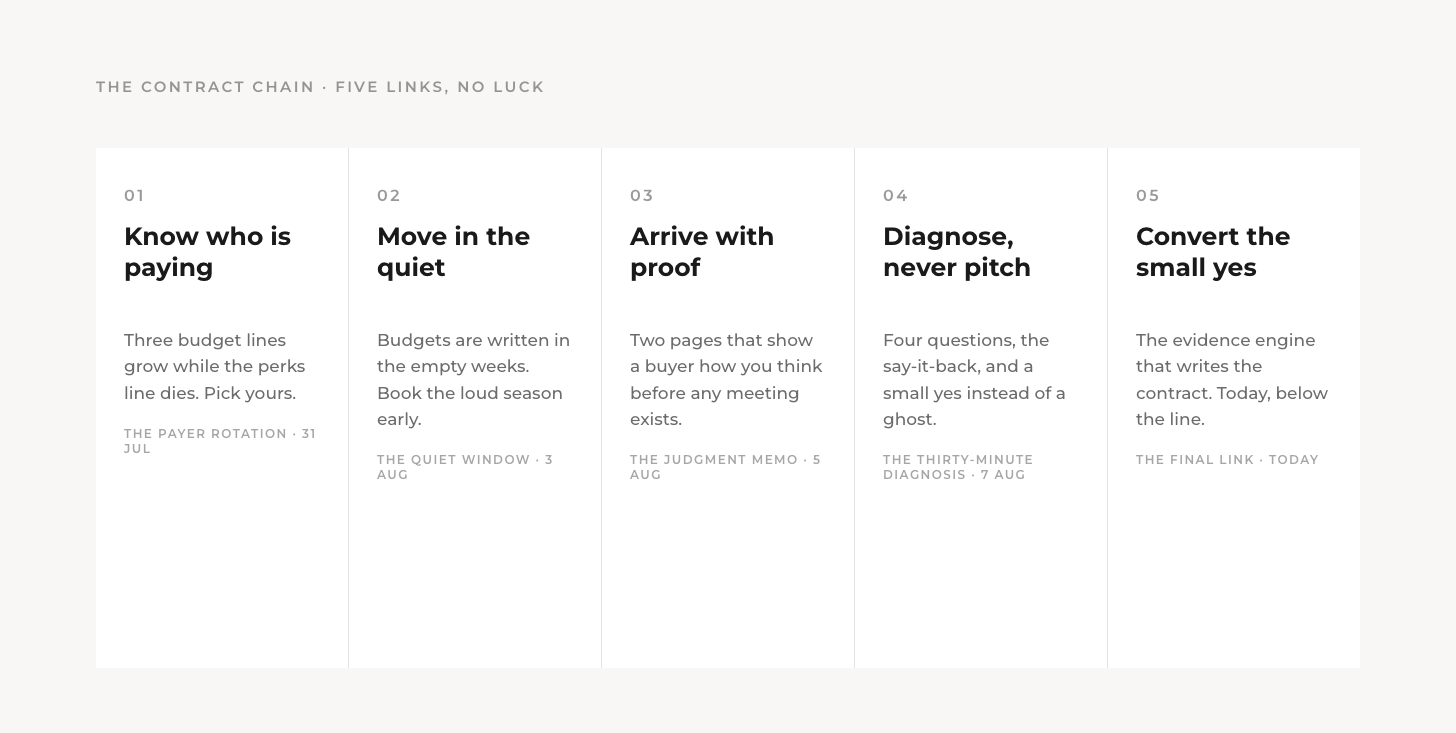
Here is the chain and where each part came from.
Audit yourself against it as you read: which links do you hold and which are missing?
Link one: know who is paying. The payer rotation brief mapped it: the perks line is dying while three budget lines grow: the drug-offset money, the compliance-date money, and the cost-shift-softening money. Your target list comes from picking one. Without this link, you are pitching a line that is being cut.
Link two: move in the quiet. The quiet-window brief: budgets and shortlists are written in the weeks that look empty, and a request sent in the quiet lands is an open diary. This cycle, the quiet ends when September starts. Without this link, you arrive with everyone else and queue.
Link three: arrive with proof. The Judgment Memo: two pages that show a buyer how you think about their problem before any meeting exists. Without it, you are asking a stranger for trust instead of showing evidence.
Link four: run the meeting as a diagnosis. Friday’s script: the opening sentence, the four questions, the say-it-back, and the small yes. Without it, the meeting ends with “send me a proposal,” and you know what that means now.
Link five: convert the small yes. The two-week review, the one-department look, the data pull. This is the link almost nobody holds because nobody really teaches it: the small step isn’t the prize. It’s the evidence engine that writes the contract. It is also today’s paid section.
Score yourself, one point per link you could produce today: a named budget line, a booked September conversation, a written memo, a rehearsed meeting, a designed small step. Most readers score two. The machine needs five, and every missing link is one specific brief away, all of them in the archive.
You know the question: what budget line does this sit on? Every link exists to answer it more precisely. The map names the line, the window catches it being written, the memo speaks to its owner, and the meeting confirms the number, the line, and the signature. And the final link, the small step, does the thing no pitch can do: it puts a result on that budget line before the buyer has made any real commitment, so the contract conversation starts from delivered evidence instead of promised outcomes.
This is also the September logic, this cycle’s version of an evergreen truth. Plan designs freeze in early autumn, the Gulf season restarts in mid-September, and the UK’s October dates are only three weeks from becoming budget-relevant. A chain assembled in August closes in September. A chain started in October waits for the next window.
What to avoid saying, “I am waiting to hear back.”
What to start saying, “The review gets to their desk Friday, and the decision is whether to scale it.”
Below the line, the Final Link, scripted like Friday’s meeting, was:
How to size and price the small step so one person can approve it
The three numbers to capture while you run it
The upgrade conversation, word for word
And this being a special edition, a reminder of how the archive works: one subscription includes the entire chain, today’s final link plus the four briefs behind it, the map, the window plan, the memo, and the full meeting script.
The read is $94 a year. About $8 a month.
Whatever price you join at is locked for as long as you stay.
The content below closes contracts; one of them pays for a decade of this.
Comments
Nothing yet. Say the first thing.
Sign in to join the conversation.