
This article originally appeared on Weijin Research on Sina on July 26, 2026. Original Chinese title: 「K3与华盛顿燥热的夏天」. It has been translated and adapted for an English-speaking audience.
Just as Washington politicians were gearing up for summer recess, a development from Beijing's Moonshot AI disrupted their political rhythm.
The 2.8 trillion parameter Kimi K3 model, set to release its full weights on July 27, sent shockwaves from Silicon Valley and Wall Street to the White House, Congress, and K Street in Washington.
Summers here usually follow a predictable slowdown. In late July, Congress rushes to finish the last batch of bills and budget items before recess. Lawmakers prepare to head back to their districts, and committee hearings taper off. White House officials shift from public events to internal coordination. Think tanks compress large conferences into breakfast briefings and online discussions. K Street lobbying firms scramble to submit final memos before clients and government decision-makers leave town. Journalists start scheduling vacations, saving the more important policy debates for September.
In the summer of 2026 specifically, the House wrapped up its Washington session on July 23 and won't resume normal business until late August. The Senate plans to work from their home states from August 10 to September 11.
I've been in Washington these past couple of days. The White House and Congress, which would normally be quieting down, are now embroiled in a major debate over the future of American technology, triggered by the K3 release and a White House report titled "Science: The New Golden Age."
On July 17, amid Shanghai's scorching heat, the World Artificial Intelligence Conference (WAIC) opened, and K3 was unveiled. Moonshot AI called it the first 3-trillion-level open-source model, with a 1 million token context window, using KDA, Attention Residuals, and highly sparse MoE, designed for long-duration coding, knowledge work, and agent tasks.
K3 hasn't been publicly proven to outperform the strongest American models across all tasks, but its strong showing on some coding and agent benchmarks, lower price, and the promise of soon-to-be-open weights were enough to set off alarm bells in the U.S. But K3 raised an even more disruptive question:
If a Chinese open model is already this close to America's closed frontier models, and companies can download, modify, and deploy it locally, how much longer can the scarcity of capability and high-priced APIs that U.S. frontier labs rely on hold up?
In the days after K3's release, Washington and Silicon Valley abruptly shifted from summer slowdown to high-speed debate.
On July 17 local time, White House technology advisor David Sacks called K3 a wake-up call for U.S. regulatory policy, arguing that if the U.S. imposes model approval thresholds while allowing Chinese open models to spread freely, it could "lose the AI race." On July 20, media reports revealed that the Trump administration had internally discussed adding Chinese AI labs to the entity list, restricting U.S. cloud platforms from hosting Chinese models, and squeezing their market space through government procurement and security warnings. On July 22, Michael Kratsios, director of the White House Office of Science and Technology Policy, publicly accused Moonshot AI of obtaining Anthropic's model capabilities through large-scale, covert distillation. These remain unilateral U.S. allegations for now.
The Little Tech Association, made up of 179 startups and founders, sent a letter to the White House and Commerce Department, warning that banning Chinese open models would raise the "intelligence tax" on American startups and hand the market to OpenAI and Anthropic. On July 24, 25 companies and organizations including Nvidia, Microsoft, Meta, Palantir, and IBM issued a joint letter titled "Open Weights and American AI Leadership," urging the government not to conflate legitimate distillation and open weights with intellectual property theft.
In just about a week, a single model release pulled in the White House, Congress, tech giants, startups, venture capital, think tanks, and the media. K3 caused issues that might have been left for fall discussion to erupt publicly right before Washington's recess.
The joint letter's core argument is straightforward: open weights can lower AI costs, prevent customer lock-in to a single model provider, expand the ability of businesses and governments to deploy models on their own, and allow more researchers to test model safety. If there are indeed cases of illegally obtaining model outputs or trade secrets, they should be addressed through targeted contracts, intellectual property, and sanctions tools, not by restricting the entire open model ecosystem.
But what's most worth analyzing about this letter isn't the words or the reasoning, but the list of signatories and their interests.
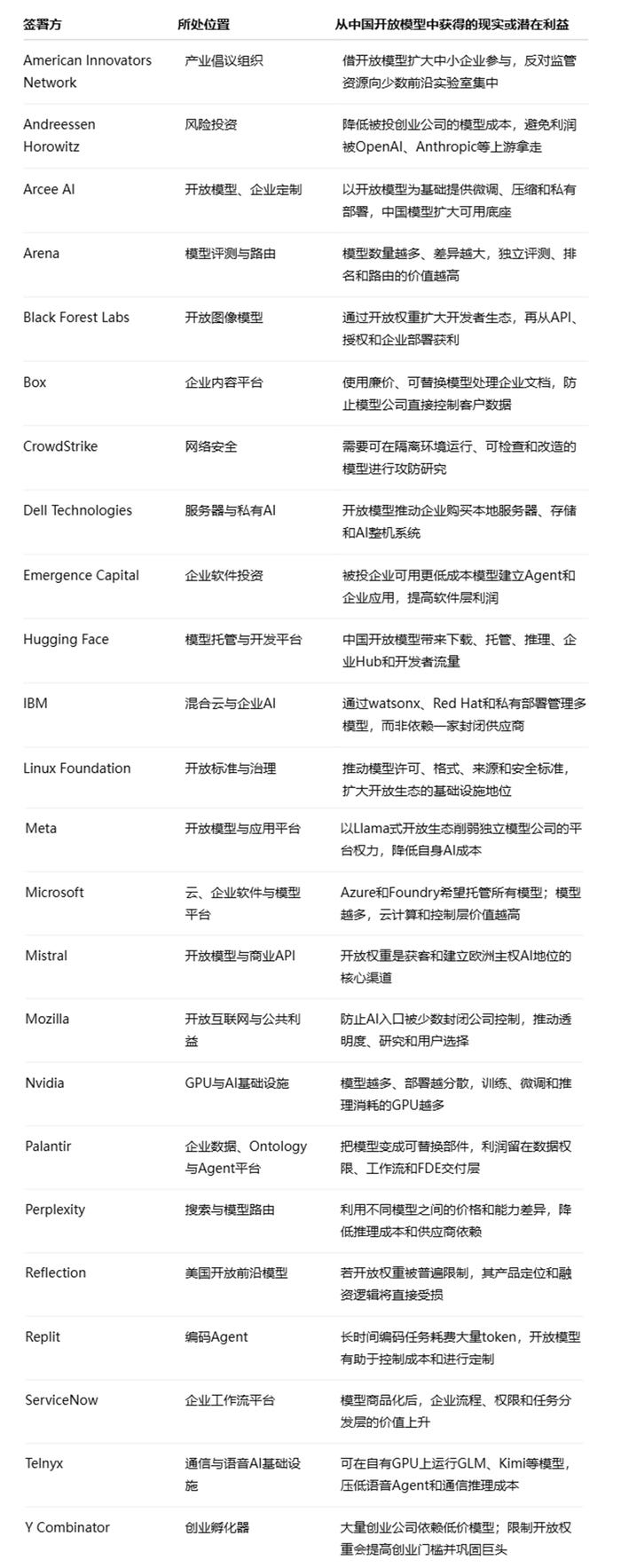
Table listing major organizations and their positions on open AI models, including their stated benefits and risks. The table has three columns: Signatory (签署方), Position (所处位置), and Stance on Open Models from China (从中国开放模型中获得的现实潜在利益).
The 25 signatories are either not primarily dependent on the high API rents of closed frontier models, or they both cooperate and conflict with them. They are spread across the chip, server, cloud platform, enterprise software, open model, model hosting, security, application, and venture capital layers.
This lineup forms a clear alliance of interests: chip companies want more models consuming more compute; cloud providers want all models running on their own platforms; server companies want enterprises to deploy locally; enterprise software companies want models to become replaceable commodity components; application companies want to lower token costs; and venture capitalists and startups are unwilling to hand their profits and fate to a few closed labs.
They do not necessarily favor “Chinese models.” They favor a market where models compete fully, prices keep falling, and customers can migrate freely. K3 happens to be the most powerful price and capability variable at this moment.
Jensen Huang, breaking with precedent, opened an account on X and explicitly opposed broad restrictions on American companies using Chinese open models. This is consistent with the same business and strategic logic behind his chip policy stance: American technology must be widely adopted globally in order to sustain chip sales, the CUDA ecosystem, and dominance in technology standards. Whether it is banning GPU sales to China or banning American firms from adopting Chinese open models, overly broad restrictions could shrink the AI market that Nvidia can participate in and push China to build an alternative ecosystem independent of the American technology stack.
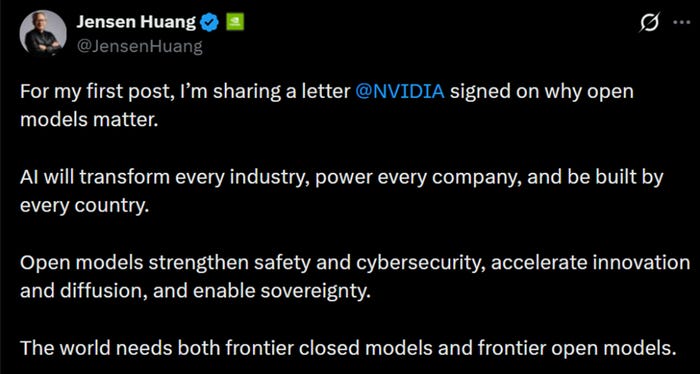
Screenshot of a Twitter/X post by Jensen Huang (@JensenHuang) about open AI models, mentioning a letter signed by NVIDIA on why open models matter.
Microsoft’s stance is equally intriguing. It is one of OpenAI’s most important partners, yet it joined the open-weight joint letter. OpenAI wants to preserve model scarcity. Azure wants to be the infrastructure and control platform where all models run — U.S. closed models, open models from Meta and Mistral, and even Chinese models that have passed security reviews. Their interests do not fully align.
K3 exposes the long-running policy fractures inside the U.S. government all at once.
The first fracture is the conflict between open innovation and national security. The Trump administration’s America’s AI Action Plan explicitly supports open-source and open-weight models, arguing they benefit startups, research, private enterprise deployment, and American geotechnological influence. But the same policy also calls for assessing whether Chinese models contain “censorship, political bias, and security risks” and for protecting American models, talent, and intellectual property from being “stolen.” The result: the United States supports open weights, but it would much prefer an open ecosystem dominated by American models.
The second fracture is the conflict between national-security hawks and the anti-regulation, anti-monopoly camp. The Commerce Department, Treasury Department, and the intelligence and cybersecurity apparatus tend to favor entity-list listings, government procurement restrictions, cloud-host requirements, and security warnings for dealing with Chinese models. They worry that open weights, once released, cannot be revoked or remotely shut down and might be exploited for cyber attacks, biological risks, or military use. Technology and Silicon Valley officials, represented by Sacks, believe the real danger is “regulatory capture”: closed-model labs citing China and security as reasons to raise the industry’s regulatory barrier to entry, ultimately killing their open competitors. A formal study by the NTIA (National Telecommunications and Information Administration) previously concluded that existing evidence is not yet sufficient to support blanket restrictions on open model weights; risks should be monitored, not preemptively banned.
The third fracture is the conflict between regulating illegal conduct and regulating the technical method. Distillation itself is a training technique widely used throughout the AI industry. Even Kratsios, when criticizing Moonshot AI, acknowledged that legitimate distillation is valuable for building smaller, more efficient models. The real dispute is where the legal boundary lies between using normal APIs for learning, evaluation, and model improvement versus using fake accounts, evading access restrictions, and scraping outputs at scale. The joint letter demanded a clear distinction between illegally extracting commercial value and the distillation technique itself. Anthropic, for its part, argues that covert, industrial-scale distillation already amounts to intellectual-property theft and may directly help adversaries close the military and intelligence capability gap.
This debate carries another significance: it is defining a new intellectual-property boundary for the entire AI industry. Is a model’s output merely a service result provided for the customer’s use, or does it contain proprietary capabilities that the supplier has a right to prevent from being systematically learned and replicated?
The first outcome is a blanket ban on Chinese open models. It is possible, but not highly likely. Once model weights are public, they can be copied and moved across borders at near-zero cost, making a total ban technically hard to enforce. It would also hurt the interests of Nvidia, Microsoft, Meta, Hugging Face, and a large number of American startups, colliding with White House policy that supports American open models.
The second, and most likely, outcome is a tiered openness regime differentiated by nationality and use case. The United States would continue to support its own open models while imposing additional requirements on Chinese models — restrictions on government and critical-infrastructure procurement, cloud-platform customer identification, disclosure of model provenance and training lineage, security evaluations, and reviews of remote-control and data-backhaul capabilities. Open weights might still be allowed in ordinary commercial settings, but models entering defense, energy, communications, and government systems would face higher barriers.
The third outcome is targeted sanctions against specific companies suspected of illegal distillation, rather than restricting the entire technical ecosystem. Tools could include the entity list, financial sanctions, account bans, contract lawsuits, cloud-service restrictions, and ultimate-beneficial-owner reviews. This aligns with the approach advocated in the joint letter: “use a scalpel, not a sledgehammer.”
The fourth outcome is that the United States accelerates its own efforts to build open frontier models. K3’s most forceful policy consequence may not be that America shuts out Chinese models, but that it forces the U.S. government to provide computing power, datasets, evaluation frameworks, government procurement, and financing support for domestic open models. Otherwise, America will face an awkward situation: the strongest models remain locked under the closed control of OpenAI and Anthropic, while the world’s most active open ecosystem is increasingly supplied by Chinese companies.
The fifth outcome is the accelerating commoditization of the model layer. Even if the United States curbs K3, it cannot reverse the trend of Qwen, DeepSeek, GLM, MiniMax, and other open models continuing to appear. American closed models may still retain cutting-edge capability, but a large share of everyday enterprise tasks will be taken over by cheaper, locally deployable models. The AI industry’s profits and control will increasingly shift toward chips, cloud, enterprise data, model routing, workflows, and application-layer gateways.
K3 has therefore not only disrupted Washington’s summer; for the first time it has exposed the internal structure of America’s AI industry with such clarity. For frontier labs like Anthropic, K3 is a symbol of threats to intellectual property, safety, and model rents. For Nvidia, it is more demand for GPU inference. For Microsoft and Palantir, it is an opportunity to strengthen the platform control layer. For startups, it is a tool that lowers the “cost of intelligence.” For the national-security system, it is a strategic capability that, once released, is extremely hard to take back.
What truly unsettles America this summer is that China is turning open models into a global competitive strategy — and the United States has not yet decided whether to respond by building a better open ecosystem or by erecting a national-security wall.
Comments
Nothing yet. Say the first thing.
Sign in to join the conversation.