
This article originally appeared on Weijin Research on Huxiu on July 29, 2026. Original Chinese title: 「AlphaFold时代落幕,全球AI科学家竞争开启」. It has been translated and adapted for an English-speaking audience.
The AlphaFold team, whose core members won a Nobel Prize, is exiting the historical stage.
According to the Financial Times, Google DeepMind has dismantled the AlphaFold team. The team, which was organized around the single scientific problem of protein folding, will no longer operate as a standalone unit and will gradually be integrated into the Gemini-powered AI for Science framework.
DeepMind confirmed that some members have moved on to Gemini-related research agent projects, while others have shifted to new scientific directions such as enzyme design, genomics, nuclear fusion, and downstream applications including Alphabet’s drug discovery company Isomorphic Labs. In addition, nearly a quarter of the full-time authors on the original AlphaFold paper have left the company.
This shift is not a repudiation of the dedicated model approach, but an acknowledgment of its expanding boundaries. When the number of scientific questions far exceeds what even top research teams can cover, AI for Science must find an organizational model that can be replicated at scale, and agent-based technologies are beginning to offer that possibility.
Over the past nine years, DeepMind has pursued a “major scientific challenge plus dedicated AI model” approach: for a long-standing scientific problem, assemble a top research team and train a specialized model to solve a specific task. That is how protein structure prediction was tackled, and weather forecasting, and algorithm optimization. AlphaFold was the pinnacle of this paradigm, marking the first time AI achieved a Nobel-worthy breakthrough in fundamental science and proving that AI can be a vital tool for scientific discovery.
In the future, specialized models like AlphaFold will remain irreplaceable. They are more like powerful “AI scientific tools” that can serve as specialized capability modules called upon by scientific AI agents. Moreover, some vertical fields lack sufficient scientific data and will still require dedicated curation.
Now, Google hopes to build an entirely new “AI scientific agent.” AI needs to move beyond solving individual scientific problems to participating in the entire research process. Real scientific discoveries typically involve multiple steps: reading existing knowledge, formulating hypotheses, designing experiments, analyzing results, and adjusting theoretical directions. Advances in large language models and agent technologies are giving AI, for the first time, the opportunity to cover these continuous stages.
Google DeepMind’s restructuring of the AlphaFold team is not an isolated event. Betting on AI for Science is a shared strategic direction for the “big three” of North American AI—Google, OpenAI, and Anthropic.
At its recent I/O conference, Google unveiled the new Gemini for Science suite, consolidating several of its LLM-based science systems under one brand, including the AI Co-Scientist that generates scientific hypotheses and AlphaEvolve for algorithm optimization. OpenAI has also tried connecting GPT to laboratories, with agents and robots carrying out experimental operations and feeding back data; the industry speculates that a general reasoning model also overturned a core Erdős conjecture in discrete geometry that had remained unsolved for 80 years. In June, Anthropic officially launched Claude Science, an AI workbench for scientists that can automatically spawn multiple sub-agents and assign them research tasks.
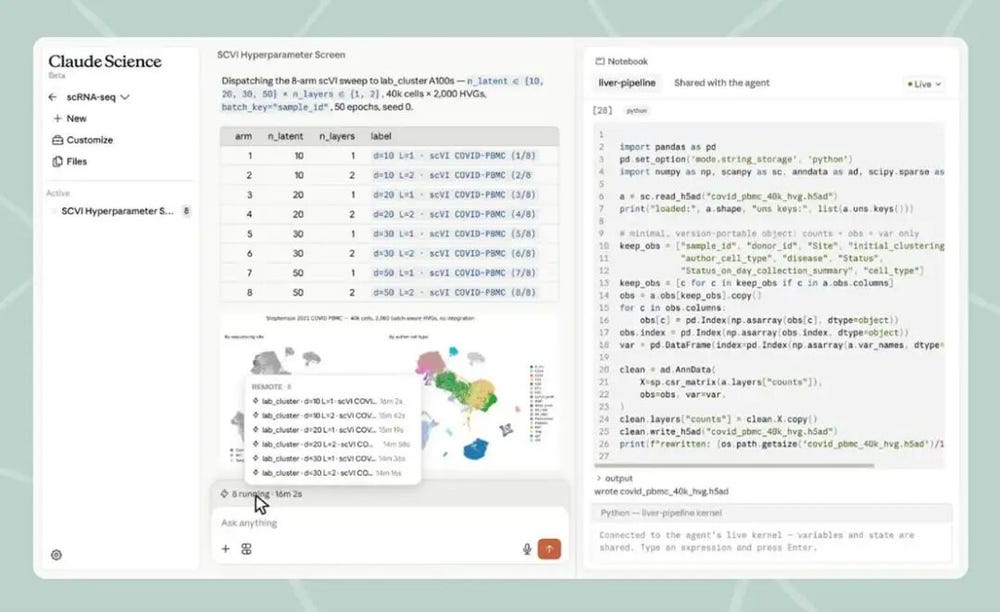
Claude Science interface showing an scRNA-seq analysis workflow with a hyperparameter screen table, a UMAP visualization of cell clusters colored by sample, and a Python code notebook for processing COVID-19 single-cell RNA-seq data.
(Claude Science can build environments and manage compute resources on demand across laptops, clusters, or GPUs)
When AI giants pour resources into AI for Science, they are not straying from commercial competition. They are fighting over the next frontier of artificial intelligence capabilities.
Over the past few years, competition among North American AI leaders has centered on foundation model ability. But as models improve, the contest is extending into more complex territory: real professional workflows and open-ended problems. Scientific research is one of the most representative arenas. Seen this way, AI for Science is not an ordinary vertical application. It may become a critical pathway for the evolution of future general-purpose AI.
Scientific discovery places higher demands on AI. A scientific agent cannot merely generate plausible-sounding answers. Its output must meet a loftier delivery standard: verifiable, reproducible, and capable of producing new knowledge. First, AI cannot succeed in science through "hallucinatory creativity" because any error will eventually be exposed in real-world verification. Second, AI must do more than give a conclusion. It needs to provide an auditable research trail — data sources, experimental conditions, tool-call logs, the reasoning behind key decisions, and the verification process — so that humans can understand and double-check how it arrived at a finding. Finally, AI must not only answer questions that already exist; it should raise questions that humans have not yet solved, or even questions that have not yet been asked, and push the boundaries of knowledge further forward.
Yet science is also one of the most complex testing grounds for AI safety. The stronger a scientific agent's autonomous research capability, the higher the potential risk. In fields like life sciences, materials science, and chemistry, the process by which an AI agent searches for, designs, and optimizes drugs is, in its essentials, also a path toward a "biochemical weapon" that could induce cell death or gene inactivation. In the future, competition among frontier model companies will not only be about model capability. It will also require building a safety-verification system that matches that capability. Aligning the safety of scientific research in the lab in advance points toward a controlled environment of "staged deployment" and an "allowlist" of permitted activities.
The most immediate consequence of this paradigm shift is a sudden escalation in the war for talent. Before, AI companies competed for machine-learning researchers and large-model engineers. Now, scientists who can grasp scientific problems, design research roadmaps, and provide real feedback are becoming a new strategic asset. Last month, John Jumper, the mastermind behind AlphaFold, joined Anthropic — seen as a key piece in the company's effort to build a "nation of geniuses inside a data center." And this year's Fields Medalist, Jacob Tsimerman, announced he would join OpenAI immediately after receiving the award.
At its core, AI companies are not vying for "scientists" but for a "scientific feedback loop." In April, Anthropic launched the Anthropic STEM Fellow program, inviting experts in mathematics, physics, chemistry, and biology to help improve its models by letting scientists directly pinpoint where Claude falls short in complex reasoning.
Chinese AI firms are now entering this race. Earlier, China had already explored the first-generation AI for Science path represented by AlphaFold, with considerable success. Last week, ByteDance's Seed launched the "Seed STEM Scientist Program," opening collaboration opportunities to fundamental-science experts worldwide. The logic closely mirrors Anthropic's effort to attract STEM experts. It is likely that more Chinese AI giants will soon follow suit, shifting from the first paradigm of AI for Science to the next generation.
In addition, the White House recently released a report titled "Science: The New Golden Age," framing AI-empowered science as a matter of national competition. The United States is using the current window — in which it still holds advantages in AI foundation models and top-tier research resources — to push AI deeper into the scientific research system, hoping to convert its technology lead into a long-term capacity for scientific discovery.
Going forward, the AI competition between China and the United States will not only play out in model capabilities, computing infrastructure, and commercial applications. It will also extend to who can be the first to close the research loop: models, agents, experimental platforms, and scientists.
Comments
Nothing yet. Say the first thing.
Sign in to join the conversation.