

BLUF: The United States can strike Pickaxe Mountain with overwhelming force, but no conventional weapon can guarantee its destruction. Any attack would likely delay Iran’s nuclear program rather than eliminate it—raising difficult questions about escalation, dwindling US munitions stockpiles, and whether military action can achieve Washington’s strategic objectives.
President Donald Trump is threatening to strike Pickaxe Mountain, Iran’s deeply buried nuclear-related complex near the damaged Natanz enrichment facility.
“We’re going to take out Pickaxe Mountain,” Trump recently warned, suggesting that the United States might deliver a “nice, big, fat shot” against the facility’s main entrance.
There is little doubt that the United States can attack Pickaxe Mountain.
But can the United States, despite its massive firepower and reach, destroy the suspected nuclear weapons development facility? That answer, sadly, is likely “no.”
Pickaxe Mountain—known in Persian as Kūh-e Kolang Gaz Lā—is located roughly one mile south of Natanz beneath a considerably larger mountain than the one covering Iran’s Fordow enrichment facility. Open-source assessments place portions of the tunnel complex more than 100 meters, or approximately 330 feet, beneath solid rock.
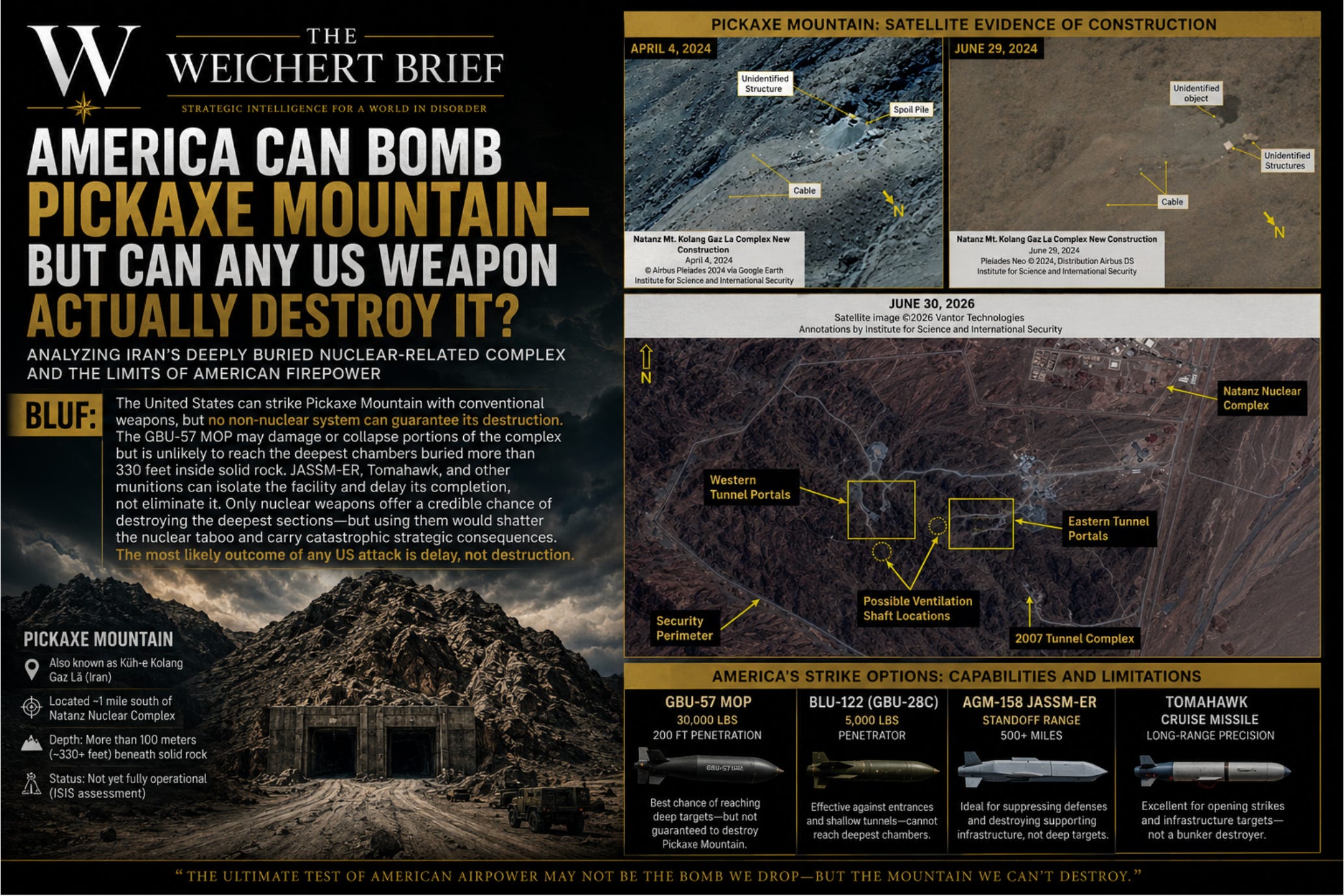
The Institute for Science and International Security (ISIS) assesses that the Iranian military facility at Pickaxe Mountain is not yet fully operational. They make these assessments based upon satellite imagery, which depicts ongoing construction. However, many questions remain as to how reliable this analysis is.
The uncertainty creates a peculiar military problem.
The United States may be preparing to expend some of its rarest and most valuable weapons against a site that might not contain centrifuges, enriched uranium, or an operational nuclear production line.
Yet once Pickaxe Mountain becomes operational, it may be nearly impossible to eliminate from the air.
The logic behind attacking Pickaxe Mountain now is preventive rather than reactive.
Iran began constructing the complex after sabotage destroyed a centrifuge assembly facility at Natanz in 2020. Tehran publicly connected the mountain project to the replacement of that facility.
However, the enormous size and extraordinary protection surrounding Pickaxe have fueled suspicions that Iran could eventually use it for advanced centrifuge manufacturing, uranium enrichment, storage of enriched material, weaponization work, or some combination of those activities.
There is no conclusive public evidence that it is performing any of those missions today.
The limited visible infrastructure and ongoing construction suggest that, even if incomplete, Pickaxe Mountain could soon support some level of nuclear activity, underscoring the importance of careful threat assessment and strategic planning for this audience.
The uncertainty about the complex’s status underscores the need for thorough intelligence and careful planning.
If the United States waits until intelligence confirms that the complex is operational, Iran may already have transferred sensitive equipment or nuclear material hundreds of feet beneath the mountain. Bombing the entrances at that point might trap the equipment inside, but it would not necessarily destroy it.
Undoubtedly, a US conventional airstrike could delay construction on the site and prevent the Iranians from hardening it. But that is all it would do: delay the Iranians.
The military objective would therefore not necessarily be to destroy a functioning nuclear facility.
It would be to prevent Pickaxe Mountain from becoming one.
The risk remains that Iran could possess undiscovered entrances, deeper chambers, or excavation equipment capable of reopening blocked portals, meaning that even a successful strike might not prevent the reconstitution of the facility or its nuclear activities.
Comments
Nothing yet. Say the first thing.
Sign in to join the conversation.