
Hi, everyone. Woke up early last Friday to celebrate two years since Zach and I eloped at sunrise in the Rockies, 15 minutes from where I grew up. Finished the day out with dinner at Elske.
In today’s newsletter I’ll teach you customer journey mapping, including:
What a customer journey map is
How much of the customer journey you actually need to map
The essential ingredients every customer journey map needs
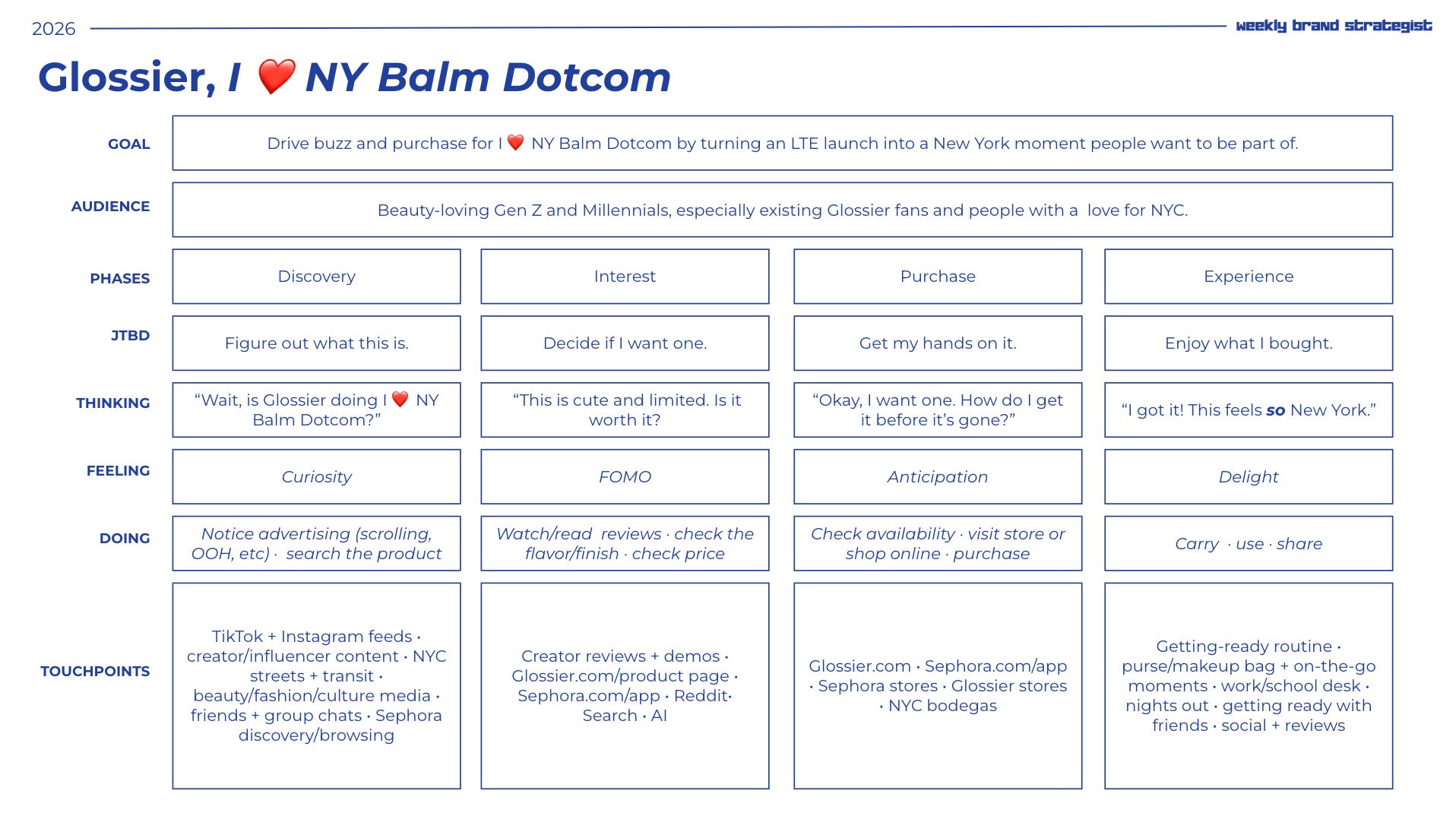
A filled-in example using Glossier’s recent I ❤️ NY Balm Dotcom campaign
A customer journey map is a visual roadmap of every step your audience takes with a brand, product or service, from first awareness through purchase. It’s written from the perspective of your customer, not your brand. They’re useful for identifying pain points and opportunities that can help your brand reach a specific goal.
That goal determines the altitude of your map. If you’re trying to improve the overall brand experience, map the customer’s entire relationship with the brand. If you’re trying to improve the launch or performance of a specific product, zoom in on the journey surrounding that. For a new product, that means understanding how people navigate the category today and identifying where your product could naturally enter the picture. Map only as much of the journey as you need to solve the problem at hand.
These maps tend to look different depending on who is making them. They can be incredibly intricate or fairly straightforward. Personally, I prefer simple. Fewer variables makes for a more powerful document; one that’s easier to understand, share and use. With that in mind, below are the ingredients needed for a customer journey map:
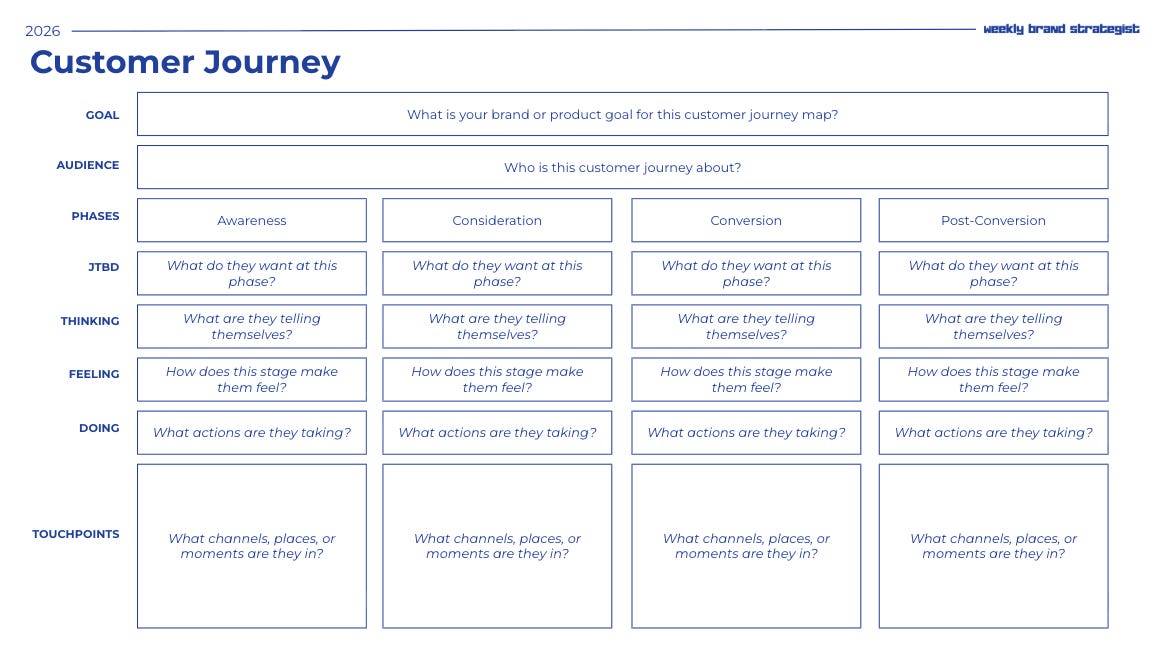
Goal: Your overarching brand or product goal that the customer journey map will support.
Audience: Who are you trying to connect with, at the highest-level. Ground yourself in any existing persona work. And if you don’t have an audience persona, this post can help you.
Phases: The major stages your customer moves through. If you need a starting point, begin with a marketing funnel, then rename the stages to reflect how people actually move through your category. For example, a hotel journey might be dreaming (awareness) → planning (consideration) → booking (conversion) → staying & returning (retention).
Job To Be Done: What your audience is trying to achieve at each stage.
Think: What’s going through their head. What are they wondering, considering, questioning or telling themselves at each stage? Ideally, write these almost like quotes; e.g.“Is this actually worth the money?”
Feel: How your audience feel at every stage of the marketing funnel. Dramatize it. Think of this in terms of peaks and valleys. Use research, speak to people you love, and/or consider how you’ve felt if you’ve ever been in this situation.
Do: The high-level action(s) your customer takes at each stage.
Touchpoints: The moments, channels and places along the journey where your audience encounters your brand, product, category or other influences shaping their experience.
Once you map all that out, comb through it to identify opportunities. Where is there friction you could remove, an unmet need you could address, a high you could amplify or a moment where your brand or product could meaningfully show up?
🌟Paid subscribers can access a reverse-engineered customer journey map for Glossier’s I ❤️ NY Balm Dotcom campaign at the end of this post🌟
By Alex Mason · Thousands of Subscribers
Pick one brand, product or upcoming launch and map the customer journey around the problem you’re trying to solve. Start with your goal, then include only the parts of the journey that help you understand how your audience moves through the experience.
As you build it, pressure-test the map:
Is it written from the audience’s point of view? This is not a map of what your brand does. It’s a map of what your audience is thinking, feeling, doing and encountering in regards to your product or brand.
Are you mapping the right amount of the journey? If your goal is to find opportunities for the entire brand experience, zoom out. If your goal is to find opportunities for a specific product launch, zoom in.
Are your stages meaningfully different? Each stage should be a real shift in your audience is trying to accomplish. Make sure you push them apart.
What opportunities does the journey reveal? Look across the full map for highs and lows. What are the moments your brand can add value? Note them.
If you’d like another set of eyes on yours, bring it to my monthly paid subscriber Office Hours. I’m always happy to help you work through it!
“Seek first to understand, then to be understood.”— Stephen R. Covey
Next week, I’ll go over annual brand planning. See you then!
🌟Paid subscribers can access a reverse-engineered customer journey map for Glossier’s I ❤️ NY Balm Dotcom campaign below🌟
Have a question? Submit it below and you may see it answered in a future issue.
Comments
Nothing yet. Say the first thing.
Sign in to join the conversation.