
Hi, everyone. This weekend, I jumped on the bandwagon and rode it straight to a morning IMAX screening of The Odyssey. Like all of Christopher Nolan’s films (minus Tenet) it was fantastic and made even better by a large popcorn and a box of Milk Duds.
In today’s newsletter I unpack everything you need to know about campaign messaging hierarchies, including:
What a campaign messaging hierarchy is
What inputs go into a campaign messaging hierarchy
A filled in example, using GAP’s recent Hailey Bieber collab
When you should build one (and when to skip it)
A messaging hierarchy is a single-page document that tells your Creative team the exact messages they need to focus on for a specific campaign. It’s not everything your campaign could say. It’s everything your campaign needs to say based on what your audience cares about.
The ingredients for a messaging hierarchy are straight-forward. However, writing them requires careful consideration. Every word carries weight—needing to support your strategy and speak to your target audience.
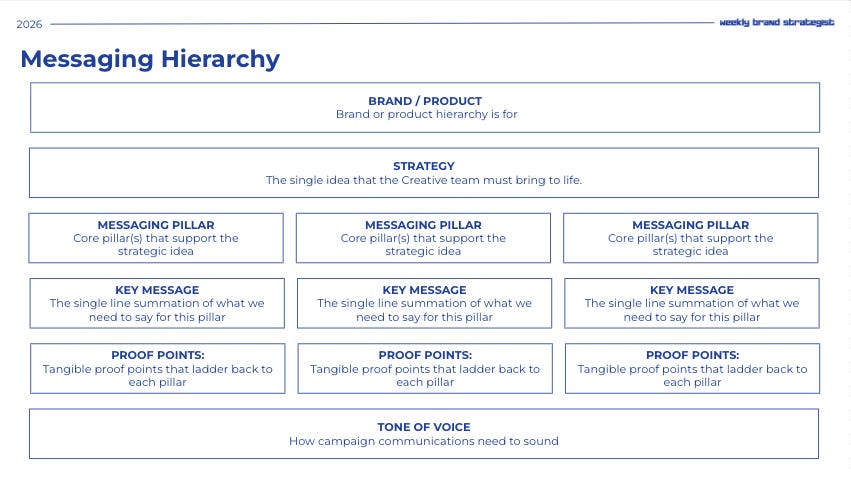
Brand / Product: What brand or product this hierarchy is for.
The Strategy: The single idea that your Creative team must bring to life.
The Messaging Pillars: The core pillars that support that strategic idea. The amount needed depends on your campaign, but fewer is better. If you are seeing overlap in them, push them apart more or fold them into one.
Key Messages: The single line summation of what needs to be said for each pillar.
Reasons to Believe (RTBs): Tangible proof points that ladder back to each pillar
Tone of Voice (TOV): How campaign communications need to sound
🌟Paid subscribers can access a reverse-engineered campaign messaging hierarchy for GAP’s recent viral Hailey Bieber collaboration at the end of this post🌟
One thing to note is that you don’t always need to make one. They are really only useful if a campaign has multiple messages it needs to communicate (e.g. product benefits, products, etc.). If it’s a straight-forward campaign with one message and straight-forward RTBs, then I’d just make that clear when you brief in your creative teams.
For example, when McDonald’s runs a value-menu campaign, the key message is simple: you can get a lot of food for cheap. That doesn’t warrant a full messaging hierarchy. You’d just make the message clear in your creative brief.
By Alex Mason · Thousands of Subscribers
Pull up that Creative Brief you’ve been working on and drop in a messaging hierarchy slide at the end. Use the questions below to help as you construct your hierarchy:
Does everything ladder back to the strategy?
Are the key messages something the audience cares about?
Are the RTBs hyper-specific and something the Creative team could easily write about?
Is it clear? Is it short? If it’s super wordy, where can it be cut?
As you work through your own Messaging Hierarchies, I'd love to help. If you'd like feedback, join my monthly paid subscriber Office Hours. I'm always happy to offer advice on messaging hierarchies (or any other work challenges you're facing).
"Perfection is achieved, not when there is nothing more to add, but when there is nothing left to take away." —Antoine de Saint-Exupéry
Next week, I’ll teach you launch plans. Chat then!
🌟Paid subscribers can access a reverse-engineered campaign messaging hierarchy for GAP’s recent viral Hailey Bieber collaboration below🌟
Have a question? Submit it below and you may see it answered in a future issue.
Comments
Nothing yet. Say the first thing.
Sign in to join the conversation.