
Hey pals,
A proper mixed bag of things to talk about today, from the response to last issue’s comments on media, to a politics lesson around Chamonix’s mayor’s plans for UTMB, to my case why in some cases radio broadcasts would work better than livestreams.
Hope you have a fantastic week,
Matt

If there’s one thing we can confirm after my piece last week on Trail Runner’s return is that trail runners have strong opinions about media. Many comments and emails stating that there is enough media and we don’t need anymore, or sharing their scepticism around the commitment Outside will have to sport, or that journalism isn’t really well read in this sport, and maybe it’s a fools errand to attempt to pursue it.
Brian Metzler, former Editor in Chief of Trailrunner, had a corker of a comment I’ll link to here, but these two paragraphs contained the main thrust of his argument:
“As always, I have no doubt about the skilled and passionate writers/editors/photographers who are creating the content for Outside Inc., but I am not sure how journalism hits nowadays, especially in trail running. There is so much social media and Substack content, some of it very good, some of it very bad (and/or filled with errors, lacing perspective and/or driven by AI) and most of it not journalism but more fan service, sponsored content and co-created with brands, and content created just for clicks. And now that brands are really involved, a lot more content is driven or sponsored by brands, and that’s not great for journalism, either. But honestly, true journalism was rare in trail running (and other sports like triathlon, skiing, mountain biking, etc) at least inside niche/special interest media.
However my biggest observation is how seriously skeptical I am about the management and ownership of Outside Inc., which appears to be under water with equity/investor debt with no obvious path to what will be an inevitable sale. The executive management at Outside doesn’t seem to care about the core of the sports their outlets cover, except for that fact that their audiences are growing, their content is getting traction and they can put more pop-up ads and videos into every single post. Some of the same executive management team decided to rashly sunset the online Trail Runner and Women’s Running (the fastest growing segments in running) as we launched RUN, something that was forced on me and our team the night before we turned the lights on at RUN. Heck, it was dumb/ignorant, but that relates to the toxicity of the upper management and the need/greed to grow/scale while also lowering costs. (Yes, similar to what’s happening with WaPo and other media controlled by huge financial machines and corporate oligarchs.)”
Read the full article here:
François-Xavier Laffin, elected Chamonix mayor this spring, told L’Équipe that a “large majority” of Chamoniards now resent UTMB week rather than love it, citing gridlock, night-finish noise, and a sense of losing their town for several days each August (even access to their own garages’…). He’s not attacking the race itself (calls it “remarkable”) but wants to shrink its footprint: a smaller exhibitor village, fewer passages through nature reserves, capped spectators, fewer night races, and even discouraging runners’ whole entourages from all traveling out for it. Format changes are on the table from 2027.
It’s worth taking a step back and considering the broader political context because it gives a sense the scale of influence Laffin has.
My understanding from a bit of googling (je suis desole to any french readers if i butcher this, let me know in the comments) is that in France, towns are run by a mayor who isn’t elected directly by voters in the way you might expect. People vote for a list of local councillors, and then those councillors vote among themselves to pick the mayor. So Laffin first had to win his council seat in a town-wide vote, then get chosen as mayor by his fellow councillors.
Chamonix itself had been politically very stable for a long time - one mayor, Michel Charlet, ran the town for 25 years (1983-2008), then handed off smoothly to Éric Fournier, who ran it for another 18 years. Both were from the same broad political centre-right family holding power uninterrupted for over four decades.
Laffin broke that streak. He’d been in opposition to that establishment for years, and this March he won the town’s mayoral election outright with about 54% of the vote, beating two other candidates (one of whom dropped out before the final round and backed him instead).
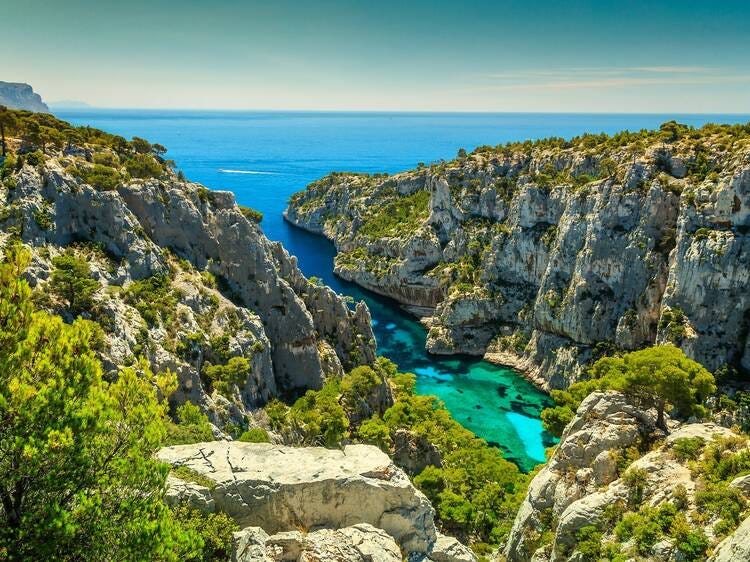
The hot topics in Chamonix’s election was housing and overtourism. With only around 8,700 permanent residents against millions of annual visitors, all four candidates spent the campaign addressing a town where seasonal workers and locals increasingly can’t find housing or parking. Laffin, in a June interview, pointed to the Calanques, a national park near Marseille which uses a reservation system to cap visitor numbers, as his model for popular hiking sites like Lac Blanc, framing the whole approach around “capacity” and “quality of life” rather than simply limiting tourism outright.
There’s also a second, less well-known layer: Chamonix sits alongside three neighbouring towns (Servoz, Les Houches, Vallorcine), and together they share a joint local authority that makes some shared decisions, a bit like a mini regional council. Laffin also won the leadership of that body, but only just - by one vote, 12 to 11. So while he clearly won Chamonix itself, his authority over decisions affecting the wider valley is more uncertain.
When we put Laffin’s UTMB comments back in this light, they carry real weight, but his position is shakier than the his strong rhetoric suggests. He won Chamonix decisively, ending a 40+ year run by one political family, so he clearly has a mandate to change course on the town’s own turf. But UTMB doesn’t just run through Chamonix; large chunks of the route cross Servoz, Les Houches, and Vallorcine, and decisions affecting the whole valley go through the joint intercommunal body, where Laffin won the presidency by a single vote, 12-11.
This matters for how seriously UTMB Group needs to take him. A landslide mayor with valley-wide backing could genuinely force structural change (e.g. permitting leverage, reserve access, the works). A mayor who just scraped control of the body governing the neighbouring towns is in a weaker spot to push through anything contested, especially if UTMB Group works the room and finds allies among the other three communes, several of which likely benefit economically from the race in ways Chamonix’s residents feel less directly.
So I’d read this less as “the valley has decided” and more as “the valley’s new leader wants to renegotiate the terms, but hasn’t yet proven he can bring the other three towns with him.” UTMB Group’s likely play is probably to engage on the softer asks (exhibitor village size, spectator numbers) while quietly testing whether that 12-11 split holds when something actually costs them, like permitting, route access or race-day scheduling on land Laffin doesn’t fully control.
Mathias at Electric Cable Car did a great bit of snooping for this piece around livestreaming in trail running and what feels like an unsustainable venture for most races/brands in the sport.
I’ve talked about this a few times, but let’s put forward an alternative in a serious/not serious way. What if we’ve been chasing the wrong media format to broadcast trail races?
Livestreams demand constant visual action, and ultra racing simply doesn’t offer it. Hours can pass between meaningful moments, and all we get in the gaps is drone footage of empty singletrack or a static feed nobody’s watching. We’re forcing a football-shaped format onto a sport that moves at an entirely different rhythm, and we’re pretending the emptiness is a technical problem when it’s actually a format problem.
Radio solved this a century ago. Cricket figured out how to make eight hours of very little happening into something people leave on in the background all day, because commentary - that real, textured, narrated commentary - doesn’t need a picture to hold you. It needs voices who understand the story; who’s fading on the climb, who’s about to make a move, what that next descent is going to do to legs that have already run sixty miles. Trail running has that story in abundance, we’ve just not built the format to bring it to life.
Production cost is the other argument. Camera crews and stable connectivity are nearly impossible across most of a mountain course, but a spotter phoning in from an aid station is cheap and reliable. For races without broadcast budgets (which is most of them) that’s the difference between some coverage and none.
It’s not even a hard sell! it’s cheap, it’s reliable where cameras and connectivity aren’t, and it matches exactly how people already follow these races: checking in, not watching eyes glued to the screen. The sport doesn’t need more drone shots. It needs commentators willing to talk about the mountain the way cricket commentators talk about the pitch.
What are your thoughts? I’m so here for a return to radio!

Comments
Nothing yet. Say the first thing.
Sign in to join the conversation.