
Hey pals,
I write to you from a bucolic garden in Oxfordshire where I’m taking a much needed respite from the rampage of work.
I wanted to get a full-debrief from Shane Ohly, Founder of Ourea about the backstory to their collapse, but with administrators roaming Shane can’t say anything on the record. However, there are a few lessons and learnings we can take from their demise - reflections on the unsteady finances that our sport sits on and the forces that shape them.
We also have Nike’s running return, much needed outdoor industry criticism, takeaways from Mile&Stone’s trail running conference and a new trail running publication!
Hope you’re having better weeks than i am,
Matt
🔎 Want me to look into a story? Work at a brand that’s got some new news and launches? or just want to say hey? Reply to this email or message me at Matt@wearetrailmix.com

1. This was not representative of the UK market. It was a model failure.
Ourea’s collapse says less about the health of UK trail running and more about the limits of a specific way of operating within it. Participation of trail running remains strong, calendars are more crowded than ever, and interest in the sport hasn’t disappeared. What struggled was a model built around high-cost, high- time commitment, low-frequency participation. Shane always built events that put the runner’s safety and experience first to make epic distances seem achievable, but that is difficult to maintain when you’re swimming in debt. Multi-day stage races demand early commitment, both financially and logistically, and rely on a steady flow of runners willing to lock in plans months in advance. As sign-up behaviour shifted later, closer to the race date, and competition for runners increased, that model became increasingly exposed. Ourea attempted to build in shorter distances into the long multi-day events to introduce runners to the routes, but this initiative came too late. We can point to the increasing market pressures, brexit etc. as a rationale for Ourea’s downfall, but we first need to recognise the fault in Ourea’s model.
2. Multi-day racing is structurally dependent on international demand
Shane’s statement highlighted a structural reality about multi-day racing that is easy to overlook (and something I have missed). These events are not just premium products for a self-identifying group of masochists, but are built on the assumption of a global audience. In a market like the UK, the pool of domestic runners able and willing to commit significant time and money to a single race of this extent is limited. The format therefore depends on attracting international participants to fill the field and make the economics work. For Ourea, their races (Dragons Back, Northern Traverse, Capes Wrath) maintained a 20-40% participation rate of international runners, according to their finisher data, whilst typical single day UK ultramarathon races of the same scale typically only have 10% finishers that are outside the UK. That reliance introduces a layer of vulnerability. As international participation becomes more selective and more concentrated into fewer events (read: UTMB), the available audience narrows. When that happens, it is the most demanding formats that feel the pressure first.
3. International growth is real but most races won’t feel it
The broader trend in trail running points toward increasing international participation, but that growth is not evenly distributed. Runners are still travelling, and in some cases travelling more, but their choices are being shaped by systems that offer structure, recognition, and progression. Events tied into UTMB’s global stone system benefit from this concentration of demand, while independent races must continue to attract runners on the strength of their individual proposition. In the UK, since Ultra Trail Snowdonia’s entry into the UTMB’s system, the number of finishers with a non-GBR nationality increased by 18% in three years. Across independent UK races its hard to find any races that increased it’s international base outside of UTMB events since they began. The result is a landscape where internationalisation benefits UTMB races, but not others. Some races become global hubs, while others operate in a more constrained and competitive environment despite being part of the same overall market. You could make the argument that travel introduces new runners to a different market, who are more likely to try other races in that country as a result, but currently that hasn’t been reflected in independent UK race’s finisher data.
4. The middle has been neglected and no one built the system to support it
Trail running has spent years elevating its most iconic races, building narratives around extremes and positioning them as defining experiences that we should all aspire to. What has received far less attention is the development of a coherent middle layer that connects everyday participation to those headline events. UTMB has done this through the stone system, but independent governing bodies like ITRA have not established clear pathways, incentives, or structures that encourage runners to move through different levels of the sport in a sustained way. ITRA point’s original purpose was to start to facilitate this progression, but when the Poletti’s split from ITRA and UTMB formed their own system, ITRA failed to adapt and build on theIr rankings to build something that could compete. Without that scaffolding, mid-tier races are left to operate without the support systems that might stabilise demand or create repeat engagement and runners choose races based on appeal in the moment, rather than as part of a longer-term pathway. The result is a landscape where the top is highly visible through livestreaming, pro athlete participation and word of mouth, the base remains sustainable with its basic provisions, and the space in-between carries more of the strain than it can reliably support.

Running continues to be Nike’s guiding light as the category saw double figure growth in their latest quarter, when most other categories remained ‘soft’. I was curious to see if their ‘demand creation expense’ (marketing) had increased markedly for their ACG launch, but there was only a 2% increase over the past nine months. However, when they’re spending £1bn a quarter, wrapping an entire Italian train car is actually well within their budget. Don’t know why they don’t do it every year.
We finally have some critical analysis in the outdoor industry! Wes Allen, a leader of an outdoor retailer in Wyoming, makes a distinction between Outdoor and Outside brands in a piece this week that argues that the outdoor industry is misreading inflated participation and market data, causing heritage brands to chase low-value “outside” consumers they’re not built to serve, leaving them stuck in an unprofitable middle while both specialist outdoor brands and lifestyle-focused competitors pull ahead.
This is a sharp, challenging piece, exactly the kind the outdoor industry probably needs more of. The distinction between the “outside” and “outdoor” economies is particularly effective at naming something many brands and retailers are dancing around but rarely articulate. The critique of inflated market sizing and the overreliance on participation data is also pretty well made. It’s common practice across any industry where big top-line numbers, whether from the Outdoor Industry Association or elsewhere, get mistaken for real, addressable demand (another example is race impact reports that state “£xM was generated for local economy”).
But the argument ultimately overcorrects. The “outside” and “outdoor” economies aren’t parallel systems anymore, let alone separate, they’re interconnected, and realistically always have been. Treating them as separate forces a false choice on brands that have historically thrived by managing the tension between them; you can be both an “outdoor” and an “outside” brand, you don’t have to “pick a lane”. The success of companies like Patagonia or even the cultural expansion of Arc’teryx suggests that the real challenge isn’t picking a lane, but building a model that can translate credibility across different buying contexts without diluting it. The risk is that brands fail to understand how one context feeds the other, not whether they should serve both audiences.
Regardless, it’s a good read if you’ve got 15 mins.
Mile and Stone, the french trail running B2B newsletter, put on its annual trail running conference this week and Alessio Punzi, head of running at World Athletic, had some useful takeouts from it:
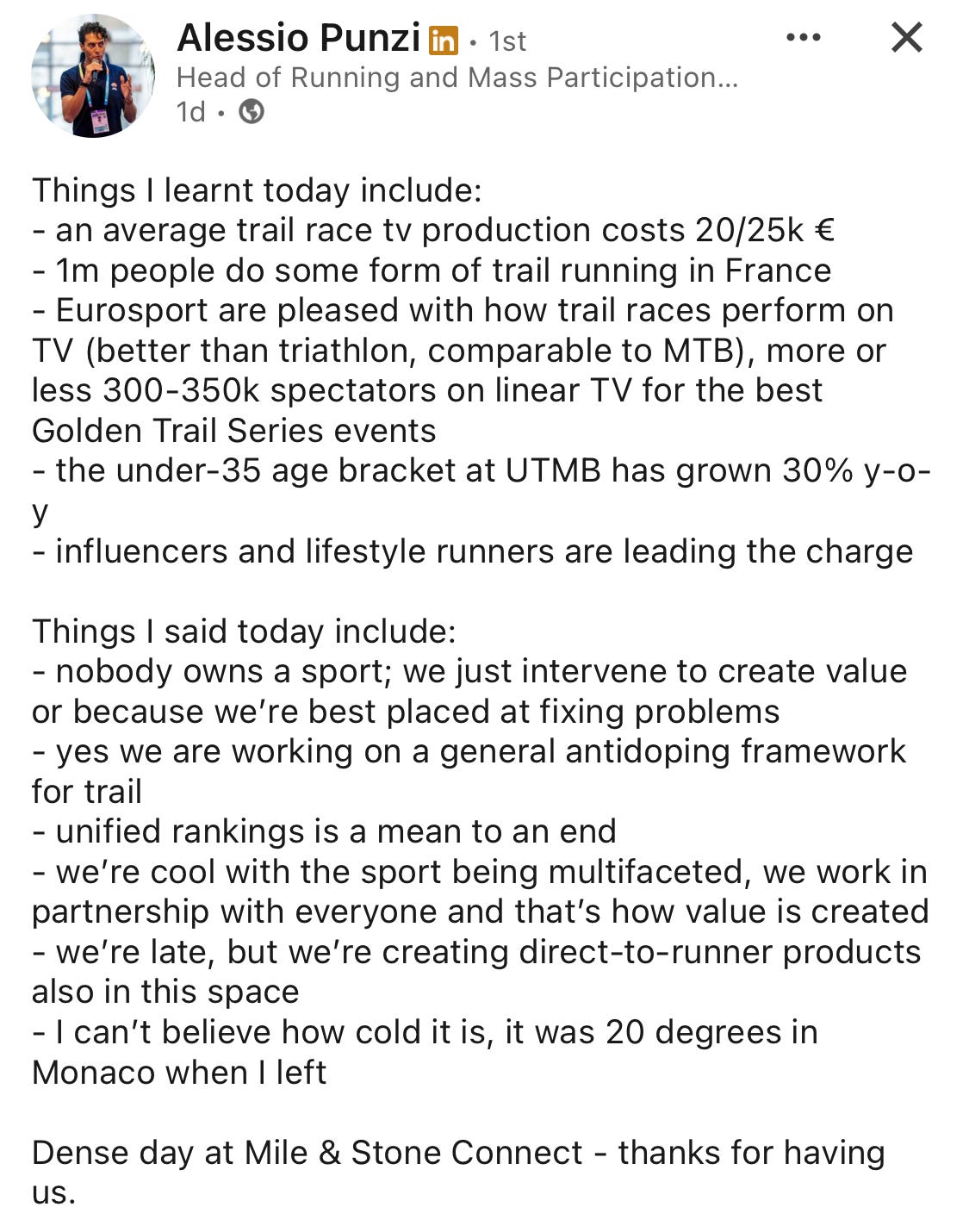
Asia is the fastest growing continent for trail runners at 35% YoY growth rate, according to ITRA data reported in an interview with Janet Ng in Trail Running World, a German website i recently discovered (make sure you translate the page, there’s quite a few well researched articles in there including this one on the rules that hinder the likelihood of trail running entering the Winter Olympics).
Comments
Nothing yet. Say the first thing.
Sign in to join the conversation.