
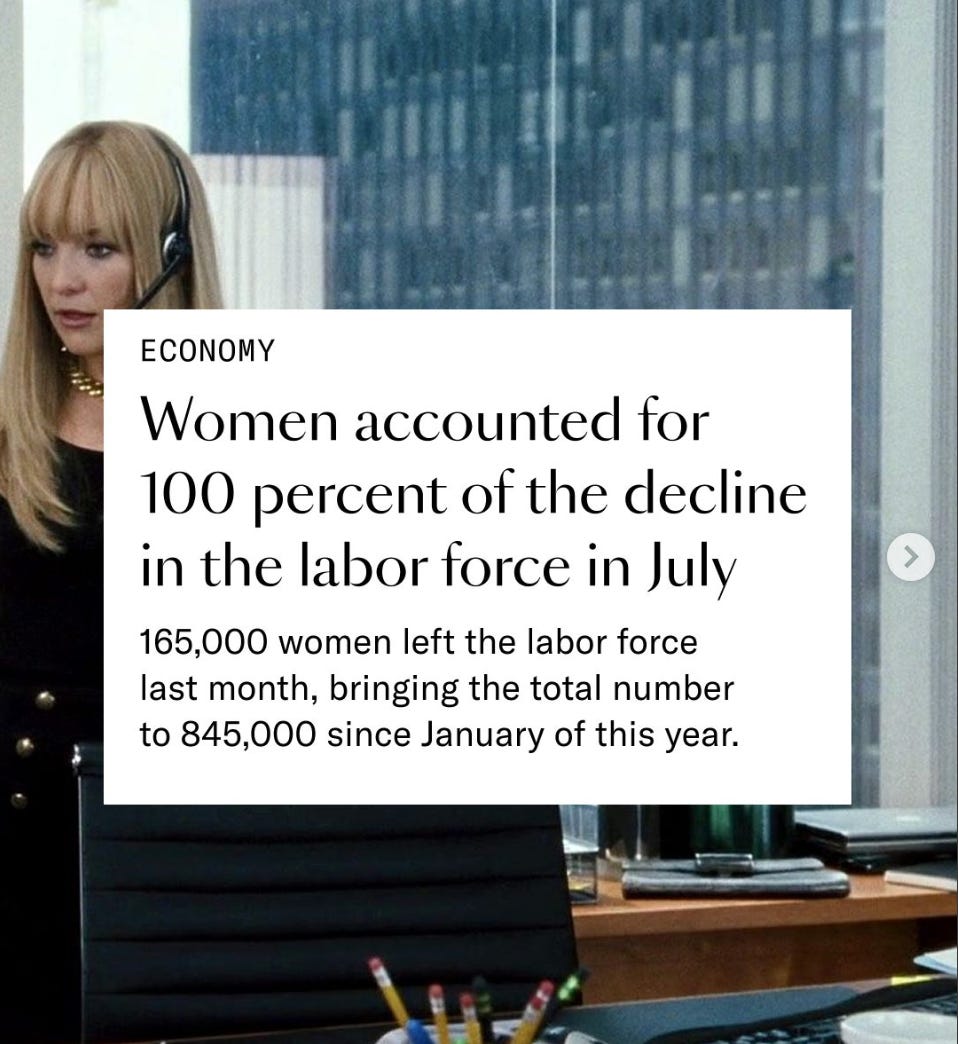
This week, a stark statistic has made the headlines: women accounted for 100 percent of the decline in the U.S. labor force in July. The National Women’s Law Center ran the numbers from the Bureau of Labor Statistics and found that 165,000 women left the labor force last month, meaning they are neither working nor looking for work. Since January, 845,000 women have left. The economy lost 23,000 jobs overall in July. Women lost 32,000 while men gained 9,000.
Jasmine Tucker, who leads research at NWLC, said “Too many women are being pushed to the sidelines.“ She’s right, and I don’t want to gloss over that. Childcare costs that outrun salaries. Job cuts are landing hardest in female-dominated sectors. A policy environment that treats women’s participation as optional. Plenty of those 845,000 women wanted to stay and couldn’t.
But “left the labor force” is a government category, and I’ve been thinking about how poorly it describes the women I actually know, including myself. The labor force count measures who works for someone else or is looking to. It has no column for the woman who left a hospitality job in March and now runs a catering business out of her kitchen. It can’t see the fractional CMO, the consultant billing her first clients, the founder in her pre-revenue year. On paper, she left. In reality, she went to work for herself.
Here’s the data that should be traveling as fast as the jobs report. Women started 49 percent of all new businesses in the United States in 2024, according to Gusto’s New Business Formation Report. In 2019 it was 29 percent. That’s the highest share Gusto has ever recorded.
Wells Fargo’s 2025 Impact of Women-Owned Businesses report shows the scale: roughly 14.5 million women-owned businesses in this country, 39.2 percent of all U.S. firms, generating $3.3 trillion in revenue and employing nearly 13 million people. Between 2019 and 2024, women-owned firms grew significantly faster than men-owned firms.
Hold those two datasets next to each other. Women are exiting traditional employment in record numbers during the same era they’re founding nearly half of all new American businesses. That’s cause and effect. When Wells Fargo asked women why they start businesses, 75 percent said they want to be their own boss and 62 percent said they want control over how and when they work. Autonomy, flexibility, ownership. The traditional workforce wouldn’t offer those terms, so women wrote their own.
Neha Ruch has spent nearly a decade giving language to this territory, first through Mother Untitled and now through The Power Pause, her bestselling book on career breaks. Her argument is one I come back to often: stepping back from paid work is not stepping away from ambition. “There is no such thing as ‘just a mom,’” she writes.
Her research shows how many women are already living this. A Mother Untitled study found one in three women working outside the home planned to pause within two years, and Harvard Business Review research shows 90 percent of women who pause intend to return to paid work eventually. Neha describes modern women as living in a “vast in-between” of entrepreneurship, freelance, consulting, and part-time work, where the old binary of working mom versus stay-at-home mom fails to describe anyone’s actual life. Increasingly, what women return to after a pause isn’t a corporate ladder at all. It’s something they own.
We keep measuring women’s economic power by their proximity to someone else’s org chart. Meanwhile the real story is happening off the chart entirely.
There is a harsh reality about a woman pushed out of a job she loved and into freelancing she didn’t choose: it isn’t a triumph of entrepreneurship. She’s doing what she has to do, and she’s tired.
And the gap is real: Women own nearly 40 percent of American businesses but capture only 6.2 percent of business revenue and 9.6 percent of employment. Ventureneer estimates that if women-owned businesses reached revenue parity with men-owned businesses, it would add $10.2 trillion to the U.S. economy. Ten trillion dollars, left on the table, because women build companies inside the same systems that undercapitalize them: harder access to funding, thinner networks, a venture ecosystem that still sends the overwhelming majority of capital elsewhere.
So the answer to a labor market pushing women out isn’t “just start a business.” The answer is to fund the businesses women are already starting at record rates. Buy from them. Hire through them. Sit next to the women building them and ask what they need. The individual response is well underway, yet we’re still waiting on the systematic response to show up…
At The Breadwinners, we’ve always said breadwinning is bigger than a paycheck. It includes the systems we change and the ground we clear for the women building behind us. This moment is that thesis playing out in real time.
The modern workforce women are building runs on different rules.
It counts caregiving as work.
It treats a pause as a chapter instead of a liability.
It lets ambition move in seasons.
And it doesn’t wait for permission.
The July jobs report measured the economy women are leaving. Nobody has built the report that measures the one they’re creating. We intend to help write it.
As always, thanks for being here,
Alexis
We go deep on all of it, the emotional complexity of building a life worth living, in The Breadwinners community.
Learn more: www.thebreadwinners.co
Follow: @wearethebreadwinners
Sources: National Women’s Law Center analysis of Bureau of Labor Statistics data (July 2026); Gusto New Business Formation Report; Wells Fargo, The 2025 Impact of Women-Owned Businesses; Ventureneer; Mother Untitled Career Pause Study (2023); Neha Ruch, The Power Pause (Putnam, 2025).
Comments
Nothing yet. Say the first thing.
Sign in to join the conversation.