
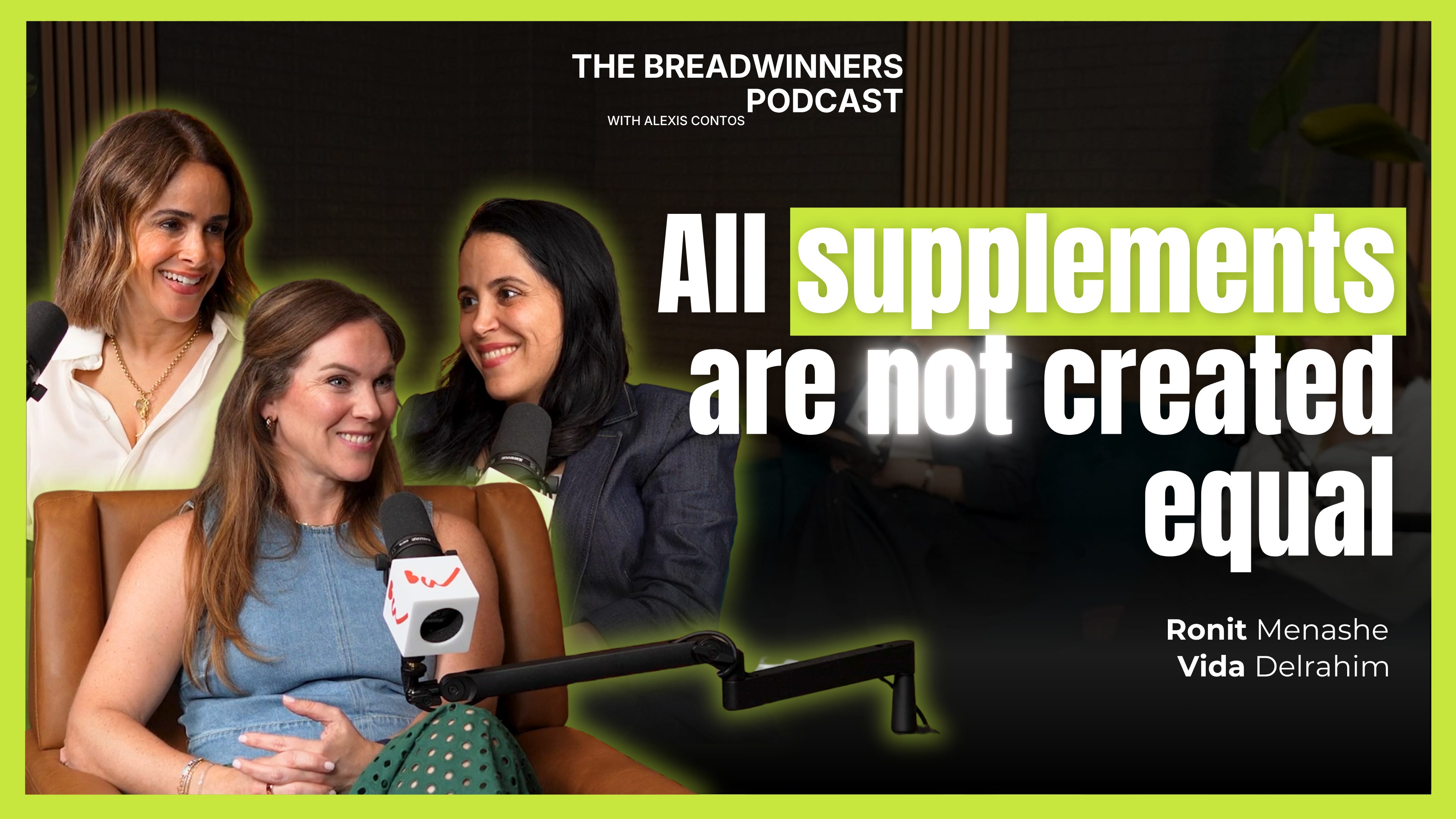
I joined ‘the club’ at 37. Ronit joined at 41, Vida in her late thirties, and when the three of us sat down together in Austin, we did not have to explain it to each other. It is the club where a doctor writes "geriatric" on your chart and tells you that you have waited too long to have kids.
Nobody signs up for that club. You get enrolled the day you walk into an OB’s office in your late thirties or early forties and watch the tone shift. For Ronit and Vida, membership came with a second, harder tier: miscarriage. Two of them, a week apart, and no explanation from anyone in a white coat beyond “just happens.” I now wear the geriatric label as a badge of honor. But at the time it was a lonely place to be, and I know a lot of you are there right now.
The club is bigger than anyone tells you. Somewhere between 10 and 20 percent of known pregnancies end in miscarriage, and the true number is higher because so many losses happen before a positive test. Age moves that number fast. Under 35, the risk sits around 15 percent. Between 35 and 39, it climbs to roughly 20 to 25 percent. In your early forties, it is 35 to 40 percent, and one Norwegian population study found the odds are five times higher at 40 and up than they are for a woman between 25 and 29. Read those numbers backward, and they still leave room for hope: two out of three pregnancies between 40 and 44 do not end in loss. But here is the stat that explains the silence in the exam room. In up to half of all miscarriages, no cause is ever found. So the doctor says, “just happens,” because in the current system, that is the honest answer. It is also not a plan.
I got married at 37. We tried for a year and a half, and we chose the IVF path. I went in like a deer in headlights, and I did not even know what to research. That was the starting point for this conversation, and it is the starting point for WeNatal, the prenatal supplement company Ronit and Vida built for both partners. Here is what I took away from my conversation with them.
In spring 2020, both of them lost pregnancies within a week of each other. Vida went in for a routine ultrasound and watched her OB’s face drop. Ronit, at 41, went in for her 11-week scan and there was no heartbeat. When she asked her doctor what she could do differently next time, the answer was, in her words, “just happens. It’s random. It’s common after the age of 40. It happens a lot.”
Ronit’s response was to become, as she put it, “a PubMed nerd.” She called every functional medicine doctor and fertility doctor she knew. And she found the number that changed everything for them: “male factor influences 50% of pregnancy health, miscarriage, infertility.“
Think about that: Two women were scrutinizing their coffee intake, work travel, and workouts, and half the equation was sitting next to them on the couch. The research backs her up: Fathers over 40 carry about 1.6 times the odds of a miscarriage compared to fathers in their late twenties, and men whose partners have miscarried show more than double the sperm DNA damage of fertile men. In one recurrent-miscarriage clinic, 61 percent of the male partners who had passed a standard semen analysis as “normal” turned out to have elevated DNA fragmentation. Normal on paper but not normal where it counted.
So Vida & Ronit ran an experiment. For 3 months, their husbands went on high-dose antioxidants (CoQ10, vitamin C, zinc), cut alcohol and anything else that stresses sperm, and the women leveled up their own nutrition. Ronit got pregnant on the first try and gave birth to Emma four days after her 42nd birthday. Vida got pregnant two months later. That three-month window is what they now call trimester zero, and it is the whole premise of the company.
My takeaway: I wish someone had handed me this at 37. Forget the product for a second. I would have given anything to know there was something I could do other than wait and blame myself. Ronit said it well: “you spend your whole life trying to figure out how not to get pregnant, but then when it’s time to get pregnant, you’re like, wait, how do I do this?”
We talk about this constantly in the Breadwinners community. Women are extraordinary, and it still takes a unit. What I love about WeNatal is that it gives men a way into a conversation they have historically been left out of, and it turns out they want in. Ronit and Vida told me that men now buy the product for themselves and show up alone to the free nutrition consults. “These men are going to be the best dad,” they said, “because they are showing up for the future of their family before their family is even there.”
I will have that conversation all day. When you give men the tools, they use them.
Vida spent the first three years of WeNatal still working her corporate job at Nike. Nights, weekends, two little kids, a husband. She described it as “a very delusional time frame.” Her health took a hit. Ronit went full-time and took no salary for two years, borrowing money at one point to pay off her Amex. It was a harsh reality most founders know all too well, Ronit says: “we ate like shit, and we own a supplement company, and we know better.”
Then, in January 2025, Ronit lost her house in the Palisades fire.
Their whole approach to managing their lifestyle changed after that. Meal prep with Ronit’s sister, who is a chef, so nutrition is no longer a decision. Workouts on the calendar, non-negotiable, and they hold each other to it. Sleep protected. Saying no to events they are grateful to be invited to. Ronit said it well: “balance is like a hoax.” And, “any chapter of your life, something’s gonna give.”
Vida added the part I am living right now: “your body will eventually stop you.” She had to take a few months and treat getting her health back like a full-time job. Her message to every exhausted woman listening: “Don’t wait for the rock bottom, because that was our story and it doesn’t need to be yours.”
I am building The Breadwinners by myself with three little kids at home, and I am slowly hitting that point. When I hosted our New York dinner in May, I asked every woman on the RSVP what she most wanted from the table. Roughly 70 percent said some version of the same thing: I am exhausted, and I need to figure out how to integrate my life. That is a pattern, and it is everywhere. And the women in our community are proud of running through walls, because we have done it over and over and it has worked. The hard part is the look in the mirror that says something has to change, before the fire does it for you.
The best advice Vida ever got, and the one she admits she still struggles with, is this: “doing nothing is doing something.”
WeNatal grew organically every single month from launch, and she was never satisfied. “I was never happy. I was always like, we need more.” A thousand subscribers meant two thousand. Now, four years in, she looks back and says, “the timeline was actually perfect.” They built a foundation. They did not blow up.
And then the reminder they give each other: “we don’t have a boss.” The goals are goals they invented.
That is harder for me to sit with than it sounds. Our own standards are the loudest voice in the room, and nobody else can hear them. I am building my plan for the back half of the year right now, and this conversation has me asking whether I need to host as many events as I have told myself I do. Maybe the right answer for this season is fewer, and better, and more time at home. Doing nothing is doing something, right?
Ronit built WeNatal from home, around her daughters. “If you ask my daughter Eden about sperm quality,” she told me, “she’ll tell you everything you need to know.” For their fourth company birthday, they told the WeNatal story through a choreographed dance: first the two founders, then their husbands, then their kids. A few weeks later Ronit caught five-year-old Emma on a pretend Zoom call with a Barbie laptop, telling her employees she needed to plan her company birthday party and that her family was going to do a dance.
Vida used to shove her kids under the desk during Nike Zoom calls. Now they pop on to say hi to “bestie” and know the medical advisory board by name.
I think involving them is the most important part. Even if they just sit on your lap during a call. As Ronit says: “you can involve your kids, they don’t have to be two separate things.”
For Breadwinner Artifacts, they brought screenshots of the original business plan. It was a Google Doc titled “Bestie Co,” opened over coffee at a Whole Foods before the company had a name. Three principles from that first doc still run the business: equal biology, equal prep; education over fear; community over isolation.
They also write emails to their future selves, and they open team offsites by asking everyone to describe the year ahead with no budgets and no limits. I do a version of this at every Breadwinners dinner, where each guest writes a letter to herself in twenty or thirty years and puts it away. It works because it forces you to step out of the day-to-day and see the season you are actually in.
Their last piece of advice was about trusting your gut. Vida: “I can’t tell you how many times we silenced it when we knew, and it’ll come back and it’ll be expensive.” She also noted that her husband is confident even when he has no idea what he is talking about, and that there is something to learn from that.
When I asked Ronit how her definition of success had changed since WeNatal, she said, “being able to go on a field trip with my kids, pick up, take them to ballet class, make my own schedule.”
That is what we are all building toward. A company, a career, a household that can bend around the people in it. Ronit and Vida did it while bootstrapping against competitors with fifty million dollars in venture money and ads running around the clock. Slower, on their own terms, and it worked.
Listen to the full conversation wherever you get your podcasts.
As always, thanks for being here,
Alexis
Start your WeNatal routine today by going to wenatal.com/BREADWINNERS and receive a free Rest+Digest Magnesium supplement ($30 value) with your first prenatal subscription.
We go deep on all of it, the emotional complexity of building a life worth living, in The Breadwinners community.
Learn more: www.thebreadwinners.co
Follow: @wearethebreadwinners
Comments
Nothing yet. Say the first thing.
Sign in to join the conversation.