
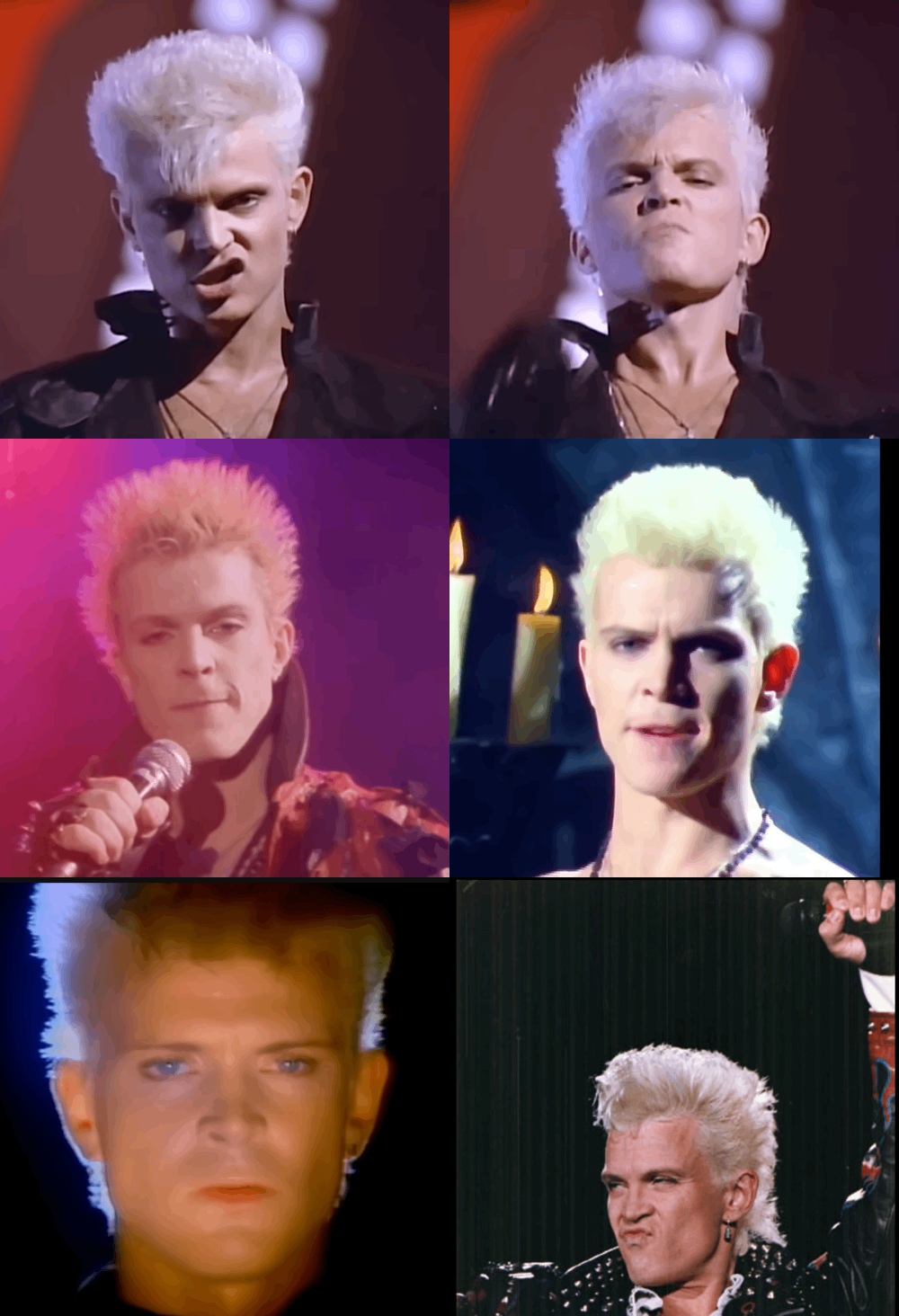
Billy Idol, with his sneer, his outlandish hair & wardrobe, and his devoutly sensualist lifestyle, may be the quintessential rock star. His decade-plus heroin addiction was less a battle than an alacritous regimen; his prodigious philandering was performed almost publicly, described legibly in lyric and rumor (and his autobiography); his bare chest and piercing blue eyes bedecked the bedroom walls of a generation of teenaged girls, and he accomplished all this while tattooing our cultural consciousness with half a dozen singles that seem to casually distill punk, pop, rock, and disco down to an essence as shiny and black as studded leather.
In the streaming era, “Eyes Without a Face” has become the principal jewel in his legacy’s barbed wire crown. Listeners play it 858,000 times a day on Spotify, compared to 339k for “Rebel Yell” and 209k for “White Wedding.” It’s a weird song, “my murder song,” according to Billy (even if it's fairly clear the words concern a relationship that’s dying, not a person). The backing vocal hook of the chorus is in French. (Did you realize that? Or do you, like my wife, have a brain that for years subconsciously translated the line into English?)
Squint and you might misjudge Billy Idol’s project. Is it occult? Does he ride for Moloch? Are vampires involved? Emphatically not. After all, he was born into a stable home, had uncommonly good looks — perfect teeth out of the box — and a knack for song that, when paired with superior musicians, was adequate to conquer the world. What did the Devil even have to offer this man?
Let’s discuss.
***Thanks to Renée Barrera for nominating “Eyes Without a Face” in the Great Ape suggestion box. Paid subscribers can hop in anytime with their proposals.***

CHRIS: Keith, Billy Idol may be famous for his lip-curling sneer, and it may be impossible to find a single frame in a single music video in which he’s smiling, and he may have told Bill Maher that he “started smoking crack to get off heroin,” but he actually had a very happy childhood. Born in 1955 just outside of London to an English father and an Irish mother, he spent his teenage years in Dorking and Bromley, two towns whose names anyone in the world, living in any culture, would immediately identify as British. He did one year at University of Sussex before dropping out and joining West London retro-rockers Chelsea. They didn’t last long. Young William and his bandmates chafed under singer Gene October’s artistic direction, and after just a few weeks they left to form Generation X. Gen X, as they would later call themselves, almost worked: they signed to Chrysalis Records, put out three albums, and were the first punk band to play Top of the Pops, but their music, though surely “punk,” was too shamelessly hooky for the Sex Pistols/Clash crowd (“Wild Youth,” off of their first LP, has a verse melody the Beatles could’ve written). Chrysalis started whispering into Billy’s ear about the possible benefits of going solo — correctly, one must admit — and when in late 1980 he agreed, the label dropped Gen X.
I know you can’t wait to hear what happened next, but first I need to show you this sentence from Generation X’s Wikipedia page in the bit where the band members start to fight. (NB: Derwood Andrews is the lead guitarist.)
Andrews was in antipathy with Idol’s changing character caused by Idol’s increasingly severe narcotic use, and his sensing of a soloist career intent within Idol.
Possibly the most awkward sentence ever typed. 🏆
So it’s off to New York with a freshly inked solo deal, and the gods waste no time letting Billy know they approve of his choices. His first single for Chrysalis as Billy Idol is… his previous single for Chrysalis as Gen X. But this time it works. Yes, “Dancing with Myself” had topped out at #62 in the UK charts when Billy’s ex-band released it in October, 1980. When Billy Idol released it the following year, it went to #27 on Billboard’s Hot Dance Club Play chart — he reports hearing that at dance nights in New York, DJs would loop the song for 30+ minutes to sate fanatical clubbers. Chrysalis quickly followed up “Dancing…” with its b-side “Mony Mony,” a cover of the 1968 track by Tommy James and the Shondells. It went to #7 on the Dance chart, and Billy was off to the races.
And fucked on heroin! Over the previous two years, our man had gotten cozier and cozier with H, and Billy touched down in New York in bad shape. In his memoir, “Dancing with Myself,” he describes his first visit to US-based manager Bill Aucoin’s office:
Walking into Aucoin’s office, I tried to act as normal as I could. The fact is, I had arrived in New York suffering from serious heroin withdrawal. I had taken so much before I left, I had a bad skin reaction. Scabs covered my face, and I had an extreme case of constipation. Bill was a bit shocked at how I looked, which was something, because he was a hard guy to shock.
I did have a three-week supply of DF 118s, a heroin substitute (like methadone) that was used for getting over the initial cold-turkey reaction. The DFs kept me functioning, and some booze quelled most of the clammy sweats and general discomfort. I took speed to counteract how sick I felt and to keep up with New York’s quick pace. (Dancing with Myself, Billy Idol. 2014. All quotes below Ibid unless noted.)1
Don’t worry. He’s soon living on Jones Street with a “junkie college student” named Fish who shows him how to score dope in Alphabet City. At their apartment, Billy and Fish “slumbered like junkie babes in the woods, deep inner dreams playing in our subconsciouses as the din of New York traffic receded in our ears,” but Billy Idol was fully capable of functioning in an opiate haze. Through Bill Aucoin, he meets Steve Stevens, a kickass guitarist who will play and co-write songs basically till the end of his 1980’s golden era. (To immediately hear Stevens in your head, conjure the lead guitar on the Top Gun anthem — that’s him.) Throughout 1981, Billy and Steve are beavering away on material for the first Billy Idol solo LP, and our man is also snortin’ plenty of heroin and hittin’ all the clubs…
One of the first gigs I went to at the Ritz was a Prince show. At that time, he was wearing a raincoat with thigh-high socks and a jock strap that squirted water during his guitar solos.
How are we thinking this jock strap worked? Crude-but-functional: a bladder on Prince’s pedal board connects via aquarium tubing to his jock strap; he steps on the bladder to eject water. Doc-Brown-level-ingenuity: when it’s time for the solo, Prince activates a tiny sound-sensitive motor that compresses a water reservoir in his raincoat, which pulses liquid through a tube that runs down his back, along the valley floor of his butt crack, then into the jockstrap pouch, where it’s joined to a squirt-gun nozzle that’s sewn into the strap fabric. Or the soul of simplicity: Prince simply pees on people when he wants to.
By February of ‘82, Billy and Steve have found a producer, Keith Forsey, and flown to L.A., where Keith has access to his mentor Giorgio Moroder’s studio. (Moroder had allowed Forsey to take on the project after himself passing on an offer to produce.) I started reading Billy Idol’s memoir, Dancing with Myself, yesterday after finding online sources like Wikipedia strangely sparse; it’s not a bad read, but a pattern emerges where the musical stuff is depicted as being effortless in a way that feels either anticlimactic — which I suppose would just be me grumbling for a more gripping story — or hazy, and I suspect this is more the issue. Can he really have written “White Wedding” in twenty minutes, after Keith Forsey locked him in a control room with his guitar, a drum machine, tape deck, paper and pen? I suppose it’s possible!
Songs seem to pop out more or less as needed for B.I. The drug adventures usually feel more fleshed out:
After getting kicked out of the Sunset Marquis, Steve and I moved across Sunset to the Chateau Marmont. I had one of those little bungalows off from the main hotel. I started drinking tequila in the dead of night since I was suffering some withdrawals from “chipping” the H, and I found it difficult to sleep. I would drink half a bottle of tequila, become comatose, and wake up a few hours later from having psychedelic nightmares.
One night I was put to sleep drunk and raving in the early evening by [Chrysalis exec] Brendan Bourke, who then took what remaining booze I had left. I woke up at two in the morning jonesing, knowing I couldn’t get any more booze until six. I was pissed-off drunk and raging in an alcohol-induced nightmare. Incensed, I began to smash up the room, taking out the bungalow windows with my elbows, screaming. I destroyed the TV and whatever else was in my immediate vicinity that sounded good crashing to the floor. Soon, the place was in complete shambles. I was nude and covered in blood and sweat, going nuts.
Hotel management finally shows up and threatens to give Billy the boot, but Bourke convinces them to let him stay till breakfast. Billy falls asleep, and is awakened the next morning by loud voices in the parking lot; peering out his window, he sees policemen. He decides to go peacefully:
I opened the door and went outside, but the cops had moved on from my bungalow and were searching farther away toward another bungalow. They showed no interest in me as I stood there fully nude, just outside my door, staring at them. They continued to comb the ground, looking for . . . what? It wasn’t until later that I learned that John Belushi had OD’d in another bungalow the previous night. After that, the hotel manager had forgotten all about me, and after sending her a bouquet and promising no more destruction, I moved to another bungalow.
They finish the album, and in July of 1982, Billy’s first solo record, Billy Idol, debuts at #45 on the Billboard 200. First single “White Wedding” reaches #36 on the Hot 100, then “Hot in the City” makes it to #23. (“Wedding” eventually got to #6 in the U.K. as a re-release — part of the wonderfully titled 1985 hits collection Vital Idol.)
“White Wedding”’s music video — censored at the time and considered scandalously profane, but rather cozy to eyes that have seen, say, Charli XCX’s recent ode to onanism — elevates Billy Idol from club curiosity to recognizable cultural figure. That’s because MTV, having debuted the year before in August of 1981, is on-air 24/7, and has a shortage of content. “White Wedding” was being played hourly. “There I was, in America’s living rooms, and whatever residual radio airplay problems we had vanished as soon as the kids at home saw the video and began to call their local stations to request the song.” Musta’ been nice!
(You may be thinking, viz. iconic Billy Idol videos, “What about ‘Dancing With Myself’!? A post-apocalyptic zombie fantasia from the director of Texas Chainsaw Massacre and Lifeforce?!?! THAT didn’t make him a household name???” Thing is, although the song goes all the way back to 1980, and was indeed Billy’s foot in the door in America, he didn’t shoot a video for it until after “White Wedding” blew up, cementing his identity. “Dancing”’s vid dropped in 1983 and did good business, but by then Billy Idol was established as a black-leather pale-skin goth-punk guy with vaguely satanic undertones, and the image was simply too ingrained to be displaced by a black-leather pale-skin Mad Max guy with vaguely sci-fi undertones.)
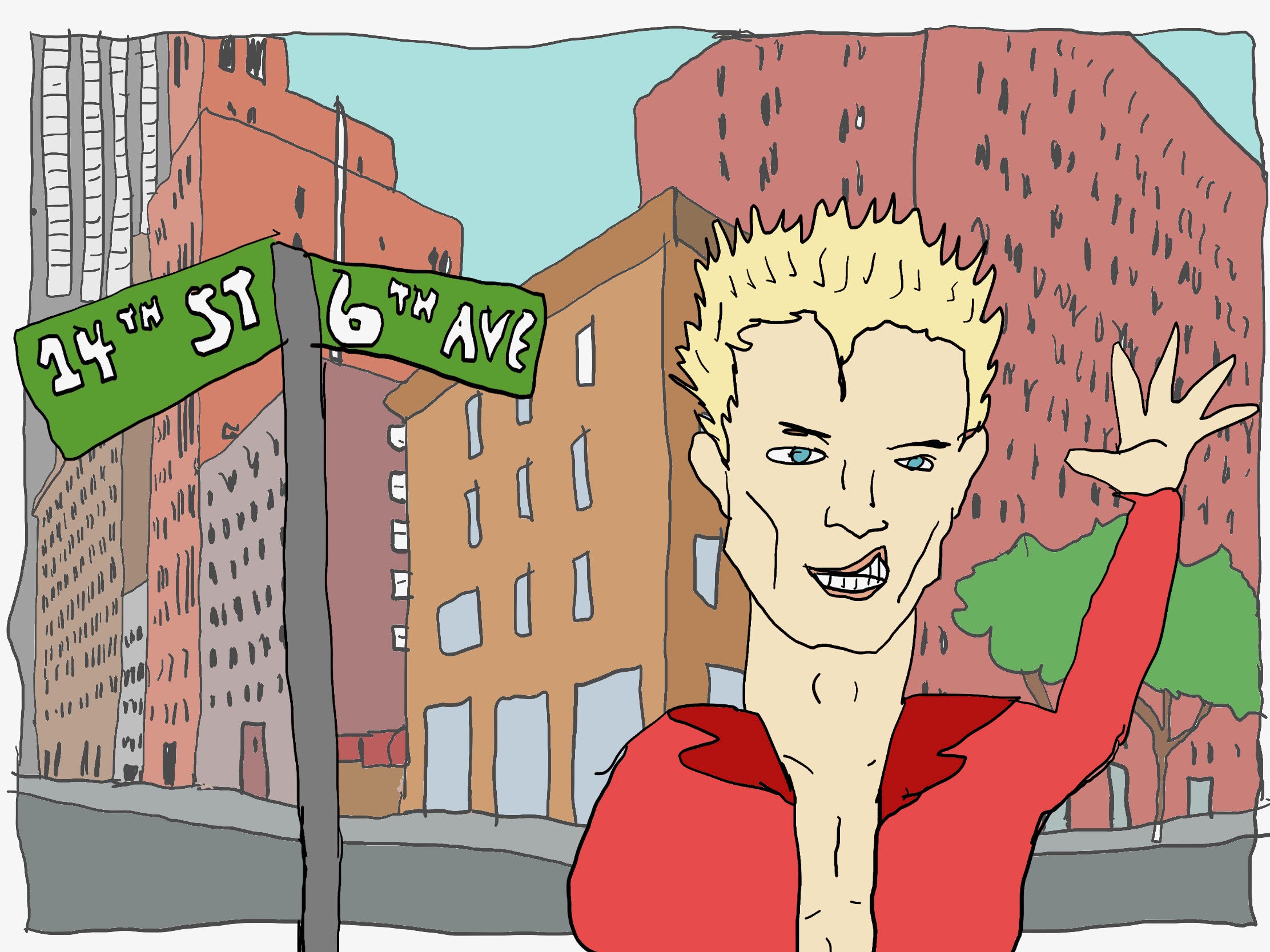
And now we get to the meat — “Eyes Without a Face” is at hand. 1982 comes to an end, along with the US club tour that Billy and band did to support their first LP. They’re back in New York, they shoot the video discussed in the above parenthetical ‘graph, and the gang starts meeting at a rehearsal space “below Fourteenth Street.” As tends to happen for Billy, inspiration quickly strikes: “Walking across Sixth Avenue, I started to hear a tune in my head, like a series of notes running up the scale.” “Eyes Without a Face” has come knockin’!
Pause: THIS is kinda crazy: I just looked at the corner of 14th and 6th Ave. on Google Maps to see where this rehearsal studio might have been, and one feasible spot is occupied by Mind of a Serial Killer: The Experience(!). And where does “Eyes Without a Face” get its title? Tell ‘em, Billy:
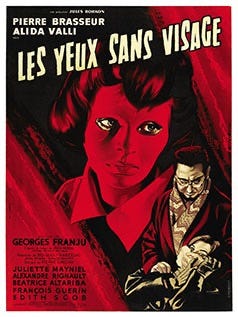
I’ve always had a fascination with the titles of horror films. I had been reading a book about the genre’s history, with riveting concepts and titles such as The Cabinet of Dr. Caligari. I was particularly intrigued by the ’60s French nouvelle vague forerunner Les yeux sans visage2 (Eyes Without a Face), about a brilliant plastic surgeon who vows to restore the face of his daughter, who has been horribly disfigured in a car accident. This vow leads him to murder, as he sets out collecting the facial features of his victims, which he then grafts onto his daughter’s hideous countenance, attempting to restore her beauty. Her staring eyes remain the only thing visible.
Disappointingly, it sounds like he just read about the movie, didn’t actually see it? Should we send him a copy on BluRay? I mean *I* haven’t seen it, but I didn’t write a song about it. That would be like us releasing “Pine Beetle” without my having finished The Summer I Turned Pretty!!! 😬 Anyway, kudos to Billy for recognizing the potential of “eyes without a face” as a concept; it must have been tempting to instead write toward the title used for the film’s 1962 English-language release: The Horror Chamber of Dr. Faustus.
A month or two at the Mind of a Serial Killer Rehearsal Studios had Billy & Steve ready to start recording, so they tell Keith Forsey to hop a flight — this time, they want to work closer to home, at NYC’s Electric Lady. Everything in the studio, of course, goes just fine, unless you count Billy making the most tragic mistake of his life:
The recording of “Eyes Without a Face” went well. Steve came up with a blistering guitar riff for the middle of the song that added a whole other dimension, rendering it more than just a ballad. I improvised a rapping part to go over the top. Rap was everywhere in New York at the time, in all the discos and clubs, so it made sense after my croon to start talking streetwise over Steve’s supersonic barrage of sound.
I’ll be honest, I love this song, but the rap’s rough as hell. Is it ever a good idea to drop a rap into a non-rap song? I can’t think of any positive examples. You’ve had to deal with this before, when aping New Radicals’ “You Get What You Give” … does it get any easier? Why don’t I pause the Idol History here and let you get a word in.
KEITH: I can’t believe I’m saying this, but I actually find the “Eyes Without a Face” bridge-rap substantially worse than the outro of “You Get What You Give.” Don’t get me wrong: the New Radicals rap is dopier and more cringe-inducing and outright lame than Billy Idol’s, but at least it kind of makes sense? Like, the outro is relevant to the rest of that song, lyrically, and kind of puts an aptly-venting button on the songs’ anti-music industry screed. It’s crummy, but at least it kind of understands what rap is. I suspect that the Billy Idol of 1983, as drug-addled and steeped in rock-and-roll hedonism as he apparently was, didn’t have much clarity on this new musical phenomenon other than that it seemed to be a creative and commercial force that was going to require his reckoning, sooner or later. But he kind of seems to just think rap involves free-associative speak-singing over repetitive musical bars, which, yeah, is probably how my uncle who still only really listens to the Beatles might describe it. This bit of the song calls to mind perhaps the most egregious example of rap dilettantism in recorded music: Blondie’s “Rapture.” Easily the dorkiest thing ever affixed to an otherwise kickass song, that “Rapture” rap has forever calcified Debbie Harry — a totally awesome and otherwise unimpeachably hip person — as an absolute square in my mind. I try to give her credit for having been inspired by rap so early (“Rapture” was released in 1980, so she truly was an early adopter of hip hop), but that credit is eroded by the crushing tidal waves of cringe delivered thanks to her “eating cars” jag. It’s humiliating to behold, like that video of DJ Khaled playing the acoustic guitar gifted to him by the Bob Marley estate. Like, it’s cool to be a fan, but maybe sometimes it’s best to admire something from afar.
What’s most inexplicable about the “Eyes Without a Face” bridge is that it’s an absolutely unforced error. The musical bit that it’s performed atop is rad — so cool, in fact, that until I recorded this cover, I wasn’t even really aware that Billy Idol was rapping over it. In my memory, it was just a sick, palate-cleansing rock moment. I really only remembered the vibey, noodley guitar solo that undergirds the “Say your prayers….” bit at the end. That’s how perfunctory and inessential Idol’s contribution to this section is. One gets the sense that everyone at the recording session had assumed that somebody else was going to write something for that part. Maybe Idol would sing a lovely, aching bridge melody, maybe Steve Stevens would shred a sick solo, maybe David Lee Roth would randomly pop into the studio and squeal? But nobody had written shit, and David Lee Roth was asleep, and solo Billy Idol had to (apparently) freestyle something real quick before their studio time was over? He seems to have vaguely recalled that his great rap influence, Debbie Harry, had rhapsodized extensively about “cars” and “driving far,” and so he had the presence of mind to incorporate that essential hip hop trope, but otherwise, it’s a moment of total water-treading. Fortunately, it has the desired effect of making the following verse seem like a deep drink of orange Gatorade after an extended drought — delicious, life-giving, and concocted with great intention by experts in a well-equipped lab full of enlivening chemicals.
I actually took a photo of that Mind of a Serial Killer installation a couple of weeks ago and sent it Keith Carne to provoke a visit. Should we take a band trip, to better understand this Great Ape and also hopefully get jump-scared by a guy dressed as Leatherface popping out of a garbage pail?
CHRIS: Without experiencing Mind of a Serial Killer: The Billy Idol Experience, we will never be able to inhabit Billy’s black leather pants during the moment when he landed on “talking streetwise” over EWAF’s bridge. For maximum verisimilitude, let’s remember to ‘chip some H’ while we’re there. But before we attempt the unprecedented empath phase of this Ape, let’s speed-run the rest of the official history:
When the “Eyes Without a Face” video debuted in June of 1984, it went to number one on MTV for six weeks. Add to that the over-the-top radio play for this twisted ballad, which was always paired with the Cars’ “Drive” on the NY drive-time station, and we climbed into the Top Ten singles chart at Billboard. At one point that spring, we were at number 4 on the album chart and number 6 on the singles tally. After that, we began to play arenas.
The video is indeed pretty cool! It was directed by David Mallet, who had done “White Wedding,” and while I don’t really see the Cabinet of Dr. Caligari homage that Billy claims they were going for, it is apparent that for 1986’s Cobra, Sylvester Stallone leaned heavily on “Eyes Without a Face,” especially when creating the lair scenes for the New World murder cult.
In July of ‘84, Billy makes his triumphal return to England, where he’s booked to play “Eyes…” on Top of the Pops. The evening of his arrival, he and longterm girlfriend Perri Lister (they’ve been dating off and on since 1979) go to a friend’s apartment and snort some “very strong Persian brown heroin.” Everybody but Billy and his host “nodded out” after one line, but Billy hoovered five more. He woke up in a bathtub full of ice-cold water, surrounded by his panicking friends. This is his first overdose. It won’t be his last. 😬
Rebel Yell takes Billy a couple more rungs up the fame ladder, and he and the band tour for the better part of a year. The debauchery surges.
If you weren’t a sex addict at the start of the tour, you soon would be. Shit, the mind boggles at the thought of it. Hotel after hotel, gig after gig, a million scantily clad chicks all hopped up on excitement. Many of them had drugs, a great combination. It was nonstop sex, drugs, and rock ’n’ roll music. You got a license to live fast and leave an incredible-looking corpse. After moonshine washed down with Mountain Dew, anything was possible.
Moonshine and Mountain Dew, eh? Sounds like they were still figuring out cocktails in those days. You may wonder how that longterm relationship I mentioned endures this unending bacchanal. Perri Lister, a professional dancer whom Billy had met back in his Generation X days, seems to have kept pace with him for a couple of years. Especially when she was in London and Billy was in New York, neither was faithful, both were doing a lot of drugs, and Instagram didn’t exist. But after the Rebel Yell tour, Perri has moved to New York, and Billy fails to downshift into “home” gear. Fortunately or not, manager Bill Aucoin puts Billy on a plane to LA, where they spend six months trying to get a rock-star assassin movie called King Death off the ground. Ron Silver signs on to produce and Universal Pictures actually green-lights the movie — committing $10M, plus $1M for the soundtrack album — but then Aucoin, under the influence of heavy frequent crack use, blows it all up. Bumming around Hollywood with a moribund movie and an M.I.A. manager, Billy spirals into depravity, and when he finally slinks back to NYC in 1986, Perri, disgusted, moves out. His heart, perhaps not broken, is badly bruised, and he’s just wasted six months he could have put toward writing a new record with Steve.
He gets to work. Unfortunately, he shits the bed:
Whiplash Smile had a lot of potential. It should have been a worthy successor to Rebel Yell, an album featuring a real band working, rehearsing, and recording songs collaboratively. But I insisted that I should be the only one writing the songs, and in true punk fashion I insisted on doing something completely different, making this album a synthesizer album. This might have worked if I’d been at the top of my game, but overall I slacked off. Left to my own devices, I fucked up and lost sight of what I could be. I threw away my guidebook of how to make a record. The result was an unfocused performance from yours truly, with a writing and recording process that resulted in alienating my partner Steve Stevens.
While making this bad album, Billy copes with Perri’s departure by “build[ing] a massive monument to her with sex and drug addiction.” Aware he needs to ease up on heroin, he substitutes cocaine. Tired of frequent nose bleeds, he substitutes crack. “I would hole up in my apartment smoking and staying awake, at one point for three straight weeks.” That’s… a long time. One of Billy’s friends nicknames his belligerent, cracked-out persona “Zuul,” after the demonic monster “gatekeeper” dog in Ghostbusters. He does ten days of rehab at Beth Israel, gets back on the coke, finishes the album, goes to Mallorca for two weeks with his parents and weans himself onto a booze-only regimen, comes home, gets back together with Perri, is caught in an NYPD coke sting in Washington Square Park, finds a new manager, and heads out on tour. Whiplash Smile does just fine commercially, hitting #6 on the album charts, with three singles landing in the Top 40, but it sucks. And according to Billy, the tour “wasn’t as much fun or as carefree,” either.
During the not-fun, care-laden Whiplash tour, Chrysalis releases an 8-song collection of all the Billy Idol remixes to date — Vital Idol — and “Mony Mony” gives Billy his first and last #1 on the U.S. charts. (Check out the 8:25 “White Wedding” remix, feat. a synth-driven second half: 👍.) But the tour loads a bunch of straw onto the back of the camel that represents Billy’s relationship with Steve Stevens, which was already piled pretty high, and at the end of the run, in late 1987, Steve leaves the band. Billy and Perri decide it’s time to really turn the page, so they move to a village on Sardinia, right in the middle of one of the world’s famed “blue zones,” where an endemic healthy lifestyle yields 10x as many centenarians per capita as the U.S., and where anything stronger than grappa is impossible to come by.
Just kidding, they move to L.A.
(I don’t know why I’m driven to type out this guy’s entire fucking life story. Something about him fascinates me. I wasn’t actually that big a fan as a kid — you may recall that I grew up without MTV, which was clearly pivotal in manufacturing Idol idolatry. But I have a visceral memory of seeing a Billy Idol poster, many times, on the basement rec room wall of my childhood friend Alex. Bare chest, spiky blond hair, leather vest probably not smiling! The poster belonged, of course, to Alex’s hot older sister.)
In L.A., at first, all is well. Billy and Perri start exercising. In photos from this period, they look tan, in that 2nd-degree-sunburn way that Brits do. Billy buys himself a Harley-Davidson Wide Glide to celebrate “Mony Mony”’s chart success (I guess motorcycles are healthy? You get, like, fresh air while you ride them?) and in 1988, Billy & Perri’s son Willem is born.
Buuuuuut, Billy gets back in the studio with producer Keith Forsey, plus new guitarist Mark Younger-Smith, and the ancient ways emerge. A few months after the kid is born, Billy tells Perri, poolside, that he’s gonna call the fellas and organize a chill little motorbike ride for later that afternoon. He goes inside and instead calls Naomi, a lady he’s started seeing on the side. Alas, he uses a phone near Will’s crib, where a baby monitor transmits his tender, skanky words to the receiver sitting next to Perri’s pool chair. Like a sack of bricks tied to the already overloaded saddle of a weak elderly camel, this incident breaks the back of Billy & Perri’s relationship for good. 😭
One last push, Keith. We’re in the final chapter of the golden era, after which everything can mostly be ignored. Let me jolt your flagging interest by announcing the imminent arrival of Oliver Stone(!), Michael Mann(!), James Cameron(!), David Fincher(!), and Andrew Dice Clay(!?).
First Stone. As the new album, Charmed Life, starts to take shape, Billy gets word that Sir Oliver Stone wants to cast him in a new biopic he’s making about The Doors. Billy will play Jim Morrison’s drinking buddy Tom Baker, and after a successful audition, he starts hanging out with other actors from the film, including Val, and even takes a few acting classes.
Let’s get Andrew Dice Clay out of the way. Geffen Records approaches Billy’s management about recording a song for The Adventures of Ford Fairlane, the execrable Andrew Dice Clay vehicle that I’m embarrassed to admit I saw. The song was “Cradle of Love,” and our man accepts. A little sad to learn that Billy’s last big single was written by someone else, one David Werner, but nobody coulda sung it like Billy, amirite?
And now here’s Michael Mann, asking Billy to record a cover of the Doors’ song “L.A. Woman” for his upcoming movie L.A. Takedown, which I’ve literally never heard of. That’s TWO tracks for Charmed Life, taken care of. Add to that “Pumping on Steel,” which Billy says came out “true to my initial intention, which was to write a fuck song about screwing on my motorcycle.”
Unfortunately, he didn’t just screw on his motorcycle. In February of 1990, right around the time they’re mastering Charmed Life, Billy runs a stop sign on his Harley and is side-swiped by a car. Doctors narrowly avoid amputating his leg, and he spends the next couple months recovering. Soon it’s time to shoot a video for Charmed Life’s first single, “Cradle of Love,” but Billy can barely walk, even with crutches. Enter David Fincher, who comes up with a concept that involves a cat-on-a-hot-tin-roof teen sorta-seducing (?) a nerdy yuppy (or does she just want to mess up his bed?) while Billy Idol, shown waist-up trapped in a picture frame on the wall, sings and cavorts admirably.
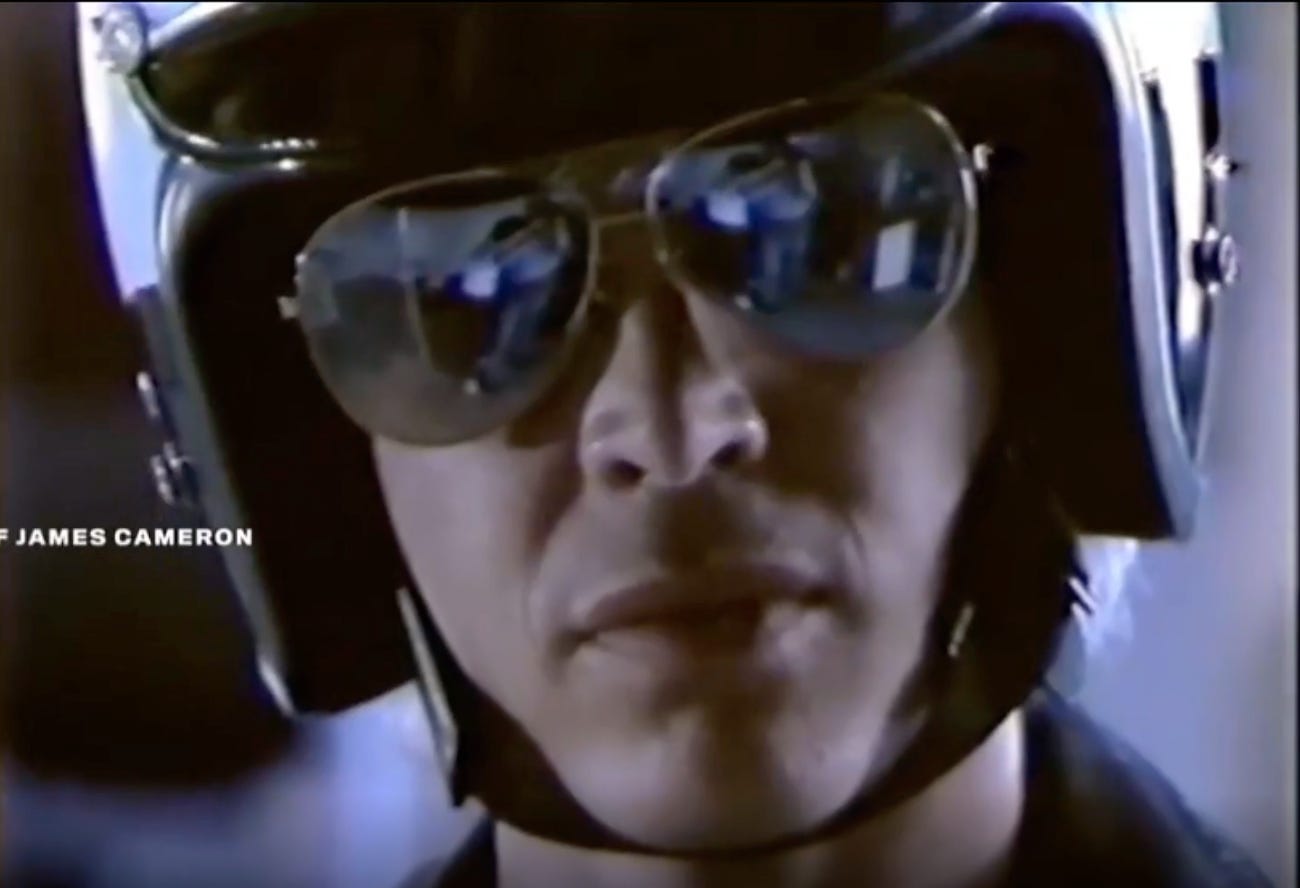
Not long after that, James Cameron asks Billy to come in for an audition. Cameron wants him to play the mighty T-1000 in his new chrome-&-muscle robot flick, Terminator 2: Judgement Man. Apparently story boards already depicted Billy in the role, so this was basically a slam dunk. Except… Billy’s still walking with a limp, and the T-1000 needs to be able to perform strong predatory running. In the end, Billy loses the part, AND that of Tom Whoever, friend of Jim Morrison (Oliver Stone gives him a small consolation role that he can play on crutches).
In April of 1990, Charmed Life drops. “Cradle of Love” goes to #2 on the US Hot 100 (#34 in the UK), which I have to believe has everything to do with Fincher’s striking video, David Werner’s legit catchy tune, Billy Idol’s iconic pipes, and nothing at all about man-pig Andrew Dice Clay’s vile film. Touring began in August, and included about 80 shows before the end of the year — Billy completed them with the help of a cane.
We could lower the curtain here, but there are one or two other things worth mentioning. First, Willem isn’t Billy’s only son. Almost how could he be? Surprisingly, the decade-long orgy spawned just two other children: The first, Bonnie, was born about a year after Willem, to a woman Billy had started seeing shortly before Perri left him. The second, Brant, became known to Billy only recently, when Bonnie took a 23andMe test and discovered a half-brother. She contacted him, and his mother — who may have been in the dark herself? — admitted that she had spent a long weekend with Billy Idol sometime during the Rebel Yell tour. If you watch the recent Billy Idol documentary, Billy Idol Should Be Dead (2025; Hulu in the US), it actually seems like Billy, his three kids, and his four grandchildren have a pretty good relationship. Even Perri now speaks well of her ex — she says they were a couple of knuckleheads, and they should have just pushed through their disagreements, cuz he’s the absolute love of her life. 🥰
Based on the sheer volume of unprotected fucking Billy Idol does in his memoir, I’m able to project six to ten other children whose mothers, like Brant’s when the time came, had a more suitable guy in mind for the job of father.
Musically, Billy Idol has never completely stopped, though the returns continually diminish. I listened through most of it. 1993’s Cyberpunk is probably the most interesting. It was recorded at home on a Mac computer using a very early edition of ProTools, and is putatively a “concept album” about cyberspace, à la William Gibson. The lyrics occasionally bear that out, but mostly not, and the songs are usually not weird or ‘cyber,’ just lower quality (this despite the return of good boy Steve Stevenson).
You make the call as to whether you need a 15-track Billy Idol Christmas album (2006; including two originals). Maybe you just need the music videos he made for four(!) of the songs?
Kings & Queens of the Underground (2014) was recorded with Trevor Horn (The Buggles) and Greg Kurstin (Tegan & Sara, Foo Fighters, Sia, everyone), and sounds great. The tunes, though…
The Cage EP (2022) opens with an eponymous melange of Killers and down-the-middle 80s cock rock. Then “Running From The Ghost” shows us what would happen if Jim Steinman had written a Muse song.
And on last year’s Dream Into It, we get to hear Billy and Avril Lavigne duet on a pop punk song (“77”), and watch Alison Mosshart realize how fun it is to smirch an older gentleman’s reputation (see this year’s album Sweet Chaos, by her husband Damian Lewis).
I skipped a couple of EPs and a long-player or two, but I think you’re pretty well caught up. Let me ask you this, Keith, after everything you’ve learned, and everything you already knew: Is Billy Idol the quintessential rock star?
KEITH: Well, Chris, I don’t know. I just don’t know. Did he manage to commingle punk rock insouciance with melodic know-how? Boy howdy, did he ever! Did he terrify parents with his look alone, despite his pretty family-friendly musical output? Yessir!
But did he snort a line of ants like Ozzy? Nah! Drive his car into a pool at a Flint, MI, Holiday Inn, like Keith Moon? Not according to TMZ, he didn’t. Did he kill the drummer of Hanoi Rocks in a totally-his-fault DUI car accident, like Vince Neil did? Not that he’s confessing, no! Does he even pretend to urinate (or ejaculate? I can’t tell what thing was supposed to be happening in that Prince anecdote) on his audience while shredding a hot guitar solo? Maybe? I guess we gotta go to the next Billy Idol show, rain slickers and umbrellas in tow, to find out!
I didn’t provide page numbers when quoting Dancing with Myself because I have an ePub (digital) copy, and the page numbering changes when I resize the document window or the font. How do people cite digital books these days?? I suppose that if you also have a digital copy, you can simply drop a few words from my quote into the search box and you’ll find it. Not sure what to prescribe for you hardback readers, though perhaps your Luddism is being justly punished? (JK! Vive le papier!)
French movie titles don’t get title caps! They’re capitalized like a sentence. (You probably already knew this. Somehow, I did not!) Thus Les yeux sans visage. How unassuming; how refreshingly laid back. Other titles, such as books, work the same way: The Old Man and the Sea becomes Le vieil homme et la mer.
Comments
Nothing yet. Say the first thing.
Sign in to join the conversation.