
You’ve not had any sleep. One of your team members is desperately unhappy and your students are making life difficult.
You’ve got deadlines coming up. You need to get your curriculum plan to the senior leadership team. You're running homework detention after school. You're feeling really irritated with your team and classes because they’re responsibility or volunteering for anything.
It happens.
But what to do about it?
This week’s highlights from the We Are In Beta community will help.
They also help you share and get feedback on the brilliant work you (and your team) doing in your classrooms. And learn how one of the highest performing schools in the county approaches intervention (which might surprise you).
We - schools - Are In Beta - always learning (when we help others think and be (and keep up not catch up)).
🧑🏫 Leadership coaching: what actually is it? Why do we really do it?
🗳️ Clarify your thinking: join the lineup for Curriculum Thinking Week 2026
📺 Keep up not catch up: interventions and the Accelerated Learning programme at Mercia School
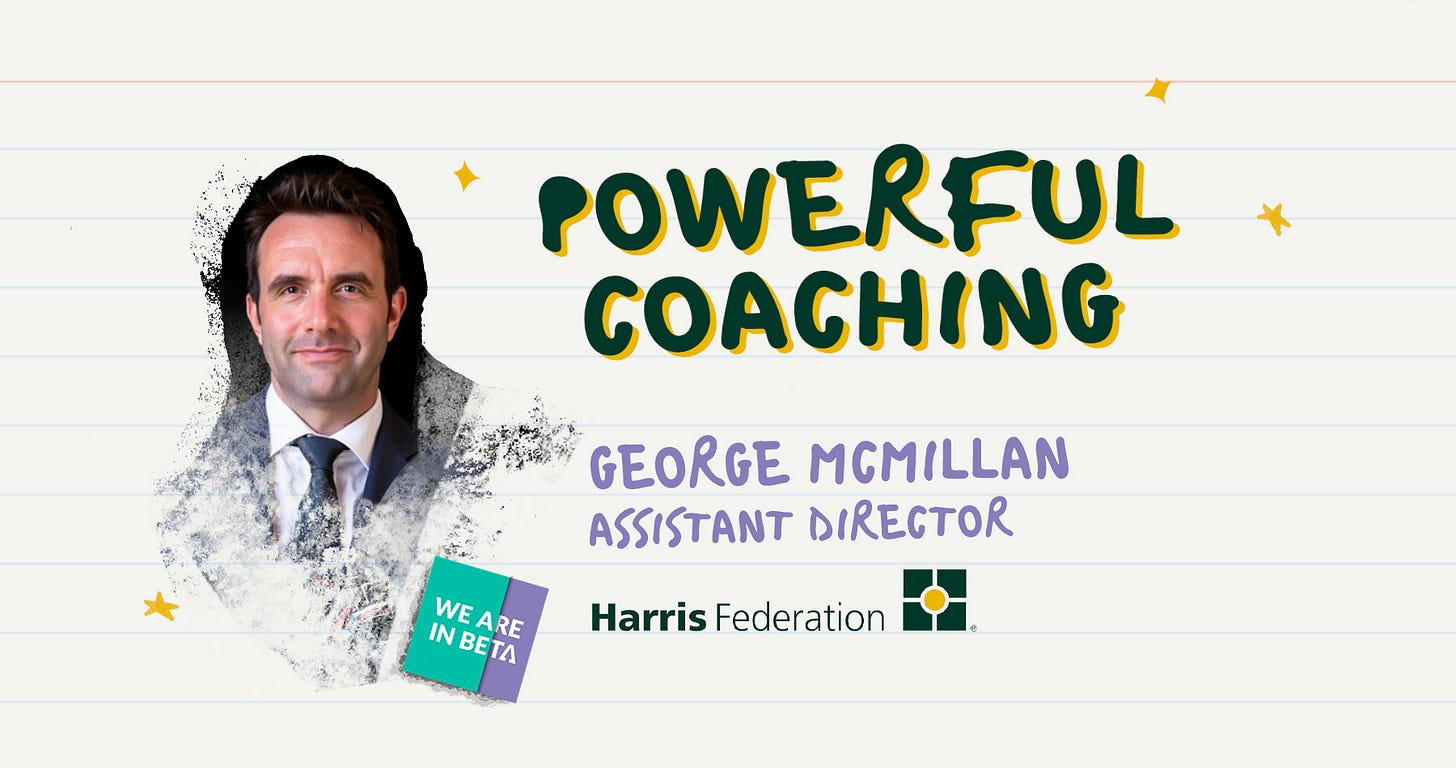
By George McMillan, Assistant Director, Harris Federation.
There's often a misconception about what coaching actually is. It's as if it's a big mystery. Even though coaching is now a billion-dollar industry. There are thousands of coaching books out there. So let’s start with an analogy that I think explains it really well.
Imagine a picture. Imagine your own head is filled with spaghetti. The spaghetti’s all jumbled around in a big swirling heap. That’s what lives inside your brain.
Let me ask you a question as a starter for 10: How does that resonate with how you feel on any given day in terms of work, school and classroom pressures etc?
If you suffer from spaghetti brain, don’t worry. You are not alone (and over coming weeks I’ll be sharing how to solve it of it).
Now imagine your head, again, with spaghetti in it. But instead of a swirling, jumbling mess where you can’t even find the ends of the spaghetti, it’s now all in lovely circles and all making sense.
You can see where the beginning is. You can see where the end is. You can make sense of it. How does that land as a metaphor?
That’s what coaching is, certainly in a school’s context.
You’re helping someone get from here to there. You’re helping get the spaghetti out onto the table. You’re helping muddle through it and just find where the ends are. You put it into nice, neat rows, wrap it up again in a way that’s going to make sense and stick it back in their head.
Let’s try and stretch this metaphor to the point of breaking. You’re not necessarily creating a recipe for something that’s brand new and wonderful because you’re not Gordon Ramsay. All you’re doing is sorting piles of fettuccine, fusilli and penne, etc. That’s the job of coaching.
Then the question is, how do we get from the big mess of sludge in there to something that’s a lot more ordered?
There are various ways of doing it (which I will unpack in later posts about barriers, principles, tools and techniques). But I think people are more innately skilled at doing that when they have and understand the spaghetti metaphor, when they understand that their job is not to create a recipe, to create a brand-new meal, to fix something. It is simply to help the person find order.
If you know your job is to help someone find order, let me ask you, how would you help someone find order?
Not a recipe, not a dish, just order in terms of what the components of the recipe are. How would you approach it?
You might ask them: what ingredients they have, what kind of meal they’re trying to cook, what they want that meal to look like, taste like and when they want it to be served. You might then ask how you might get from ingredients to the finished dish
It all about a spirit of curiosity.
I think we should probably leave this metaphor of food now because I think it’s probably broken.
For me, it’s about getting the different components just right in people’s brains. Let’s bring it back to the reality. Sometimes our problems seem so big and so vast and complicated because we mix it in with our personal problems - your sleep, your kids, your boss, your leadership team, your students etc.
With all that rumbling around you in your head, unless you have someone who’s– even half skilled– to help you just get all of that out into the table, work out what’s real, what’s not real, work out what the problems actually are, what is the order in which you need to fix them, and just someone who actually say, “Yeah, wow, that’s a lot of things” your brain will forever feel like jumbled spaghetti.
That is the power of coaching.
It is not about saying, “here’s what you should do, mate. You need to do this, this and this and in this order. And you need to fix all this stuff”.
First of all, it’s just about really, really good listening, which takes me to one of the things that I really believe about leadership and what leadership is and what leadership isn’t…
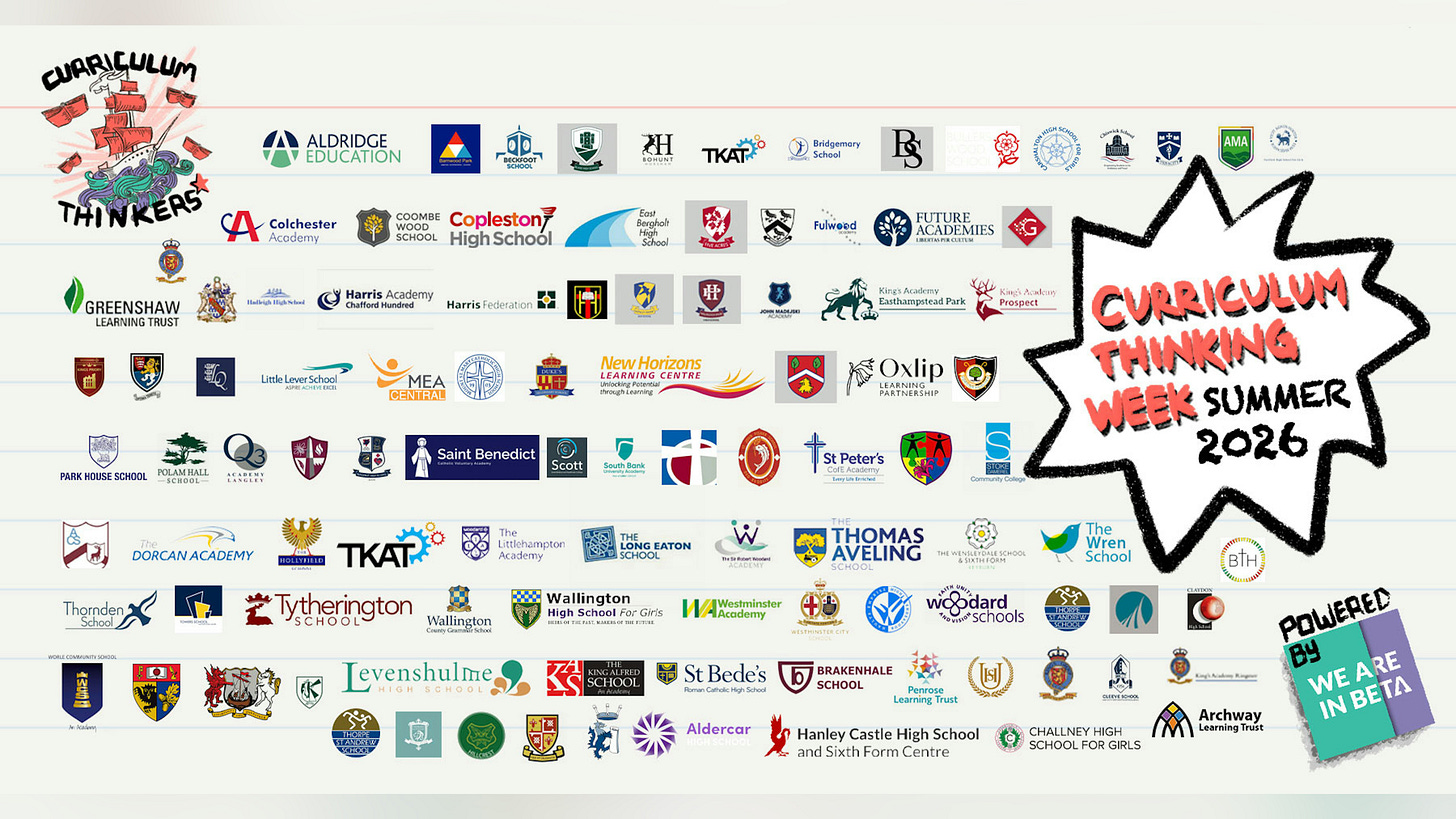
Thank to everyone who’s nominated colleagues and submitting session proposals for our Curriculum Thinking Week conference in July (6th to 10th), where we celebrate what’s happening in classrooms across the country.
If you’d like to share and get feedback on your work from colleagues across the community, while increasing your impact beyond your classroom, department and school…
…join the line up!
Here are some key dates:
By 8th June - tell us you’d like to speak in this short form
By 22nd June - share an outline of your session in this form
By 26th June – create and upload your video, supported by your SLT
w/c 6th July – conference goes live! Jump in to meet fellow speakers, discuss sessions and learn from a wealth of ideas and resources on offer.
What are we looking for sessions to be about? Click below to learn more about how to…
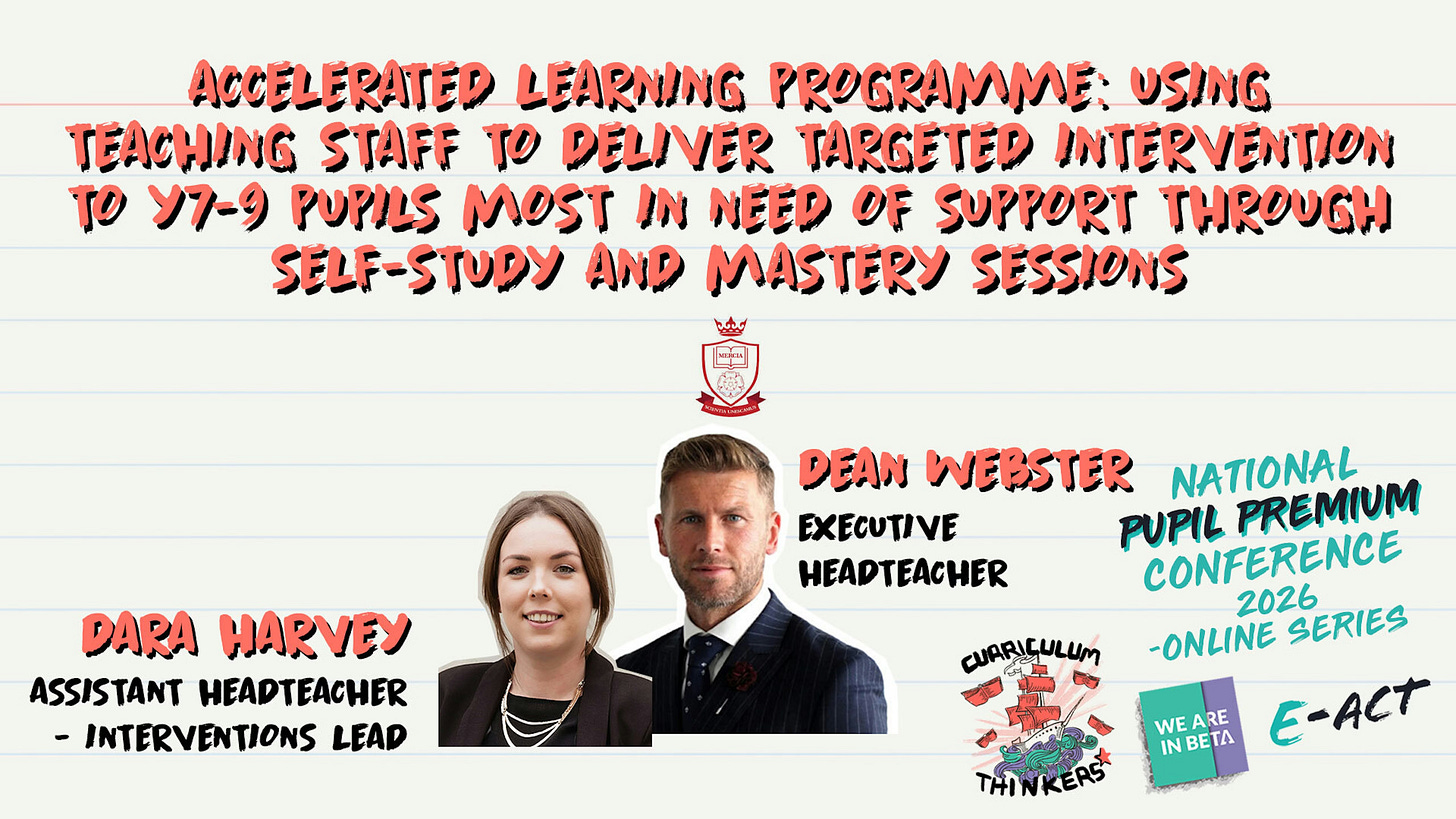
The Progress 8 for disadvantaged students at Mercia School is incredible. In 2023 it was 2.21. In 2024 it was 2.12.
Join Dean Webster (Executive Headteacher) and Dara Harvey (Assistant Headteacher - Interventions Lead) at Mercia School to learn…
How to find the basic knowledge and skills gaps among eligible pupils as soon as they arrive in Year 7.
How to use SATs data and internal assessment to help identify the pupils most in need of support.
How to use timetabled bespoke reading sessions and mastery sessions to accelerate pupil progress.
How to identify pupils who need further intervention and high-quality tutoring.
📆 Tue, May 19th
🕓 4:15pm
When was the last time someone listened to you?
I mean, really listened to you? Where the only purpose of the conversation was to let you say everything you need to say? To give you the time and space to explore the mess in your head?
If your answer is ‘never’, I’m sorry. I urge you to read George’s piece and follow the series he has lined up over the coming weeks, where he’ll unpack powerful listening.
If my questions reminded you of the incredible impact listening can have - on the mess in your head, the anxiety it can cause and that feeling of being stuck - you are one of the lucky ones.
You hold the keys to unlocking true potential in both your staff and students. You know that it’s only when you understand what it feels like to be truly listened to, that you are able to really listen to others yourself.
I was lucky enough to have a leadership coach for 10 years. She helped me navigate re-building broken teams, suffocating workloads, guiding colleagues through capability and more.
The model she used most often was the GROW model, works like this:
G - Goal: Define what the coachee wants to achieve. The goal should be specific, measurable, and aligned with their long-term objectives
R - Reality: Assess the current situation. Look at the facts without judgment to understand where the coachee stands today and what challenges they face.
O - Options: Brainstorm all possible ways to bridge the gap between their Reality and their Goal.
W - Will (or Way Forward): Decide on specific action steps, set a timeline, and build commitment and accountability to ensure the goal is reached.
Get a coach yourself if you can. Train your team in coaching skills if you have the opportunity. The benefits will far outweigh the costs. George has shared 3 routes into coaching here.

📱 Get 21,135 school leaders and teachers in your pocket - download We Are In Beta.
🚀 Looking for a new role? Get updates about specific jobs you’re looking for before anyone else.
🆕 New here? Catch up with previous editions, podcasts and webinars via the archive.
Comments
Nothing yet. Say the first thing.
Sign in to join the conversation.