
Education is about getting the the best out of people: staff, students, parents, communities.
But it’s easier said than done. Schools are complex. So are people. Especially when the context is challenging.
So how do we get the best out of others?
This week’s highlights from the We Are In Beta Community will help you do exactly that.
Whether you are a senior leader working across schools or a beginning teacher working out how to mange the kids in your class, the lessons (and opportunities) below are just as applicable.
We - schools - Are In Beta - always learning (when we work to get the best out of others).
🧑🏫 Leadership coaching: three battles for your mind to help others think
🗳️ Get the best out yourself and your subject teaching team
📺 How all strategies work together to secure better outcomes for our students
This is a guest post by George McMillan, Assistant Director, Harris Federation.
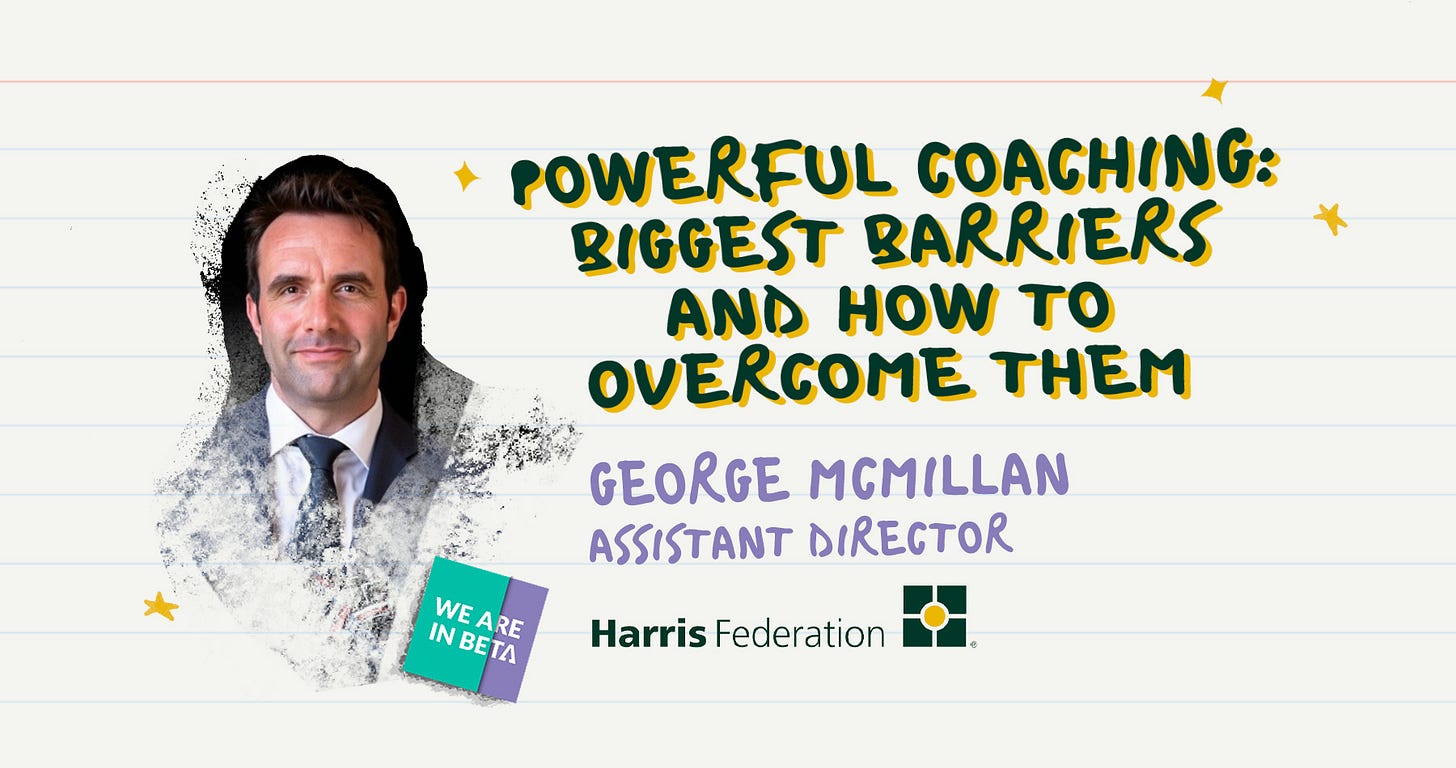
I argued in my last post that coaching is about helping others to think. To help others to think, you have to be able to think yourself. The trouble is you are only human and your mind is a battlefield, especially when you are coaching.
Below I explore the three biggest battles you have to fight and how I overcome them to make sure I arrive at conversations in the right frame of mind.
When there is noise in your head it will stop you from creating an environment that helps someone to think.
“I don’t like this colleague when I am coaching them”
“I am too busy for this today”
“I’ve left the gas on”
“I am not good at this”
“I don’t know what question to ask next”
These are all examples of the noise in your head that’s stopping you having better coaching conversations.
What’s going on? And how do you fix it?
In his book “the Inner Game of Tennis” Tim Galloway talks about “Self 1” and “Self 2”
Self 1: the loud, critical voice in your head.
Self 2: your intuition, the part that already knows what to do.
When Self 1 runs the show, you overthink, over-perform, and usually get worse. But when you quiet that voice and trust Self 2, you let your natural presence take over.
You need to silence the noise in your head to be an effective coach (and teacher). Being aware of it is the first step.
I have a developed a couple of tricks that help me. I’m going to sound like a yoga teacher here or some sort of guru - and I don’t want to sound woo-woo because I’m really not - but we live in our bodies. For me personally, it’s about how do I get back into my body?
So, I have a thing where I’ll twist my wedding ring. That keeps me in the present and keeps me focused and avoids the noise. I’ll sometimes tap my foot. I’ll just move my body gently so that nobody would notice. Sometimes inside my shoe– again, I’m sounding mad here - I’ll curly my toes in my shoe. That’s a personal thing. Just for me, it keeps me in the room.
So, noise for you is whatever’s chattering in your head, how you find some sort of technique to stay in your body and in the zone is up to you.
Linked to the noise in your head, if you are carrying baggage you are not going to have a good conversation.
So again, a coach’s job is to help you think. You cannot think when you all tense, and slightly out of breath, anxious and still thinking about the previous thing you were doing. We would be better not to meet than do that.
Arriving at a session in the right frame of mind is essential.
Now that I’m quite senior, I’m doing lots of serious, high level, stressful things. So, I’m flipping from these really, really intensely different emotional situations. Then all of a sudden, I’m coaching a colleague who needs help back in school.
So, how do you manage emotional regulation like that?
What I do is take three really deep breaths- again, it’s about getting into my body. I just let out slowly. But I can do it as I’m walking up the stairs now because I’ve done it for long enough. And then I arrive and I’m ready because I’m thinking about how I need to turn up.
So arrive to the session in the right frame of mind in a way that’s planful in terms of your own emotions. Three deep breaths can make the most enormous difference.
There are two great enemies of learning. We are all guilty - to one extent or another - of one or both of them. What are they?
Looking good
Being right
We think that looking good will convince others to follow us. We think that being right will help others to think and improve.
In fact the opposite is true. Especially when coaching. Your job is not to look good. Your job is not to be right. Your job is to put your ego aside. Your job is to listen properly. Your job is to approach conversations with a spirit of curiosity.
In my younger days, I would sometimes lie, or I would fudge the truth, or I would pretend that I knew the answers.
I was terribly self-conscious. I had this thing - especially when I was first a headteacher - where I thought “Oh, I’m supposed to know all the answers” I didn’t want to look stupid.
Looking back, it was daft. How are you supposed to know all the answers? You can’t. It’s impossible.
But is possible react different. I’ve revealed how I’ve learned to not look good and be right in my full article here, alongside three other barriers getting in the way of leadership and coaching.
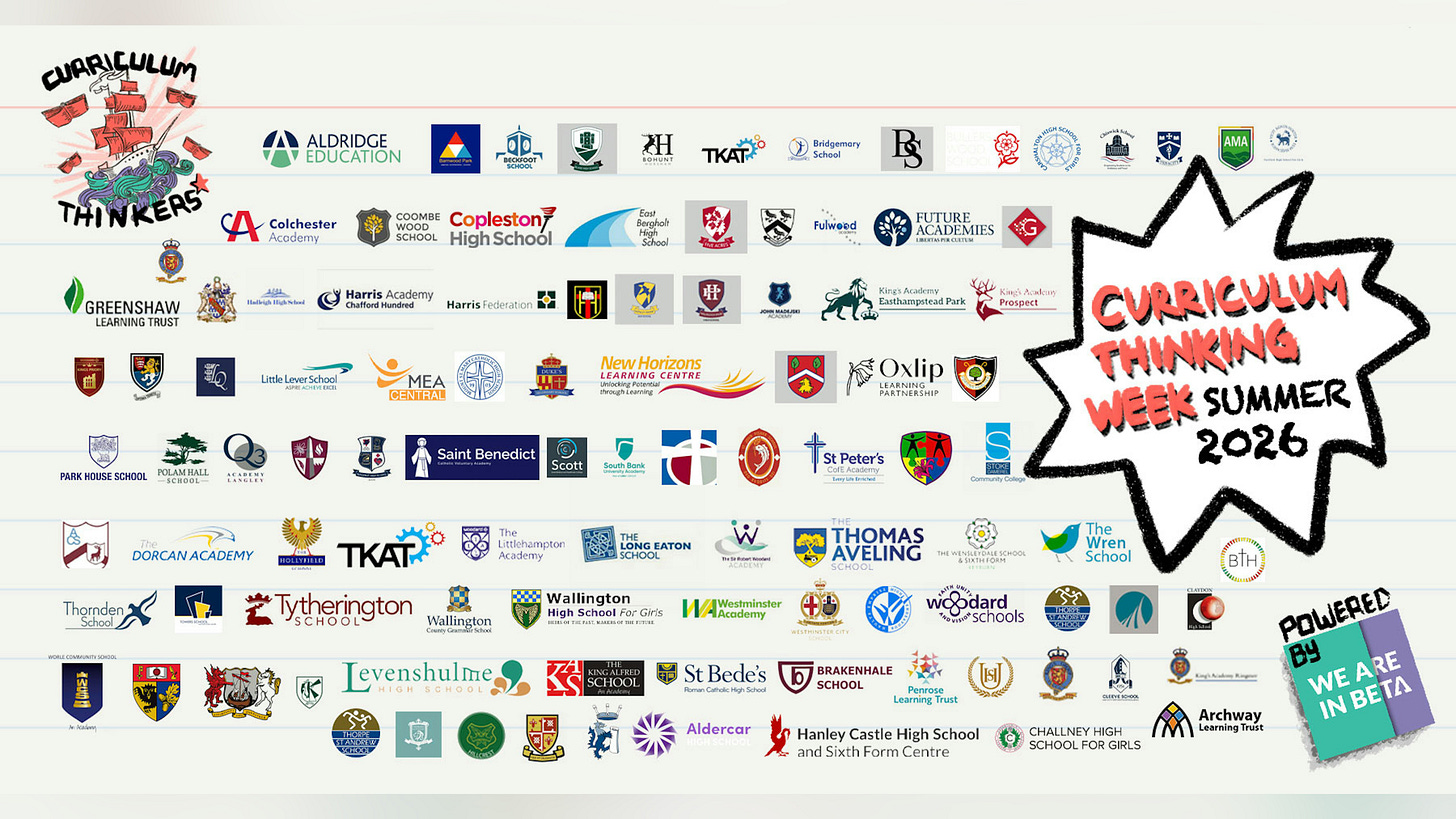
How often do you get share and get feedback on your/your teaching team’s subject work with folks in other schools?
I’m guessing not often.
Don’t miss this unique opportunity to celebrate your/your teams work and grow your networks beyond your school gates.
Colleagues and submitting session proposals for our Curriculum Thinking Week conference in July (6th to 10th), where we celebrate what’s happening in classrooms across the country.
If you’d like to share and get feedback on your work from colleagues across the community, while increasing your impact beyond your classroom, department and school…
…join the line up!
Here are some key dates:
By 8th June - tell us you’d like to speak in this short form
By 22nd June - share an outline of your session in this form
By 26th June – create and upload your video, supported by your SLT
w/c 6th July – conference goes live! Jump in to meet fellow speakers, discuss sessions and learn from a wealth of ideas and resources on offer.
What are we looking for sessions to be about? Click below to learn more about how to…
Only one school in the county has appeared in every high performing schools (for disadvantaged students) list in a single year...
A while back the following lists were published:
Top performing schools for disadvantaged students (2024)
Schools with sustained year on year improvement (2019 to 2024
Most improved schools for progress of disadvantaged students from 2023 and 2024
By region: top performing schools for disadvantaged students 2024
Mixed: top performing schools for disadvantaged students 2024
Non faith schools: top performing schools for disadvantaged students 2024
Churchdown School Academy in Gloucestershire featured in every single one of them - the only school to do so.
Since then, they've continued to do incredible things with their disadvantaged students (swipe slides below for more info).
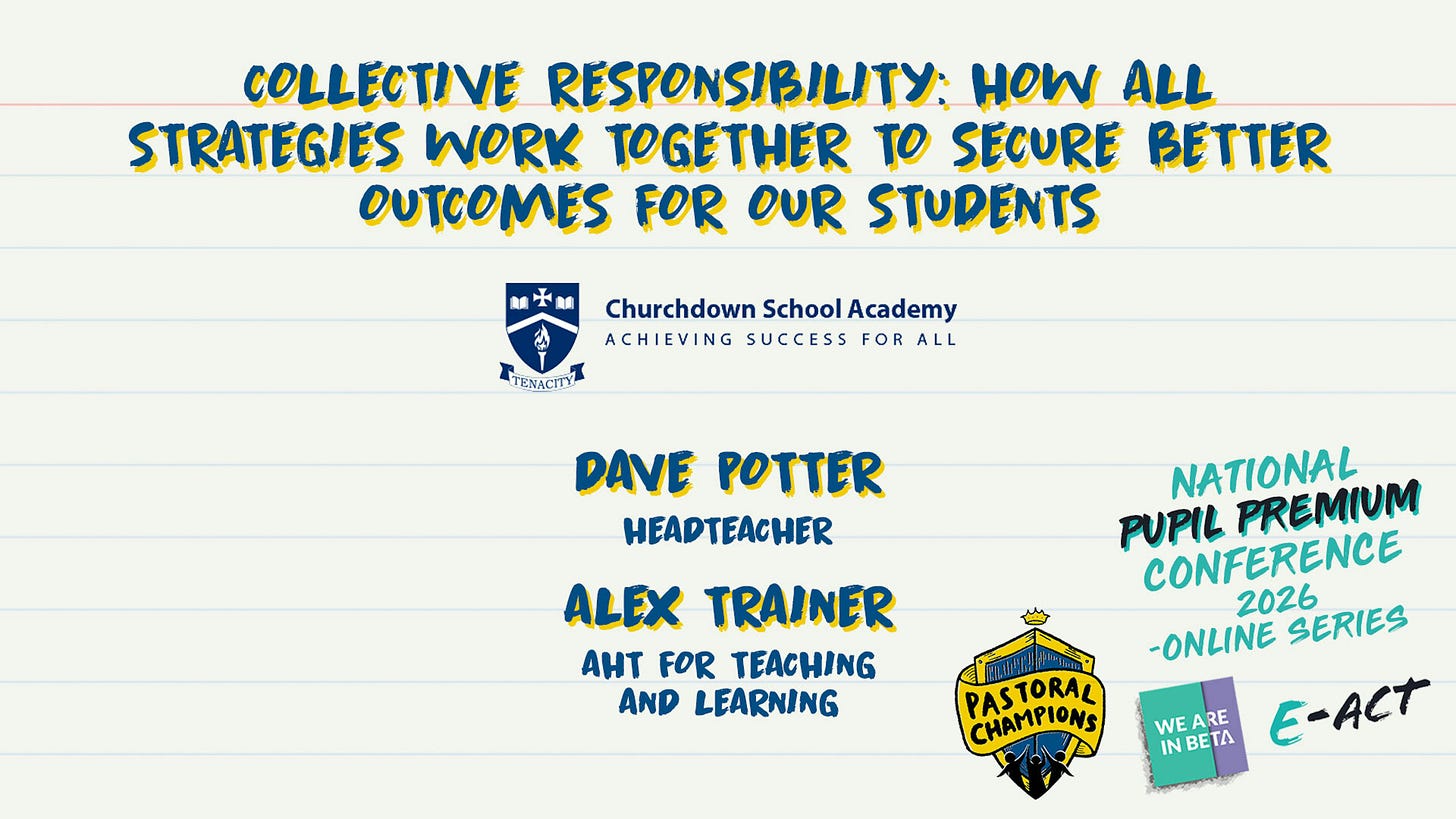
On Thursday June 4th, Dave Potter (Headteacher) and Alex Trainer (Assistant Headteacher) will be talking about:
"Collective Responsibility: how all strategies work together to secure better outcomes for our students"
They'll be sharing:
How to establish strong intentionality and active engagement of students in lessons and wider school life. Once a student disengages from their school, it is often too late and there are multiple opportunities for them to be brilliant that are missed.
How to work with staff to fully believe in this principle of engagement and know their role and daily actions to achieve it.
How to plan for all students to be present not catch them being absent by making a school where every student can thrive and want to attend.
📆 Thur, June
🕓 4:15pm
I am an Arsenal fan. I am gutted that we lost the Champion League Final last night.
But if had you told me in August last year that we would finish Champions of England and runners up in the fiercest competition in world football, I probably would have bitten your hand off.
So what has Arsenal’s journey taught me about leadership, teaching, community building (and the battles in our minds when “Self 1” is kicking in)?
Culture is important - when Arteta became manager, a small number of big egos were underperforming and halting progress. He moved them on and built a team around players who bought into a new culture and vision.
Progress take times - Save the FA cup in 2020, results did not come early for Arteta. It would not have been surprising if he was removed for finishing 8th between 2019 and 2021. But the board stuck with him. Results take time. Trust the process.
Be grateful for what you have not bitter about what you have lost - when he Arteta was asked what he said to the players after they lost the UCL Final he said he thanked the players - for what they have achieved and what they have given to the cause.
Which of these is most relevant to your MAT, school or classroom?
Would love to hear from you, even if you’re not an Arsenal fan. All positive vibes will be gratefully received today!
Just reply to this email :)
📱 Get 21,160 school leaders and teachers in your pocket - download We Are In Beta.
🚀 Looking for a new role? Get updates about specific jobs you’re looking for before anyone else.
🆕 New here? Catch up with previous editions, podcasts and webinars via the archive.
Comments
Nothing yet. Say the first thing.
Sign in to join the conversation.