
Whenever someone asks me why I love history, I never quite know how to answer, because the truthful answer has very little to do with history as it was taught to me in school. I don’t remember history through dates, dynasties or examination questions. If you asked me to list every ruler of the Delhi Sultanate in chronological order, I would probably embarrass myself. Yet I can spend hours standing in front of an old baoli wondering about the hands that carved its stones, or walk through a forgotten graveyard imagining the conversations that once unfolded there. Somewhere along the way, history stopped being a subject and became a way of looking at the world.
I think the first hint of that came long before I ever picked up City of Djinns. Like most students, I encountered The Diary of Anne Frank because it appeared on a school syllabus. It was supposed to be another chapter to read, underline and eventually reproduce in an examination. Instead, it became an obsession. I spent weeks reading everything I could find about Anne Frank, about Amsterdam under Nazi occupation, about the Holocaust and about the people whose lives intersected with hers. Looking back, I realise that I wasn’t captivated by the enormity of history so much as its intimacy. Anne Frank wasn’t simply a victim of one of humanity’s darkest chapters; she was a teenager worrying about friendships, family, love and the future. Through her diary, history ceased to be an abstract collection of events. It became a young girl writing by candlelight, unaware that the thoughts she scribbled into a notebook would one day become part of the world’s memory. That discovery stayed with me. I began to understand that history was not only what happened, but what it felt like to live through what happened.
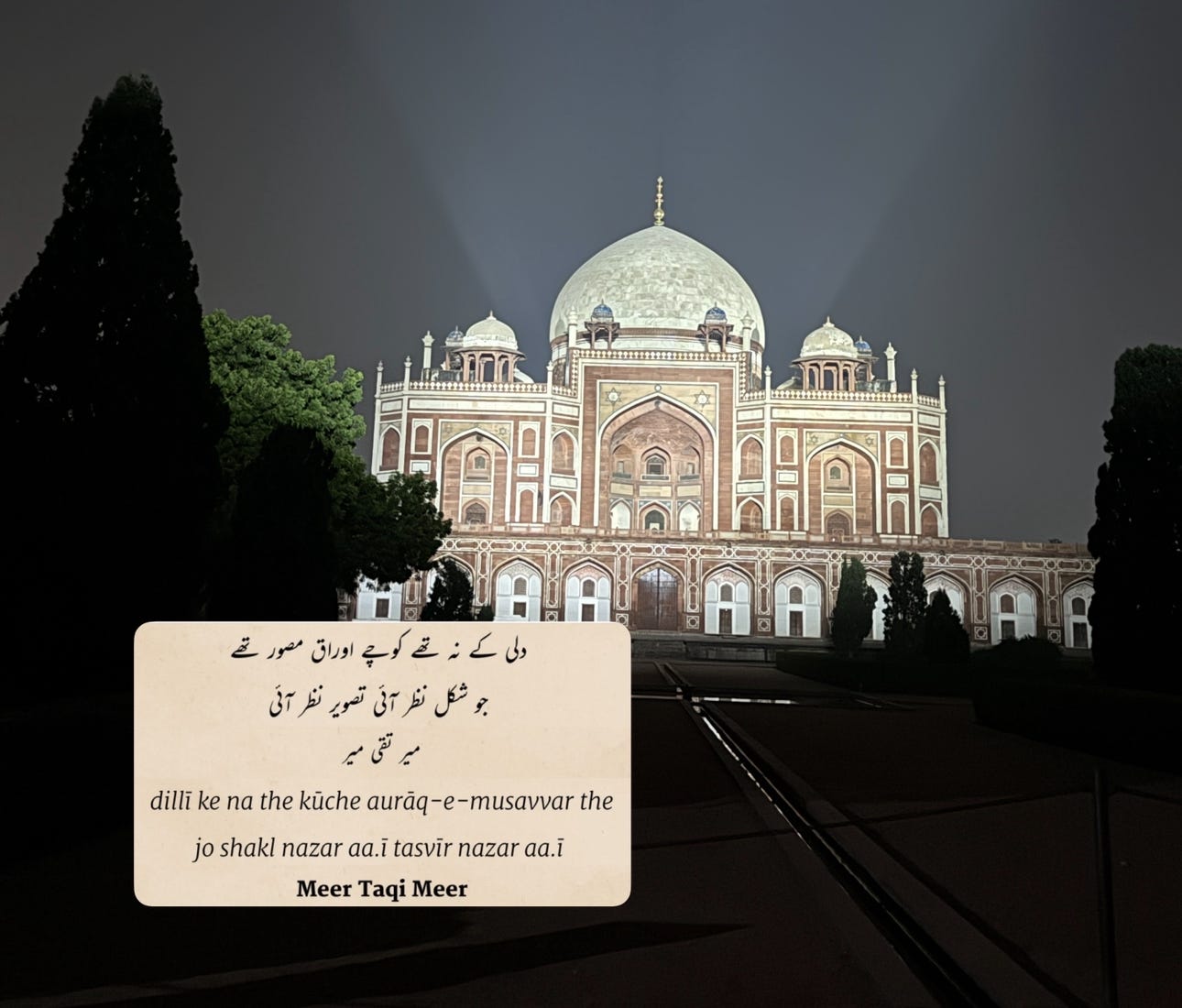
Growing up in Delhi only deepened that feeling. Before I knew the names of dynasties, I knew the pleasure of wandering through ruins. My childhood memories are filled with Sunday picnics in Hauz Khas, running around the remains of Alauddin Khalji’s madrasa with the kind of carefree curiosity only children possess. Lodhi Gardens was never introduced to me as a historical site; it was simply where families gathered on winter afternoons, where children played cricket beside fifteenth-century tombs and where old men discussed politics beneath trees that had witnessed centuries of change. One of my earliest museum memories is the Indian Air Force Museum, only a short walk from my house, where my uncle, who served in the Air Force, would patiently explain the aircraft displayed there, many connected to the Kargil War. Even then, I found myself wondering less about battles and more about the people who occupied those cockpits, the families who waited for them to return and the lives that continued long after the headlines disappeared. Looking back, I realise that Delhi had been teaching me history all along. I simply hadn’t learned its language yet.
When I was sixteen, I wandered into Faqir Chand Bookstore in Khan Market, as I had done countless times before, and noticed a book with a title that sounded more like folklore than history. City of Djinns. Before I even turned it over, the title had already won me over. What kind of city belonged to djinns? Then I noticed the subtitle, A Year in Delhi, and there was no question that I was taking it home. Like many people born in this city, my relationship with Delhi is difficult to explain. I have lived elsewhere, travelled elsewhere and fallen in love with other places, but Delhi remains the place through which I understand myself. It is the city that shaped my earliest memories, my curiosity and, in many ways, my imagination. I thought I was buying a history of Delhi. What I was really buying was a different way of seeing not only Delhi, but history itself.
The most remarkable thing about City of Djinns is that it quietly refuses to accept the version of history many of us inherit. School had taught me that history belonged to emperors, generals and governments. Dalrymple seemed interested in everyone else. Yes, the Mughals appear, the British appear, and the great upheavals of Delhi’s past are all there, but they never overshadow the ordinary people who have carried the city’s memory across generations. He spends time with descendants of Mughal nobility living lives far removed from imperial splendour, with caretakers of Sufi shrines, with practitioners of traditional medicine, with members of the hijra community and with Anglo-Indian families whose stories rarely occupy the centre of historical narratives. He listens far more than he lectures. Slowly, almost without my noticing, he convinced me that history survives not because kings build monuments but because ordinary people continue telling stories.
One encounter in the book has remained with me more than any other. Dalrymple’s conversation with the novelist Ahmed Ali in Lahore is not merely an interview with an ageing writer; it becomes an encounter with memory itself. Decades after leaving Delhi during Partition, Ahmed Ali still carried the city within him. He remembered its language, its manners, its poetry and, above all, its shared culture. The Delhi he described was one where identities were shaped through centuries of exchange rather than separation, where traditions overlapped and influenced one another until they became inseparable. Whether every memory was perfectly accurate almost seemed beside the point. What mattered was that a city continued to exist inside a human being long after he had been forced to leave it.
Those pages moved me in ways I still struggle to explain. I remember closing the book and thinking about the strange endurance of cities. Buildings collapse, governments change, neighbourhoods transform, and generations pass, yet something survives. Sometimes it survives in architecture. Sometimes in language. Sometimes in food or poetry. More often than not, it survives in memory. If I could speak to Ahmed Ali today, I think I would tell him that the Delhi he mourned has undoubtedly changed, as every city must, but I would also tell him that its generosity has not entirely disappeared. You still hear Urdu verses at literary gatherings. You still find people of different faiths standing quietly together at Sufi shrines. You still encounter the impossible contradictions that make Delhi feel less like a city and more like an argument that has been unfolding for a thousand years. The Delhi he loved is not frozen in time, but fragments of it continue to live in the people who refuse to let it be forgotten.
What fascinated me most was that Dalrymple never treated memory as something secondary to history. In many books, personal recollections are used merely to illustrate larger events. Here, they become history. An old conversation, a family anecdote, a forgotten tradition or the recollection of someone who witnessed a vanished Delhi often reveals more about the city than official records ever could. It reminded me of Anne Frank again. The diary had not mattered because it summarised the Second World War; it mattered because it revealed how history entered the life of one ordinary person. I began to realise that the stories we inherit from our grandparents, the recipes passed down through families, the names people continue using for streets long after they have officially changed, these are not trivial details. They are the threads from which history is woven.
Perhaps this is why the book also changed the way I think about writing. Before reading it, I believed good nonfiction was about collecting information. Afterwards, I realised it was equally about collecting people. Facts can tell us when something happened, but only stories can tell us why it mattered. Dalrymple approaches strangers with genuine curiosity, as though every person he meets knows something that no archive can preserve. That idea has stayed with me ever since. Whenever I write now, I find myself drawn less towards grand conclusions and more towards individual lives. I want to know how people remember the places they come from, what objects they choose to keep, which stories they tell repeatedly and which silences they carry with them. Somewhere between the pages of City of Djinns, I learnt that curiosity is a form of respect.
The book also transformed the way I walk through Delhi. I have lived here all my life, yet after reading it, I realised how little I had actually seen. I began noticing inscriptions on old walls that I had walked past hundreds of times. I found myself slowing down in Lodhi Gardens, wondering not only who was buried inside the tombs but who had built them, who had repaired them and who continued sweeping their courtyards each morning. A peepal tree growing through an old wall no longer seemed like an accident of nature; it became a reminder that even ruins continue to live. Delhi revealed itself as a city where centuries coexist. A Mughal monument, a colonial boulevard, a modern metro station and a roadside tea stall can all occupy the same street without cancelling one another out. The city is not layered neatly like chapters in a textbook. Everything exists at once.
A few weeks ago, I had the opportunity to meet William Dalrymple in Delhi and have my old copy of City of Djinns signed. As I handed him that worn paperback, filled with years of folded pages and pencilled notes, I realised that what I wanted to thank him for had very little to do with the book’s scholarship. I wanted to thank him for giving me permission to believe that history belongs to everyone. That a conversation with an elderly novelist can illuminate a city as profoundly as the chronicle of an emperor. That a forgotten shrine deserves as much attention as a famous fort. That ordinary people, with their memories and habits and stories, are not footnotes to history but its custodians.
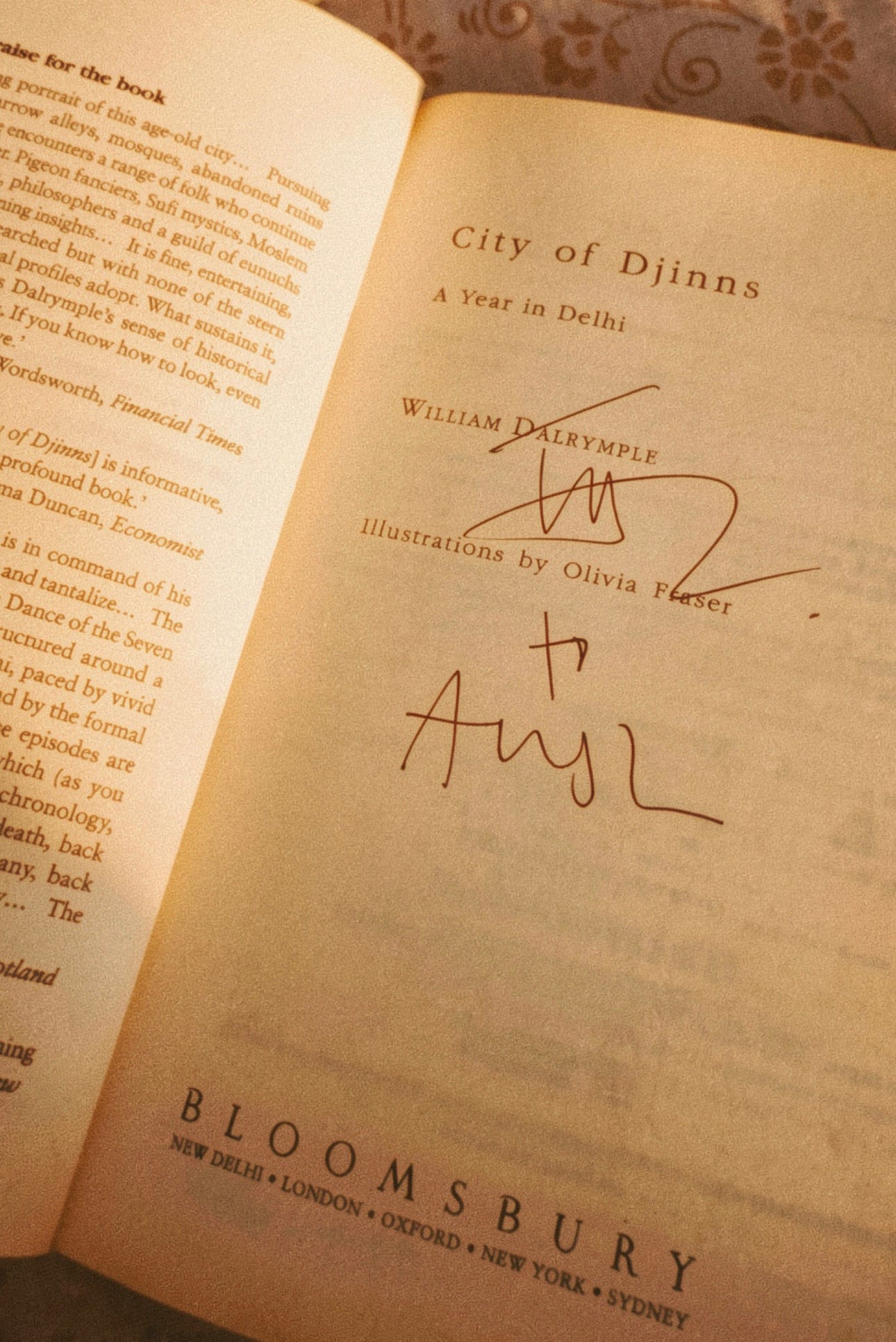
When I came home that evening, I placed the signed copy back on my bookshelf, but it no longer felt like just another favourite book. It felt like a marker between two ways of seeing the world. Before reading it, I thought history was something preserved in museums, locked behind glass and explained by plaques. After reading it, I began to understand that history is far more fragile and far more alive than that. It survives in conversations between strangers, in family stories repeated over dinner, in old photographs tucked inside drawers, in languages that refuse to disappear, in the memory of a city carried across a border, and in the quiet persistence of people who continue remembering long after the world has moved on.
That, more than anything else, is what City of Djinns gave me. It did not simply make me admire Delhi more deeply. It taught me that every city is, at heart, a collection of remembered lives. The monuments may be what we photograph, but it is people who keep a place alive. And perhaps that is the most beautiful lesson history has to offer: that long after empires crumble and rulers become names in textbooks, what endures are the stories ordinary people choose to carry forward, generation after generation, until they become the memory of a city itself.
No posts
Comments
Nothing yet. Say the first thing.
Sign in to join the conversation.