
This article follows on from a previous piece covering the ceasefire negotiations between the US and Iran. If you haven’t read that one, it’s worth doing so for additional context.
The shaky start to the deal
When the ceasefire was announced just over two weeks ago, one of the key provisions, according to Iranian state media, was a “limited daily passage” protocol for the Strait of Hormuz. While some ships passed through, it was largely in line with the previous days, around a dozen per day. A wider reopening didn’t fully develop. On the 18th, traffic peaked at 53 before collapsing back down to the levels of the previous weeks.
The negotiation breakdown was fairly immediate. Either there was a misunderstanding about what the ceasefire was, or Iran attached additional conditions to the reopening of the Strait. They demanded that the conditional ceasefire agreement also cover Hezbollah and Israeli operations in Lebanon. Israel and the US rejected this demand outright.
What has made the situation harder to read from the outside is an apparent growing fracture within the Iranian government. With much of Iran’s senior leadership killed over the preceding months, different factions appear to be vying for control. The hardline IRGC has shown little appetite for concessions of any kind, while other figures within the government structure appear more open to negotiation.
In Venezuela, it seems that the equivalent, more moderate factions were negotiated with in order to ensure a smoother outcome after the capture of Maduro. In Iran, the IRGC appears to be largely in control. While this is a working theory rather than a confirmed fact, it would go some way to explaining the pattern of contradictory signals coming out of Tehran in the past month.
In a series of social media posts on April 9th, Trump claimed Iran was charging fees to tankers attempting passage of the Strait.
“There are reports that Iran is charging fees to tankers going through the Hormuz Strait — They better not be and, if they are, they better stop now!”
-Donald J. Trump, Truth Social
He followed this with a second post calling Iran’s handling of the passage of oil.
"Iran is doing a very poor job, dishonorable some would say, of allowing Oil to go through the Strait of Hormuz. That is not the agreement we have!
-Donald J. Trump, Truth Social
On April 11th, it briefly looked like a partial opening might be underway. Reuters reported that Iran had allowed a pair of Chinese supertankers carrying oil for energy giant Sinopec to cross the Strait, along with an additional Liberia-flagged vessel. It was a narrow, selective opening to Iranian-aligned states. It would also prove to be short-lived.
The US blockade
On April 12th, Trump announced that the US Navy would blockade “any and all Ships trying to enter, or leave, the Strait of Hormuz,” and would interdict any vessel that had paid a toll to Iran.
He drew a comparison to the blockade implemented against Venezuelan ports, stating that it would be similar, but to a higher level.
The Venezuela blockade sharply curtailed that country’s oil exports, with only ships associated with Chevron and bound for the US continuing to operate as normal. The US blockade of Hormuz will block ships that have used Iranian ports, or are cooperating with Iran’s tolling system.
While the Strait had been effectively closed to most international shipping, Iran had continued to export its own oil and was partly benefiting from the elevated prices the disruption was causing. The US blockade was designed to stop Iran from being the only one determining who could transit the Strait.
Oil Prices: High and unstable
Throughout Operation Epic Fury, oil markets have been swinging sharply in both directions. Prices have spiked repeatedly on escalating tensions, then fallen back each time Trump announced a deal was close, that Iran was on the verge of agreeing, or that the Strait was about to reopen. When those statements proved premature, prices climbed again. Since the start of the campaign, oil prices have bounced between around $85 and $110 per barrel compared to the $65 before the conflict began.
As so much of the world’s oil passes through the Strait, the impact across the globe has been significant. Limited supply and dwindling reserves have led to queues at petrol stations in less prepared countries and significant flight cancellations across Europe.
A brief, chaotic reopening
April 17th produced one of the more chaotic days of the crisis in the Strait. Iranian Foreign Minister Seyed Abbas Araghchi announced that, in line with the ceasefire in Lebanon, passage through the Strait of Hormuz was “declared completely open for the remaining period of the ceasefire” for all commercial vessels. Trump acknowledged the opening but added that the US naval blockade would remain “in full force and effect as it pertains to Iran only.”
In response to this apparent good news announced by both sides, a large number of vessels began heading toward the Strait to exit the Gulf. But within hours, dozens of the ships had turned back.
This was because of a new statement out of Iran, this time from the parliament speaker, Mohammad Bagher Ghalibaf. Ghalibaf stated that the Strait would not remain open while the US blockade was still in place, and any vessel wishing to pass still required explicit IRGC permission. The brief opening had collapsed almost as quickly as it was announced. It was another example of the disagreement in fundamental agreement conditions between the US and Iran.
On April 18th, the UKMTO (UK Maritime Trade Operations Centre) reported that an unknown projectile near the Strait had struck a vessel. The same day, IRGC gunboats attacked and fired upon the Sanmar Herald, an Indian-flagged crude oil tanker that had departed the UAE only the day before, bound for India.
According to Reuters, Iran broadcast the following radio message to ships in the Strait:
“Attention all ships, regarding the failure of the U.S. government to fulfil its commitment in the negotiation, Iran declares the Strait of Hormuz completely closed again. No vessel of any type or nationality is allowed to pass.”
Two days ago, the UKMTO reported that a further two commercial vessels had been attacked by Iranian gunboats. This time, the ships were boarded and seized by Iran. Both were MSC-operated cargo ships, the MSC Francesca and the MSC Epaminondas.

OSINTtechnical@Osinttechnical
Iran's IRGC Navy has released footage of its forces seizing a pair of container ships in the Strait of Hormuz this morning.
9:17 PM · Apr 22, 2026 · 879K Views
555 Replies · 633 Reposts · 3.32K Likes
According to maritime tracking group TankerTrackers.com, those two seizures bring the total number of foreign vessels currently being held involuntarily by Iran to six. The oldest has been in Iranian custody since October 2022.
Three Carrier Strike Groups
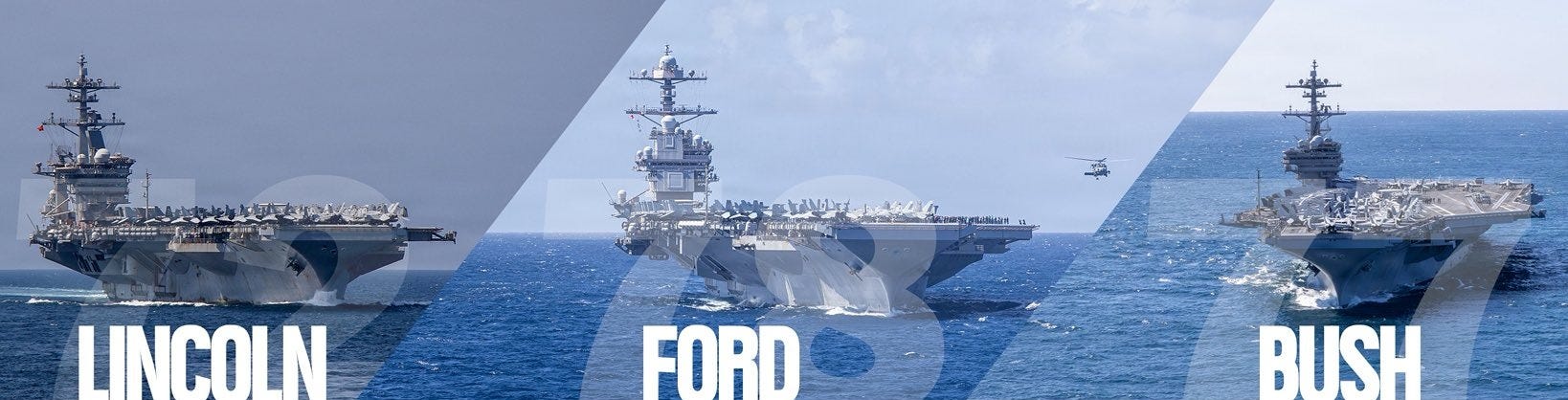
With the arrival of the USS George H.W. Bush carrier strike group (CSG) south of Iran, CENTCOM has confirmed that the United States now has three Navy carrier strike groups operating in the Middle East simultaneously. This is the first time that has occurred since the 2003 invasion of Iraq.
This new CSG arrival brings the total US Naval CSG deployment in the region to 12 ships, 200+ aircraft, and more than 15,000 sailors and marines. That is a significant concentration of naval and air power, and goes beyond what would be needed to enforce the blockade.
Israeli media outlet N12 has reported that Trump has set a deadline of this Sunday (26th April) for a deal with Iran. This is unconfirmed, and other sources suggest that it is instead the end of next week or that there is no hard deadline at all. If there is any substance to a Sunday deadline, the positioning of three carrier strike groups would indicate preparation and willingness for a renewed strike campaign, possibly to a greater degree than before.
What to look out for?
As suggested in the last post on Iran negotiations, the purpose of the ceasefire was very likely to allow the White House to avoid carrying out its threats of total annihilation of Iran. It also bought both the US and Iran time to reorganise and regroup.
While there was a possibility of a resolution to the conflict, it was very clear from the start that each side had red lines that directly contradicted the other side, making constructive negotiations nearly impossible. Added to that was the clear disconnect for what the ceasefire itself even was and what it covered. Both sides made numerous statements over the past few weeks regarding agreements or terms as though they were understood and accepted by both sides. Only for the other to quickly make their own statements contradicting this.
Negotiations were held in Pakistan last week that didn’t come to a positive close. Today, reports are that Iran is sending another delegation to Pakistan to resume talks. Whether this is a genuine effort to come to a resolution or is intended rather to avoid the possibility of US military action being taken on Sunday.
Once again, this would mirror what was seen with the ‘goodwill’ shown by Russia in the Ukraine negotiations. Deadlines were set by the White House for deals to be made, then just before they were passed, Russia would show willingness to make an agreement, and the deadline would be pushed. No deals were reached, and the cycle repeated. It looked as though this was going to be the case again with Iran. We will see this coming week if that’s true.
Comments
Nothing yet. Say the first thing.
Sign in to join the conversation.