

This article is adapted from our High Intensity Military Urban Combat book which we plan to publish here on Substack in serial form. We offer special thanks to the courageous members of our team who have volunteered to deploy overseas to current conflict zones. Their real-time feedback has proven invaluable for our analysis.
How must urban combat tactics change if the United States and its allies find themselves in a high-intensity conventional war against a modern, combined arms force like Russia, China or North Korea? While many tactics and general principles will remain the same, there are some very important differences between high-intensity conventional urban combat and the sort of precision Close Quarters Battle (CQB) that the U.S. military adopted while fighting low-intensity conflicts in Iraq and Afghanistan.
Modern military doctrine for CQB and Military Operations in Urban Terrain (MOUT) traces its origin to hostage rescue tactics. Beginning with the British 22nd Special Air Service Regiment (SAS), counterterrorist units became the experts in room clearing and CQB. Because their focus was hostage rescue, their tactics demanded a very high degree of precision and target discrimination.
After September 11, 2001, the United States and its allies found themselves embroiled in numerous counterinsurgency and low-intensity conflicts around the globe. Because these conflicts also demanded tactics that focused on precision and target discrimination, conventional military units were able to adapt counterterrorist CQB tactics (and in some cases law enforcement tactics) to the new battlefield. However, in the event of a conventional war, urban tactics may need to evolve once again. Below are six critical factors that military units will need to consider when preparing for high-intensity conventional urban combat:
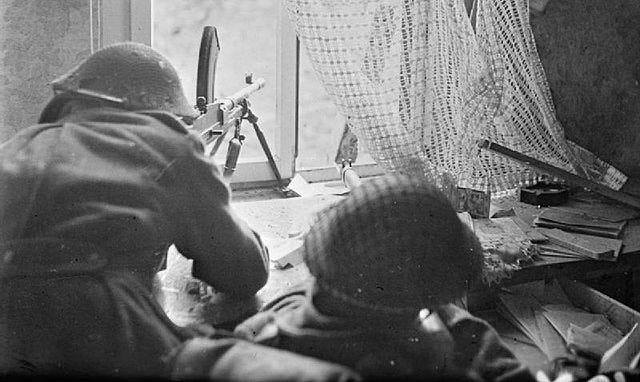
In a combined-arms urban fight, it is likely that civilians will either have evacuated prior to the battle or will be doing everything they can to stay out of the way. Even if civilians remain on the battlefield, accidental civilian deaths are often accepted as a tragic but unavoidable reality of high-intensity warfare. As a result, military commanders on both sides will have much more freedom in their application of heavy weapons and firepower. Tactics like tossing fragmentation grenades through windows, firing machineguns through walls and using airburst artillery to clear rooftops will suddenly become both acceptable and necessary. This will require breaking many habits learned during the Global War on Terror (GWOT).
When facing an adversary armed with machine guns, mines, booby traps, high explosives and artillery, the task of clearing an enemy-held room or building becomes much more dangerous. A platoon or company-sized element might clear a building successfully, only to die in a massive explosion as the enemy detonates pre-positioned demolition charges, bringing the entire building down. In many cases, units will want to avoid going into a room or building at all and instead use firepower to neutralize threats from a distance.
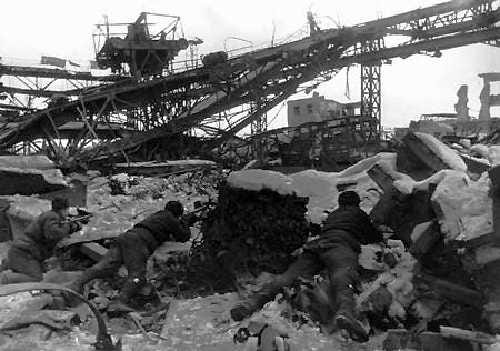
The intense employment of machine guns, artillery and explosives will greatly change the urban landscape. Military units used to clearing normal rooms in a counterinsurgency fight will be surprised when they open a door and almost fall multiple stories down because half of the building is gone. Buildings may be damaged, unstable, on fire, or filled with smoke. When buildings are completely destroyed, the tangled mass of rubble can provide even more effective defensive positions. Military units might benefit from talking with firefighters about how to move and operate in heavily damaged buildings.
Enemy defensive measures will make the urban terrain even more complex. Enemies might create holes in the floor so they can drop grenades into the rooms below or cut holes in the walls to use as firing/observation ports. Enemies might booby-trap stairwells or rip out the stairs completely and instead rely on retractable rope ladders. Both sides will also avoid using doors if possible and instead use explosives, heavy shells or armored vehicles to “mouse-hole” through walls. Military units might want to study World War II battles to relearn many “dirty tricks” of urban combat that have not been used for decades. Studying contemporary high-intensity conflicts like Ukraine can also prove useful.
Sewers and subway tunnels will become much more important in conventional urban warfare since they offer hidden routes to move around the city without being exposed to direct fire and artillery. However, these narrow passages can also become deathtraps if the enemy clears them using explosives or flamethrowers. Both sides will need to learn new techniques for fighting and surviving underground.
Casualties in an urban fight are typically very high. Units must prepare mentally, physically and tactically to absorb a large number of casualties and keep fighting. More importantly, on the modern battlefield, combatants on both sides may wear highly effective, modern body armor. This will save more lives but it may also mean that a much higher percentage of casualties will be wounded (WIA) as opposed to killed (KIA). A large number of WIA presents a far more difficult logistical challenge for evacuation than an equal number of KIA. Military forces might need to reorganize and augment their MEDEVAC and medical treatment capabilities to deal with numbers of WIA that could exceed any historical precedent.
The six points above are only a few of the many new urban warfare challenges that will emerge in the event of a high-intensity conventional conflict. Special Tactics staff members continue to study both historical and contemporary cases to predict what urban warfare will look like should the U.S. and/or NATO become involved in a major conflict. In future High-Intensity Urban Warfare articles we will share some specific tactics that have proven and are currently proving effective.
We hope you found the short article useful and once again we welcome your reactions, comments or suggestions below in the chat area. We want to promote constructive discussions on tactics with people from various tactical backgrounds and experience levels.
Comments
Nothing yet. Say the first thing.
Sign in to join the conversation.