
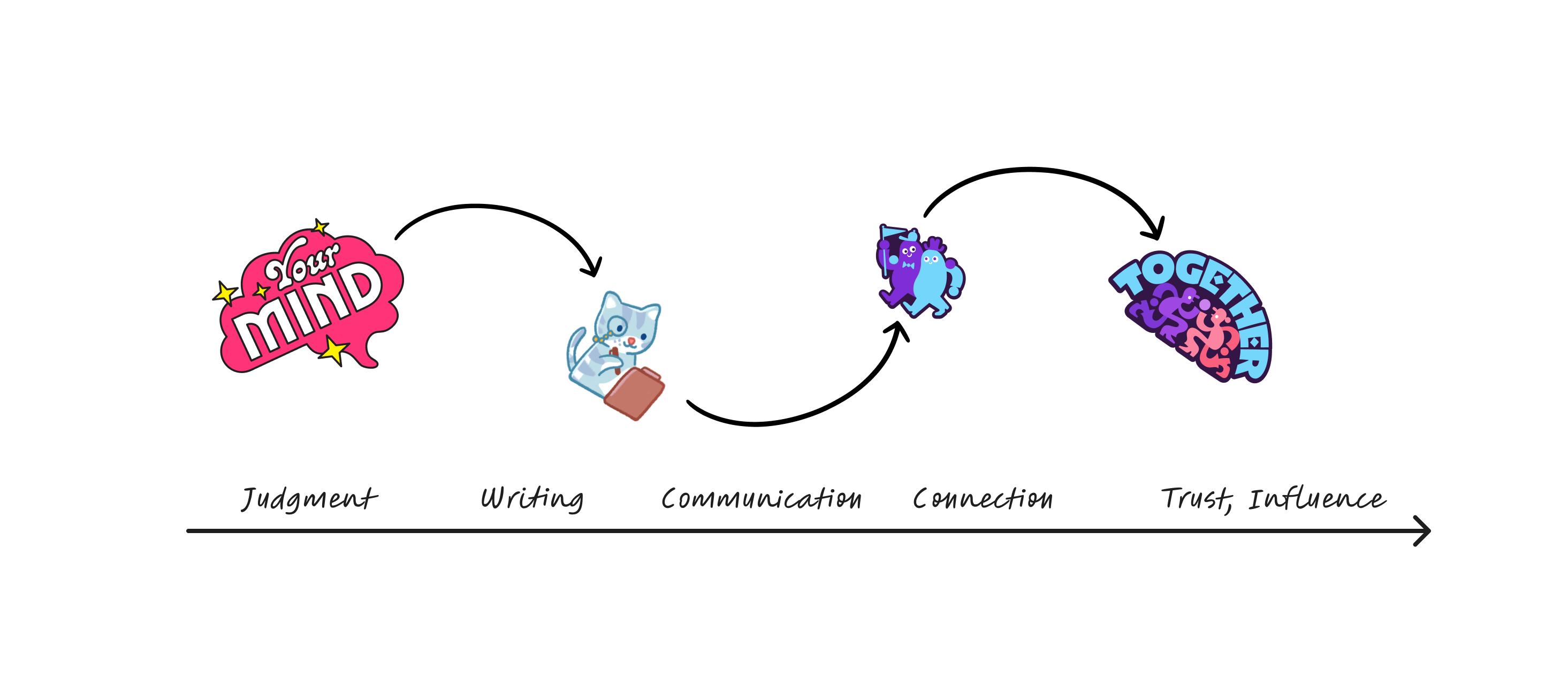
Reflection: writing is a form of communication, translating ideas from our minds to paper. Communication is a form of building connection, from us as the messengers to our receivers. And connection is how we build mutual trust, and ultimately, better influence.
AI-generated content is now abundant.
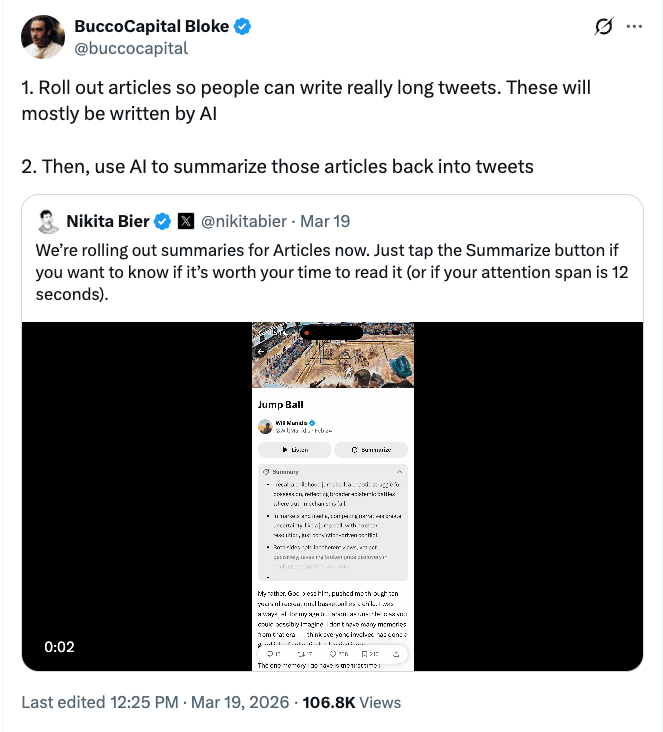
AI-generated short-form videos are flooding our feeds, and AI-generated writing is becoming predominant than ever before. And we are already experiencing the inevitable first/second order effects of this phenomenon, for example the need for new tools to find signal in the middle of a lot more noise, ex:
Closer to home for us product folks…
AI is fast becoming a primary interface for product building, spanning research, analysis, prototyping, coding, collaboration. To the surprise of some, the oft-maligned written ‘plan’ or ‘spec’ or ‘PRD’ has become even more important and influential than ever before - even if it is being generated or packaged or presented in new ways. The traits of effective plans/specs/PRDs remain durable, if not more important as we lean-in more on AI tools: synthesizing context, specifying goals, expressing guiding principles, clarifying instructions and constraints and aligning expectations of ‘what good looks like’ in terms of outputs and outcomes. And if you keep pulling on the thread, there is an inevitable implication for product builders staring at us.
The ability to map strong judgment to influential outcomes, via writing, is now a cardinal skill for all product builders.
Here is the rub though: writing is (and has always been) a vehicle for us to do this mapping. It is a step in the journey, but the steps around it are important - and connected. For example, while writing is not the same as thinking, it tends to acts as a forcing function for ensuring that our judgement can translate to others through clarity. Similarly, collaboration around written artifacts is not the mechanical exercise of reading or consumption. It is a forcing-function to build stronger cohesion and mutual trust across the team1. The influence and better outputs/outcomes we seek are all downstream of that.
Allow me to tell you a quick story. A couple of months ago, as part of a brainstorming exercise I was facilitating, one of the participants shared their ideas with me asynchronously in the form of a ChatGPT-created proposal doc. As I began to parse inputs from their doc to coalesce it with the stickies & chicken-scratch from others, I had a funny realization. Unlike the others, I couldn’t automatically assume that the ideas contained in the doc were ones they really believed in. Notably, this wasn’t because of any specific reason for me to be doubtful; it was purely because of a new degree-of-separation that was introduced when they chose to write and share with AI.
I am choosing to call this new pattern an “uncanny trust valley”: the potential trust-deficit that emerges when a human expresses their ideas or thinking via AI, creating just enough distance between brain to paper to allow doubt to form. To me, the uncanny trust valley is surmountable. And it doesn’t require us to avoid using AI in writing altogether. But if you name the problem, you are halfway to solving it. The solution in this case is to choose to use AI in your writing process - or prototyping, or coding, etc. - in ways that build deeper trust with others, rather than losing it. And to that end, let me sharpen my assertion from earlier:
The ability to map strong judgment to influential outcomes, via writing that builds more confidence, is now a cardinal skill for all product builders.
Have a question or musing of your own?
Feel free to drop a comment below, or DM me.
Enjoyed today’s musing?
Consider sharing with a colleague or friend who may benefit too.
Interested in more of Waqas’ Musings?
Find all my past essays at https://waqas-sheikh.com, and subscribe below 👇
This is still true, even if AI Agents are part of your team.
Comments
Nothing yet. Say the first thing.
Sign in to join the conversation.