
In recent months, a surprising pattern has emerged around AI. Contrary to what many people predicted (and in some cases, sold to us), the use of AI at work has not reduced our workload; it’s had the opposite effect. Those of us immersed in AI work are working more than ever before - taking on more tasks, working longer hours, and operating with more intensity. The net effect of using AI at work has been an expansion of work, not a contraction.
There are many factors that contribute to this - the raw power of the tools unlocking new tasks1 and unprecedented levels of multitasking, the novelty and complexity of orchestrating work across multiple AI agents and the corporate & socio-cultural pressures at play (both explicit & implicit), etc. But in trying to understand this pattern, this quote from a recent HBR article2 resonated with my personal experience the most:
We found that employees worked at a faster pace, took on a broader scope of tasks, and extended work into more hours of the day, often without being asked to do so. Importantly, the company did not mandate AI use (though it did offer enterprise subscriptions to commercially available AI tools). On their own initiative workers did more because AI made “doing more” feel possible, accessible, and in many cases intrinsically rewarding.
Today’s essay is not about AI. It is about the nature of our work. And how, when it comes to our most important and impactful product work, there is often more depth to it than we may think. That depth remains invisible to us, unless we choose to go looking for it, or it reveals itself.
Many years ago, as an ambitious mid-career PM3, I found myself in the midst of a time management crisis. The scope and span of my work had increased dramatically, and I hadn’t caught up to it yet. As someone who’d prided myself on being able to juggle lots of things, without dropping any balls, I was starting to drop balls more often and more visibly than ever before. My teammates at the time were very gracious, my manager was empathetic, and my stakeholders and x-team partners were… skeptical.
With the benefit of hindsight, I can now describe my past approach to time management as naive. I assumed that time management was an exercise in covering as much ground as possible, as efficiently as I could. Implicitly, I treated my priorities as either things that were preordained for me, or things that would reveal themselves to me on a day-to-day, week-to-week basis. My approach to where I spent my time was less about priority management, and more about priority absorption.
When we manage our time this way, we inevitably run into a few common failure modes. Firstly, the slope from ‘busy’ to ‘oversubscribed’ to ‘overwhelmed’ is as slippery as a banana peel. Secondly, no matter how good you get at grooming your backlog of priorities, the backlog keeps growing. And finally, we assume that the skill to get really good at is context-switching. But that means that instead of focusing on focus, we focus on minimizing time + effort per task, while still trying to absorb more and more.
I lived this story (a familiar one to many of you, I presume) for quite a while. And as any reasonably smart PM would, I tried prioritizing my investment of time, focus & energy as best as possible, to make sure the bulk of it went to my most important priorities. But even with that, at best, my TODO list resembled a diversified financial portfolio that a Charles Schwab might recommend to you:
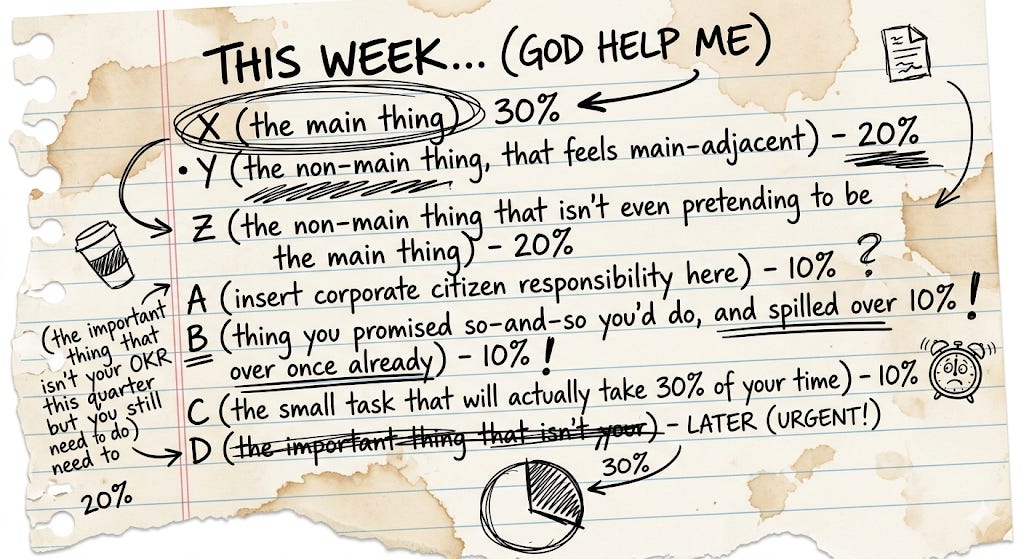
At some point, after further attempts to adhere to the Eisenhower matrix (do/delegate/defer/delete) followed by declaring yet another calendar bankruptcy - it became clear that I wasn't dealing with a time management problem per se. It was something more fundamental in my approach, but something I didn't have a name for yet.
As part of that introspection, and in a moment of equal parts vulnerability and clarity, one day I ended up writing down 3 new commitments that I made to myself, and shared with my closest colleagues around me too. And without exaggeration, these commitments ended up as the foundation of a transformation in how I approached work - one that sustains to this day.
Commitments
I will never let my active priorities grow past 3-4 (and my default answer to new things was ‘no’ unless I had space).
I will always have a clear idea of what it means to get to ‘done’.
My ‘definition of done’ would be outcome-based, not task-based.
As many of you may imagine or know, these commitments helped me - significantly. They were the first steps I had to take, to assume control of my work in a new way. By focusing on fewer things I could go deeper on, I immediately benefited from more focus. And I also clawed back a lot more of my own energy than before; I realized that the cost of constant context-switching was both mental and physical.
But counterintuitively, this new approach did not actually save me more time. In fact, I found that I ended up working both more and longer. My ‘main things’ - the big rock priorities that were already known to be my ‘P0’s’ in nature - ended up absorbing 40-50% of my time. Even 100% on certain days or weeks. The work expanded to fill the extra time that I now allocated to it. But not in a bad way; rather, in a focusing and energizing and impactful way. The extra time allowed me to be more strategic, more creative, more expansive, more enterprising - and more confident. The main things took up more of my time, but the payoff was higher.
The more I stuck to this new regimen, the more I realized what I was missing before. Unbeknownst to me, I was silently paying a massive opportunity cost, in terms of the quality and depth of my work, by stretching myself too thin. While I prided myself on being a skilled juggler, I was really meant to be a sculptor and a diver - someone who builds with craft and goes deep enough to develop real expertise. The wells of product craft run deep, but you can only find that out by choosing to dive into them.
Looking back, I now have a name for this phenomenon. Depth blindness is a specific kind of blind spot, where we are unaware of the true bounds of how deep we can go, for our highest leverage work. This isn’t just a time management or prioritization problem, but a perceptual issue when it comes to our work. And as with other blind spots, they tend to reveal themselves to you reactively (unless you proactively seek out the light).
The idea that tasks vary in depth and leverage wasn't new to me. But the idea of primarily designing how you manage your own time, energy & focus around leverage was a step further than that4. And to actively consider the intangible opportunity cost of under-investing in our highest leverage creative and knowledge work was certainly new - or perhaps, a more advanced lesson.
The idea of avoiding depth blindness goes beyond the surface-level conventional wisdom of “do fewer things better”. It is a call to go deeper than you may think you need to, and to ‘over-invest’ where you know the work matters the most. When priorities carry deep leverage, you can always put more time into them, without regret. This is a core principle that you can apply to yourself - and to your products and teams.

In my mind, an under-appreciated reason why AI is expanding our workload is that it makes our depth blindness more visible and visceral. By making it lightning fast to go from 0→80 in creative work, it makes the journey from 80→100 - and 100 → 200 and so on - more precious, more painstaking and precisely where human judgement & craft is most crucial.
Have a question or musing of your own?
Feel free to drop a comment below, or DM me.
Enjoyed today’s musing?
Consider sharing with a colleague or friend who may benefit too.
Interested in more of Waqas’ Musings?
Find all my past essays at https://waqas-sheikh.com, and subscribe below 👇
Somewhere along this journey, I first came across Shreyas Doshi‘s “LNO” framework for effective priority & time management for product leaders. Very powerful. I highly recommend this framework for anyone of you who may be facing similar challenges to the ones I shared in today’s essay.
Comments
Nothing yet. Say the first thing.
Sign in to join the conversation.