
Many of you may be familiar with Kent Beck’s 3X’s model of product maturation1, illustrated quite beautifully below. The 3X framework is popular because it maps the general S-curve maturity model in business to an actionable framework for understanding product innovation specifically.
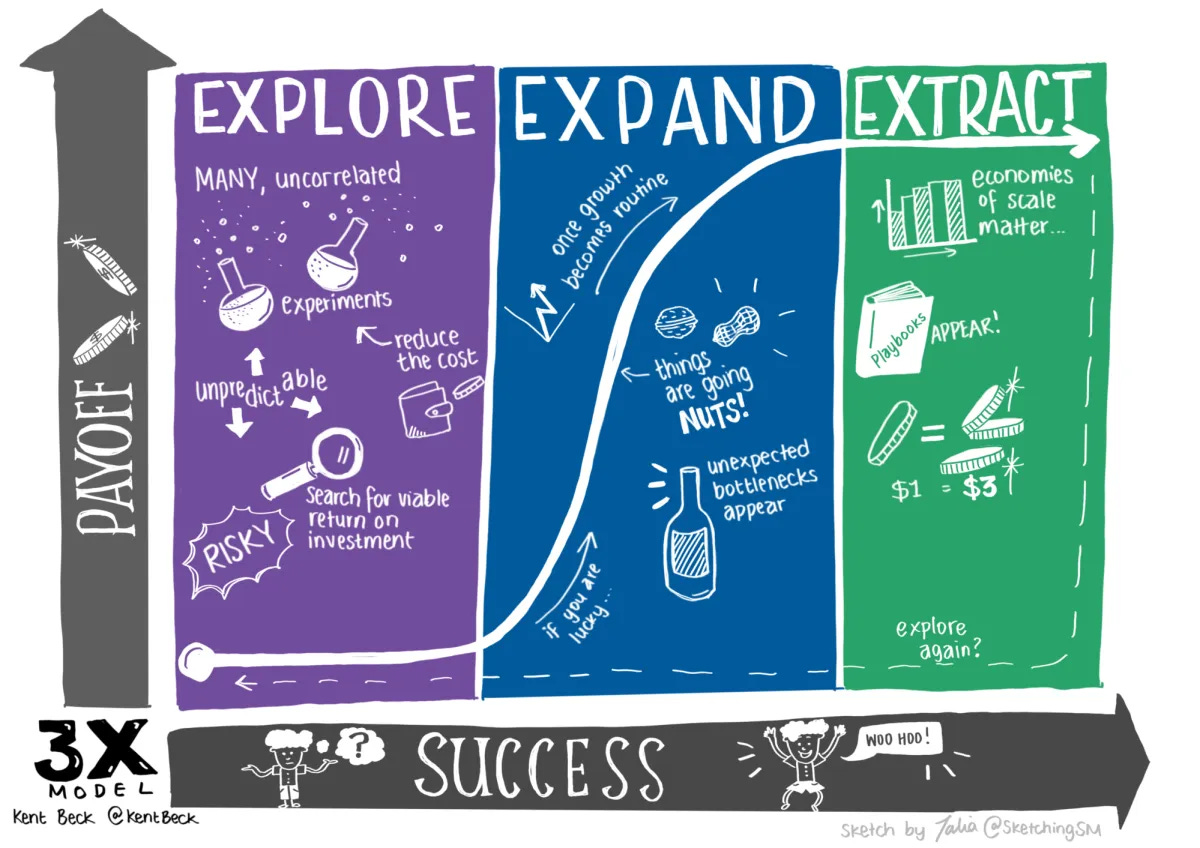
Each phase represents a distinct stage of maturity in a product’s lifecycle: from the early Explore phase (0→1) to growing distribution & scale of the new product in the Expand phase (1→10) to maximization of payoff & value capture during the ongoing Extract phase (10→100), before a product reaches maturity and a point-of-diminishing-returns.
Most product orgs understand this conceptually, in how they manage their product portfolios, structure their teams, or approach work differently towards existing or newer products. But in my experience, the transformative power of the 3X model (or similar ones) comes when it acts as the connective fabric for the whole organization to rally around innovation. When product maturity becomes a shared vocabulary, it allows all teams & functions to be more strategic in decision-making (ex: when to dial-back from mature products with low future ROI? when to incubate new bets? what proof-points do we need to see, and when? how to balance distribution for old vs. new features?). It also makes it easier for all parts of the org to support innovation on a continual basis, as opposed to simply executing on one-time “strategic initiatives” or time-bound “special projects”.
My conviction in this comes from 2 closely related core beliefs that have been time-tested in my experience:
Innovation is produced - not manufactured.
Product innovation plays out over an ongoing cycle, not a linear manufacturing process. We must continuously connect our insights & ideas to our customers & market to inform and validate them. This connection needs to be bidirectional, so we can shape, ship and chisel the product to fit the market best over time based on customer feedback. In this context, manufacturing (i.e. building, shipping, deploying…) plays a critical role, but is only one piece of the puzzle. To produce innovation, you need more than just the capacity to build; you need a strong organizational culture of transformation and the capabilities to learn systematically.
Innovation work comes in different forms, and happens at every point along the curve.
Product innovation feels like gold-mining in the early days, and farming later on. Gold-mining is about excavation, with asymmetric outcomes. Farming is about calibration & cultivation, with relatively more predictable outcomes. But in either case, the outcomes of your bets are not entirely in your control; they are a product of both environmental factors and the work you put into it. To improve your odds of success, you need to master different forms of innovation work, at different phases. At times you are exploring new territory, and at other times you are calibrating and refining the product, carefully. But at all times, you are innovating with intent and conviction.
Let’s unpack both of these beliefs together today.
Text within this block will maintain its original spacing when published
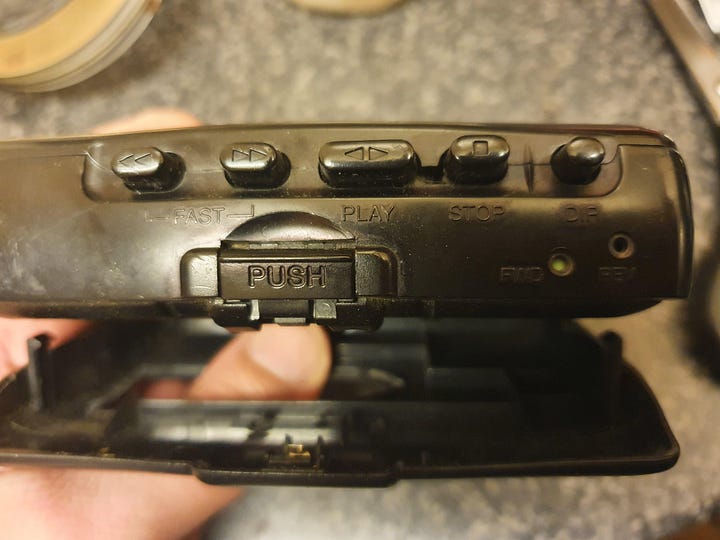
Innovation: to make changes in something established, especially by introducing new methods, ideas, or products. Innovation is, at its core, a rebellious act. But the rebellion is not just about the “new thing” that ultimately wins mass adoption in the market - such as the automobile that surpassed the horse-carriage, or our digitally connected interfaces/apps that replaced our analog tools for work and play.
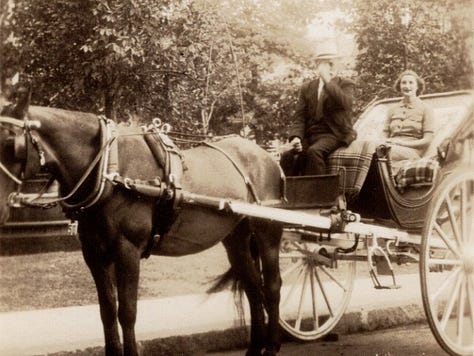
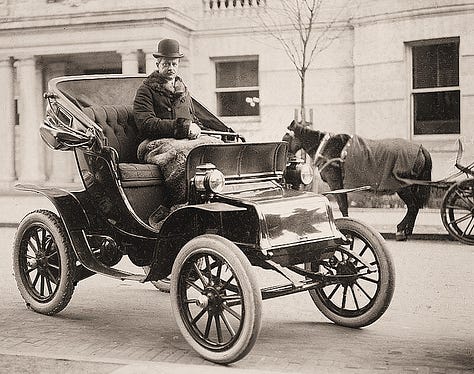



The rebelliousness of innovation runs deeper than the manufacturing of the new product; it encompass many other facets. It needs strong intent and conviction in the need to disrupt the status-quo, and push for a more promising, albeit fuzzier, future. It requires experimentation in terms of risky ideas, new tools (ex: prototyping) and varied working methods. With the patience needed to readily discard the ideas that don’t work out, and to adapt your methods based on what is helping or hurting your innovation model. It asks for ingenuity to discern what parts of the status-quo are valuable - as a bridge-of-familiarity from present to the future - and thus worth preserving. Lastly, it needs resilience to rally around products and solutions that are inherently more emergent than predictable, and the perseverance to keep moulding them around market response, to deepen product-market fit and maximize impact.
As builders, it is easy for us to underestimate how critical these other factors are. Manufacturing is the tangible and visible work of building & shipping. Production is the continuous practice of applying these facets to our work, across all phases of the product lifecycle. Without a production-like mindset, your innovation approach is reduced down to more mechanical execution - like moving widgets through the assembly line of a factory - with your business success riding on a heavy dose of “build it, and they will come”.
Earlier, I asserted that innovation work comes in different forms, and to achieve superior outcomes, you need to master all forms. Here is how innovation work can manifest across each phase of the product S-curve:
In the Explore phase, the most critical innovation work to do is to establish a core hypothesis for how and why the status-quo is broken, and a clear point-of-view on how you will transform it into something better. I call this process identifying the kernel of innovation; it is the the act of defining the bet you’re making in a crisp way, and focusing all of your execution work towards proving-out and de-risking the bet. It is the first attempt to determine if your hypotheses holds up against reality. Or disproving and pivoting away from it early - which is also a form of success.
The nature of innovation work that is most valuable in this phase is experimental and exploratory in nature. It is oriented around conviction in the core hypothesis, but with minimal attachment to any specific product solution, until it is more rigorously contrasted and vetted against alternatives. The type of learning that is most critical is strategic and systematic in nature; it is about excavating the insights that are most salient to identifying the direction you will choose to invest in, more so than the efficacy of a particular feature or methodology.
When you are successful at this phase, you exit with no doubt around “is there a there, there?” Product-market fit feels more inevitable than elusive. And while you may not be seeing a full-on gold-rush yet, you know that there is a gold-mine in your vicinity. The confidence you build here acts as the product foundation for subsequent phases.
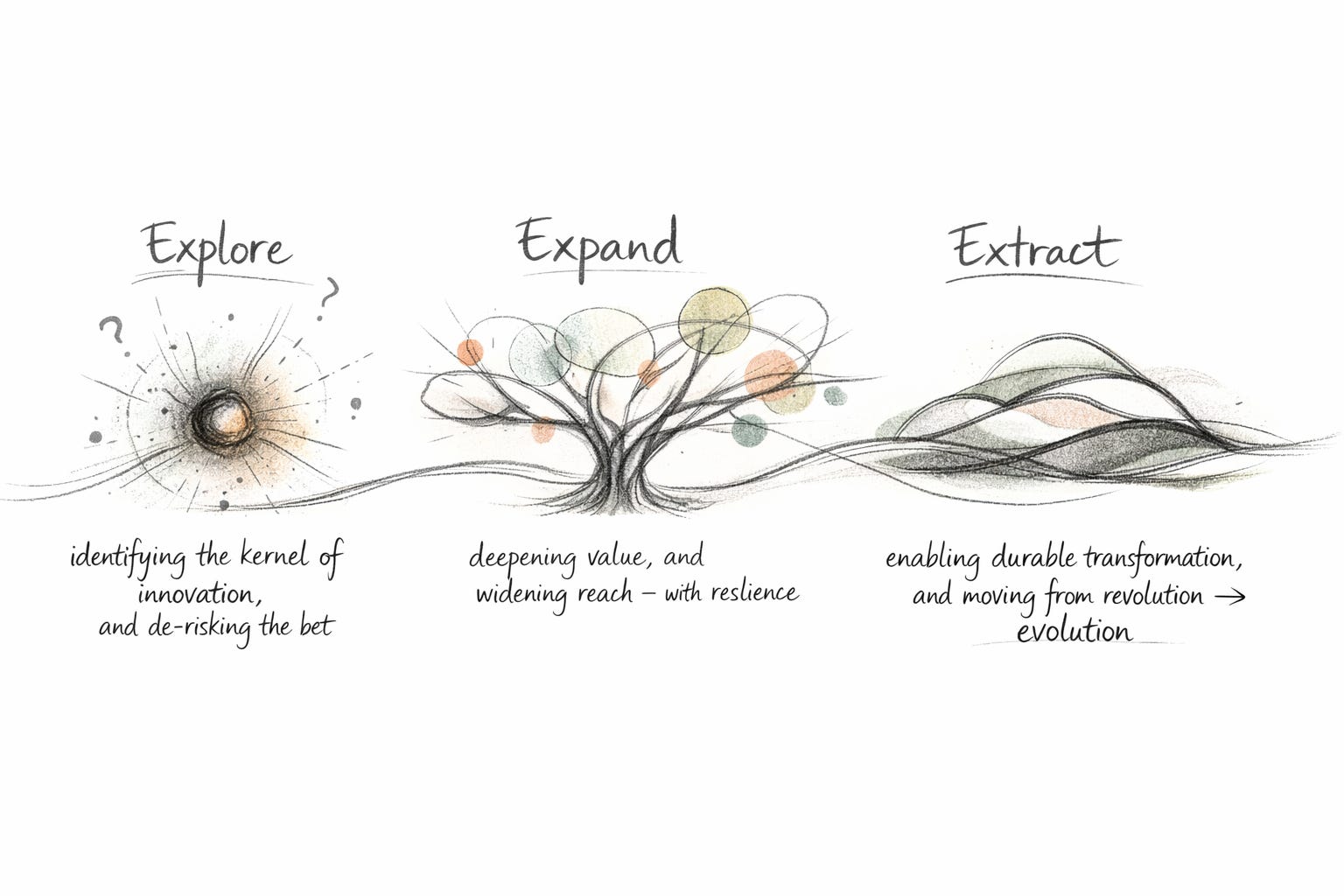
In the Expand phase, the most critical innovation work is to leverage scale & reach to deepen the value and opportunity that your new product represents for the market. This requires resilience and ingenuity, to preserve and build upon the kernel of innovation, even as you uncover new obstacles to mainstream adoption that will inevitably rear their head with more exposure.
It is easy to treat scaling and distribution as a prize or entitlement due to your success in the Explore stage. I prefer to see them as mechanisms to pressure-test your product-market fit, and learn and adapt even faster. Running into and navigating distribution barriers, operational complexities, PMF variance across user segments, gaps in comprehension in the market around the new thing: these are all earned privileges, when you apply a learning & value creating mindset to this phase.
One of the most critical strategic questions you will face in this stage is how to influence the market to move from the status-quo to the new product. This requires real discernment, since the status-quo is well-established, even if the new product is provably better. Often, the hardest part of innovation is not envisioning the new future, but it is creating the right bridge that makes it easy for customers to cross from A → B. Building this bridge is part of the craft of the Expand phase.
Exiting this phase means you have moved from opportunity in theory to market value in practice, at scale. And shared organizational momentum to focus growth efforts around the new product; transformation now feels inevitable to everyone.
In the Extract phase, the most critical innovation work to do is transform how you ensure the innovation can deliver maximum value over the long-term.
Innovation doesn’t end with a product out-to-market. From a lifecycle perspective, the new product is still in a fragile position, until and unless you do new kinds of work to stabilize it and guarantee its primacy. This involves execution on ‘second-order’ innovation strategies ex: evolving your GTM motions, adapting your pricing and monetization models, building operational and infrastructural efficiencies, shifting from pure user growth and adoption to tracking cohort performance and retention and continuing to invest towards further enhancements or new adjacent capabilities to stay ahead of competitive, copycat threats.
These are all examples of shifting from a defensive to an offensive stance when it comes to the innovation cycle. You shift from de-risking the bet to maximizing its value. You are fully focused now on making the new product foundational for the market externally, and to your organization internally. The success of this phase comes in the form of enduring impact, and knowing the product is now the new normal. It has established a winning position in the market, and you’ve designed a moat around it to ensure it stays deeply valuable, relevant and differentiated moving forward. You won. 🏆
This essay has been a while in the making, but it feels very relevant today.
We are in the middle of an awe-inspiring technological transformation with AI. But this AI era today comes with a prevailing sense of “the future is here, but not evenly distributed”. For every jaw-dropping demo and model breakthrough we celebrate, we can chalk up 10s or 100s of failed AI transformation projects/pilots, or products that feel like solutions looking for problems. Many of the most successful AI products, apps and platforms today are what I would consider to be overnight successes that were years in the making!2
What explains the gap between the winning products we love and the rather lackluster ones? Perhaps two key principles can give us some pointers:
Innovation is a holistic exercise in production. It spans the capacity to build, a culture of transformation and capabilities needed to learn and adapt fast.
Innovation must be threaded through all phases of the product maturity curve. It needs some excavation (like gold-mining) and some cultivation & nurturing (like farming). And while success is not guaranteed, you can improve your odds of winning by trying to master innovation work in all its forms.
Have a question or musing of your own?
Feel free to drop a comment.
Enjoyed today’s essay?
Consider sharing this essay with a colleague or friend who may like it too.
Interested in more of Waqas’ Musings?
You can find all my past essays at https://waqas-sheikh.com, and subscribe below.
This essay from Kent from 2019 on the Explore/Expand/Extract framework is a worthy read.
A useful reminder: OpenAI was formed in 2015, the landmark Attention Is All You Need paper from Google introducing the Transformer tech that underlies modern GPTs (enabling the “Gen” in GenAI) was published in 2017 and ChatGPT was launched in late-2022.
Comments
Nothing yet. Say the first thing.
Sign in to join the conversation.